On this page
Checking whether a phone number is on WhatsApp is not unlawful in itself, but whether your check is lawful depends on whose numbers you check, why, and which law applies. Checking your own customers to pick a channel for messages they expect usually fits data-protection law with a lawful basis, a clear notice and minimal storage. A registered number is never permission to message.
This is general information, not legal advice.
This guide is for businesses that hold a customer list and want to know which customers can be reached on WhatsApp, in Europe, South Asia, Southeast Asia, Latin America or the US. It covers the rules that apply to the check, which are mostly data-protection rules, and keeps them apart from the rules that apply to the message, which are WhatsApp's policies and messaging laws. For the workflow itself, see the bulk WhatsApp check guide.
Is checking registration the same as permission to message?
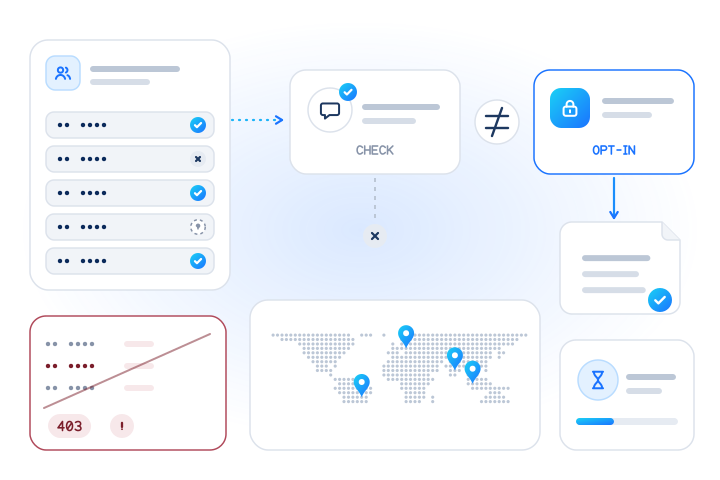
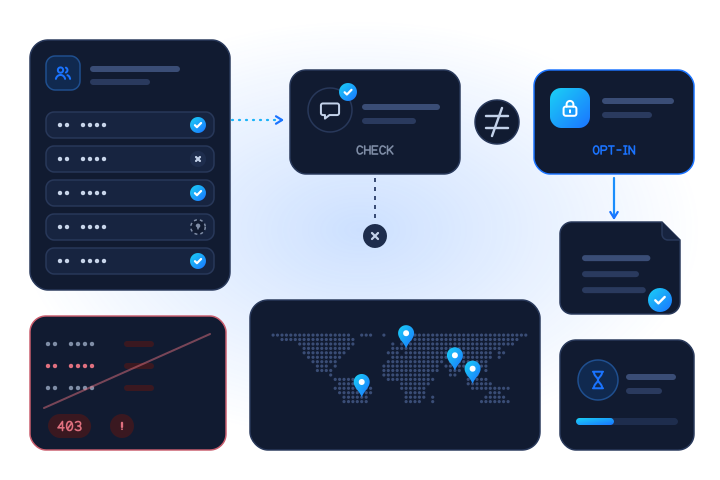
No. They are two separate questions under two separate sets of rules, and mixing them up causes most compliance mistakes.
| Question | What answers it | Rules that apply |
|---|---|---|
| Does this number have a WhatsApp account? | A registration check: registered: true, false or unknown, with checked_at | Data-protection law (lawful basis, notice, minimisation, retention) |
| May I send this person a WhatsApp message? | Your opt-in record for that person and that business | WhatsApp's business policies, plus marketing and messaging laws such as the TCPA, PECR or national anti-spam rules |
WhatsApp's Business Messaging Policy says you may only contact people on WhatsApp if they "have given you their mobile phone number or username" and you "have received opt-in permission from the recipient confirming that they wish to receive subsequent messages or calls from you". You must also respect requests "to block, discontinue, or otherwise opt out". Meta's opt-in guide adds that businesses "must clearly state the business's name that a person is opting in to receive messages from" and "must comply with applicable law".
Nothing in a check result changes any of that. A registered: true answer means only that an account exists for the number. Our acceptable use policy states it directly: you must not "treat a result as consent to contact someone, or contact a person only because a result shows an account."
What does the GDPR require for a WhatsApp check?
A lawful basis, a stated purpose, minimal data, a notice and a way to object. A phone number linked to a customer is personal data, and running a check on it is processing (our post on whether a phone number is personal data covers the definitions). The UK GDPR follows the same structure.
Lawful basis (Article 6). For checking existing customers, businesses usually consider legitimate interests (Article 6(1)(f)): getting service messages through, cutting failed sends, spotting mistyped numbers. The European Data Protection Board says the basis needs "three cumulative conditions": a legitimate interest, the need to process the data for it, and that the person's interests and rights "do not take precedence" (EDPB Guidelines 1/2024). The EDPB adds that controllers should "assess and document" this before processing. The UK regulator frames it as a purpose test, a necessity test and a balancing test (ICO). The balance is easier when the check serves the customer (their order update arrives) and harder when it serves outreach the customer never expected.
Data minimisation (Article 5(1)(c)). Check only the numbers you have a reason to check, request only the apps you will route on, and store only the answer and its date.
Transparency (Articles 13 and 14). People must be told the purposes of processing. If you collected the number from the customer, put the check in the notice you give at collection (Article 13). Where personal data was not obtained from the person, Article 14 sets out what to tell them and when. Either way, a line such as "we check which messaging apps your number can receive so we can send service messages by the right channel" is clearer than a generic "we may use third-party services".
Right to object (Article 21). Under legitimate interests, people can object. Build a suppression step so that an objecting customer is not checked again. Our privacy checklist for phone and e-mail checks walks through retention, DPAs and DPIAs in detail, so we don't repeat it here.
What do India, Brazil and Malaysia require?
Each has a comprehensive law, but the bases for processing differ from the GDPR in ways that matter for a WhatsApp check.
India: Digital Personal Data Protection Act, 2023. Personal data may be processed only for a lawful purpose "for which the Data Principal has given her consent" or "for certain legitimate uses" (section 4). Consent must be "free, specific, informed, unconditional and unambiguous" and limited to what is necessary for the specified purpose (section 6). Unlike the GDPR, there is no general legitimate-interests basis. The closest legitimate use, in section 7(a), covers the "specified purpose for which the Data Principal has voluntarily provided her personal data", as long as she has not objected (DPDP Act). In practice, your sign-up and consent notices should name channel checks as part of the purpose. The government notified the DPDP Rules on 14 November 2025, and says they "introduce an eighteen-month period for phased compliance" (PIB, 2025). Plan now rather than at the deadline.
Brazil: LGPD (Law 13.709/2018). Article 7 lists the legal bases, including consent (item I) and processing "necessário para atender aos interesses legítimos do controlador" unless the person's fundamental rights prevail (item IX). Where you rely on legitimate interest, Article 10 §2 requires the controller to "adotar medidas para garantir a transparência". The necessity principle in Article 6 limits processing to "o mínimo necessário" for its purposes (LGPD). The structure is close to the GDPR's: a balancing test, a notice and minimal data.
Malaysia: Personal Data Protection Act 2010. The General Principle in section 6 says a data user shall not process personal data "unless the data subject has given his consent", with exceptions such as processing necessary "for the performance of a contract to which the data subject is a party". Section 6(3) adds that the data must be "adequate but not excessive" for a purpose "directly related to an activity of the data user", and section 7 requires a written notice of purposes (PDPA, Act 709). The Act was amended in 2024, and the regulator publishes the amendment and its commencement dates on the same page. Read the current text with your adviser.
Pakistan and Bangladesh. Bangladesh's Personal Data Protection Act, 2026 (Act No. 63 of 2026) was published in the Bangladesh Gazette on 10 April 2026 and is republished by the telecoms regulator (BTRC); we don't summarise its consent rules or commencement here. Pakistan has worked on comprehensive data-protection legislation, but at the time of writing we could not confirm from official sources a final law that would govern a check like this. For both, ask local counsel. Until you have advice, the baseline in this guide (own customers, stated purpose, minimal data, honoured objections) is a reasonable place to start. Our Bangladesh and Pakistan guides cover the local messaging rules.
What applies in the United States?
There is no general federal privacy law like the GDPR. A Congressional Research Service overview describes federal data-protection statutes as "not comprehensive in nature", regulating "certain industries and subcategories of data" (CRS, 2022). State laws fill part of the gap. California's CCPA, for example, gives consumers rights including "the right to know about the personal information a business collects about them and how it is used and shared" and the right to delete it (California DOJ). Disclose checks in your privacy notice and make sure your provider acts as a service provider under its contract.
The TCPA (47 U.S.C. 227) restricts calls and texts, not data checks. A registration check sends nothing, so in our reading the TCPA governs what you send afterwards, not the check. Our TCPA checklist for SMS covers consent, opt-outs and quiet hours.
How do the main laws compare?
The table compares the points that matter most for a check, not the laws in full.
| Jurisdiction | Law | Bases you might rely on for a check | Notice | Worth noting |
|---|---|---|---|---|
| EU / UK | GDPR / UK GDPR | Legitimate interests (documented three-part test), contract, consent | Articles 13 and 14 | Right to object to legitimate-interest processing |
| India | DPDP Act 2023 + Rules 2025 | Consent, or a section 7 legitimate use such as data voluntarily provided for a specified purpose | Section 5 consent notice | No general legitimate-interests basis; phased compliance |
| Brazil | LGPD | Legitimate interest (Art. 7 IX), consent, contract | Transparency duty for legitimate interest (Art. 10 §2) | Necessity principle: the minimum required |
| Malaysia | PDPA 2010 (amended 2024) | Consent, or listed necessities such as performing a contract | Written notice (section 7) | Applies to commercial transactions |
| United States | No general federal law; state laws such as the CCPA | Depends on the state law | State-law privacy notice | TCPA applies to calls and texts, not to the check |
| Bangladesh | Personal Data Protection Act, 2026 (gazetted 10 April 2026) | Not summarised here; ask local counsel | — | Treat with the same baseline until advised |
| Pakistan | No final law confirmed from official sources | Ask local counsel | — | Treat with the same baseline until advised |
What should a business do, and not do?
Use the check to serve people who already deal with you, and leave everyone else alone.
| Do | Don't |
|---|---|
| Check numbers your customers gave you, for a purpose you have written down | Check purchased, scraped or "leaked" lists |
| Name channel checks in your privacy or consent notice | Rely on a generic "we may use third parties" line |
| Request only the apps you will route on | Request every app "just in case" |
Keep the answer and checked_at; refresh it periodically | Keep the uploaded file and full results indefinitely |
| Message only people with a WhatsApp opt-in for your business | Treat registered: true as consent |
| Suppress people who object, and stop checking them | Re-check someone who asked you to stop |
| Sign a DPA with your provider (GDPR Article 28 or local equivalent) | Use a tool that won't say how it handles your data |
| Route unknown answers to your default channel | Read unknown as "no WhatsApp" |
WhatsApp's Terms of Service also forbid "bulk messaging, auto-messaging, auto-dialing, and the like" through the app. Business messages go through WhatsApp's business platform, to people who opted in.
What should a responsible provider refuse?
Anything that looks like discovering people rather than checking customers. A provider that will check any range you send is a red flag for your own compliance.
- Enumeration. At MobileValidate, a request with 20 or more consecutive numbers is refused with
403 suspected_enumeration, every account has a daily cap on identifiers checked, and rate limits apply per key. The rules are in rate limits and abuse. - Scraped or generated lists. Our acceptable use policy forbids checking ranges or generated lists "to discover who uses a platform", finding recipients for unsolicited messages, and building profiles of private individuals.
- Reverse lookups. Checks never return names, photos, profiles or online status, and we don't offer number-to-person lookups.
- Platform-specific authority. The policy also requires that your lawful basis covers checking a person's account on a named app. "A general marketing opt-in is not enough."
- Objections. People can exclude their number through our opt-out form. Suppressed numbers are skipped and never charged. Our notice to people whose number is checked explains what we hold and why.
How long should you keep check results?
Only as long as you use them. For channel choice, that usually means the latest answer and its checked_at on the customer record, refreshed on a schedule. Delete the uploaded file and the full results once your systems are updated.
At MobileValidate the defaults are short. Real-time lookups are kept for 7 days. Bulk job inputs, results and downloads are kept for 30 days by default, adjustable from 1 day to 24 months, and you can delete a job at any time with DELETE /v1/jobs/{id}. A per-account check history (sealed number, answer and time) is kept for up to 400 days for your cache, billing evidence and disputes, as the DPA and privacy policy describe. Set your own retention to match your purpose, not ours.
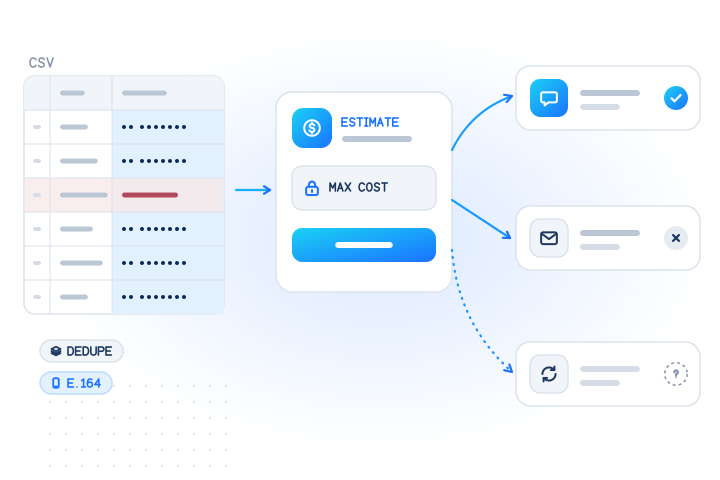
Before a large run, the free estimate (POST /v1/jobs/estimate) shows the maximum cost, and unknown or inconclusive results are never charged. See current prices.
WhatsApp is named here descriptively. MobileValidate is not affiliated with WhatsApp or Meta. This article is general information, not legal advice, and laws change. Confirm what applies to your business with qualified counsel.
What are the key takeaways?
- A check is not consent.
registered: truemeans an account exists. WhatsApp's policy separately requires the person's number and opt-in for your business. - The check is data processing. Under the GDPR you need a documented lawful basis (often legitimate interests), a notice and minimal storage.
- India and Malaysia lean on consent. The DPDP Act has no general legitimate-interests basis, and Malaysia's PDPA starts from consent, so name channel checks in your notices.
- Brazil's LGPD is closer to the GDPR, with a legitimate-interest basis, a transparency duty and a necessity principle.
- In the US, there is no general federal privacy law. State laws apply to the data, and the TCPA governs messages, not checks.
- Pick a provider that refuses enumeration, scraped lists and reverse lookups, and keeps data briefly. Start with the WhatsApp number check.
Sources
- Personal Data Protection Act, 2026 (Act No. 63 of 2026, Bangladesh Gazette, 10 April 2026) — Bangladesh Telecommunication Regulatory Commission (republished), 2026
- Regulation (EU) 2016/679 (General Data Protection Regulation), Articles 5, 6, 13, 14 and 21 — European Union, 2016
- Guidelines 1/2024 on processing of personal data based on Article 6(1)(f) GDPR, version 1.0 (adopted 8 October 2024) — European Data Protection Board, 2024
- What is the 'legitimate interests' basis? — Information Commissioner's Office (UK), 2026
- The Digital Personal Data Protection Act, 2023 (No. 22 of 2023) — Government of India (copy hosted by TRAI), 2023
- DPDP Rules, 2025 Notified: A Citizen-Centric Framework for Privacy Protection and Responsible Data Use — Press Information Bureau, Government of India, 2025
- Lei nº 13.709, de 14 de agosto de 2018 (Lei Geral de Proteção de Dados Pessoais) — Presidência da República, Brazil, 2018
- Personal Data Protection Act 2010 [Act 709] — Department of Personal Data Protection, Malaysia, 2025
- Data Protection and Privacy Law: An Introduction (IF11207, updated 12 October 2022) — Congressional Research Service, 2022
- California Consumer Privacy Act (CCPA) — State of California Department of Justice, 2026
- 47 U.S.C. 227: Restrictions on use of telephone equipment — Office of the Law Revision Counsel, US House of Representatives, 2026
- WhatsApp Business Messaging Policy (last updated 23 September 2026) — WhatsApp, 2026
- Get opt-in for WhatsApp — Meta for Developers, 2026
- WhatsApp Terms of Service — WhatsApp, 2021
Frequently asked questions
Is it legal to check if a phone number is on WhatsApp?
It can be, but legality depends on whose numbers you check, why, and which law applies. Checking your own customers' numbers to choose a channel for messages they expect is the kind of use most data-protection laws can accommodate with a lawful basis, a privacy notice and minimal storage. Checking ranges or scraped lists to find people to contact is not. This is general information, not legal advice.
Do I need consent to check if a customer's number has WhatsApp?
Not under every law. The EU and UK GDPR and Brazil's LGPD allow legitimate interests as a basis if you pass a documented balancing test. India's DPDP Act and Malaysia's PDPA are built around consent with narrower exceptions, so the specific purpose your customer agreed to matters more there. Ask your counsel which basis fits.
If a number is registered on WhatsApp, can I send it WhatsApp messages?
No. A registration check says only that an account exists. WhatsApp's Business Messaging Policy separately requires that the person gave you their number and opt-in permission to receive your messages, and that you honour every request to stop.
Do I have to tell customers that I check their numbers?
Under the GDPR and similar laws, people must be told the purposes of processing. Mention channel and number checks in your privacy notice, at the point you collect the number where you can. Article 14 GDPR applies to data you obtain from a source other than the person.
How long should I keep WhatsApp check results?
Only as long as you use them. For channel choice that usually means keeping the answer and its checked_at date, refreshing it periodically, and deleting the uploaded file and full results once your systems are updated.
Will a responsible WhatsApp checker refuse some requests?
Yes. It should refuse sequential number ranges, generated lists and attempts to find all users of an app. MobileValidate rejects requests with 20 or more consecutive numbers with 403 suspected_enumeration, applies daily caps, and its acceptable use policy forbids treating a result as permission to contact someone.
Related services and guides
More from the blog
All articlesGuides
A privacy checklist for phone and e-mail checks
A practical GDPR-oriented checklist for phone and e-mail checks: purpose, lawful basis, minimisation, retention, objections, rights, DPAs and logging.
9 min read
Guides
Is a phone number personal data under the GDPR?
When a phone number is personal data under the GDPR, what changes for business numbers, and how lookups and enrichment fit lawful basis, notice and rights.
10 min read
Guides
Bulk WhatsApp number check: how to verify a customer list (CSV upload or API)
Check WhatsApp numbers in bulk: prepare a CSV, get a free estimate, cap the cost, run the job in the dashboard or API, and act on each answer.
8 min read