

On this page
Published comparisons
The first comparison pages are being prepared and checked. Until they are published, the guides below cover the same questions: what to ask a provider, which criteria matter, and how to test on your own data.
Compare phone and e-mail verification APIs by the job you need done, then by dated public facts: the list price at your volume, whether unknown results are billed, what one request returns, and how the provider handles your data. This hub explains how our comparison pages are built, which question each one answers, and where to check the facts yourself.
How are these comparisons built?
Every comparison page follows the same rules, so you can judge it the same way:
- Dated public prices only. Each price comes from the provider's own public pricing page, with the currency, the fetch date and a link. Where a price isn't public, or a page couldn't be read, the cell says so. We never estimate a price.
- Criteria before products. Each page lists what matters for the job, and why, before any product appears.
- "When to choose them instead". Every provider we name gets at least one concrete situation where it is the better choice.
- A "where MobileValidate doesn't fit" row. We make MobileValidate, so each page says plainly where it is the wrong tool.
- No accuracy scores for anyone, including us. We don't publish test results on other providers' APIs. You get a test script to run on your own data instead.
- Links, not copies. We paraphrase facts and link to the source. No logos, no copied tables, no affiliate links.
- A correction path. Every page has a "Report a correction" link. We check reports against the provider's public page and update the page and its date.
We re-check prices every quarter, and sooner when a provider tells us about a change. The "Last verified" date at the top of each page is the day we last checked its facts.
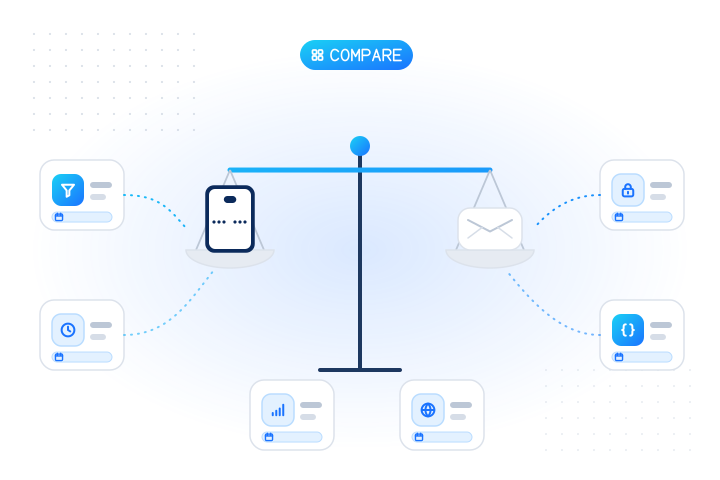
Which question does each comparison answer?
| Your question | Page type | What it compares |
|---|---|---|
| What does e-mail verification cost at 10k, 100k or 1M checks? | Price comparison | List prices per 1,000 checks, billing model, unknown billing, credit expiry |
| What does a phone number lookup cost, and what does one lookup return? | Price comparison | Price per lookup, fields returned (LRN, MCC/MNC, line type, porting), failed-lookup billing |
| We're leaving an e-mail verifier. What else is there? | Alternatives | Use-case fit, price at 100k, unknown billing, catch-all reporting, retention, SDKs |
| How do two well-known e-mail verifiers differ? | Head-to-head | Side-by-side public facts, row by row, with the gaps marked |
| Which kind of WhatsApp number checker should I use? | Tool categories | Browser extensions, scripts, the official platform and number-check APIs, by risk, scale and privacy |
The published pages are listed at the top of this page. New pages appear there on their publication date.
What should you compare first?
Start with the job, because the same API can suit one job and not another.
- Sign-up forms (real time). You need a single-request API that answers in a second or two, clear unknowns, and no charge for them. For phone numbers, line type is the key field. For e-mail, typo suggestions and a disposable-domain flag help.
- List cleaning (bulk). Price per 1,000 at your volume matters most, then whether unknown and catch-all results are billed, then how long the provider keeps your list.
- Carrier and routing. What one lookup returns decides the value: a routing number (LRN), the network code (MCC/MNC), line type, porting status or live reachability.
- Fraud screening. Ownership signals such as SIM swap or reassigned numbers need specialist providers. A cheap lookup is a first filter, not a replacement.
- Channel choice. To choose between SMS and a messaging app, you need to know whether the number is registered on that app, from a consented list.
Our phone number validation API buyer's guide walks through each criterion for phone checks, and the e-mail verification guide does the same for e-mail.
How do I compare prices fairly?
A list price per request isn't the whole cost. Three adjustments make prices comparable:
- Price at your volume, not the headline rate. Most providers sell credit packs or plans with falling unit prices. Compare the smallest published option that covers your volume.
- Price per conclusive answer. If a provider bills unknown results, divide the list price by your share of conclusive answers. At 20% unknowns, a billed unknown adds 25% to the cost of each useful answer (1 ÷ 0.8 = 1.25).
- What one request returns. A lookup that returns only a routing number isn't the same product as one that returns line type and porting. Compare like with like.
Prices on our comparison pages are list prices on the stated date, before discounts, taxes and promotions. Check the provider's page before you buy.
How do I test providers myself?
Run the same labelled sample through each candidate on the same day, and record four numbers: conclusive rate, agreement with your labels, latency and billed rows. Use data you're allowed to process and whose outcome you already know, such as confirmed sign-ups and addresses that hard-bounced. Never build a sample by guessing numbers or addresses: that's enumeration, which our acceptable use policy forbids, and you wouldn't know the right answers anyway.
Each comparison page includes a short script you can adapt. Our own results in your test are billed like any other request, and unknown results are free.
Where does MobileValidate fit, and where doesn't it?
| Situation | Fit | Why |
|---|---|---|
| Sign-up checks that combine e-mail and phone | Good | One request can check both; unknown results are free |
| Messaging-app presence for channel choice | Good | Registration checks for WhatsApp, Telegram, Viber and others, from $0.0001 per number in bulk |
| Carrier and line type | Good for price | $0.002 in real time, $0.001 in bulk (beta), prices from our live catalog on 2026-09-27 |
| Company or custom e-mail domains, catch-all detection | Poor | Our e-mail check covers major webmail providers only; other domains return unknown |
| Live network status (HLR) and porting (MNP) | Good | HLR $0.005 and MNP $0.001 per conclusive answer, real time and bulk; unknown is free |
| Spam reputation | Limited | Limited access; report coverage is strongest for North American and European numbers |
| SIM swap, identity match, reassigned numbers | No | We don't sell ownership signals |
Our prices are on the pricing page and come from the same live catalog as the API.
Frequently asked questions
Which phone or e-mail verification API should I choose?
There isn't one answer. The right choice depends on the job: sign-up checks, list cleaning, carrier lookup, fraud screening or channel choice. Each comparison page names the job it answers and says when another provider is the better choice, including cases where that isn't us.
Where do the prices on these pages come from?
Only from each provider's own public pricing page, fetched on the date shown and linked from the table. We don't use sales quotes, reseller sites or third-party roundups. Where no public price exists, the table says so instead of estimating.
Do you test other providers' accuracy?
No. Accuracy figures depend on the sample and the definition of unknown, and some providers' terms restrict benchmarking. We publish a test script instead, so you can compare candidates on your own labelled data.
Is MobileValidate included in the comparisons?
Yes, and we disclose that we make it. Every page has a row that says where MobileValidate doesn't fit, for example company e-mail domains, SIM-swap data or self-serve spam reputation.
How do I report a mistake?
Use the contact page and say which page and which cell. We check the provider's public page and correct the comparison, usually within five business days.
Product and company names are trademarks of their owners and are used only to identify their products. MobileValidate is not affiliated with, endorsed by or sponsored by any company named here.
Related guides and services
- ArticleHow to choose a phone number validation API: a buyer's checklist
- ArticleE-mail verification: the complete 2026 guide
- PagePricing: pay per conclusive check
- ServiceCheck if an e-mail mailbox exists
- ServiceCarrier and line type lookup for any phone number
- ServiceCheck if a phone number is registered on WhatsApp