On this page
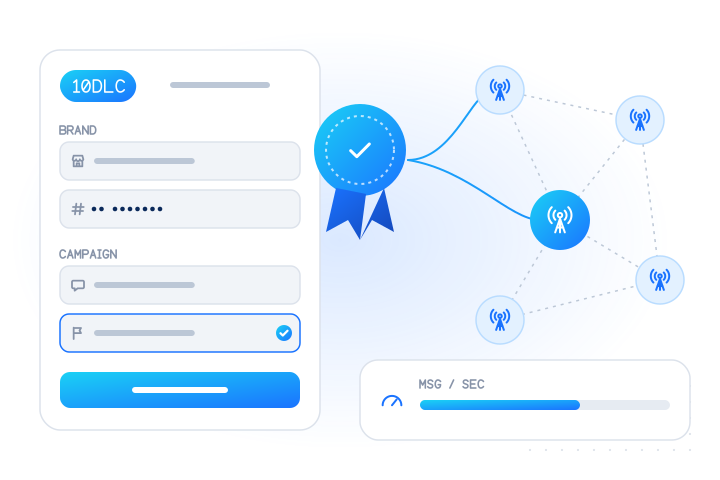
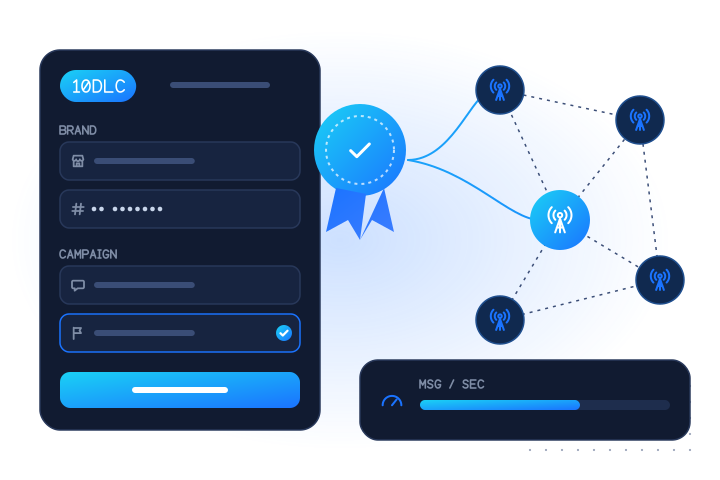
10DLC registration means telling US carriers who you are and what you send before you text customers from a normal 10-digit number. You register a brand and one or more campaigns through your messaging provider, which submits them to The Campaign Registry for carrier review. Providers report that unregistered 10DLC traffic has been blocked since early 2025.
This is not legal advice. 10DLC is an industry programme run by US carriers and messaging providers. It sits next to laws such as the TCPA but is separate from them. Fees and rules below are dated, and they change, so check your provider's current terms.
What is 10DLC, and why does it exist?
10DLC stands for "10-digit long code", the ordinary US phone number format. US carriers use the term for application-to-person (A2P) messaging sent from such numbers: alerts, passcodes, reminders and marketing sent by software rather than typed by a person.
The Campaign Registry (TCR) describes 10DLC as "an A2P messaging channel in which Brands and Campaign Service Providers (CSPs) are verified prior to being allowed to send messages". Its aim is that "both the 'Who' and the 'What' of a campaign are traceable" (TCR, 2026). The goal is the one in CTIA's Messaging Principles and Best Practices (May 2023): messages sent only after opt-in, clear identification of the sender, and easy opt-out (CTIA, 2023).
Three US sender types exist for A2P SMS:
| Sender | What it is | Registration |
|---|---|---|
| 10DLC | Local-looking 10-digit number | Brand + campaign via TCR |
| Toll-free | 8XX number | Separate toll-free verification, not part of 10DLC |
| Short code | 5–6 digit code | Separate short-code application process |
This article covers 10DLC. According to one provider's FAQ, "all traffic sent by – or on behalf of – businesses from +1 long code numbers (not Toll Free or Short Code) is governed under 10DLC" (Telnyx, 2026).
Who has to register?
Practically everyone sending A2P SMS from US 10-digit numbers, including small senders. One provider's FAQ adds that "virtually all SMS and MMS sent by a business—even if manually triggered by a human—is considered A2P" under guidelines as of 2023 (Telnyx, 2026). If software or a business sends the text, assume it needs registration.
You can't register with TCR yourself as a brand. TCR says "direct registration with TCR is not available for Brands". You register through a messaging provider that acts as your Campaign Service Provider (TCR, 2026).
What happens if you don't? Unregistered traffic was first charged extra fees and filtered more heavily. One provider's FAQ now says: "From February 3rd 2025, any 10DLC traffic which is not registered will be blocked altogether" (Telnyx, 2026). If your texts from a US long code silently fail, missing or rejected registration is one of the first things to check.
How does registration work, step by step?
The flow is similar across providers:
- Register the brand. Legal company name, tax ID (EIN in the US), address, website, contact details and business type. One provider notes one brand per tax ID in its portal, with more requiring their own tax ID.
- Optionally apply for vetting. An external vetting score can raise your throughput tier. One provider's FAQ says a brand without a vetting score "will tend to lead to low throughput" for complex campaigns.
- Register a campaign. Choose a use case (for example account notifications, two-factor authentication, customer care or marketing) and describe it. You also give sample messages, how people opt in, and your opt-out and help replies.
- Wait for review. Carriers and TCR review the campaign, and some use cases need extra vetting.
- Link your numbers to the approved campaign and start sending within the declared use case.
Timelines vary. The AWS documentation, retrieved on 29 September 2026, gives these expected times (AWS, 2026):
| Step | US-based company | International company |
|---|---|---|
| Register brand | 1–2 business days | Up to 3 weeks |
| Apply for vetting | 1–2 business days | Up to 3 weeks |
| Register campaign | Up to 4 weeks | Up to 4 weeks |
| Request the 10DLC number | Up to 10 days | Up to 10 days |
Plan launches with that margin, especially if your company is outside the US.
What does 10DLC cost?
There are registration fees, monthly campaign fees and per-message carrier fees on top of your provider's own message price. Fees are set by carriers and TCR and passed on by providers, sometimes with a markup. One provider that says it passes 10DLC fees on at cost published these figures (retrieved 29 September 2026, Telnyx, 2026):
| Fee | Amount listed |
|---|---|
| Brand registration | $4.50 |
| Campaign review (manual carrier review) | $15 per review |
| Monthly campaign fee | $1.50 (low-volume mixed) to $10 (standard); $3 charity; $5 emergency; billed for three months at first, then monthly |
| Carrier fee per registered SMS | $0.003 (T-Mobile, AT&T) and $0.0045 (Verizon) |
The same page also lists The Campaign Registry's monthly fee per use case as of 22 July 2025, from $2 for sole proprietors to $30 for agents and franchises. Your provider may charge differently, so treat these as an order of magnitude, not a quote.
What throughput do you get?
It depends on the carrier and your registration. The AWS documentation explains the model (AWS, 2026):
- AT&T gives each campaign a per-second send rate.
- T-Mobile gives each campaign a daily message cap, with no separate per-second rate. Messages above the cap fail until it resets.
- Verizon hasn't published throughput limits and relies on filtering instead.
- Throughput applies per campaign. Adding more numbers to the same campaign doesn't add capacity.
Brand quality matters too. Providers describe carriers assigning throughput from a brand's tier or score, which an external vetting score can raise. Small and sole-proprietor registrations get low limits, so check your provider's table before promising delivery speeds to your own customers.
Why are registered messages still blocked?
Registration lets you send. It doesn't guarantee delivery. Common causes:
- Content doesn't match the declared use case. A campaign registered for account notifications that starts sending promotions invites filtering and possibly fines. One provider's fee page warns against declaring a false use case and lists carrier non-compliance fines, including $10,000 per violation from T-Mobile for text-enabling a number without verifying ownership (Telnyx, 2026).
- Missing opt-out or help language. CTIA expects clear opt-out instructions, a confirmation message when someone joins a recurring programme, and one final confirmation when they opt out.
- Unwanted or prohibited content. CTIA lists content that is unlawful, deceptive (such as phishing), threatening or lacking age gating, among others, as content senders should prevent.
- Poor list quality. Sending to numbers that never opted in, that belong to someone else or that can't receive SMS drives complaints and failures. CTIA notes that opt-in "can also help prevent messages from being sent to a phone number that does not belong to the Consumer who provided that phone number".
- Exceeding the campaign's rate or daily cap. This shows up as throttling or failures, not a clear rejection.
Our guide to SMS pumping covers a different failure: fake traffic you pay for.
How should you prepare your list before registering?
Carriers review your opt-in story, and your list decides how your campaign behaves after approval. Do this before you send:
- Keep proof of opt-in. CTIA suggests keeping a timestamp, the collection method, the wording shown, the campaign, the IP address and the phone number for each consent.
- Normalize to E.164 and dedupe. Duplicates double your cost and your complaint risk. See our bulk list-cleaning guide.
- Check line type. Landlines and many toll-free numbers can't receive SMS, and people sometimes type a landline or office number into a form. Our carrier lookup and the bulk US and Canada carrier lookup return line type and current carrier.
- Apply opt-outs everywhere. One suppression list across all campaigns and channels, checked before every send.
- Re-check old numbers. Numbers are disconnected and reassigned, so consent from years ago may belong to someone else. See our TCPA checklist for the reassigned-numbers step.
MobileValidate doesn't register brands or campaigns, and a lookup is not proof of consent. The checks remove numbers that can't or shouldn't receive your texts before you pay for them. Invalid and duplicate inputs are flagged for free, and inconclusive results aren't charged. The SMS cost reduction use case shows the savings side.
What about hobby projects and small apps?
A 2024 Hacker News thread asked whether 10DLC makes hobby SMS impossible (Hacker News, 2024). It is harder than it used to be, but there are options:
- Sole-proprietor brands, which some providers offer for individuals without a business tax ID, typically with one campaign and a low daily cap.
- Toll-free numbers, which have their own verification outside 10DLC.
- Managed verification products. Some messaging providers send one-time codes from their own registered senders, so you don't register a campaign for codes alone. Check the terms of the product you use.
- Not SMS at all. For personal alerts, e-mail or a messaging app the user already has may be simpler.
Whichever you choose, the fundamentals stay the same: opt-in, clear sender identity and working opt-out.
What are the key takeaways?
- 10DLC is the US carriers' registration system for A2P SMS from 10-digit numbers. You register a brand and campaigns through a messaging provider, not with TCR directly.
- One provider reports that unregistered 10DLC traffic has been blocked since 3 February 2025.
- Expect days to weeks for approval, and budget for registration, monthly campaign and per-message carrier fees.
- Throughput is set per campaign: per-second rates at AT&T, daily caps at T-Mobile and filtering at Verizon.
- Registration doesn't guarantee delivery. Content that matches the use case, clear opt-outs and a clean, consented list do most of the work.
- This is guidance, not legal advice. Check current provider terms and consult counsel for legal questions.
Sources
- The Campaign Registry: the 10DLC ecosystem — The Campaign Registry, 2026
- Messaging Principles and Best Practices — CTIA, 2023
- United States 10DLC registration (AWS End User Messaging SMS User Guide) — Amazon Web Services, 2026
- Frequently asked questions about 10DLC — Telnyx, 2026
- 10DLC Fees and Charges — Telnyx, 2026
- Ask HN: Do 10DLC requirements make it impossible for hobby projects to send SMS? — Hacker News, 2024
Frequently asked questions
What is 10DLC?
10DLC (10-digit long code) is the US carriers' system for application-to-person SMS sent from ordinary 10-digit numbers. Senders register a brand (who they are) and a campaign (what they send) through a messaging provider, which submits them to The Campaign Registry for carrier review.
What happens to unregistered 10DLC traffic?
It is blocked. One messaging provider's public FAQ states that from 3 February 2025 any unregistered 10DLC traffic is blocked altogether. Before that, carriers charged higher fees for it.
How long does 10DLC registration take?
One large cloud provider's documentation, retrieved 29 September 2026, gives 1–2 business days for a US brand, up to 3 weeks for an international one, up to 4 weeks for a campaign and up to 10 days for the number.
Can a hobby project send SMS in the US?
Yes, but it still needs registration on 10DLC numbers. Some providers offer a sole-proprietor brand type for individuals, with one campaign and low daily limits. Toll-free numbers, which have their own verification, are another option.
Is this legal advice?
No. 10DLC is an industry programme run by carriers and providers, separate from laws such as the TCPA. Rules and fees change, so check your provider's current terms and consult counsel on legal questions.
Related services and guides
More from the blog
All articlesGuides
TCPA compliance checklist for SMS senders (2026)
A dated TCPA checklist for SMS: consent, opt-out words, 10-day revocation, quiet hours, do-not-call, reassigned numbers and list hygiene. Not legal advice.
9 min read
Deliverability
How to clean a phone number list in bulk, step by step
A step-by-step way to clean a phone list with the MobileValidate jobs API: free estimate, dedupe, invalid rows, capped cost, CSV download and data purge.
7 min read
Fraud prevention
SMS pumping: how it works and how to stop it
How SMS pumping (artificially inflated traffic) drains OTP budgets, the signals that give it away, and a layered checklist to stop it before you pay.
8 min read