

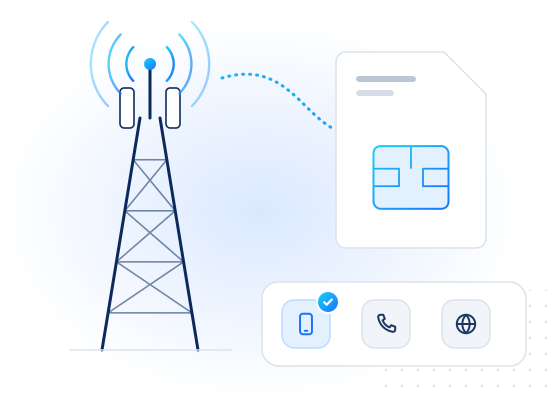
A phone number's line type is the kind of service the number belongs to: a mobile line, a fixed (landline) line, a VoIP service, a toll-free or premium-rate number, and so on. It decides whether a number can receive SMS, how much a call to it costs, and which regulations apply when you contact it.
Which line types exist?
MobileValidate's carrier lookup returns line_type with the values below. They follow the categories used by common numbering-plan libraries.
| Value | Meaning | SMS? |
|---|---|---|
mobile | A mobile (cellular) number | Yes |
fixed_line | A landline | Usually no |
fixed_line_or_mobile | The numbering plan doesn't separate the two | Depends |
voip | Served by an internet-telephony provider | Sometimes |
toll_free | Free for the caller (e.g. 0800, 800) | No |
premium_rate | Caller pays a higher rate (e.g. 09xx) | No |
shared_cost | Cost is split between caller and receiver | No |
personal | A "follow-me" personal number that forwards elsewhere | Depends |
pager | A paging service | No |
uan | Universal access number, usually a company hotline | No |
voicemail | A direct voicemail access number | No |
unknown | Not determinable | — |
How is line type determined?
There are two ways, with different reliability.
From the numbering plan. Every country publishes which ranges are used for which services. In the UK, for example, numbers starting 07 (other than 070 and 076) are mobile, and 0800 numbers are toll-free. This works offline and costs nothing, but it describes the range, not the current service. It fails in countries where mobile and landline numbers share ranges (the US and Canada, which is why fixed_line_or_mobile exists), and it fails when a number has been ported to another kind of service.
From network or carrier data. A carrier lookup reads current data about the specific number. It can tell you that a number in a geographic range is actually served by a VoIP provider, or that a former landline now belongs to a mobile network. In the US, where numbers can be ported between landline, wireless and VoIP services, this is the only reliable way.
Why does line type matter?
- SMS cost and delivery. Texts to landlines, toll-free and premium-rate numbers usually fail, but many providers still charge for them. Filtering by
line_typebefore a send avoids that. See SMS cost reduction. - Fraud signals. A cluster of sign-ups from VoIP numbers, or OTP requests to premium-rate ranges, are classic patterns of fake accounts and SMS pumping.
- Compliance. Some calling and texting rules differ between wireless and landline numbers. In the US, for example, the TCPA's consent rules for autodialled calls apply specifically to wireless numbers.
- Data quality. A "mobile" form field that holds a landline or toll-free number tells you the entry needs another look.
How do I check line type with MobileValidate?
Use the carrier lookup (all countries, real time or bulk) or the US and Canada carrier lookup (bulk). Both return line_type and the current carrier. When we hold no data, the answer is unknown and you aren't charged.
Frequently asked questions
Why do some numbers come back as fixed_line_or_mobile?
In some numbering plans, the United States and Canada among them, mobile and landline numbers share the same ranges. The format alone can't separate them. A carrier lookup based on current network data can.
Can a number's line type change?
Yes. In markets with number portability, a number can move from a landline to a mobile or VoIP service while keeping its digits. Recheck lists periodically.
Can a landline receive SMS?
Usually not as a normal text. Some fixed-line operators turn texts into voice calls, but most SMS sent to landlines is lost. Filter them out before a send.
Related
Guides on this topic
All articlesGuides
Carrier and line type lookup, explained
What carrier and line type data is, allocated vs current network, how porting changes it, and how to read every field of a carrier lookup answer.
8 min read
Developers
E.164 phone number format: a practical guide for developers
How to normalize phone numbers to E.164 in JavaScript and Python, the pitfalls that break deduplication, and how the MobileValidate API normalizes input.
8 min read
Fraud prevention
IRSF: international revenue share fraud, explained
How international revenue share fraud turns your calls and texts into someone else's income, how it differs from SMS pumping, and how to cap your exposure.
7 min read