On this page
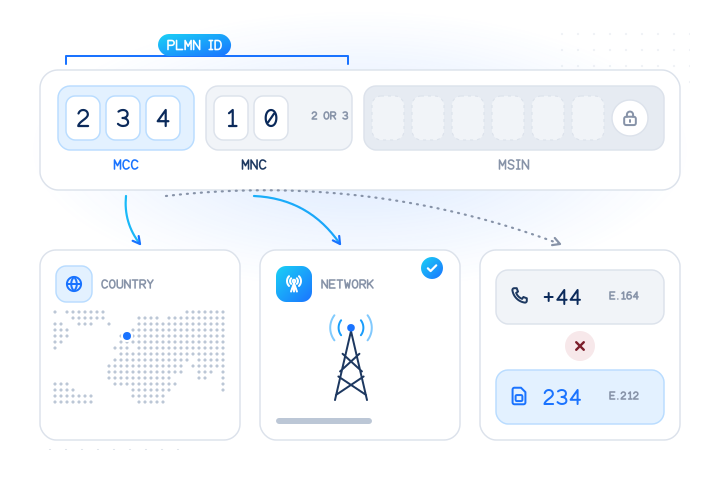
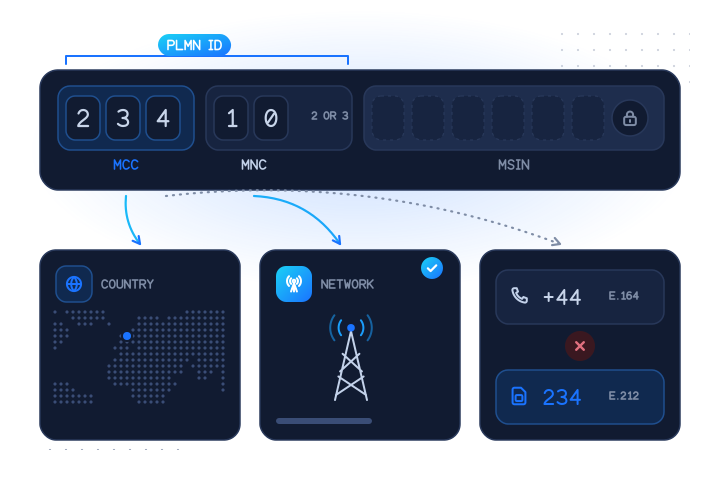
MCC and MNC codes are the numbering system that gives every mobile network in the world a unique ID. The mobile country code (MCC) is three digits and names the country, such as 234 for the United Kingdom. The mobile network code (MNC) is two or three digits and names one network inside that country, such as 10. Together, 23410 is one network's PLMN ID. Both codes are defined in ITU-T Recommendation E.212, and they are a separate system from the +44-style calling codes you dial.
This guide explains how the code system works: who assigns the codes, how to read one, why some countries have several MCCs, when an MCC doesn't mean a country, and how MCCs differ from calling codes. It ends with a reference table for 34 countries, checked against the ITU's own lists. If you want the practical side, finding the current code of a specific phone number, see our step-by-step guide on how to get the MCC and MNC from a phone number.
What are MCC and MNC codes?
An MCC is a three-digit code that identifies a country or geographical area for mobile networks. An MNC is a two- or three-digit code that identifies one mobile network within an MCC. The pair is called the PLMN ID (public land mobile network identifier): 3GPP's numbering specification defines it simply as MCC followed by MNC (3GPP TS 23.003, clause 12.1, 2026).
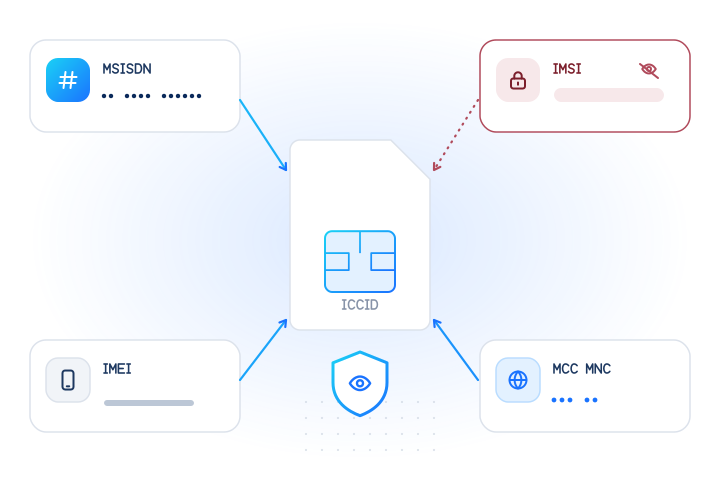
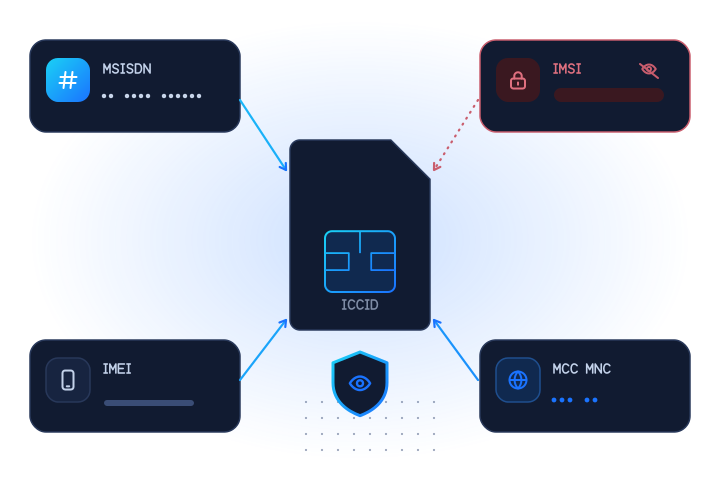
The codes come from ITU-T Recommendation E.212, "The international identification plan for public networks and subscriptions". The version in force is E.212 (06/2024). E.212 defines the MCC and MNC as the first two fields of the IMSI, the subscription identity stored on every SIM and eSIM profile:
| Field | Length | Identifies | Assigned by |
|---|---|---|---|
| MCC (mobile country code) | 3 digits | The country or shared area | The ITU (its Telecommunication Standardization Bureau) |
| MNC (mobile network code) | 2 or 3 digits | The home network within that MCC | The national numbering plan administrator (usually the telecoms regulator) |
| MSIN (mobile subscription identification number) | Up to 10 digits | One subscription on that network | The network operator |
| IMSI (all three together) | Up to 15 digits | One mobile subscription worldwide | n/a |
The MCC and MNC are public, network-level information: every phone in range can see them, and operators publish them. The MSIN is not. It identifies an individual subscriber, so it must never leave the network. MobileValidate never returns or stores the IMSI or the MSIN. Our lookups report the network by its MCC/MNC only. Our IMSI vs MSISDN vs ICCID guide covers the other identifiers in detail.
How do you read an MCC/MNC code?
A combined MCC/MNC code is five or six digits long. Read it in three steps:
- Take the first three digits as the MCC. The MCC is always exactly three digits, so this step never fails.
- Take the remaining two or three digits as the MNC. A five-digit code has a two-digit MNC; a six-digit code has a three-digit MNC.
- Look the pair up in the ITU's MNC list or a national register to get the country and network name.
Three examples, all taken from the ITU's November 2023 MNC list:
| Code | MCC | MNC | Country | Network |
|---|---|---|---|---|
23410 | 234 | 10 | United Kingdom | Telefónica UK (O2) |
310260 | 310 | 260 | United States | T-Mobile USA |
405005 | 405 | 005 | India | Reliance Communications (Delhi) |
Keep codes as text, never as numbers. MNC 01 and MNC 001 are different codes, and leading zeros vanish in an integer column or a spreadsheet cell. That also means a code like 310 + 010 (Verizon Wireless) must stay 310010, not 31010.
The three-step rule works for a combined code that a lookup or a list hands you, because its length tells you the MNC length. It does not work for a raw IMSI, where the MNC length has to come from a per-country table: the 15 digits don't show where the MNC stops.
Who assigns MCC and MNC codes?
Two levels share the job:
- The ITU assigns MCCs. The Director of the ITU's Telecommunication Standardization Bureau (TSB) assigns MCCs to countries and the shared 90x codes to international networks (E.212, Annex A). The list is published as an annex to the ITU Operational Bulletin. The last full edition of the MCC list has a position date of 1 February 2017, and later changes are published as numbered amendments.
- National regulators assign MNCs. Inside a country's MCC, the national numbering plan administrator decides who gets an MNC and on what terms (E.212, Annex B). Applicants have to show they need one. The administrator should assign MNCs first come, first served, and notify the ITU within 90 days of each assignment or withdrawal.
The ITU's MNC list, last consolidated on 15 November 2023 in Operational Bulletin No. 1280, only contains what administrations have notified. Some countries report every assignment; others report a handful. In that list, the United Kingdom has 53 MNCs under 234 and Australia 62 under 505, while some large markets show only two or three. Treat the ITU list as authoritative for what it contains, not as complete. National registers, such as the ones regulators publish alongside their numbering data, are often more current.
E.212 is also explicit that these codes are a public resource: an operator that holds an MNC doesn't own it, and the administrator can reclaim it if the conditions for the assignment are no longer met. A reclaimed MNC can be given to another operator later, which is one reason to refresh any code-to-name table you keep.
Why do some countries have more than one MCC?
Because they ran out of MNCs. One MCC holds at most 100 two-digit or 1,000 three-digit MNCs. Under E.212 Annex C, a country's administrator can ask the ITU for an additional MCC when an existing one is approaching exhaustion, defined as less than 20% of its MNCs left, and has to show that the current codes are used efficiently.
Examples from the ITU's MCC list:
| Country | MCCs | What it shows |
|---|---|---|
| United States | 310, 311, 312, 313, 314, 315, 316 | Hundreds of carriers, rural operators and private networks |
| India | 404, 405, 406 | Licences were historically issued per telecom circle (region), each with its own MNC |
| United Kingdom | 234, 235 | 53 MNCs under 234 and 13 under 235 in the 2023 MNC list |
| Japan | 440, 441 | 441 holds newer assignments, including IoT operators with 3-digit MNCs |
| China | 460, 461 | A second code is assigned, though the 2023 MNC list shows networks only under 460 |
| United Arab Emirates | 424, 430, 431 | 430 and 431 are listed for Abu Dhabi and Dubai |
India shows why a single country can need several codes: its MNCs were assigned per operator per circle, so one operator holds many codes. In the 2023 ITU list, 40410 is Bharti Airtel in Delhi while 40402 is Bharti Airtel in Punjab. The same brand, two different MNCs.
Is the MNC two or three digits?
It depends on the country. E.212 says the length of the MNC "is a national matter". 3GPP TS 23.003 adds that the length depends on the MCC and that mixing two- and three-digit MNCs within one MCC "is not recommended".
In practice, some countries mix them anyway:
| MNC length | Countries (examples) |
|---|---|
| Always 3 digits | United States, Canada, Mexico, Argentina, Colombia |
| Always 2 digits | United Kingdom, Germany, Italy, Netherlands, Brazil, Nigeria, Kenya, South Africa, Indonesia, China, Australia and most other countries |
| Mixed | India (MCC 405 has both), France and Spain (3-digit MNCs for private networks such as electricity utilities), Japan (MCC 441) |
France is a good example: public operators such as Orange (20801) and SFR (20810) have two-digit MNCs, while the ITU list shows three-digit MNCs from 208500 upward for private networks run by EDF and local authorities. Spain does the same for utilities such as Iberdrola (214700).
The practical rule for developers: never split an MCC/MNC by assuming a fixed MNC length. Use the length of the combined code, or a table keyed by MCC that you keep up to date.
What's the difference between an MCC and a country calling code?
They come from two different ITU plans and do different jobs. The calling code is part of a phone number; the MCC is part of a SIM's identity.
| Country calling code | Mobile country code (MCC) | |
|---|---|---|
| Standard | ITU-T E.164 (numbering plan) | ITU-T E.212 (identification plan) |
| Length | 1 to 3 digits | Always 3 digits |
| Used for | Dialling and routing calls and SMS | Identifying a SIM's home network, roaming, network selection |
| Who sees it | Everyone who dials the number | Networks and devices; not dialled |
| Example: United Kingdom | +44 | 234, 235 |
| Example: Germany | +49 | 262 |
| Example: India | +91 | 404, 405, 406 |
| Example: United States and Canada | +1 (shared) | 310 to 316 (US), 302 (Canada) |
Two traps follow from this:
- Coincidences. +234 is Nigeria's calling code, but 234 is a United Kingdom MCC. Nigeria's MCC is 621. Never derive one code from the other.
- Shared calling codes. +1 covers the United States, Canada and much of the Caribbean, but each of them has its own MCC: Jamaica is 338, Barbados 342, the Bahamas 364. A +1 number alone doesn't tell you which MCC applies.
E.212 even says the IMSI "should not be directly related" to the subscription's E.164 number. That separation is what makes number portability and SIM replacement possible: the phone number can move to a new SIM, with a new IMSI, without changing.
Does an MCC always mean a country?
Most MCCs map to one country or territory, but there are four important exceptions.
1. Shared, non-geographic MCCs (90x). E.212 defines MCCs in the 90x range as country-agnostic, administered directly by the ITU:
| MCC | Used for |
|---|---|
| 901 | International mobile networks: satellite phone systems, maritime and in-flight networks, global IoT and roaming operators |
| 902 | Networks specified by regional or international organisations and standards bodies (for example 90201, assigned to the MulteFire Alliance) |
| 991 | Trials: a temporary two-digit trial MNC for a limited period, then reclaimed |
| 999 | Internal use within a private network. MNCs under 999 aren't assigned, aren't globally unique and must not be used for roaming |
A SIM with MCC 901 tells you only that the network is international, not where the person is.
2. Extra-territorial use. E.212 Annex E lets an operator use its MCC+MNC in a neighbouring country through base stations there, with both administrations' agreement. The ITU's 2023 list records several cases:
- Monaco: subscribers of Orange, SFR and Bouygues Telecom use French codes
20801,20810and20820, told apart only by MSIN ranges. - Liechtenstein: a Swisscom range under Swiss
22801. - Belgium: ranges of two Luxembourg operators' codes,
27077and27099. - Faroe Islands: a range under Iceland's
27402. - Nauru: a Digicel range under Fiji's
54202.
3. Reserved codes. MCCs beginning with 0, 1 or 8 are reserved for future use, according to the notes of the ITU MCC list. A code starting with one of those digits is not a real network.
4. Codes in shared regions. A few MCCs are listed for more than one territory. For example, 340 covers both Guadeloupe and Martinique, and 362 covers Curaçao, Sint Maarten and the Caribbean Netherlands.
Where do MCC and MNC codes appear?
You'll meet the same five- or six-digit code in several places:
- On the SIM. The first five or six digits of the IMSI are the MCC and MNC of the home network, the operator that issued the SIM.
- In the network's broadcast. Each cell broadcasts its network's PLMN ID. That's how a phone picks a network in manual network selection, and how it knows when it is roaming: the network's code differs from the SIM's home code.
- In apps on the device. On Android,
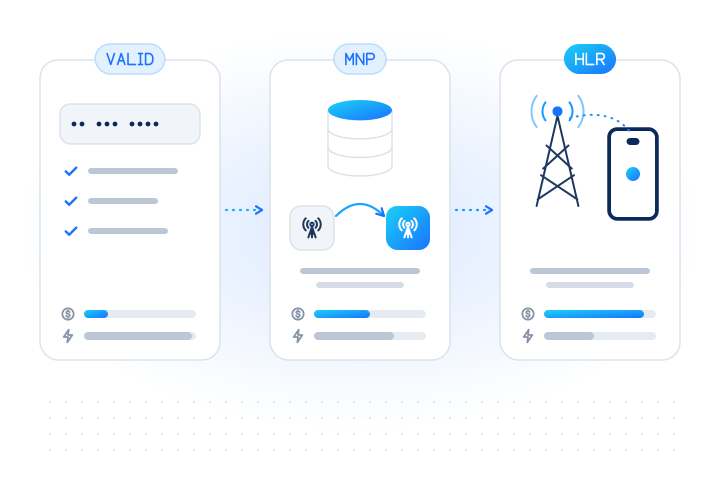
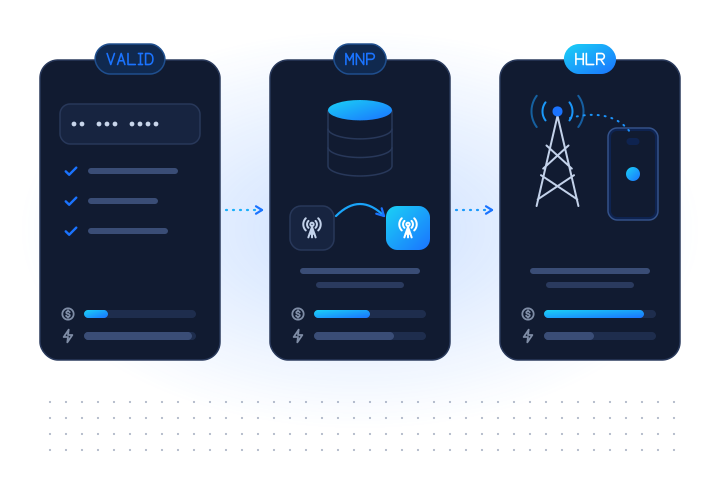
TelephonyManagergivesgetSimOperator()(the SIM's home code) andgetNetworkOperator()(the network the phone is on now). iOS no longer gives apps real values. - In HLR and MNP lookup results. Number-intelligence lookups report the network that currently serves a number as an MCC/MNC, because the code is unambiguous where operator names are not.
- In SMS routing tables. Messaging platforms price and route per destination network, keyed by MCC/MNC.
- In roaming and wholesale billing. Operators identify each other's networks by these codes in roaming agreements and settlement.
Why does the MNC of a phone number change after porting?
Because the code identifies the network, not the number. When a subscriber ports their number to another operator, they get a new SIM with a new IMSI that carries the new operator's MCC/MNC. The phone number stays the same.
So there are two different "MNCs of a number", and they answer different questions:
| Question | Where the answer comes from | Right after a port? |
|---|---|---|
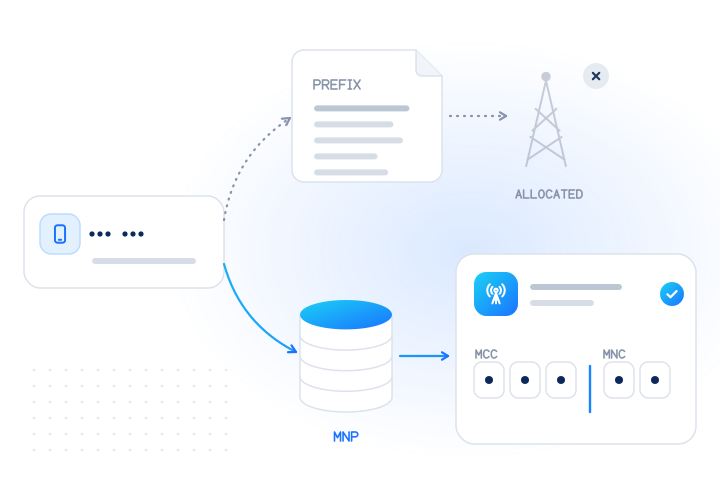
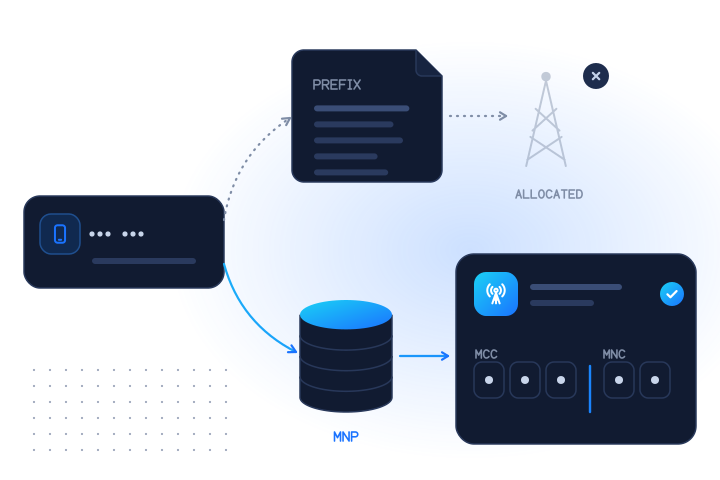
| Which network was this number range allocated to? | National numbering plan data (prefix tables) | No, it still shows the old network |
| Which network serves this number today? | Porting records (MNP lookup) or the home network itself (HLR lookup) | Yes |
Prefix tables and libraries that map numbers to carriers show the original allocation. That's fine for numbers that were never ported, and silently wrong for those that were. In countries with high porting volumes, a large share of numbers is affected. Our mobile number portability atlas shows where portability exists, and why carrier lookups go wrong after a port explains the mechanics.
One more subtlety: a virtual operator (MVNO) often runs on its host network's MNC, so a port between an MVNO and its host network may not change the code at all. Larger MVNOs with their own core network have their own MNC.
How do you get the MCC and MNC of a phone number?
Ask a source that knows about porting. With MobileValidate, two checks return the current code for a number in E.164 format:
| Check | Returns | Price per conclusive answer |
|---|---|---|
| MNP lookup | porting (ported or not ported), mcc_mnc, country | $0.002, real time and bulk |
| HLR lookup | mcc_mnc and network name, plus whether the number is reachable now, ported or roaming | $0.006 in real time, $0.005 in bulk |
Use the MNP lookup when you need the code for routing, delivery reporting or refreshing the operator stored in your records. Use the HLR lookup when you also need to know that the phone is live. In both cases you are only charged for conclusive answers. unknown, timeouts, invalid formats and duplicates are free. See pricing for volume details.
Our carrier lookup is a different tool: it returns the line type and the carrier name, not an MCC/MNC code. The full walkthrough, including a code sample and how to split the mcc_mnc field, is in how to get the MCC and MNC from a phone number.
MCC list by country (with example MNCs)
The table below lists the MCCs of 34 countries, their calling codes, how long their MNCs are, and one example network code. MCCs come from the ITU MCC list (Operational Bulletin No. 1117, position on 1 February 2017). MNC lengths and examples come from the ITU MNC list (Operational Bulletin No. 1280, position on 15 November 2023). Network names are shown as listed by the ITU, with a current brand in brackets where it differs.
| Country | Calling code | MCC(s) | MNC length | Example code (network) |
|---|---|---|---|---|
| United States | +1 | 310–316 | 3 | 310260 (T-Mobile USA) |
| Canada | +1 | 302 | 3 | 302720 (Rogers Wireless) |
| Mexico | +52 | 334 | 3 | 334020 (Radiomóvil Dipsa, Telcel) |
| Brazil | +55 | 724 | 2 | 72406 (Telefônica Brasil, Vivo) |
| Argentina | +54 | 722 | 3 | 722070 (Telefónica, Movistar) |
| Colombia | +57 | 732 | 3 | 732101 (Comcel, Claro) |
| United Kingdom | +44 | 234, 235 | 2 | 23415 (Vodafone) |
| Germany | +49 | 262 | 2 | 26201 (Telekom Deutschland) |
| France | +33 | 208 | 2 (3 for private networks) | 20801 (Orange) |
| Spain | +34 | 214 | 2 (3 for private networks) | 21407 (Telefónica Móviles España, Movistar) |
| Italy | +39 | 222 | 2 | 22201 (TIM) |
| Netherlands | +31 | 204 | 2 | 20404 (Vodafone Libertel, Vodafone) |
| Poland | +48 | 260 | 2 | 26003 (Orange) |
| Turkey | +90 | 286 | 2 | 28601 (Turkcell) |
| Saudi Arabia | +966 | 420 | 2 | 42001 (Saudi Telecom, stc) |
| United Arab Emirates | +971 | 424, 430, 431 | 2 | 42402 (Etisalat, e&) |
| Egypt | +20 | 602 | 2 | 60202 (Vodafone) |
| Nigeria | +234 | 621 | 2 | 62130 (MTN Nigeria) |
| Kenya | +254 | 639 | 2 | 63902 (Safaricom) |
| South Africa | +27 | 655 | 2 | 65501 (Vodacom) |
| India | +91 | 404, 405, 406 | 2 (404); 2 or 3 (405) | 40410 (Bharti Airtel, Delhi) |
| Pakistan | +92 | 410 | 2 | 41003 (Ufone) |
| Bangladesh | +880 | 470 | 2 | 47001 (Grameenphone) |
| Indonesia | +62 | 510 | 2 | 51010 (Telkomsel) |
| Philippines | +63 | 515 | 2 | 51502 (Globe Telecom) |
| Vietnam | +84 | 452 | 2 | 45204 (Viettel) |
| Thailand | +66 | 520 | 2 | 52003 (Advanced Wireless Network, AIS) |
| Malaysia | +60 | 502 | 2 | 50213 (Celcom, CelcomDigi) |
| Singapore | +65 | 525 | 2 | 52501 (Singtel) |
| Hong Kong | +852 | 454 | 2 | 45400 (HKT) |
| China | +86 | 460, 461 | 2 | 46000 (China Mobile) |
| Japan | +81 | 440, 441 | 2 (440); 2 or 3 (441) | 44010 (NTT Docomo) |
| South Korea | +82 | 450 | 2 | 45005 (SK Telecom) |
| Australia | +61 | 505 | 2 | 50501 (Telstra) |
Two notes on using this table. First, an example code shows one network that holds the MCC; most countries have several networks and many have dozens of MNCs, including test, IoT and private networks. Second, after a port the code that serves a number may be any of them, so don't infer a number's network from its prefix and this table alone.
Common questions about MCC/MNC codes
Can two networks share an MNC?
Not within the same MCC: each MNC identifies one home network. But one network can hold several MNCs, for example separate codes for different technologies, regions or test networks. In the ITU list, Verizon Wireless appears under many US codes, and Bharti Airtel under one code per Indian circle.
Do landlines have an MCC and MNC?
Not normally. MCC/MNC codes identify mobile networks and the subscriptions on them. A fixed line or a typical VoIP number has no SIM and no IMSI, so lookups return no MCC/MNC for it. E.212 does describe uses of its codes beyond classic mobile networks, but phone-number lookups only return a code for numbers on a mobile network.
What is an HNI?
HNI (home network identity) is another name for the same MCC+MNC combination, common in the US industry; it appears, for example, in a test entry under MCC 310 in the ITU list. PLMN ID is the 3GPP term.
How often do MCC and MNC assignments change?
New MNCs are assigned every year, mostly to private, IoT and small regional networks, and some are withdrawn or transferred after mergers. MCC changes are rarer. If you keep a code-to-name table, refresh it from the ITU's latest list and amendments, or from national registers, at least yearly.
Sources
- Recommendation ITU-T E.212 (06/2024): The international identification plan for public networks and subscriptions — ITU, 2024
- List of Mobile Country or Geographical Area Codes, Annex to ITU Operational Bulletin No. 1117 (position on 1 February 2017) — ITU, 2017
- Mobile Network Codes (MNC) for the international identification plan, Annex to ITU Operational Bulletin No. 1280 (position on 15 November 2023) — ITU, 2023
- 3GPP TS 23.003 version 18.8.0: Numbering, addressing and identification (ETSI TS 123 003 V18.8.0, 2026-08), clauses 2.2 and 12.1 — ETSI / 3GPP, 2026
- Recommendation ITU-T E.164: The international public telecommunication numbering plan — ITU, 2010
- TelephonyManager: getSimOperator and getNetworkOperator — Android Developers, 2026
Frequently asked questions
What is an MCC and MNC code?
The mobile country code (MCC) and mobile network code (MNC) together identify one mobile network worldwide. The MCC has three digits and names the country, or a shared international range. The MNC has two or three digits and names the network inside that MCC. Written together, as in 23410 or 310260, they form the network's PLMN ID. Both are defined in ITU-T Recommendation E.212.
Is the MCC the same as the country calling code?
No. The calling code comes from ITU-T E.164 and is what you dial, such as +44 for the United Kingdom. The MCC comes from ITU-T E.212 and identifies mobile networks, such as 234 or 235 for the United Kingdom. The two plans are separate, so the numbers rarely match, and +1 alone covers the United States (MCCs 310 to 316), Canada (302) and many Caribbean countries.
Why does the United States have several MCCs?
Because one MCC holds at most 1,000 three-digit MNCs, and the United States has hundreds of mobile networks, including small rural carriers and private networks. Under ITU-T E.212, a country can ask for another MCC when less than 20% of the MNCs in its current one are left. The ITU list assigns 310, 311, 312, 313, 314, 315 and 316 to the United States.
How do I know if an MNC has two or three digits?
You can't tell from the digits alone; the length is set by each country. In the United States, Canada, Mexico, Argentina and Colombia, MNCs have three digits. Most of Europe, Asia and Africa use two. Some countries mix both: India's MCC 405 and the private-network MNCs of France and Spain use three digits next to two-digit ones. If you have a combined five- or six-digit code, the first three digits are the MCC and the rest is the MNC.
Does an MCC always tell you the country?
Usually, but not always. MCCs in the 90x range are shared and country-agnostic: 901 is used by satellite, maritime, in-flight and other international networks, and 999 is for private networks. ITU-T E.212 also allows extra-territorial use, so subscribers in Monaco can sit on French MCC 208 and subscribers in Liechtenstein on Swiss MCC 228.
How do I find the MCC and MNC of a phone number?
Run a number portability (MNP) or HLR lookup on the number in E.164 format. Both return the current network's code, for example 23410. The number's prefix only shows the network the range was first allocated to, which is wrong for numbers that have been ported to another operator.
Can a lookup return the IMSI of a phone number?
MobileValidate doesn't. The MCC and MNC are the public, network-level part of the IMSI, and that is all our HLR and MNP lookups return. The rest of the IMSI, the MSIN that identifies the individual subscription, is never returned or stored, and neither are other SIM or location identifiers.
Related services and guides
More from the blog
All articlesGuides
How to get the MCC and MNC from a phone number (and why the prefix can be wrong)
MCC/MNC lookup by phone number: why the prefix shows only the original network, how to get the current code with MNP or HLR, and 5 mistakes to avoid.
8 min read
Guides
IMSI vs MSISDN vs ICCID: the mobile identifiers, explained
What the IMSI, MSISDN, ICCID and IMEI are, where each lives, what changes when you port or swap a SIM, and why the IMSI must never leave the network.
8 min read
Guides
HLR lookup vs MNP lookup vs number validation: what each one answers
Validation checks the digits, MNP finds the current network, HLR asks the network if the number is live. What each answers, costs and misses.
7 min read