On this page
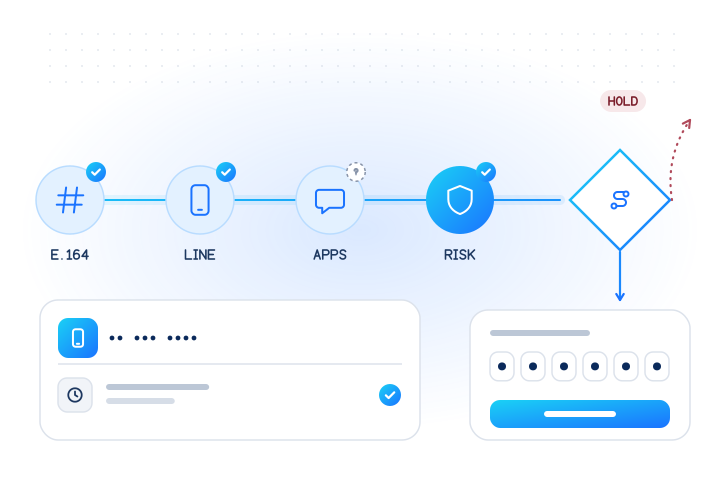
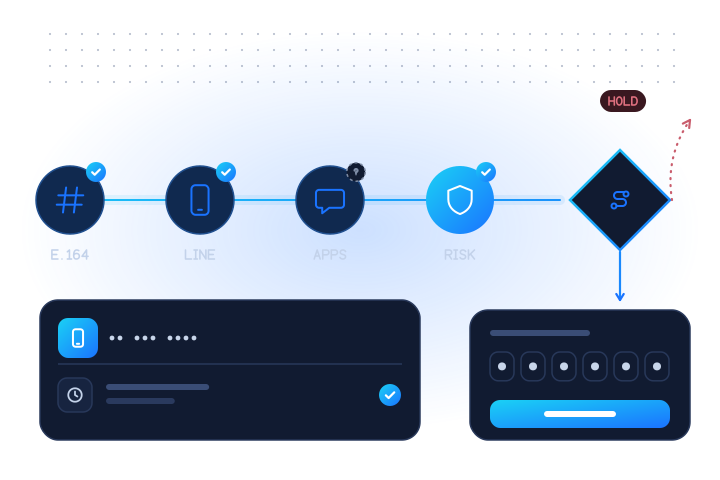
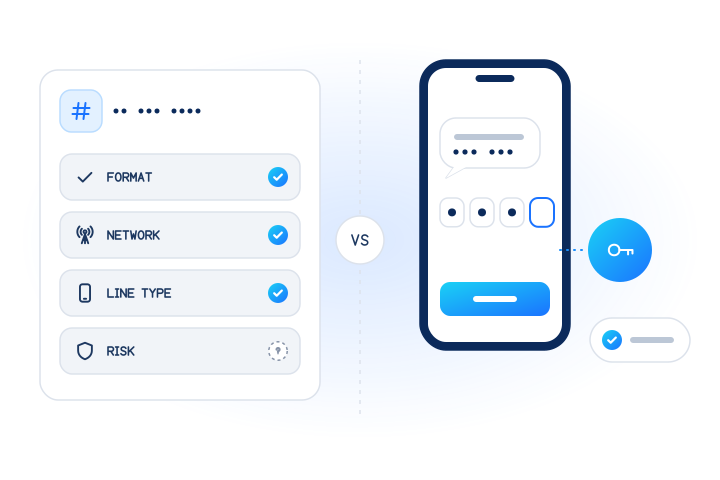
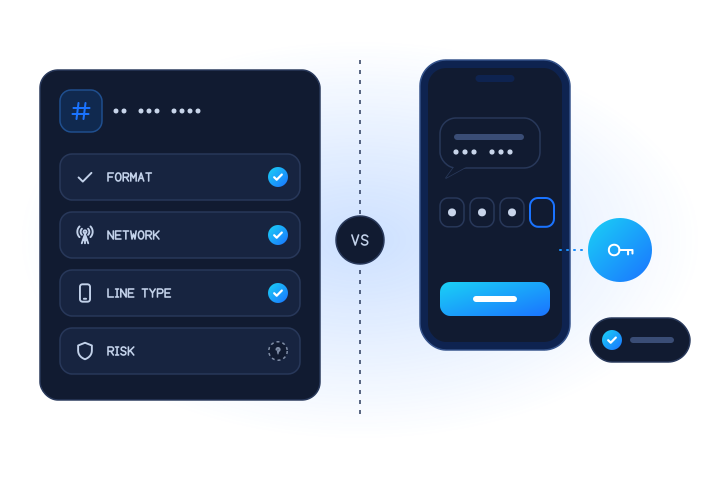
Phone validation checks facts about a number without contacting anyone: is it well formed, which country and line type is it, is it registered on messaging apps. Phone verification proves that the person in front of you controls the number right now, usually by sending a one-time passcode (OTP) and asking for it back. Validation is cheap and silent; verification costs a message and some friction. Most products need both, in that order. This guide compares them side by side, shows what each one stops, and gives one flow that combines them.
What does phone validation check?
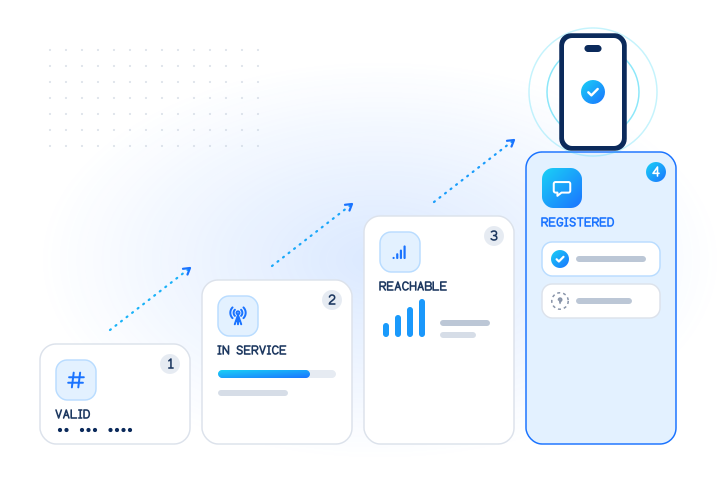
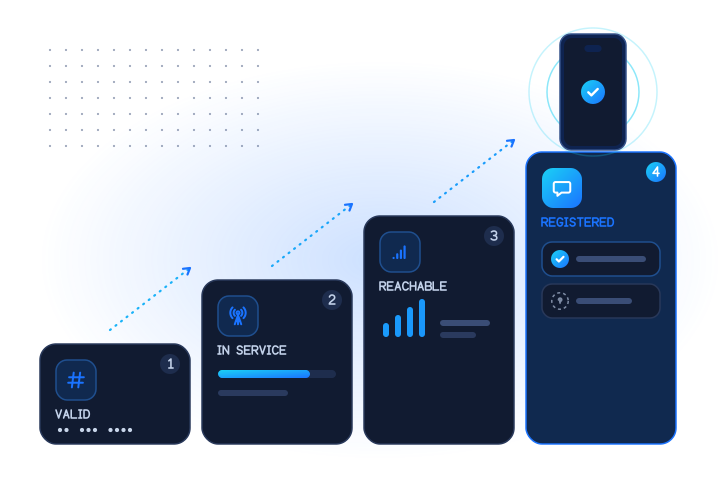
Validation answers questions about the number, not the person. There are three depths:
| Depth | Question | Example signal | Cost |
|---|---|---|---|
| Format | Is it a possible, dialable number? | E.164 normalization; invalid_number | Free |
| Numbering and network | What country, line type and carrier? | line_type: mobile, voip, premium_rate | Per check |
| Presence | Is it registered on messaging apps? | whatsapp.registered: true | Per check |
None of these sends anything to the number: the checks are designed not to contact or alert the person, who doesn't have to do anything. That's why validation fits early in a flow: on a sign-up form, before a passcode is sent, or across a whole contact list in a bulk job. Our guide to checking whether a number is active goes deeper into the network layer, and the E.164 guide into format.
What validation can't do is tell you who holds the number. A valid, mobile, WhatsApp-registered number can still belong to someone other than the person typing it.
What does phone verification prove?
Verification proves possession: the user received something sent to the number and returned it. The common methods are an SMS passcode, a voice call reading out a code, a passcode sent through a messaging app, and newer network-based methods that confirm the SIM in the device matches the number.
NIST's digital identity guidelines, finalized in July 2025, treat this carefully. SP 800-63B-4 says use of the public telephone network for out-of-band authentication "is restricted", and that verifiers "SHOULD consider risk indicators (e.g., device swap, SIM change, number porting, other abnormal behavior) before using the PSTN to deliver an out-of-band authentication secret" (NIST, 2025). It also requires rate limiting of failed attempts for short codes.
So verification is stronger than validation for one question, "does this user hold this number now?", and weaker than it looks for another, "is this a trustworthy account?". A fraud operation with real SIM cards passes every OTP.
How do they compare side by side?
| Validation | Verification (OTP) | |
|---|---|---|
| Question answered | What kind of number is this? | Does the user control it now? |
| Contacts the person | No | Yes |
| User effort | None | Enter a code |
| Typical cost | Fraction of a cent per check; format checks free | One SMS, voice call or app message per attempt, plus retries |
| Speed | Milliseconds (format) to seconds (network, apps) | Seconds to minutes, depending on delivery |
| Stops | Typos, junk, landlines, premium-rate and other risky line types, many pumping attempts | Users entering someone else's number; unreachable numbers |
| Misses | Who holds the number | Fraudsters with real SIMs; SIM swap; recycled numbers |
| Works on lists | Yes, in bulk | No: it needs the user present |
The columns aren't competitors. Validation decides whether and how to verify; verification confirms possession for the numbers worth verifying.
Which one stops fake sign-ups?
Neither on its own. Validation removes the cheap attacks: random digits, numbers that can't receive SMS, premium-rate ranges and many numbers used in SMS pumping. Verification removes users who don't hold the number they typed. Fake-account operators who buy real SIMs or virtual numbers pass both. That's why effective setups add:
- Presence and history signals, such as messaging-app registration and whether you've seen the number, device or IP before.
- Friction tiers instead of a single yes/no: allow, confirm, step up, hold value, review.
- Rate limits per number, IP, device and destination prefix.
Our guide to reducing fake sign-ups gives a points model for turning these signals into tiers, and SMS pumping explains why validating before you send is the cheapest defence against inflated traffic.
What does validation look like in practice?
One real-time request validates format, line type and messaging presence together. This real test-mode call includes a national-format number, an impossible number and a duplicate:
curl https://api.mobilevalidate.com/v1/lookup \
  -H "Authorization: Bearer $MOBILEVALIDATE_API_KEY" \
  -H "Content-Type: application/json" \
  -d '{"numbers": ["+447700900001", "07700 900002", "+44 7700 900003", "+4477009", "+447700900001"],
       "default_country": "GB", "checks": ["carrier", "whatsapp"], "wait": 5}'
The row-level results, trimmed:
{"input": "+447700900001",   "e164": "+447700900001", "number_status": "valid",
 "network.carrier": {"line_type": "mobile", "carrier": "Test Carrier", "country": "GB"}, "whatsapp.registered": true}
{"input": "07700 900002",    "e164": "+447700900002", "number_status": "valid",
 "network.carrier": "unknown (NO_DATA)", "whatsapp.registered": false}
{"input": "+44 7700 900003", "e164": "+447700900003", "number_status": "valid",
 "network.carrier": "unknown (UPSTREAM_TIMEOUT)", "whatsapp.registered": "unknown (UPSTREAM_TIMEOUT)"}
{"input": "+4477009",        "e164": null,            "number_status": "invalid_number"}
{"input": "+447700900001",   "e164": "+447700900001", "number_status": "duplicate"}
The invalid and duplicate rows were never checked and never cost anything. You're not charged for inconclusive results (unknown, unsupported country, timeout, invalid, duplicate). See the test numbers for every state.
How do I combine validation and verification in one flow?
Validate first, then choose how to verify, then keep watching after sign-up:
- Normalize the input to E.164. If it's
invalid_number, ask the user to fix it. No message is sent. - Validate in real time:
carrierfor line type, plus the messaging apps you can deliver codes on. Use a shortwaitso the form stays fast. - Decide the verification route from the answers:
| Validation result | Verification step |
|---|---|
mobile, WhatsApp true, no risk flags | Passcode via the app the user chose, SMS as fallback |
mobile, no app presence | SMS passcode |
voip | Step up: e-mail confirmation plus passcode, or hold value until the account has history |
premium_rate, shared_cost | Don't send; ask for another number |
fixed_line | Voice passcode, or ask for a mobile number |
Any check unknown or pending | Treat as no information; follow your default route |
- Verify with rate limits and short code expiry, as NIST expects.
- Re-validate when the user changes their number, and on a schedule for dormant accounts, because numbers get recycled.
Our pre-send checklist in OTP fraud prevention covers step 2 in detail.
When is validation alone enough, and when do you need verification?
It depends on what a wrong number costs you and whether the user is present:
| Situation | Validation | Verification | Why |
|---|---|---|---|
| Cleaning a CRM or contact list | Yes, in bulk | No | Users aren't present; you want to fix data, not prove possession |
| Web-form lead before a sales call | Yes | Optional | Line type and presence show whether the number is plausible; see lead verification |
| Consumer sign-up | Yes | Usually | Possession matters if the number becomes a login or recovery factor |
| Adding the number as a second factor | Yes | Yes | You're binding an authenticator; NIST treats changes as binding a new one |
| Changing the number on an account | Yes | Yes, plus step-up | A classic account-takeover moment |
| Channel selection for expected messages | Yes | No | You need reachability, not possession |
The general rule: validate everything you store, verify what you rely on for access. Validation alone is fine when a wrong answer only means a wasted message. Verification is needed when a wrong answer means someone else gets into an account.
What does each approach cost?
Validation is billed per conclusive check and is usually a small fraction of the cost of one passcode. Current prices are on the pricing page. Verification costs a message per attempt, and attempts multiply: resends, fallbacks from app to SMS to voice, and attacks that trigger codes to numbers that will never answer.
That asymmetry is the business case for validating first. Every passcode you don't send to an invalid, fixed-line or premium-rate number is a saving, and every pumping attempt stopped before sending avoids the most expensive failure mode. Repeat validations of the same number inside the freshness window are served from your account's cache for free, so returning users cost nothing extra. A useful metric is cost per completed verification: messages sent plus checks run, divided by users who entered a correct code.
What are the privacy considerations?
Validation processes a phone number the user gave you, so it's likely to be processing of personal data. Under the GDPR that needs a lawful basis (Article 6), and fraud prevention and delivering a code the user asked for are common purposes. Keep only what the decision needs, typically the line type, the answers and their dates. Checks return no names or profiles, and people can object through our opt-out form. Verification adds a message the user requested, so it rarely raises new issues, but store codes hashed and expire them quickly. This is general guidance, not legal advice; consult counsel about your own setup.
What are the key takeaways?
- Validation checks facts about the number (format, line type, carrier, app presence) without contacting anyone.
- Verification proves the user controls the number now, usually with an OTP. NIST treats phone-network authentication as restricted and asks for risk checks such as SIM change and porting.
- Neither stops fake sign-ups alone. Validate first, verify second, and add history, rate limits and friction tiers.
- Validation is cheap and works on lists; verification costs a message per attempt and needs the user present.
- Measure cost per completed verification, not cost per message.
- Compare providers with our buyer's guide and try every branch with the test numbers.
Sources
- NIST SP 800-63B-4: Digital Identity Guidelines, Authentication and Authenticator Management — NIST, 2025
- SP 800-63B-4 (publication details) — NIST CSRC, 2025
- General Data Protection Regulation (EU) 2016/679 — European Union, 2016
Frequently asked questions
What is the difference between phone validation and phone verification?
Validation checks facts about the number: is it well formed, what line type is it, is it registered on apps. Verification proves that the person in front of you controls the number right now, usually with a one-time passcode.
Which one stops fake sign-ups?
Neither alone. Validation filters junk, landlines and risky line types cheaply before you send anything. Verification proves possession. Most fake-account operators can pass an OTP with a real SIM, so combine both with your own signals.
Should I validate before sending an OTP?
Yes, for most products. A pre-send check avoids paying for passcodes to invalid, fixed-line or premium-rate numbers and helps stop SMS pumping before any cost is incurred.
Is a validated number safe to use for two-factor authentication?
Validation says nothing about who holds the number. NIST treats authentication over the phone network as restricted and asks verifiers to consider risk signals such as SIM change and number porting before relying on it.
Related services and guides
More from the blog
All articlesFraud prevention
OTP fraud prevention: the checks to run before you send a code
A practical pre-send pipeline for one-time passcodes: normalize, check line type, messenger presence and reputation in one request, then decide.
8 min read
Guides
How to check if a phone number is active (and what "active" really means)
Valid, active, reachable and registered mean different things. The methods for checking each one, what they cost and where every method falls short.
7 min read
Guides
How to choose a phone number validation API: a buyer's checklist
The criteria that matter when you choose a phone-intelligence API: coverage, conclusive rates, unknown billing, latency, freshness, privacy and test mode.
9 min read