On this page
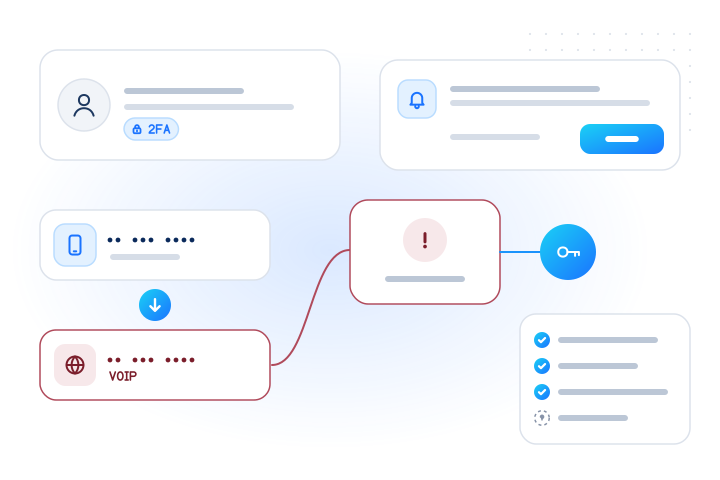
Before you reissue a recycled phone number, check three things. First, the quarantine period your country requires has passed. Second, the number is really disconnected: not live on your network and not ported to another one. Third, no app accounts are still registered on it. A number with a leftover WhatsApp, Telegram or Facebook account can deliver the previous holder's messages and login codes to the next holder. Hold that number longer, re-check it, or warn the new holder before you hand it over. In the US, also report each permanent disconnection to the FCC's Reassigned Numbers Database every month.
This guide is for operators, MVNOs, virtual-number resellers and anyone else who hands numbers to new users. It covers why old accounts survive on recycled numbers, the quarantine rules we could confirm from regulators' own documents, and a pre-reissue check you can run in bulk. Facts are as of 7 November 2026. This is general guidance, not legal advice.
What happens to a phone number when its owner leaves?
The number goes back into the provider's pool, waits, and then goes to someone new. Numbers are a limited national resource. Regulators expect providers to use their blocks efficiently, so disconnected numbers are reused rather than retired.
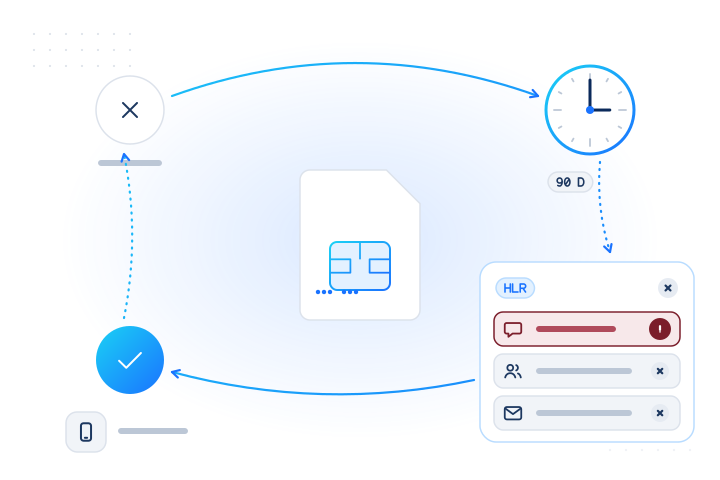
The cycle usually has four stages:
- Inactivity or cancellation. The subscriber cancels, stops paying, or a prepaid line goes unused for the period the rules allow.
- Notice and deactivation. Many countries require a warning before an inactive number is cut off.
- Quarantine (called "aging" in the US, "latency" in Italy). The number can't be given to anyone for a minimum period.
- Reissue. The number returns to the pool of available numbers and goes to the next customer.
Nothing in that cycle touches the accounts the previous holder created with the number. The operator closes the line. WhatsApp, Telegram, a bank app or a marketplace never hear about it.
Why do recycled numbers still carry old app accounts?
Because many apps identify the account by the phone number, and each app cleans up inactive accounts on its own schedule, if at all.
- WhatsApp says a recycled number is identified "when an account is unused for 45 days, then reactivated on a new mobile device". At that point it removes the old account data, such as the profile photo and About text (WhatsApp Help Center). The cleanup is triggered by the new holder's activation. Until then, the old account can still exist on the number.
- Telegram says plainly that "the phone number is the only way for us to identify a Telegram user at the moment" and that "whoever has the number, has the account". By default, an account is deleted only after its owner hasn't come online for 18 months, and users can change that period in Settings (Telegram FAQ). So a number that rested for three months can come back with a live Telegram account on it.
- Other services use the number for account recovery and login codes. A new holder who asks for a password reset can receive the code.
Researchers have measured the problem. In a 2021 study at Princeton, Kevin Lee and Arvind Narayanan sampled 259 numbers on offer to new subscribers at two major US carriers. They found that 171 of them were still tied to existing accounts at popular websites, "potentially allowing those accounts to be hijacked". When they took 200 recycled numbers and monitored them for one week, nearly 10% were still receiving security- or privacy-sensitive calls and texts meant for previous owners (Lee & Narayanan, 2021, draft of 3 May 2021). The study is US-only and from 2021, but the mechanism it describes still applies wherever apps use the number as the account key.
For a number provider, that is three risks at once:
- The previous holder's privacy and security. Their messages, groups and login codes can reach a stranger.
- The new holder's experience. They get someone else's messages and can't register cleanly. Some will blame you.
- Fraud on your inventory. For virtual-number resellers in particular, a number with a live account on it can be abused to take over that account. That is a reason to check before you resell, and to refuse any customer who wants numbers because they carry accounts.
How long do operators quarantine numbers?
These are the rules we could confirm from primary sources on 2026-11-07. Other countries set their own periods, and operators can usually wait longer than the minimum.
| Country | What the rules say | Source |
|---|---|---|
| United States | Disconnected numbers of residential customers "may be aged for no less than 45 days and no more than 90 days"; business customers' numbers for 45 to 365 days | 47 CFR 52.15(f)(1)(ii) |
| India | DoT's letter of 20 April 2017 forbids operators to reallocate a deactivated mobile number, whether cut off for non-use or at the subscriber's request, for at least 90 days. Prepaid users can't be deactivated for non-use before 90 days. | TRAI, 2025, para 2.40 |
| India (recommended, not yet rules) | TRAI recommended: no reuse for 90 days after deactivation for non-use, 180 days after surrender or disconnection, and mandatory deactivation 365 days after the first 90 days of non-use | Same, para 2.56 |
| Italy | A prepaid number can be withdrawn after at least 24 months with no commercial contact, with 30 days' notice. A withdrawn mobile number then waits three months before it can go to someone else. | AGCOM numbering plan, Art. 8.9–8.10 |
| South Africa | ICASA published the Numbering Plan Fourth Amendment Regulations on 2 July 2026, setting "a standardised framework for the churn, deactivation, and recycling of inactive mobile numbers". Operators have six months from Gazette publication to comply. Its reasons document keeps 60 days of inactivity as the trigger and refers to a 120-day recycling period. | ICASA, 2026; reasons document |
Compare those periods with the app timers above. A 45- to 120-day quarantine is shorter than Telegram's 18-month default. And WhatsApp's 45-day rule is triggered by the new holder's activation, not by the passing of time. The quarantine protects the network side. It doesn't clear the app side. That gap is what a pre-reissue check closes.
Our country guides have more detail for India, Italy and the United States.
What does the US Reassigned Numbers Database ask of number providers?
It asks them to report disconnections, so that callers can find out a number changed hands. Under 47 CFR 64.1200(l), a reporting carrier must keep the most recent date each of its numbers was permanently disconnected, and report it to the database administrator "on the 15th day of each month". A number is permanently disconnected when the subscriber has permanently given it up, or the provider has permanently reversed the assignment. A number ported to another provider doesn't count as disconnected (eCFR, 47 CFR 64.1200).
The callers' side is in paragraph (m). A caller who queries the database with the date it got consent, and gets the answer "no" (not disconnected since then), is protected if the number had in fact been reassigned. The database calls itself a safeguard "against the statutory damages that accompany inadvertently calling or texting a reassigned number" (RND). Our Reassigned Numbers Database guide explains the queries and pricing.
The database protects the next holder from callers who had consent from the previous holder. It does nothing about app accounts on the number. Report to it, and also run your own check before reissue.
How can a number provider check a number before reissuing it?
Run one bulk job on the batch of numbers that come out of quarantine, and decide per number. A workable flow:
- Select only numbers due for reissue. That means numbers you hold the rights to and whose quarantine has ended. Don't check whole blocks or ranges: our anti-enumeration controls refuse long runs of consecutive numbers, and the check is only meaningful for numbers you're about to hand out anyway.
- Confirm the network state with HLR. A live network status check should show the number as not reachable on your network. If it's reachable, something is wrong: the line wasn't fully deactivated, or the number was ported out and isn't yours to reissue. An MNP lookup answers the porting question on its own, more cheaply.
- Check for leftover app accounts. In the same job, add the app checks that matter in your market, for example WhatsApp, Telegram, Facebook and Instagram. Each answer is registered, not registered or unknown.
- Decide and record. Use the table below. Store the result as a flag on the number in your inventory, with
checked_at, and don't link it to the previous subscriber's identity. - Delete what you don't need. Once the number is reissued or held, the per-app answers have done their job. Keep only the decision.
| Result | What it suggests | What to do |
|---|---|---|
| HLR unreachable or invalid, no app accounts | Clean on both sides | Reissue |
| HLR unreachable, one or more app accounts registered | The network side is clean, the app side isn't | Hold for longer and re-check later. If you must reissue, tell the new holder what to do (see below). |
| HLR reachable, or MNP says ported | Not actually free | Don't reissue. Investigate the line or the porting record. |
| Unknown on any check | No conclusive answer (free) | Treat as not yet checked. Re-check before reissue. |
This is a hygiene check on your own inventory. It isn't proof that a number is "safe", it doesn't tell you who held the number, and it can't delete anyone's account. Apps also differ: an account that still shows as registered may be dormant and harmless, or still in use by its owner on a new number they forgot to update. A longer hold gives the previous holder time to move their accounts.
What does the job look like?
Here is a real estimate for that kind of job, made with our public sandbox key on 2026-11-07. The sandbox accepts only our test values, so it shows the shape of the answer, not real inventory:
curl https://api.mobilevalidate.com/v1/jobs/estimate \
  -H "Authorization: Bearer mv_test_publicSandboxn9ZgneuhR1B9CRfKG3fulym" \
  -H "Content-Type: application/json" \
  -d '{"numbers": ["+447700900001", "+447700900002", "+447700900003", "+447700900006"],
       "checks": ["hlr", "whatsapp", "telegram", "facebook"], "max_age": 0}'
Response (abridged):
{
  "object": "estimate",
  "total": 4, "valid": 4, "invalid": 0, "duplicate": 0, "cached": 0,
  "checks": ["number.hlr", "whatsapp.registered", "telegram.registered", "facebook.registered"],
  "checks_total": 16,
  "max_cost": { "amount": "0", "currency": "USD" },
  "breakdown": [
    { "check": "number.hlr", "price_mode": "batch", "checks": 4,
      "unit_price": { "amount": "0.005", "currency": "USD" } },
    { "check": "whatsapp.registered", "price_mode": "realtime", "reason": "small_batch", "checks": 4,
      "unit_price": { "amount": "0.004", "currency": "USD" },
      "countries": ["GB"], "batch_minimum": 132 },
    { "check": "telegram.registered", "price_mode": "batch", "checks": 4,
      "unit_price": { "amount": "0.0003", "currency": "USD" } },
    { "check": "facebook.registered", "price_mode": "batch", "checks": 4,
      "unit_price": { "amount": "0.0001", "currency": "USD" } }
  ]
}
max_age: 0 forces fresh answers, which is what you want for numbers that just finished quarantine: a cached answer from before the quarantine would be misleading. max_cost is 0 because test keys are never billed. The small_batch line shows that the bulk WhatsApp price needs at least 132 numbers from the same country in one job. Four numbers fall back to the real-time price. A weekly batch of numbers leaving quarantine is usually well above that. Then create the job with the same body and a cost cap, and download one row per number. The bulk jobs docs cover the full flow, including webhooks.
What does it cost?
From our public catalog (GET /v1/services), read on 2026-11-07, bulk-job prices per 1,000 numbers:
| Check | Per 1,000 (bulk job) |
|---|---|
Live network status, HLR (number.hlr) | US$5.00 |
Number portability, MNP (number.mnp) | US$2.00 |
WhatsApp registration (whatsapp.registered) | US$0.25 |
Telegram registration (telegram.registered) | US$0.30 |
Facebook registration (facebook.registered) | US$0.10 |
Instagram registration (instagram.registered) | US$0.10 |
A worked example with made-up volumes: 10,000 numbers leave quarantine this month. HLR plus WhatsApp, Telegram and Facebook checks cost at most 10,000 × (US$0.005 + 0.00025 + 0.0003 + 0.0001) = US$56.50, about half a US cent per number. Unknown, invalid and duplicate results are free, so the real cost is usually lower. If 800 numbers show a leftover account and you re-check them after a longer hold, the app checks alone cost at most 800 × US$0.00065 = US$0.52.
Which numbers should you not check?
The check is for your own inventory and your own subscribers. The limits are firm:
- Numbers you don't hold. Don't check numbers you have no rights to, and don't check ranges to see which numbers carry accounts. Our acceptable use policy forbids enumeration and checking accounts without specific authority. Requests that look like sequential ranges are rejected.
- Accounts on numbers you don't own. We don't support verifying, registering or taking over app accounts on numbers you don't own or don't hold for a subscriber. That includes "aged" numbers sold for their existing accounts, and bulk account creation on virtual numbers. An account check tells you an account exists. It must never be the reason a number is sold or used.
- Results as identity. A result never names a person. Don't combine it with your old subscriber records to work out what the previous holder used.
Our Terms (section 5, item 9) also require a lawful basis that covers each app check, and say that "mere possession of an Identifier" isn't enough on its own. A provider checking a number only to decide whether it's safe to reissue, without linking the result to a person, may be able to rely on legitimate interests or a similar basis, and many will add the check to their subscriber terms and privacy notice. Ask your counsel which basis fits in each country you operate in, and record it.
What should a new owner do if the number is already on WhatsApp?
If you hand out numbers, put this in your welcome message. It helps the new holder and protects the previous one:
- Register the apps you use straight away. WhatsApp says to complete verification on your own device. That updates the account with your information and replaces the old profile. If the previous holder had two-step verification, you may have to wait a few days (WhatsApp Help Center).
- Leave old groups and block unknown contacts. WhatsApp recommends exactly that after taking over a recycled number.
- Don't read or use the previous holder's data. If an app logs you into an account that clearly isn't yours, log out and contact that app's support. Telegram, for example, links the account to whoever has the number.
- Ignore codes and messages meant for someone else. Don't act on them, and tell the sender if you can.
- Ask for a different number if sensitive messages keep arriving. A provider would rather swap a number than handle a complaint.
And for the holder who is leaving: tell them to move or delete their app accounts and update their number at banks and other services before they cancel. That one notice at exit prevents most of the problems above. Our post on account takeover after a phone number change covers the service side.
How do you start with MobileValidate?
The checks for a pre-reissue job are live network status (HLR), MNP lookup and the app checks, such as WhatsApp and Telegram. All of them run in bulk jobs, and you can run several checks on the same list in one job. Viber and Zalo checks are available in bulk jobs only.
- Build free. Get a free test key to build your integration against fixed test answers.
- Check real numbers free. Every live account can check 20 phone numbers and 10 e-mail addresses for real, free, on the dashboard's Try it page. Request access to open one; accounts are approved automatically.
- Estimate before you pay. The job estimate is free and shows the maximum cost, duplicates and invalid rows before anything is checked.
- Then prepay. Top-ups of US$100 or more get a 5% bonus, US$500 or more 8%, and US$2,000 or more 10%.
Results are kept for your account's retention setting, 30 days by default, and you can delete a job's results at any time. Anyone can exclude their own number through our opt-out form. App names are used descriptively; MobileValidate is not affiliated with WhatsApp, Telegram or Meta.
What are the key takeaways?
- Operators recycle numbers after a quarantine: 45 to 90 days for US residential numbers, at least 90 days for Indian mobiles, three months in Italy, and a cycle of about 120 days under South Africa's new rules.
- App accounts outlive the quarantine. WhatsApp clears an old profile only when a new holder activates the number after 45 days of disuse, and Telegram's default inactivity deletion is 18 months.
- In a 2021 study, 171 of 259 US numbers on offer to new subscribers were still tied to accounts at popular websites.
- Before reissuing a number, check it with HLR (not live, not ported) and the app checks that matter in your market. Hold numbers that still carry accounts, or warn the new holder.
- Check only numbers you hold, with a recorded lawful basis, never ranges, and never to find or use accounts on numbers you don't own.
Sources
- 47 CFR 52.15: Central office code administration (aging numbers, paragraph (f)(1)(ii)) — eCFR / Federal Communications Commission, 2026
- 47 CFR 64.1200, paragraphs (l) and (m): reporting of permanently disconnected numbers and the reassigned-number safe harbor — eCFR / Federal Communications Commission, 2026
- Reassigned Numbers Database — Reassigned Numbers Database administrator, on behalf of the FCC, 2026
- Recommendations on Revision of National Numbering Plan (6 February 2025), paragraphs 2.40 and 2.54–2.56 — Telecom Regulatory Authority of India (TRAI), 2025
- Delibera n. 8/15/CIR, Allegato A: Piano di numerazione nel settore delle telecomunicazioni (national numbering plan), Article 8.9 and 8.10 — AGCOM (Autorità per le Garanzie nelle Comunicazioni), 2015
- ICASA publishes final amendments to the Numbering Plan Regulations (2 July 2026) — Independent Communications Authority of South Africa (ICASA), 2026
- Reasons Document: Numbering Plan Fourth Amendment Regulations, 2026 (amendment of regulation 6A) — Independent Communications Authority of South Africa (ICASA), via Acts Online, 2026
- About seeing your phone number already in WhatsApp — WhatsApp Help Center, 2026
- Telegram FAQ (deleting inactive accounts; losing access to your phone number; changing your number) — Telegram, 2026
- Security and Privacy Risks of Number Recycling at Mobile Carriers in the United States (draft, 3 May 2021) — Kevin Lee and Arvind Narayanan, Princeton University, 2021
Frequently asked questions
Can a recycled phone number still have the previous owner's WhatsApp account?
Yes. A WhatsApp account stays tied to the number until it is deleted or someone verifies the number on a new device. WhatsApp treats an account as recycled when it has been unused for 45 days and is then activated on a new device, and it removes the old profile data at that point. Until then, the old account can still exist on the number.
How long do operators quarantine a phone number before reissuing it?
It depends on the country. In the US, disconnected residential numbers are aged for 45 to 90 days and business numbers for 45 to 365 days (47 CFR 52.15). In India, operators may not reissue a deactivated mobile number for at least 90 days. In Italy, a withdrawn mobile number waits three months. As of November 2026, South Africa is moving to a cycle of about 120 days.
How can I check if a phone number was used before?
As a number provider, check whether apps still have accounts on the number (WhatsApp, Telegram, Facebook and others), and run a live network (HLR) check to confirm it is really disconnected and not ported to another network. In the US, the Reassigned Numbers Database records when a number was permanently disconnected.
What is the FCC Reassigned Numbers Database?
A US database of permanently disconnected numbers. Carriers report the latest disconnection date for each number on the 15th of each month (47 CFR 64.1200(l)). A caller queries a number with a date, such as the date it got consent. A 'no' answer, meaning not disconnected since that date, gives the caller a safe harbor if the number turns out to be reassigned.
What should I do if my new number is already registered on WhatsApp?
Verify the number in WhatsApp on your own phone. WhatsApp then replaces the old profile with yours. Afterwards, leave any groups the number was in and block unknown contacts, as WhatsApp's help center advises. If the previous holder set up two-step verification, you may have to wait a few days. If you keep getting messages or codes meant for someone else, ask your provider for a different number.
Why are recycled numbers a security risk?
Many services use the phone number to recover accounts and to send login codes. Whoever holds the number can receive them. In a 2021 Princeton study, 171 of 259 numbers on offer to new subscribers at two US carriers were still tied to accounts at popular websites, and nearly 10% of 200 recycled numbers received security- or privacy-sensitive messages for previous owners within a week.
Can I use MobileValidate to check numbers I don't hold?
No. A pre-reissue check is for numbers you hold the rights to, or for subscribers who asked you to check their own number. Checking number ranges to find out who uses an app is forbidden by our acceptable use policy and blocked by our anti-enumeration controls. We don't support verifying or creating app accounts on numbers you don't own.
Related services and guides
More from the blog
All articlesDeliverability
Number recycling and phone-list decay: how often to re-check your list
Disconnected phone numbers are reassigned to new people, so every list decays. How recycling works, what the US rules say, and a re-check cadence recipe.
7 min read
Guides
The Reassigned Numbers Database (RND), explained
What the FCC Reassigned Numbers Database does, how its yes/no/no-data answers and TCPA safe harbor work, what it costs, and where other checks fit.
8 min read
Fraud prevention
Account takeover via phone-number change: a checklist for the change-number flow
Attackers change an account's phone number before resetting everything else. A checklist to secure the change-number flow without locking out real users.
7 min read