On this page
Promo abuse is claiming a sign-up bonus, referral reward or free trial more times than the offer allows, usually by opening several accounts. Phone numbers are a useful anchor because they cost something to obtain. Tie rewards to verified numbers, raise friction on risky combinations, and measure false positives so real customers keep their welcome offer.
What is promo abuse, and why is it a phone-number problem?
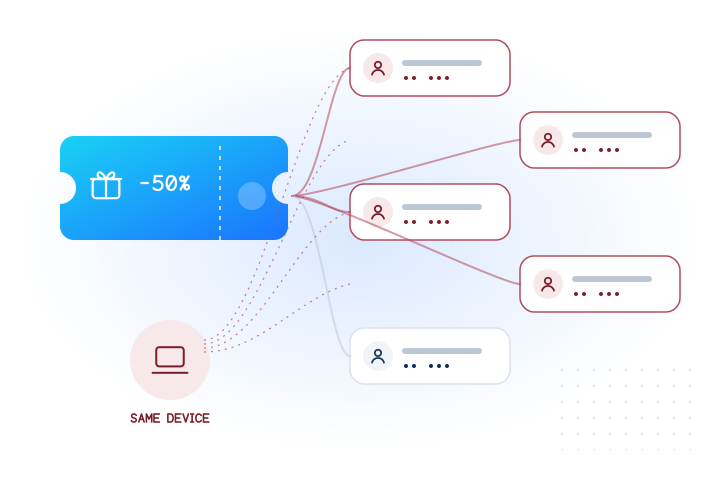
Promo abuse covers several patterns: a person opening a second account to claim a welcome bonus again, a group referring each other with fake accounts, or a script creating hundreds of accounts to farm free credit. OWASP describes the automated version as Account Creation (OAT-019): "Create multiple accounts for subsequent misuse", with other names such as "account pharming" and "registering many user accounts" (OWASP).
E-mail addresses are free and unlimited, so they don't slow anyone down. Phone numbers are different. Each one needs a SIM, an eSIM, a VoIP subscription or a temporary-number service, and each of those costs money or effort. That is why many offers ask for a verified phone number, and why abusers look for cheap numbers.
OWASP's API Security Top 10 treats this as a business-flow risk. One of its example scenarios is a ride-sharing referral programme, where an attacker writes "a script to automate the registration process, with each new user adding credit to the attacker's wallet" (OWASP, 2023). The flow works as designed. It is just used at a scale the business didn't plan for.
Is promo abuse illegal?
Usually it breaks your terms, not a law. A customer who opens a second account for a second welcome bonus is typically breaching the offer's conditions. Schemes that use false or stolen identities, or that deceive you into paying out money, can amount to fraud in many jurisdictions. Where the line sits depends on the country and the facts. This article is general guidance, not legal advice: consult counsel about your markets.
What you control is clarity. Write the offer terms so that the limit is explicit ("one welcome bonus per person, per verified phone number and per payment card"), say what happens to duplicate claims, and apply the rule consistently. Clear terms make both enforcement and appeals easier.
Which signals point to multi-accounting?
No single signal is enough. Multi-accounting shows up as links between accounts and as cheap identifiers:
| Signal | Source | Points to |
|---|---|---|
| Same phone number on several accounts | Your database (after E.164 normalization) | Direct duplicate |
| Numbers in one narrow range | Your database | Bulk-bought numbers |
| Same device, browser fingerprint or payment card | Your session and payment data | One person behind several accounts |
| Referral chains with no activity after the reward | Your referral data | Referral farming |
| VoIP line type | Carrier lookup | Easy-to-obtain numbers; common among real users too |
| No messaging-app account on the number | Messenger check | Number may not be used on a phone. Weak on its own |
E-mail patterns (name+1@, name.2@) | Your database | Generated addresses |
Normalizing numbers first matters more than it looks. 07700 900001, +44 7700 900001 and 447700900001 are the same number. Without E.164 normalization, your "one per number" rule counts them as three.
How do phone checks help without blocking real users?
A lookup adds facts that your database doesn't have. MobileValidate's carrier lookup returns the line type, and messenger checks such as the WhatsApp number check say whether the number has an account. A real test-mode request for two sign-ups:
curl https://api.mobilevalidate.com/v1/lookup \
  -H "Authorization: Bearer $MOBILEVALIDATE_API_KEY" \
  -H "Content-Type: application/json" \
  -d '{"numbers": ["+447700900001", "+447700900002"], "checks": ["carrier", "whatsapp"], "wait": 5}'
Response (excerpt: the checks of both results, test mode):
[
  {"e164": "+447700900001", "checks": {
     "network.carrier": {"status": "completed", "attributes": {"line_type": "mobile", "carrier": "Test Carrier", "country": "GB"}},
     "whatsapp.registered": {"status": "completed", "registered": true}}},
  {"e164": "+447700900002", "checks": {
     "network.carrier": {"status": "unknown", "registered": null, "reason": "NO_DATA"},
     "whatsapp.registered": {"status": "completed", "registered": false}}}
]
The first number looks like an ordinary phone in use. The second has no carrier data and no WhatsApp account. That is not a verdict. Plenty of real people don't use WhatsApp. It is a reason to look at the other signals before paying a reward. The unknown carrier answer isn't charged.
The checks describe the number only. They don't return names, profiles or any link to other people. Use them for the sign-ups and claims you receive, not to look up numbers you don't hold.
What friction tiers work?
Apply friction to the reward, not to the account. A person can sign up freely. The bonus waits until the risk is low. That keeps honest customers moving and makes abuse slow and expensive.
| Tier | When | What the user experiences |
|---|---|---|
| 0: Instant | New number, mobile line, no links to other accounts | Reward paid at once |
| 1: Light | One weak signal (VoIP, no messenger account, new device type) | Reward after a first qualifying purchase or a short wait |
| 2: Verify | Two signals, or a link to another account | Reward after an extra step: card check, e-mail confirmation or ID where the value justifies it |
| 3: Review | Strong links (same device or card as a rewarded account, number range cluster) | Claim held for manual review, with a clear message and appeal path |
| 4: Refuse | Confirmed duplicate under your terms | No reward. The account itself stays usable |
Keep tier 4 narrow. Refusing a reward is a decision about a person, so it should rest on clear evidence, and the user should be able to ask for a review.
How do you design offers that are harder to abuse?
The cheapest control is an offer that pays less to abusers than to customers. A few design choices shift that balance before any check runs:
- Pay on behaviour, not on sign-up. A bonus released after a first order, a first top-up or a week of activity is worth little to a throwaway account.
- Reward the referrer later. Credit the referrer when the referred customer becomes active, not when they register. Referral farms depend on instant credit.
- Cap per identifier. One reward per verified number, per payment card and per device, stated in the terms.
- Split large rewards. Several small credits over a few weeks are less attractive to farm than one large one.
- Limit cash-out. Credits that can only be spent in your product, not withdrawn, remove the resale motive.
- Watch the number supply. If many claims arrive from numbers in one narrow range, pause that range and review it.
These choices also help honest customers understand the offer, which reduces disputes. The same logic applies to account security: fast rewards and fast payouts are what attackers go after in a takeover too, as described in account takeover via phone-number change.
How do you keep the rules fair?
Fairness is not just good manners. It protects conversion, and in some places it is a legal matter.
- Don't block on missing data. An
unknownlookup, a new device or travel are common among real customers. - Don't treat VoIP as guilt. Many real people use app-based numbers. See VoIP number detection for sign-ups for where VoIP helps and where it misleads.
- Be careful with shared identifiers. Households share devices, Wi-Fi and sometimes cards. A shared IP address alone proves little.
- Explain holds. "Your welcome bonus will be added after your first order" is fine. A silent refusal generates complaints.
- Offer an appeal. A human review path catches the edge cases your rules miss.
- Mind automated decisions. Under the GDPR, Article 22 gives people the right not to be subject to a decision based solely on automated processing where it produces legal effects or similarly significantly affects them, and Recital 47 recognizes fraud prevention as a legitimate interest (EU, 2016). Whether a refused promotion reaches that threshold depends on the case. Ask counsel, and keep a human in the loop for refusals either way.
How do you measure whether it works?
Set up the measurement before the rules, so you can show the effect.
- Baseline. For the last full promotion, count rewards paid, rewards linked to accounts that never became active, and cost per retained customer.
- Define abuse. For example: rewarded accounts with no activity after 30 days that share a device, card or number range with another rewarded account.
- Roll out tiers gradually. Start with tiers 0–2 and a small review queue.
- Track false positives. The share of held or reviewed claims that turned out to be legitimate. If it is high, the rule is too strict.
- Track conversion. Sign-up completion and first purchase rates should stay flat for tier-0 users.
- Review monthly. Abuse adapts. Sample 20 held claims by hand and adjust.
The goal is not zero abuse. It is a cost of abuse lower than the cost of the friction you add.
What are the key takeaways?
- Promo abuse is multi-accounting to claim offers repeatedly. OWASP describes the automated form as Account Creation (OAT-019).
- Phone numbers cost something to obtain, so a verified, normalized number is a useful anchor for rewards.
- Combine account links (device, card, number ranges) with number facts such as line type and messenger presence. None decides alone.
- Put friction on the reward, not the account, and keep refusals narrow, explained and appealable.
- Measure false positives and conversion as carefully as abuse.
For the sign-up side of the same problem, read how to reduce fake sign-ups with phone and e-mail checks. The lead verification use case shows the same checks for marketing forms.
Sources
Frequently asked questions
Is promo abuse illegal?
It depends on the country and the facts. Claiming a welcome offer twice usually breaks the offer's terms rather than a criminal law, but schemes that use false identities or stolen details can amount to fraud. This is not legal advice; set clear terms and ask counsel about your markets.
Should we allow only one account per phone number?
It is a reasonable rule for rewards, not always for accounts. Families share landlines, numbers get recycled, and some users legitimately change numbers. Tie the reward, not the account, to a verified number, and allow a support path for edge cases.
Should VoIP numbers be blocked from promotions?
Not automatically. Many real people use VoIP or app-based numbers. Treat VoIP as one signal that raises friction, for example requiring a card or a waiting period before the reward, rather than as a reason to refuse.
How do we know our rules are fair?
Measure false positives: how many held or refused claims turned out to be legitimate customers. Review a sample by hand every month, give users a way to appeal, and loosen rules that mostly catch customers.
Related services and guides
More from the blog
All articlesFraud prevention
How to reduce fake sign-ups with layered phone and e-mail checks
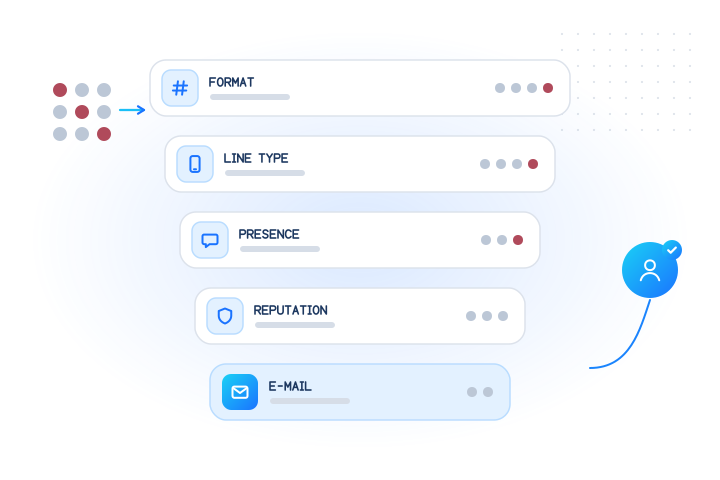
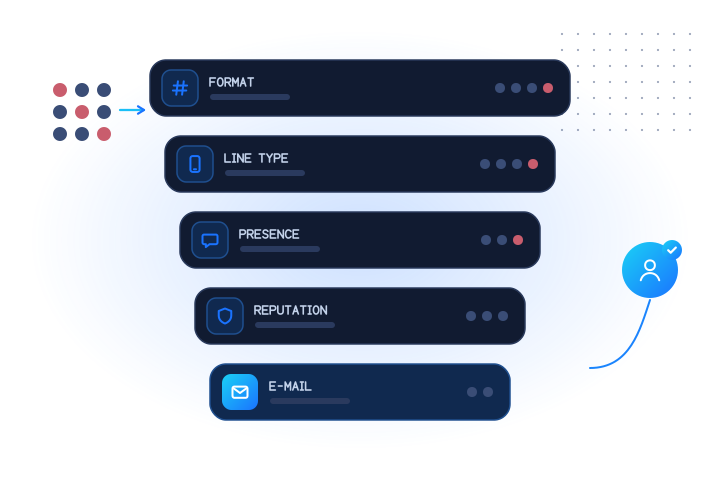
A layered sign-up defence: format, line type, messaging presence, spam reputation and e-mail checks, mapped to friction tiers you can measure.
8 min read
Fraud prevention
VoIP number detection for sign-ups: what works and what to watch out for
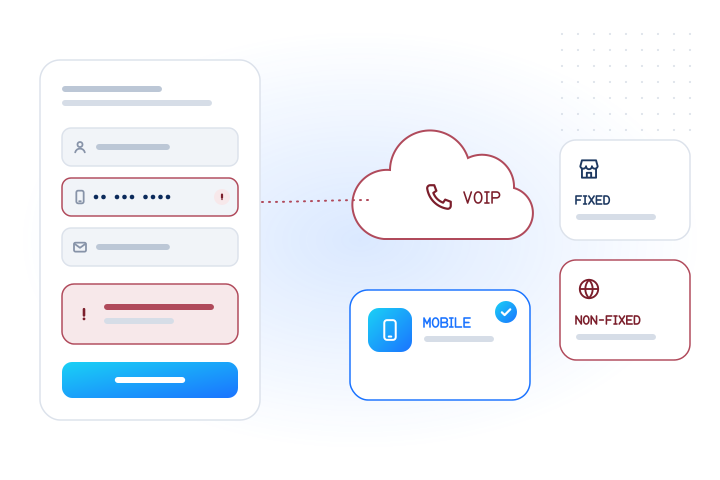
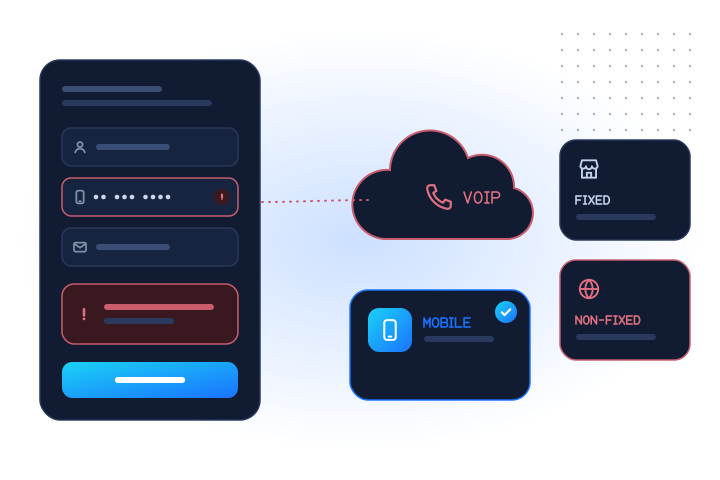
Why VoIP numbers matter at sign-up, fixed vs non-fixed VoIP, which signals detect them, and how to add friction without turning away real customers.
8 min read
Guides
How to check if a phone number has a TikTok account
Check in bulk whether numbers you hold have a TikTok account: yes, no or unknown, never a username. TikTok's phone rules, uses, $0.003 per answer, limits.
12 min read