On this page
WhatsApp usernames let people start chats without showing their phone number to new contacts, but every account is still registered to a phone number. So checking whether a number is on WhatsApp keeps working. What changes is that a business may not see a new customer's number on first contact, so match customers by identifiers they gave you with consent.
The facts below come from Meta's announcement (29 June 2026), Meta's developer documentation and Rest of World's report on India, all linked and fetched on 26 September 2026. WhatsApp is named descriptively; MobileValidate is not affiliated with WhatsApp or Meta.
What are WhatsApp usernames, and when do they launch?
A username is an optional handle you can share instead of your phone number. Meta opened reservations on 29 June 2026: "Starting this week, you can reserve a username to use later this year when we launch this feature" (Meta, 2026). You reserve one in Settings > Account > Username.
Key points from the announcement:
- Number hidden on first contact. "When you message a person or business for the first time they will no longer see your phone number, if you enabled your username."
- Optional username key. An extra code "that others will need to know to message you", to cut unwanted messages.
- No directory. "There's no directory to browse and no suggestions – people will need to know your exact username."
- Gradual rollout. Meta will roll usernames out "gradually over the coming months" and notify people in WhatsApp "when they're available in your country".
- Reserved handles. Creators, small businesses and organizations can claim their existing Instagram or Facebook username.
As of 26 September 2026, Meta had not announced a general launch date.
Timeline:
| Date | Event | Source |
|---|---|---|
| 2026-06-29 | Username reservation opens; launch "later this year" | Meta Newsroom |
| 2026-06-29 | Businesses can start reserving business usernames | Meta developer docs |
| 2026-07 | Cloud API support for sending to business-scoped user IDs planned from July 2026 | Meta developer docs |
| 2026-07-13 | Rest of World reports the Indian government's objection; WhatsApp, Telegram and Signal were asked to respond by 9 July | Rest of World |
| 2026-08-25 | Separate security update: two-step verification moves from a PIN to a password | Meta Newsroom |
Do WhatsApp accounts still need a phone number?
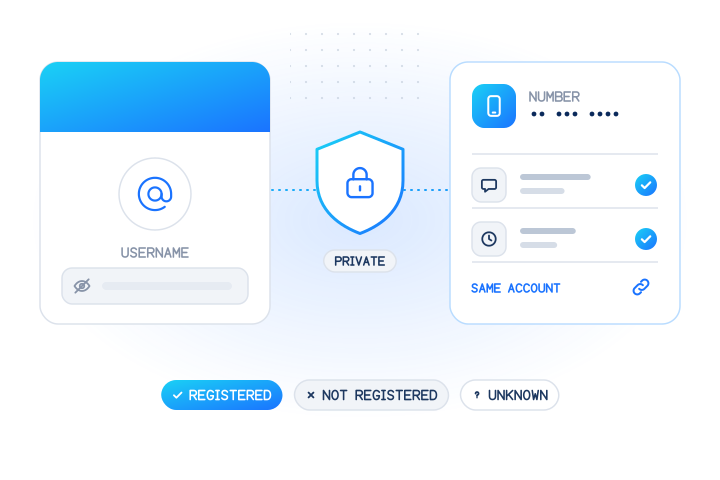
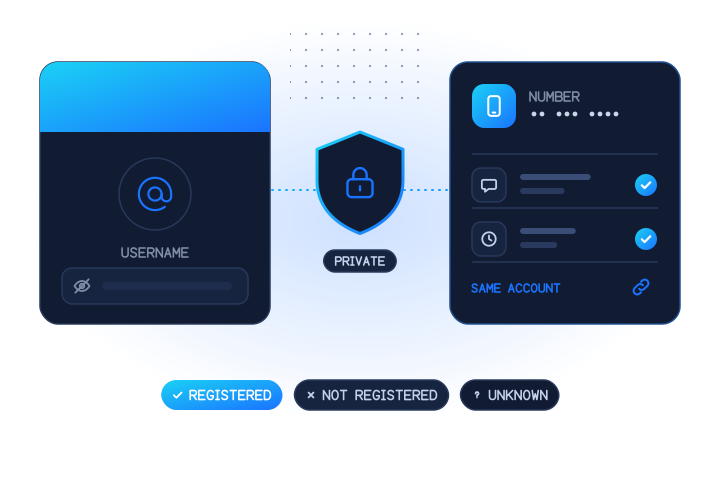
Yes. A WhatsApp spokesperson told Rest of World that "users still require a phone number to use WhatsApp" (Rest of World, 2026). Meta's own announcement describes the username as something that hides the number from new contacts, not something that replaces it.
That distinction matters. A username changes what other people see. It doesn't change how the account is registered. The account is still created and verified with a phone number, and it still belongs to that number.
Does a WhatsApp number check still work?
Yes, because it answers a different question. A number check asks: does this phone number have a WhatsApp account? Usernames don't change that answer. They only change whether the number is shown to people the user messages first.
What a check returns stays the same:
| Result | Meaning |
|---|---|
registered: true | The number has a WhatsApp account |
registered: false | The number has no WhatsApp account |
registered: null (unknown) | No conclusive answer this time; not billed |
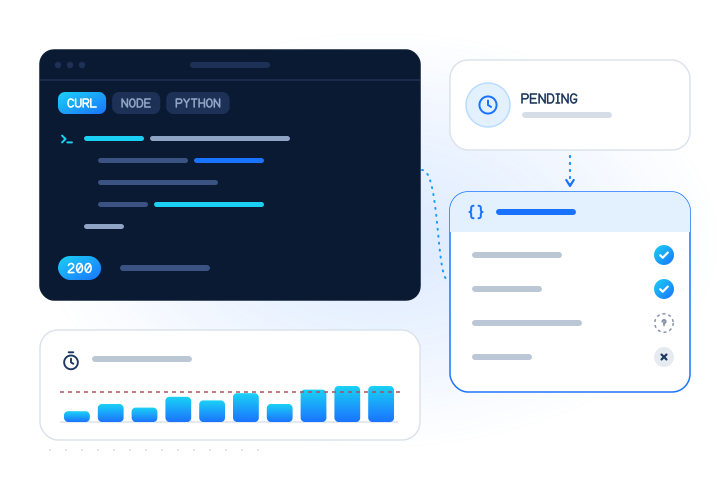
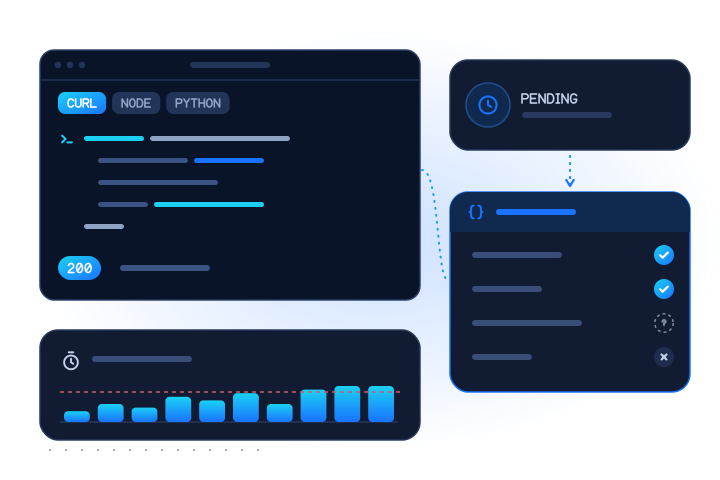
Here is the same test-mode request as before usernames, using documented test numbers:
curl https://api.mobilevalidate.com/v1/lookup \
  -H "Authorization: Bearer $MOBILEVALIDATE_API_KEY" \
  -H "Content-Type: application/json" \
  -d '{"numbers": ["+447700900001", "+447700900002", "+447700900003"], "checks": ["whatsapp"], "wait": 5}'
…001 answers registered: true, …002 registered: false, and …003 registered: null (unknown), each conclusive answer with a checked_at time. Nothing in the response mentions usernames. It never did, because the check never returns profile data.
What we won't do. There is no "find someone's username from their number" feature, and there won't be. Mapping a number to a username, name or profile is a reverse lookup, which we exclude. Usernames are designed to stop strangers from reaching people through their numbers. A tool that undid that would work against the feature and against the people it protects.
What changes for businesses messaging customers?
Businesses may see customers without seeing their numbers. Meta's developer docs describe business-scoped user IDs (BSUIDs) (Meta for Developers, 2026):
- A BSUID looks like a two-letter ISO country code, a period and up to 128 alphanumeric characters (the docs' example is
US.13491208655302741918). It is scoped to your business portfolio, so another business sees a different ID for the same person. - When a user with a username messages you, the phone number "will not be included in webhooks, unless you have interacted with the user before". The docs define that as a message or call either way within the last 30 days, checked per business phone number, or the user being in your contact book.
- Webhooks carry the BSUID in
user_id, andusernameif the user has one.wa_idis left out when the phone number isn't available. - Meta said its APIs would support sending to BSUIDs from July 2026. After that you can message users by BSUID, phone number or both. One-tap, zero-tap and copy-code authentication templates still need the phone number.
- A business that adopts a business username still shows its phone number in the app.
What changes and what doesn't, for senders:
| Area | What changes | What doesn't |
|---|---|---|
| Account existence | — | Every account is registered to a phone number, so number checks answer as before |
| First inbound message | A new customer with a username may arrive without a phone number in the webhook | Returning customers you've messaged or called from the same business number in the last 30 days still arrive with their number |
| Customer matching | You can't always join an inbound chat to your CRM by phone number | Numbers your customers gave you at sign-up or checkout are still valid identifiers |
| Outbound templates | You can address a user by BSUID once the API supports it | Templates to phone numbers you hold with consent still work |
| Pricing | — | Meta still charges per delivered template by the recipient's country (our pricing guide) |
Why did India object to usernames?
Rest of World reported on 13 July 2026 that the Indian government "has objected to the feature" (Rest of World, 2026). Its concern, as reported, was that "pseudonymous accounts could make it easier for bad actors to impersonate others and carry out scams and financial fraud". The government asked WhatsApp, Telegram and Signal to respond by 9 July, and WhatsApp reportedly sent a written response. The article's summary says the government "forced Meta to halt its global WhatsApp username rollout in its largest market".
Be careful with the details. The article refers to a "public notice" but doesn't publish the document, and we found no Meta statement confirming a halt in India. WhatsApp told Rest of World that usernames were "not yet live" and would "roll out slowly later this year". The company also said it would limit how many new people an account can contact and block repeated attempts to guess someone's username key.
For planning, assume usernames will arrive at different times in different countries, and possibly not in India for some time. Build flows that work both ways.
Do usernames reduce spam and scams?
They are designed to cut unwanted contact, but they also bring new risks, which is the argument India's government made. On the protective side, Meta lists three controls (Meta, 2026): an optional username key that senders must know, no directory to browse, and no username suggestions. WhatsApp also told Rest of World it will limit how many new people an account can contact and block repeated guessing of username keys.
On the risk side, a handle can imitate a brand or a person more easily than a phone number can. That was the Indian government's concern, as reported. For businesses, this means brand protection work: reserve your business username early (Meta lets businesses claim their Instagram or Facebook handle), and tell customers which handle and which number you really use.
Account security is changing at the same time. On 25 August 2026 Meta announced that two-step verification moves from a six-digit PIN to a full password, plus support for multiple passkeys (Meta, 2026). None of this changes what a number check returns.
What should I change in my sign-up and support flows?
Mostly small things. You don't need to replace phone numbers.
- Keep collecting the number where you need it, with a clear purpose and consent. Sign-up, delivery and account-recovery flows still rely on it.
- Store the BSUID next to the customer record when a chat arrives. Treat it as a separate key, not a replacement for the number.
- Match on what the customer tells you. If a new chat arrives without a number, ask for an order reference or the e-mail address on the account instead of guessing. Meta's docs also describe a request-contact-info button that lets the user choose to share their number.
- Don't try to unmask users. Don't build tools that turn a username or BSUID back into a number, and don't buy them.
- Keep number checks where they belong. Use them before sending to numbers you already hold, for example to choose between WhatsApp and SMS for a one-time code. The channel selection flow is unchanged.
- Update webhook parsing. Handle a missing
wa_idand readuser_idandusernamewhen present. A handler that assumeswa_idalways exists will fail on the first username chat.
Our privacy checklist for phone and e-mail checks covers consent and retention for the numbers you keep.
What are the key takeaways?
- WhatsApp usernames hide a user's phone number from new contacts. Reservations opened on 29 June 2026, with a gradual, country-by-country launch "later this year".
- Accounts still require a phone number, so a WhatsApp number check keeps answering
registered,not registeredorunknownas before. - On the Cloud API, first-contact webhooks from username users may carry a business-scoped user ID and username instead of the number.
- India's government objected to usernames, and Rest of World (13 July 2026) summarised this as a halt of the rollout in India. Plan for different timing by country.
- We don't offer number-to-username lookups, and you shouldn't build them. Match customers on identifiers they gave you.
Sources
- It's Time to Reserve Your WhatsApp Username (29 June 2026) — Meta Newsroom, 2026
- India's crackdown on a new WhatsApp feature risks setting a global precedent (13 July 2026) — Rest of World, 2026
- Business-scoped user IDs (WhatsApp Business Platform documentation, fetched 26 September 2026) — Meta for Developers, 2026
- New Account Security Features for WhatsApp (25 August 2026) — Meta Newsroom, 2026
Frequently asked questions
When do WhatsApp usernames launch?
Meta opened username reservations on 29 June 2026 and said the feature would launch later in 2026, rolling out gradually country by country with an in-app notice when it reaches you. In India the government objected to the feature and asked WhatsApp to explain it, Rest of World reported on 13 July 2026.
Do you still need a phone number to use WhatsApp with a username?
Yes. A WhatsApp spokesperson told Rest of World that users still require a phone number to use WhatsApp. A username hides the number from people you message for the first time; it doesn't replace the number the account is registered to.
Does a WhatsApp number check still work after usernames?
Yes. A number check asks whether a phone number has a WhatsApp account, and every account is still registered to a number. The answer stays registered, not registered or unknown. Usernames change what other people see, not whether the account exists.
Can I find someone's WhatsApp username from their phone number?
Not with MobileValidate, and we don't offer it. Mapping a number to a username or profile is a reverse lookup, which we exclude. Our check only says whether the number has an account.
What changes for businesses on the WhatsApp Cloud API?
Meta's developer docs describe business-scoped user IDs (BSUIDs). When a user who has a username messages you for the first time, the webhook may carry a BSUID and the username instead of the phone number, and the wa_id field is left out when the number isn't available.
Related services and guides
More from the blog
All articlesDevelopers
How to check if a phone number is on WhatsApp with an API
How a WhatsApp registration check works, what registered, not registered and unknown mean, and how to call it responsibly from cURL, Node and Python.
9 min read
Guides
Messaging-app registration checks: a guide for every app
What a registration check tells you for WhatsApp, Telegram, Viber, Signal, iMessage, RCS, LINE, Zalo and more: modes, unknowns, billing and consent.
9 min read
Guides
A privacy checklist for phone and e-mail checks
A practical GDPR-oriented checklist for phone and e-mail checks: purpose, lawful basis, minimisation, retention, objections, rights, DPAs and logging.
9 min read