On this page
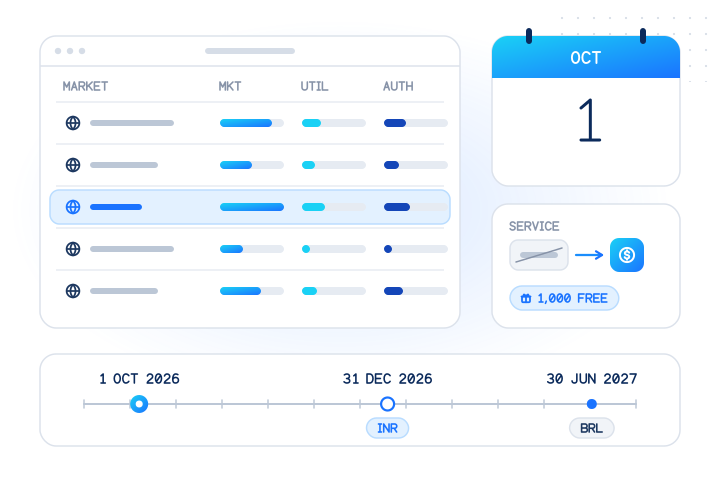
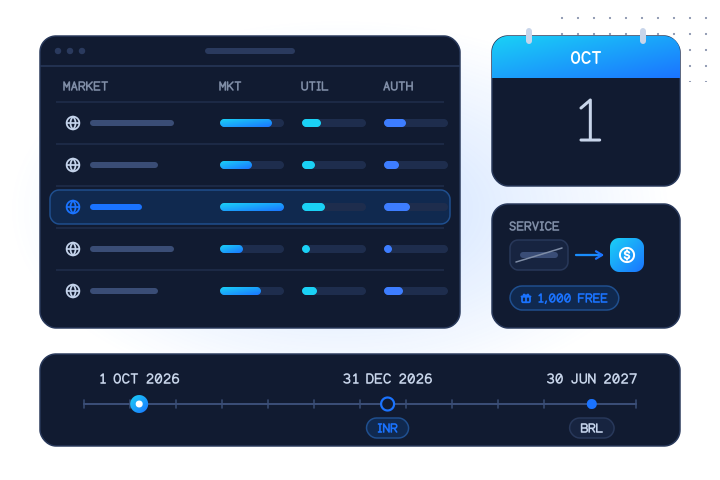
Since 1 July 2025, WhatsApp charges businesses per delivered template message, priced by category (marketing, utility, authentication) and by the recipient's country. On 1 October 2026 rates changed in 17 markets and regions, and service messages became chargeable. Businesses billed from India must switch to rupee billing by 31 December 2026.
All rates below are Meta's USD list rates from the official rate cards, downloaded on 25 September 2026. Your volume tier, billing currency and partner fees can change what you pay. WhatsApp and Meta are named descriptively; MobileValidate is not affiliated with either.
How does WhatsApp per-message pricing work in 2026?
You pay for each delivered template message. Meta's pricing page says you are "only charged when a template message is delivered", and that rates vary by "the template's category and the recipient WhatsApp phone number's country calling code" (Meta, 2026).
Four things set the price of a message:
| Factor | What it means |
|---|---|
| Category | Marketing, utility or authentication, set when the template is approved. From 1 October 2026, service messages also have a rate. |
| Recipient market | The calling code of the recipient's number. On the October 2026 card, 39 markets have their own rate; the rest fall into regions such as "Rest of Africa" or "Other". |
| Volume tier | Utility and authentication get lower rates at higher monthly volumes, per market. Only these two categories have tiers. |
| Authentication-international | A higher authentication rate for large senders based outside the recipient's country. |
The model replaced conversation-based pricing on 1 July 2025. Meta may only change rates on the first day of a quarter (1 January, 1 April, 1 July, 1 October), with at least one month's notice for a rate change and six months for a change of pricing model (Meta, 2026).
Some messages stay free. All messages sent inside an open free entry point window are free for 72 hours, templates included (Meta's page explains when that window opens). Messages from users are never charged.
What does a WhatsApp message cost by country?
Here are list rates from the USD rate card effective 1 October 2026 for common markets (Meta rate card, 2026). Utility, authentication and service share one rate in every market on this card.
| Market | Marketing | Utility / authentication / service | Authentication-international |
|---|---|---|---|
| India | 0.0118 | 0.0014 | 0.0304 |
| Brazil | 0.0625 | 0.0068 | — |
| Indonesia | 0.0411 | 0.0250 | 0.1360 |
| Mexico | 0.0397 | 0.0085 | — |
| Nigeria | 0.0516 | 0.0067 | 0.0750 |
| United Kingdom | 0.0635 | 0.0220 | — |
| Germany | 0.1365 | 0.0550 | — |
| North America (US, Canada) | 0.0250 | 0.0034 | — |
| Rest of Western Europe | 0.0592 | 0.0171 | — |
| Other (unlisted countries) | 0.0604 | 0.0077 | — |
Across the October card, marketing ranges from $0.0109 (Turkey) to $0.1597 (Netherlands). Utility and authentication range from $0.0008 (Colombia) to $0.0550 (Germany). The full card for every market and both quarters is in our dataset, WhatsApp rate-card history (CSV and JSON, CC BY 4.0).
What changed on 1 October 2026?
Three kinds of change took effect, all announced on Meta's pricing page (Meta, 2026):
- Rate changes. Marketing went up in Mexico, Saudi Arabia, the UAE, Rest of Middle East and Rest of Asia Pacific. Utility and authentication went up in Pakistan, Peru and South Africa.
- Nine new standalone markets. Bangladesh, Iraq, Kazakhstan, Kuwait, Morocco, Nepal, Oman, Sri Lanka and Ukraine left their regional groups. Each now has its own rates, its own volume tiers and a new authentication-international rate.
- Service and in-window utility messages became chargeable (next sections).
Comparing the two official cards line by line, these are the rate changes for markets that existed on both:
| Market | Category | 1 July 2026 | 1 October 2026 | Change |
|---|---|---|---|---|
| Mexico | Marketing | 0.0305 | 0.0397 | +30% |
| Saudi Arabia | Marketing | 0.0501 | 0.0576 | +15% |
| United Arab Emirates | Marketing | 0.0499 | 0.0576 | +15% |
| Rest of Asia Pacific | Marketing | 0.0732 | 0.0842 | +15% |
| Rest of Middle East | Marketing | 0.0341 | 0.0392 | +15% |
| Pakistan | Utility and authentication | 0.0100 | 0.0150 | +50% |
| Peru | Utility and authentication | 0.0200 | 0.0300 | +50% |
| South Africa | Utility and authentication | 0.0076 | 0.0095 | +25% |
The new standalone markets moved in both directions. Utility and authentication in Sri Lanka ($0.0020), Nepal ($0.0034) and Bangladesh ($0.0037) are now below the Rest of Asia Pacific rate ($0.0113). Kuwait ($0.0440), Oman ($0.0247) and Morocco ($0.0230) are now above their former regional rates ($0.0091 for Rest of Middle East, $0.0040 for Rest of Africa).
India, Brazil, Indonesia, the UK, Germany and North America had no rate changes on the October card.
Which messages became chargeable on 1 October 2026?
Two message types that used to be free now cost money (Meta, 2026):
- Service messages. These are free-form replies inside the 24-hour customer service window. From 1 October 2026 they are charged "with rates the same as those of utility and authentication, by market". Each business phone number gets a free tier of 1,000 delivered service messages per month, shared by one-to-one and group sends. Unused messages don't roll over.
- Utility templates sent in response to users. These are order updates or receipts sent while the service window is open, free since 1 July 2025 and charged from 1 October 2026.
Meta adds one operational warning. Without a payment method on the account, service messages are delivered only within the free tier, and later ones are not delivered at all.
The change is visible in your webhooks. For messages over the free tier, the pricing object on status webhooks changes from "type": "free_customer_service" to "type": "regular" with "billable": true. If your cost reports assume every service message is free, update them before the October invoice.
What is the authentication-international rate?
It is a higher authentication rate for big senders messaging users in another country. Meta's rules (Meta, 2026):
- You become eligible if you send "more than 750K messages outside of customer service windows in a moving 30-day period" to markets that have the rate.
- You get 30 days' notice before the rate applies.
- You always pay the normal authentication rate in the country of your primary business location.
Until 30 September 2026, nine markets had the rate: Egypt, India, Indonesia, Malaysia, Nigeria, Pakistan, Saudi Arabia, South Africa and the UAE. From 1 October 2026 the nine new standalone markets add their own, so up to 18 markets count, and eligibility has been measured across all 18 since 1 September 2026.
The gap can be large. Sri Lanka's authentication rate is $0.0020, but its authentication-international rate is $0.1440, 72 times higher. In India the two rates are $0.0014 and $0.0304. A global app sending codes to South Asia should model both.
What changes for India and Brazil billing in 2027?
WhatsApp billing in local currency becomes mandatory for eligible businesses in both countries (Meta, 2026):
| India (INR) | Brazil (BRL) | |
|---|---|---|
| Who is affected | Solution providers and directly integrated businesses whose Sold-To country in Billing Hub is India | The same, with Sold-To country Brazil |
| Local billing available since | 1 January 2026 | 1 July 2026 (all eligible accounts from 16 July 2026) |
| Migrate all messaging accounts by | 31 December 2026 | 30 June 2027 |
| From this date, messages from non-local-currency accounts are not delivered | 1 January 2027 | 1 July 2027 |
| Invoiced by | Not stated on the pricing page | Facebook Brasil, Meta's local entity |
Meta offers a Currency Migration API (available since 1 June 2026) to move accounts. Local-currency rate cards are published next to the USD cards.
What this means in practice: if you send WhatsApp messages as an India-billed business, the migration is not optional, and missing it stops delivery. Put it in your Q4 plan, check each messaging account in your business portfolio, and confirm that your solution provider has migrated its side.
How has the rate card changed over time?
Meta's page lists earlier updates in its "Previous rate card updates" section. The main ones since the per-message model began:
| Effective | Change (as described by Meta) |
|---|---|
| 1 July 2025 | Per-message pricing replaces conversations; lower utility and authentication rates in several markets; volume tiers introduced |
| 1 October 2025 | Colombia utility and authentication up; Mexico marketing down; UAE marketing up; Argentina, Egypt, Saudi Arabia utility and authentication down |
| 1 January 2026 | India marketing up; France and Egypt marketing down; North America utility and authentication down |
| 1 April 2026 | Saudi Arabia marketing up; India authentication-international up; Pakistan utility and authentication up; Turkey utility and authentication down; 8 new billing currencies |
| 1 July 2026 | Six markets become standalone (Hong Kong, Hungary, Poland, Qatar, Romania, Singapore); Italy, Spain and UK marketing up |
| 1 October 2026 | The changes described above, plus service and in-window utility charging |
The pattern is steady: one change set per quarter, markets moving out of regional groups, and authentication-international spreading. Budget for a review every quarter, not once a year.
How do I estimate my monthly WhatsApp bill?
Multiply each category's volume by the share that gets delivered and the market rate, then add service messages above the free tier:
Monthly cost per market = Σ (templates sent × delivered share × rate) + max(0, service messages − 1,000 per phone number) × service rate
A worked example for one business phone number sending to Brazil in a month, using October list rates (before any volume-tier discount), with every message delivered:
| Line | Volume | Rate (USD) | September 2026 | October 2026 |
|---|---|---|---|---|
| Authentication templates | 100,000 | 0.0068 | $680.00 | $680.00 |
| Utility templates outside the window | 40,000 | 0.0068 | $272.00 | $272.00 |
| Utility templates inside the window | 10,000 | 0.0068 | $0.00 (free) | $68.00 |
| Marketing templates | 20,000 | 0.0625 | $1,250.00 | $1,250.00 |
| Service messages | 30,000 | 0.0068 | $0.00 (free) | $197.20 (29,000 billed) |
| Total | $2,202.00 | $2,467.20 |
The same traffic costs 12% more in October with no rate change for Brazil. The whole difference comes from the two newly charged message types. The volumes are illustrative. Replace them with your own, per market, and apply your volume tier from Meta's tier files.
The delivered share matters for forecasting. If 8% of the numbers you message have no WhatsApp account, those messages aren't delivered or charged, and your WhatsApp bill is 8% lower than a naive forecast. But those users still need your message through SMS or e-mail, which has its own price.
How does checking numbers first help with cost?
Honestly, it doesn't lower Meta's bill: undelivered messages are already free. It lowers the cost around the message:
- No wasted fallback time. A one-time code sent to a number without WhatsApp fails first, and only then does your SMS go out. The user waits, and some give up.
- No double sends. Teams that fire SMS on a timer, "just in case", pay for both channels when both arrive.
- Better forecasts. Knowing the share of your list that is on WhatsApp gives you the delivered share for the formula above, per market.
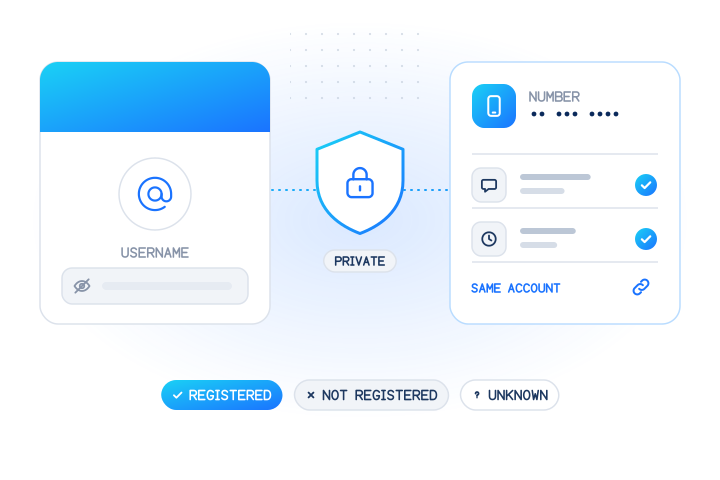
MobileValidate's whatsapp check returns registered: true, false or null (unknown) with a checked_at time. Here's a test-mode request with documented test numbers:
curl https://api.mobilevalidate.com/v1/lookup \
  -H "Authorization: Bearer $MOBILEVALIDATE_API_KEY" \
  -H "Content-Type: application/json" \
  -d '{"numbers": ["+447700900001", "+447700900002", "+447700900003"], "checks": ["whatsapp"], "wait": 5}'
In test mode …001 is registered, …002 is not registered and …003 is unknown. Route true to WhatsApp, false straight to SMS, and null to your default flow. Never block a user on an unknown. The check has a real-time and a lower bulk price (see pricing for current prices), and unknown results and cache hits are free. The check isn't free, so it pays off when it saves a fallback delay or a duplicate send, not on Meta's bill. For the one-time code case, see WhatsApp OTP vs SMS OTP, which works out cost per verified user.
What should I do before the next rate card?
Meta can change rates only on 1 January, 1 April, 1 July and 1 October, and it publishes upcoming cards on the pricing page ahead of time. A short routine each quarter keeps surprises off the invoice:
- Download the upcoming card from the "Updates to rate cards" section when it appears, and diff it against the current one by market and category. Our dataset does this for the USD cards.
- Re-run your forecast per market with your real volumes, delivered share and volume tier.
- Check your template categories. Meta charges the category applied to a template when it is used, and businesses are responsible for reviewing it. A utility template recategorised as marketing can cost several times more; in Brazil the October list rates are $0.0068 and $0.0625.
- Watch authentication-international eligibility if you send codes across borders at scale. Meta gives 30 days' notice.
- Confirm billing currency for India (INR by 31 December 2026) and Brazil (BRL by 30 June 2027).
- Update webhook-based cost reports for new pricing types. The October change moved service and in-window utility messages to
"billable": true.
How was the rate-card dataset built?
We downloaded Meta's official USD rate cards on 25 September 2026 from the links on the pricing page. The card effective 1 July 2026 is a CSV and the card effective 1 October 2026 is an XLSX, which we read with openpyxl. We transcribed each market's rates as published, to four decimal places, with n/a recorded as empty. Then we compared the two cards market by market to fill change_vs_previous. Rows for sanctioned countries, which MobileValidate doesn't serve, are left out: the dataset has 38 of the card's 39 standalone markets.
Limits:
- List rates only. Volume tiers are in separate files and are not included.
- The history starts on 1 July 2026. Earlier cards are shared as expiring download links, and we couldn't retrieve them from a primary source. The table of earlier changes above is Meta's own description, not our numbers.
- Quarterly updates. We add each new card when Meta publishes it.
Download: /datasets/whatsapp-rate-card-history (83 rows).
What are the key takeaways?
- WhatsApp charges per delivered template message by category and recipient market. The October 2026 USD card runs from $0.0008 (Colombia utility and authentication) to $0.1597 (Netherlands marketing).
- On 1 October 2026, rates changed in 8 existing markets and regions, 9 markets became standalone with authentication-international rates, and service and in-window utility messages became chargeable. There is a free tier of 1,000 service messages per phone number per month.
- India-billed businesses must be on INR billing by 31 December 2026, or messages stop on 1 January 2027. Brazil's BRL deadline is 30 June 2027.
- Forecast with delivered share × rate per market, plus service messages above the free tier. Review every quarter.
- Checking numbers first doesn't cut Meta's bill, because undelivered messages are free. It cuts fallback delay and double sends.
Sources
- Pricing on the WhatsApp Business Platform (page updated 10 September 2026; fetched 25 September 2026) — Meta for Developers, 2026
- Cost per message in USD on the WhatsApp Business Platform, effective July 1, 2026 (CSV rate card) — Meta, 2026
- Cost per message in USD on the WhatsApp Business Platform, effective October 1, 2026 (XLSX rate card) — Meta, 2026
- Authentication-international rates (fetched 26 September 2026) — Meta for Developers, 2026
- WhatsApp Business Platform rate cards (USD), 2026-07 and 2026-10 (dataset, CC BY 4.0) — MobileValidate, 2026
Frequently asked questions
How much does a WhatsApp Business API message cost in 2026?
Meta charges per delivered template message, by category and by the recipient's country calling code. On the USD rate card effective 1 October 2026, an authentication message costs $0.0014 in India, $0.0068 in Brazil, $0.0220 in the United Kingdom and $0.0550 in Germany; marketing messages cost more, from $0.0109 (Turkey) to $0.1597 (Netherlands).
Are WhatsApp service messages still free?
Not entirely. From 1 October 2026 Meta charges service messages at the same rate as utility and authentication messages in each market, after a monthly free tier of 1,000 delivered service messages per business phone number. Utility templates sent inside an open 24-hour customer service window are also charged from that date.
What is the WhatsApp INR billing deadline for India?
Businesses whose Sold-To country in Meta's Billing Hub is India must move all their WhatsApp messaging accounts to INR billing by 31 December 2026. From 1 January 2027 Meta will no longer deliver messages from their non-INR accounts. Brazil follows with BRL: migrate by 30 June 2027, enforcement from 1 July 2027.
Do I pay for a WhatsApp message to a number that isn't on WhatsApp?
No. Meta charges only for delivered messages, and a message to a number without a WhatsApp account is not delivered. The cost shows up elsewhere: the wait before your SMS fallback and any duplicate sends.
Can I download the WhatsApp rate cards as data?
Yes. Our dataset lists every market's USD list rates for the rate cards effective 1 July and 1 October 2026, by category, with the change between them. It is free under CC BY 4.0 at /datasets/whatsapp-rate-card-history.
Related services and guides
More from the blog
All articlesDeliverability
WhatsApp OTP vs SMS OTP: cost per verified user, with a calculator
WhatsApp authentication rates vs SMS prices by country, the October 2026 changes, and a calculator for cost per verified user including SMS fallback.
8 min read
Developers
How to check if a phone number is on WhatsApp with an API
How a WhatsApp registration check works, what registered, not registered and unknown mean, and how to call it responsibly from cURL, Node and Python.
9 min read
Guides
WhatsApp usernames: what changes, and what doesn't, for checking a number
WhatsApp usernames hide phone numbers from new contacts, but accounts still sit on a number. What changes for businesses, the Cloud API and number checks.
7 min read