On this page
A non-fixed VoIP number is a phone number delivered over the internet that can be used from more than one location, usually through an app on a phone or laptop. People use them for business lines, remote work, second numbers and privacy, and fraudsters use them because they are quick to create. To tell whether a number is VoIP, run a line type lookup on the specific number rather than guessing from its prefix.
What is a non-fixed VoIP number?
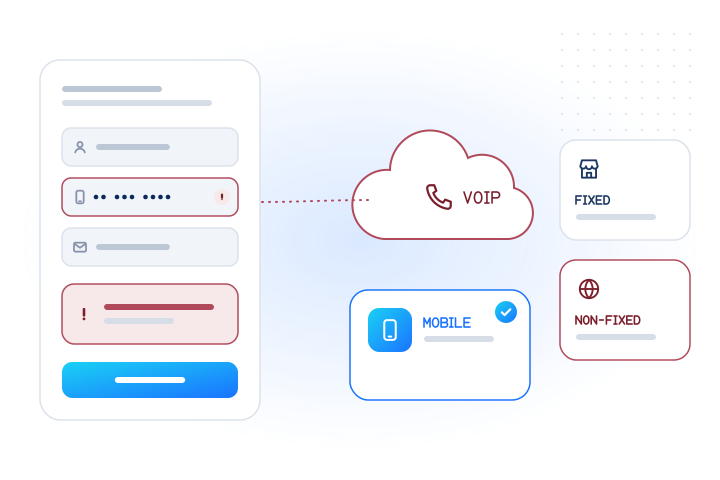
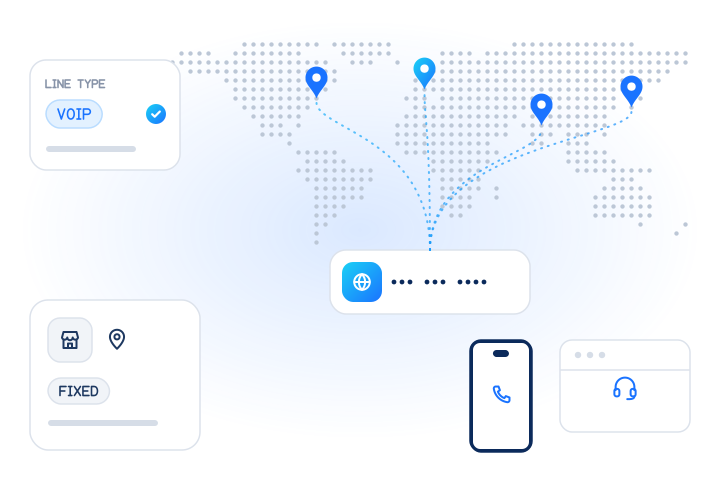
A non-fixed VoIP number is a number from an internet calling service that isn't tied to one address or one SIM card. You sign in to an app or a softphone and the number rings wherever you are, on any device with a data connection.
The term comes from US emergency-calling rules. The FCC defines an interconnected VoIP service as one that enables "real-time, two-way voice communications", requires "a broadband connection from the user's location" and IP-compatible equipment, and lets users receive calls from and place calls to the ordinary telephone network (47 CFR 9.3). Its 911 rules then split that service in two. Providers of fixed interconnected VoIP "must provide automated dispatchable location with each 911 call". Non-fixed service is defined as "service that is capable of being used from more than one location" (47 CFR 9.11).
That location rule explains the practical difference. A fixed VoIP line sits at a known address, so the provider can send that address with an emergency call. A non-fixed line moves with its user, so the provider must ask for a registered location, offer a way to update it, and detect when a 911 call comes from somewhere else (47 CFR 9.11). These FCC rules apply in the US. Other regulators use their own terms, and some countries set aside separate number ranges for nomadic internet telephony.
Our VoIP number glossary entry has the short version.
How do non-fixed VoIP, fixed VoIP and mobile numbers differ?
| Mobile | Fixed VoIP | Non-fixed VoIP | |
|---|---|---|---|
| Delivered over | Mobile network, to a SIM or eSIM | Broadband line at one address | Any internet connection |
| Tied to | A SIM and an operator contract | A street address | An online account |
| Typical device | Phone | Desk phone or home router | App on phone or computer, softphone |
| Setup effort | SIM, often an identity check | Installation or a service order | Often minutes, online |
| Can be released quickly | Rarely | Rarely | Often |
| SMS support | Standard | Varies | Varies by provider |
| US 911 location rule | Separate wireless rules | Automated dispatchable location | Registered location, updated when it changes |
Two rows matter most for anyone checking numbers. Setup effort decides how cheaply someone can get many numbers. SMS support decides whether your one-time passcode will arrive. Neither says anything about whether the person behind a number is honest.
What is a non-fixed VoIP number used for?
Far more legitimate uses than suspicious ones:
- Business lines for distributed teams. Cloud phone systems give every employee a number that rings on their laptop and phone, at home or in the office.
- Call centres and support desks. Agents working from home take calls on the company's numbers without a desk phone.
- A second number. Freelancers, small sellers and landlords keep work calls separate from their personal mobile.
- Travel and relocation. Someone who moves abroad keeps a home-country number so banks and family can still reach them.
- Privacy. People share a secondary number on marketplaces or dating apps instead of their personal mobile.
- Software and devices. Alarm panels, appointment systems and voice bots place calls from VoIP numbers.
The same properties are attractive for abuse. Numbers that can be created online in minutes and released just as fast suit fake account creation, promotion and free-trial abuse, marketplace scams and robocalling. The OTP and sign-up fraud use case and our guide to OTP fraud prevention checks cover those patterns in detail.
The honest summary: a VoIP line type is a fact about the number, not a judgement about its owner.
How can you tell if a number is VoIP?
There are three ways, and only one is reliable.
Can you tell from the digits?
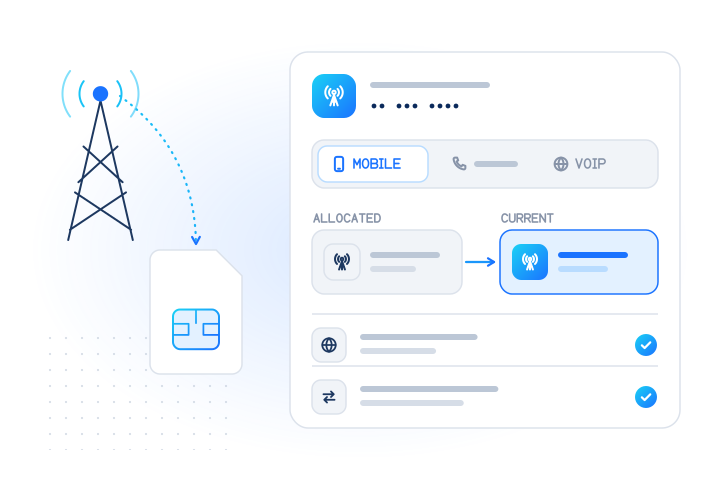
Rarely. A few countries put internet telephony in dedicated "nomadic" ranges, so the prefix gives it away. In many others, VoIP numbers sit in ordinary geographic ranges next to landlines. In the US and Canada, numbers can be ported from a mobile or landline provider to a VoIP provider and back. A regex or a numbering-plan library tells you what a range was allocated for, not what serves the number today. Our guide to carrier and line type lookups explains why the allocated range and the current line can differ.
Can you ask the user?
You can, but people don't always know, and anyone abusing your form won't say.
What does a line type lookup show?
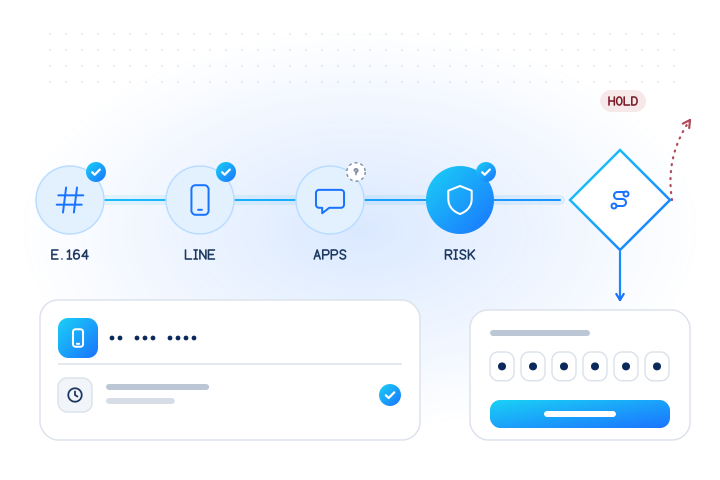
A line type lookup checks the specific number against current carrier data and returns what kind of line it is. MobileValidate's carrier lookup returns line_type (mobile, fixed_line, voip, toll_free and others), the current carrier, and the original_carrier when the number has been ported. For US and Canadian numbers, where porting to VoIP providers is common, the US/CA carrier lookup is the more specific option. The line type glossary entry explains each value.
Here is a real-time check from the command line. With a test key, +447700900001 returns fixed test data; see test mode.
curl https://api.mobilevalidate.com/v1/lookup \
  -H "Authorization: Bearer $MOBILEVALIDATE_API_KEY" \
  -H "Content-Type: application/json" \
  -d '{"numbers": ["+447700900001"], "checks": ["carrier"]}'
The part of the answer you act on is results[0].checks["network.carrier"]:
{
  "status": "completed",
  "registered": true,
  "attributes": {"line_type": "mobile", "carrier": "Test Carrier", "country": "GB"},
  "checked_at": "2026-09-25T14:25:31.270Z",
  "billed": false,
  "reason": null
}
In live mode, a number we hold no data for returns status: "unknown" with reason NO_DATA and is not charged. Real-time carrier lookups cost $0.002 per number and bulk lookups $0.001 at the time of writing; the pricing page is always current.
Can a lookup tell fixed from non-fixed VoIP?
Usually not directly, and you should be wary of any tool that claims to everywhere. Most carrier data, ours included, reports voip without a fixed or non-fixed flag. Two things help in practice:
- The carrier name. A cable or broadband operator's home-phone service suggests fixed VoIP. A provider known for app-based numbers suggests non-fixed.
- Your own context. A sign-up from a mobile app, at 3 a.m. local time, with a fresh e-mail address, reads differently from a customer's office number entered on an invoice form.
For approved customers, the spam reputation check (limited access) also returns a voip_range hint when a number's range belongs to a VoIP carrier. It is shown for context and adds no points to the risk score, which is the right weight for it.
What are the risks of non-fixed VoIP numbers at sign-up?
The risks are real but specific:
| Risk | Why VoIP makes it easier | Proportionate response |
|---|---|---|
| Multiple accounts per person | Many numbers can be created per account holder | Limit benefits per payment method or device, not only per number |
| Free-trial and credit abuse | Numbers are cheap to cycle | Add a step for VoIP numbers on high-value offers |
| OTP delivery failure | Some VoIP providers filter or don't support SMS | Offer e-mail, authenticator app or passkey |
| Account recovery hijack | A released number can be re-registered by someone else | Don't rely on SMS alone for recovery |
| Marketplace and romance scams | A throwaway number hides the scammer's mobile | Combine with account age, behaviour and reports |
What doesn't work is a blanket block. It turns away remote workers, small businesses and travellers, and abusers simply move to another kind of number. Most teams do better with friction by context: accept VoIP numbers for low-risk actions, and ask for one more signal (an e-mail check, a card, a passkey, a manual review) where the value at stake is high. Our VoIP number detection guide gives a full decision table and expected false-positive rates, and how to reduce fake sign-ups shows how line type fits next to other checks.
How do you use VoIP detection responsibly?
Check numbers only for a purpose your users would expect, such as securing their account or getting their messages delivered. Don't use line type to decide eligibility for credit, housing, employment or insurance; our acceptable use policy forbids that. Explain an extra step in neutral terms ("we need one more check for this offer"), never "your number looks suspicious". People can object to checks of their number through the opt-out form.
Key takeaways
- A non-fixed VoIP number is an internet phone number that works from more than one location, usually through an app. US rules define it by exactly that property.
- Fixed VoIP is tied to an address; mobile numbers are tied to a SIM. Non-fixed numbers are tied only to an online account, so they are quick to create and release.
- Most uses are legitimate: business lines, remote work, second numbers, travel and privacy. The same speed makes them attractive for fake sign-ups.
- To tell if a number is VoIP, use a line type lookup on the specific number. Prefixes and regexes can't see porting or VoIP in geographic ranges.
- Most data reports
voipwithout a fixed or non-fixed flag; the carrier name and your context fill the gap. - Add proportionate friction for VoIP numbers on high-value actions instead of blocking them. Unknown lookup answers are free and should count as "no evidence".
Sources
- 47 CFR 9.3 Definitions (interconnected VoIP service) — US Code of Federal Regulations, via Cornell LII, 2026
- 47 CFR 9.11 E911 Service (paragraph (b)(4): fixed and non-fixed interconnected VoIP) — US Code of Federal Regulations, via Cornell LII, 2026
Frequently asked questions
What is a non-fixed VoIP number?
A phone number served by an internet calling service that can be used from more than one location, usually through an app on a phone or computer. It isn't tied to a street address or a SIM card, unlike fixed VoIP and mobile numbers.
What is a non-fixed VoIP number used for?
Mostly for ordinary things: business lines for remote teams, a second number for work or selling online, keeping a home-country number while abroad, call-centre agents working from home, and privacy when sharing a number with strangers. Because they are quick to create, they are also used for fake sign-ups and scams.
How can I tell if a phone number is VoIP?
Run a line type lookup against current data for that specific number. The prefix alone is unreliable, because many VoIP numbers sit in ordinary geographic ranges and numbers can be ported between mobile, landline and VoIP providers.
Can a lookup tell fixed from non-fixed VoIP?
Usually not directly. Most line type data, including ours, reports voip without saying whether it is fixed or non-fixed. The carrier name and your own context, such as whether the user signed up through an app, often suggest which kind it is.
Can non-fixed VoIP numbers receive SMS codes?
Many can, some can't, and some services filter business messages to them. Delivery depends on the provider. If codes often fail for VoIP numbers in your data, offer e-mail, an authenticator app or a passkey as an alternative.
Should I block non-fixed VoIP numbers at sign-up?
Usually not outright. Many real customers use them. Treat a VoIP result as a reason for a proportionate extra step where the risk is high, such as a free trial with valuable credits, rather than as proof of fraud.
Related services and guides
More from the blog
All articlesFraud prevention
VoIP number detection for sign-ups: what works and what to watch out for
Why VoIP numbers matter at sign-up, fixed vs non-fixed VoIP, which signals detect them, and how to add friction without turning away real customers.
8 min read
Fraud prevention
OTP fraud prevention: the checks to run before you send a code
A practical pre-send pipeline for one-time passcodes: normalize, check line type, messenger presence and reputation in one request, then decide.
8 min read
Guides
Carrier and line type lookup, explained
What carrier and line type data is, allocated vs current network, how porting changes it, and how to read every field of a carrier lookup answer.
8 min read