

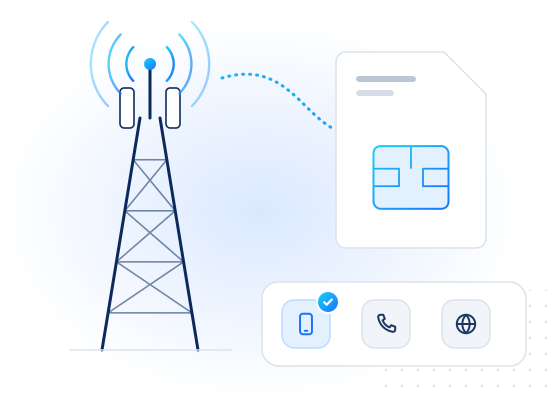
A local routing number (LRN), formally the Location Routing Number, is a 10-digit number that identifies the switch of the carrier currently serving a phone number in the US and Canada. When a number is ported to a new carrier, the national portability database records the new carrier's LRN against it. Networks look up that LRN before routing a call or text, so traffic reaches the right carrier even though the number's digits never changed.
How does LRN routing work?
North American numbers are handed out in blocks identified by area code and exchange (NPA-NXX). Before portability, the block told every network where to send a call. Once people could keep their number when switching carriers, networks needed a per-number lookup.
- Porting. When a customer moves, the new carrier updates the Number Portability Administration Center (NPAC) database for the US and Canada. The entry maps the ported number to the new carrier's LRN, which looks like an ordinary 10-digit number but points to a switch.
- Distribution. Carriers keep synchronized local copies of the database.
- The query ("dip"). Before handing off a call, the network queries the database. FCC rules put that duty on the "N-1" carrier: "Each designated N-1 carrier (…) is responsible for ensuring number portability queries are performed on a N-1 basis where 'N' is the entity terminating the call to the end user" (47 CFR 52.26).
- Routing. The call is routed on the LRN and delivered with the dialled number preserved, so the new carrier knows which customer to ring.
The same rules adopt the North American Numbering Council's portability architecture. Wireless portability followed wireline in November 2003 in the 100 largest US metropolitan areas and in May 2004 in the rest of the country (FCC). Canada introduced wireless portability from 14 March 2007 under CRTC Telecom Decision 2005-72. The NPAC also holds numbers from thousands-block pooling, where a carrier receives 1,000 numbers of another carrier's exchange, so even never-ported numbers can live somewhere their prefix doesn't suggest.
Why does a prefix-based carrier lookup go wrong?
A lookup that maps NPA-NXX to a carrier returns the carrier the block was assigned to. For a ported or pooled number, that is the wrong answer: a number that moved from a mobile carrier to a VoIP or cable provider still looks like the original mobile carrier. Numbers can also move between landline, wireless and VoIP services, so the prefix can misstate the line type too. See why carrier lookups go wrong.
Why does it matter for deliverability and fraud?
- SMS routing and cost. US messaging routes, 10DLC throughput and some wholesale rates depend on the destination carrier. Routing on a stale carrier sends traffic down the wrong path.
- Line type. A number ported from wireless to VoIP needs different handling for SMS and for consent rules.
- Fraud. A recent port-out can be a sign of account takeover. FCC rules adopted in November 2023 require US wireless carriers to authenticate customers before a port-out and to notify them of port-out requests. See SIM swap.
How does MobileValidate use portability data?
Our US and Canada carrier lookup returns the current carrier and line type of North American numbers, following ports rather than the prefix. It runs in bulk jobs, and numbers outside the US and Canada are unsupported_country and free. We return the carrier and line type, not the raw routing number. For other countries, the carrier lookup returns original_carrier when a number has moved. Background: mobile number portability.
Frequently asked questions
What is an LRN lookup?
It is a query to a copy of the US and Canadian number-portability database that returns the routing number for a ported or pooled phone number. The LRN points to the switch of the carrier that serves the number today, so it tells you the current network rather than the original one.
Is the LRN the same as the phone number?
No. The LRN is a separate 10-digit number that belongs to a switch of the serving carrier. Many ported numbers share the same LRN. The customer's own number doesn't change.
Why is the carrier from a number prefix wrong for ported numbers?
The prefix (NPA-NXX) only shows which carrier the block was first assigned to. After a port the number keeps its digits but moves to another carrier, so only a portability query shows where it lives now.