On this page
Silent network authentication confirms that the number a user typed belongs to the SIM in their phone, by asking the mobile operator over the phone's data connection. No code, no waiting, nothing to type. Flash-call verification replaces the SMS code with a short missed call whose caller ID carries the code. Both reduce the cost and friction of SMS passcodes, and both have coverage limits that decide when they can't be used. This guide explains how each works, where each breaks, and why checking the number first still matters when the verification channel changes.
What is silent network authentication?
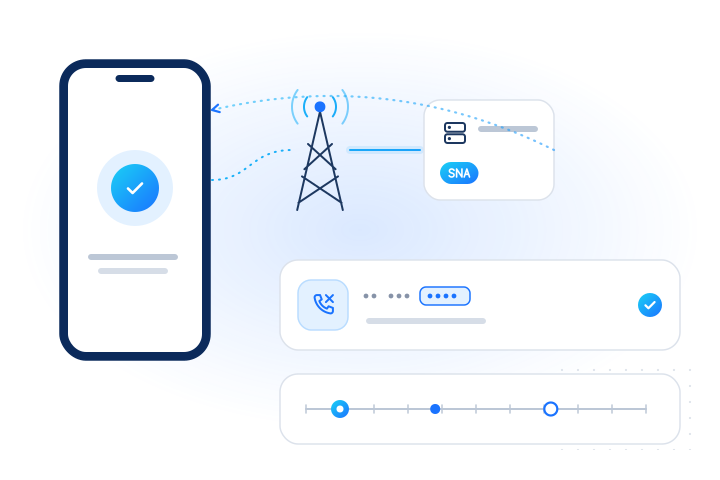
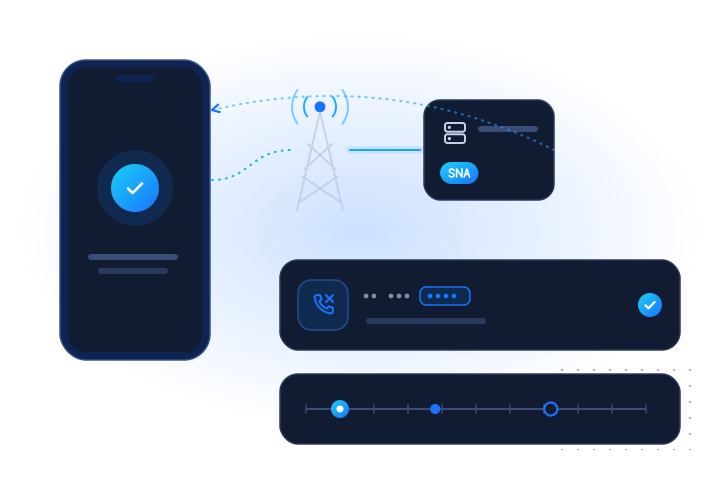
It's possession proof done by the network instead of by the user. When your app or website asks, the mobile operator confirms whether the device making the request is using the SIM tied to the number the user entered. The user sees at most a brief loading state.
The open standard is the CAMARA Number Verification API, maintained under the Linux Foundation and used in the GSMA's Open Gateway framework of "common network APIs that simplifies access to mobile operator networks" (GSMA). Its latest public release on 29 September 2026 is r3.2 (Fall 2025), with API version 2.1.0. A release candidate, r4.1 (API version 2.1.1-rc.2), was published on 27 September 2026 and lists no breaking changes (CAMARA).
The API has two operations. /verify "checks whether the mobile phone number registered by the user with the API consumer matches the one actually associated with the mobile device", and returns true or false; it accepts the number in plain text or as a SHA-256 hash. /device-phone-number returns the number the operator associates with the SIM (CAMARA API definition).
Where does silent authentication stop working?
Its strength is also its limit: it depends on the operator and the connection.
| Limit | Why | What happens |
|---|---|---|
| Wi-Fi | The standard flow "must be connected to the mobile network"; other connections work only with a SIM-based temporary token (TS.43) | Fall back to another method |
| Operator not supporting the API | Availability is per operator and per country | Fall back |
| Desktop sign-ups | No SIM in the device making the request | Fall back, or verify on the phone |
| Dual-SIM or eSIM switching | The data SIM may not be the SIM for the number entered | devicePhoneNumberVerified: false is possible even for an honest user |
| Authentication method | The API definition excludes "SMS/OTP or user/password" as the authentication method; the user must be authenticated via the mobile network | Integration errors if the flow is wrong |
The practical consequence: silent authentication is a first attempt, not a complete solution. Every product still needs a fallback path, usually an OTP by SMS, app or voice, and that fallback is where cost and fraud concentrate.
What is flash-call verification?
A flash call is a missed call used as a code. The verifier places a call to the user's number and hangs up after a ring or two. The calling number is the secret: typically, the last few digits of the caller ID form the code.
- On Android, an app with the right permission can read the incoming call from the call log and complete verification automatically.
- Otherwise, the user reads the missed call and types the digits.
The appeal is cost and speed in markets where terminating a voice call costs less than an international SMS, and there's no text message to intercept or forward. The weaknesses are real, too. The call can go unnoticed or be blocked by call-screening apps. Users who don't expect a call may call back, and a number that can receive calls may still be the wrong line type for your product.
What changes for flash call on Android in 2027?
Automatic flash-call verification on Android has relied on reading the call log. Google Play restricts that permission, and it's narrowing further. The policy page states: "Our SMS and Call Log Permissions policy will no longer permit account verification via phone call as a use case for the READ_CALL_LOG permission", effective January 27, 2027 (Google Play, 2026).
Google points developers to alternatives. Android's guidance calls the Digital Credentials API the recommended way to verify a user's phone number without sensitive permissions, and names the SMS Retriever API as the passcode option (Android Developers, 2026).
If your Android app auto-verifies by flash call, plan the migration now. After the change, users would have to type the digits by hand, and the main convenience of flash call would disappear for apps that can't keep the permission.
How do silent auth, flash call and OTP compare?
| Silent authentication | Flash call | SMS / app / voice OTP | |
|---|---|---|---|
| Proves | SIM in the device matches the number | Number can receive a call | Number (or app account) can receive a code |
| User effort | None | None (auto-read) or type digits | Type a code |
| Needs | Mobile data, supporting operator | Voice reachability; Android call-log access for auto-read | Delivery on the chosen channel |
| Works on desktop | No | Yes (manual) | Yes |
| Main fraud exposure | Low for the check itself; fallback path remains | Call-cost abuse on premium or international ranges | SMS pumping, interception, SIM swap |
| Coverage | Operator by operator | Wide, but blocked or ignored calls | Widest |
None of them answers who the person is. NIST's SP 800-63B-4 still treats authentication over the phone network as restricted and asks verifiers to consider risk indicators such as "device swap, SIM change, number porting" before relying on it (NIST, 2025).
Where do pre-checks still help?
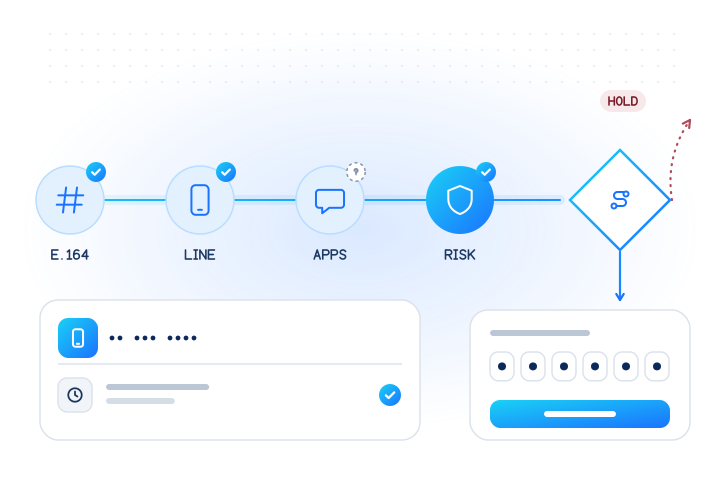
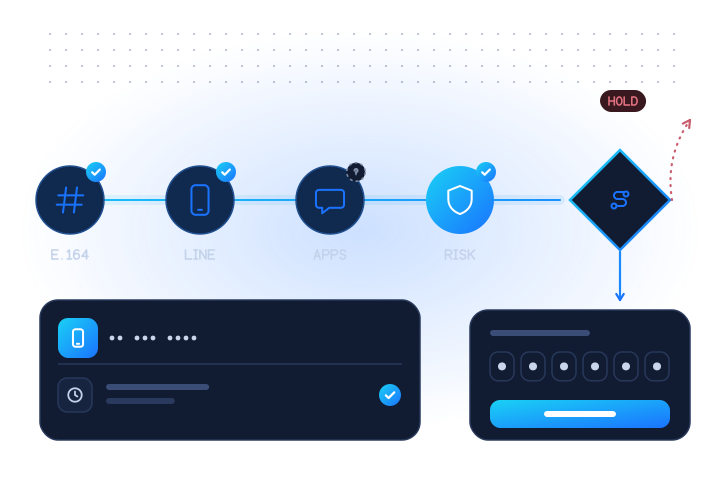
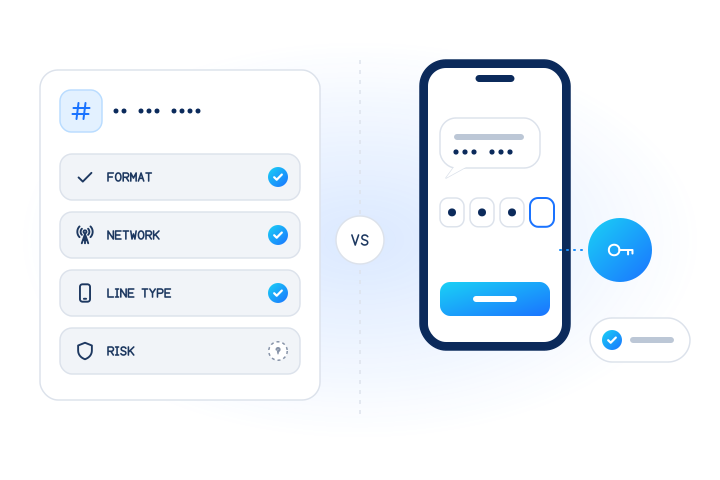
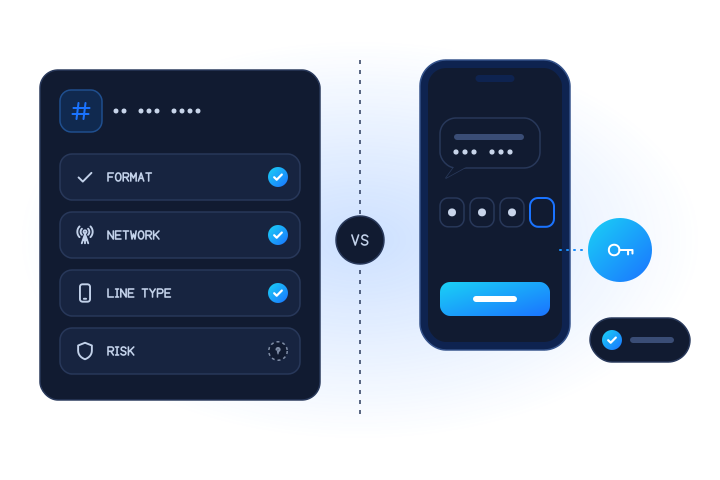
When the verification channel changes, the questions before it don't. A number check before verification decides which method to try and protects the fallback:
- Line type. A
fixed_linenumber can't do silent authentication and usually won't receive SMS;premium_rateandshared_costnumbers should never receive a call or code from you. Avoipnumber deserves a step-up. - Messaging presence. If the user has WhatsApp or another app you support, an app-based passcode can be the fallback instead of SMS.
- Country. Route by the number's country to the method your operator partners support there.
This real test-mode call returns line type and WhatsApp presence in one request:
curl https://api.mobilevalidate.com/v1/lookup \
  -H "Authorization: Bearer $MOBILEVALIDATE_API_KEY" \
  -H "Content-Type: application/json" \
-d '{"numbers": ["+447700900001"], "checks": ["carrier", "whatsapp"], "wait": 3}'"network.carrier": {"status": "completed", "attributes": {"line_type": "mobile", "carrier": "Test Carrier", "country": "GB"}},
"whatsapp.registered": {"status": "completed", "registered": true}You're not charged for inconclusive results (unknown, unsupported country, timeout, invalid, duplicate). See the test numbers.
What does a combined verification flow look like?
A decision table that tries the lowest-friction method first and keeps the fallback safe:
| Pre-check result | First attempt | Fallback | Never |
|---|---|---|---|
mobile, on mobile data, operator supports Number Verification | Silent authentication | App or SMS passcode | — |
mobile, on Wi-Fi or desktop | App passcode if registered (e.g. WhatsApp), else SMS | Voice call | — |
mobile, flash call supported in your app | Flash call (auto-read where still permitted) | SMS passcode | Flash call to international ranges you don't serve |
voip | Passcode plus e-mail confirmation | Manual review | Auto-approve |
fixed_line | Voice passcode | — | Silent auth, SMS |
premium_rate, shared_cost | Ask for another number | — | Any call or message |
Check unknown | Your default method | Default fallback | Treat unknown as a failed check |
Add per-number, per-IP and per-prefix rate limits to every path. Our OTP fraud prevention guide and SMS pumping guide cover those controls.
What should I measure when I add a new method?
Measure the whole funnel, not the method in isolation:
- Attempt rate: how often silent authentication or flash call can even be tried (network, operator, device).
- Success rate per method and fallback rate to OTP.
- Cost per completed verification, including checks, calls, messages and retries.
- Time to verified, median and 95th percentile.
- Abuse indicators: verification attempts per prefix and per country, and spikes to ranges you don't serve.
A method with a lower price but a high fallback rate can cost more overall. Our validation vs verification guide explains how pre-checks and verification split the work.
What are the key takeaways?
- Silent authentication asks the operator whether the device's SIM matches the entered number. CAMARA Number Verification standardizes it; it needs mobile data and a supporting operator.
- Flash call uses a missed call's caller ID as the code. Google Play will stop allowing call-log access for phone-call verification on January 27, 2027.
- Both need a fallback, and the fallback is where cost and fraud concentrate.
- Pre-checks still matter: line type, messaging presence and country decide which method to try and keep premium-rate and fixed-line numbers out of the flow.
- Measure cost per completed verification across methods. Try every branch with the test numbers and see the carrier lookup.
Sources
- NumberVerification (CAMARA API repository, release r3.2) — CAMARA Project / Linux Foundation, 2025
- number-verification.yaml v2.1.0 (API definition) — CAMARA Project, 2025
- GSMA Open Gateway — GSMA, 2026
- Use of SMS or Call Log permission groups — Google Play Console Help, 2026
- Minimize your permission requests (verify phone number) — Android Developers, 2026
- NIST SP 800-63B-4: Authentication and Authenticator Management — NIST, 2025
Frequently asked questions
What is silent network authentication?
It confirms that the phone number a user entered matches the SIM in the device they are using, by asking the mobile operator over the mobile data connection. No code is sent and the user types nothing. The CAMARA Number Verification API standardizes it.
What is flash-call verification?
The verifier places a short missed call to the number. The calling number itself carries the code, which an app reads from the call log or the user types in. No SMS is sent.
Does silent authentication work on Wi-Fi?
Usually not in its basic form. The CAMARA API's standard flow needs the device to be connected to the mobile network; it works over other connections only with a SIM-based temporary token.
Is flash-call verification still allowed on Android?
Google Play has announced that from January 27, 2027 its SMS and Call Log policy will no longer permit account verification via phone call as a use case for the READ_CALL_LOG permission. It recommends the Digital Credentials API or the SMS Retriever API instead.
Do I still need number checks if I use silent authentication?
Yes, in most flows. Silent authentication proves the device holds the number; it doesn't tell you the line type, whether the method is available, or how to fall back. Pre-checks decide which method to try and protect the fallback path.
Related services and guides
More from the blog
All articlesFraud prevention
OTP fraud prevention: the checks to run before you send a code
Before sending an OTP, look up the number: number type, line type and carrier, HLR status, porting. Which APIs offer it, what to compare, a pre-send flow.
10 min read
Guides
Phone validation vs phone verification: what's the difference?
Phone validation checks the number; verification proves the user holds it. What each one stops, what they cost, and how to combine them in one flow.
7 min read
Fraud prevention
SMS pumping: how it works and how to stop it
How SMS pumping (artificially inflated traffic) drains OTP budgets, the signals that give it away, and a layered checklist to stop it before you pay.
8 min read