

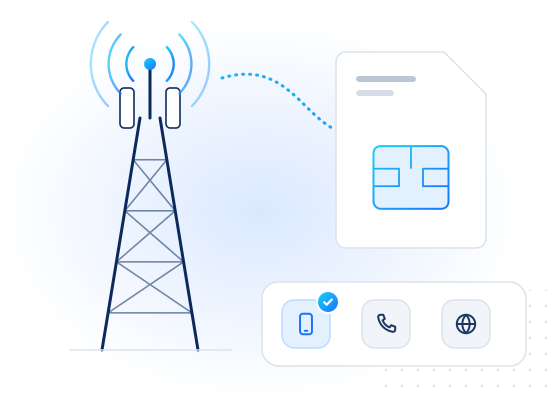
A sender ID is the name or number that appears as the sender of an SMS on the recipient's phone. It can be an ordinary phone number (a long code), a short code of a few digits, or an alphanumeric name such as a brand. Because the sender sets it, a sender ID proves nothing by itself, which is why many countries now require business sender IDs to be registered.
How does a sender ID work?
In the SMS standard, 3GPP TS 23.040 (Technical realization of the Short Message Service), the sender travels in the message's originating-address field. That field can hold a normal international or national number, or an alphanumeric value of up to 11 characters in the GSM 7-bit alphabet. The messaging provider fills it in when the message enters the network, and the handset displays it.
| Type | Example | Replies | Typical use |
|---|---|---|---|
| Alphanumeric | MyBank | No | One-way alerts, OTPs, where allowed |
| Long code (a normal number) | +44 7700 900123 | Yes | Two-way conversations; 10DLC in the US |
| Short code | 12345 | Yes | High-volume national campaigns |
| Toll-free number | +1 833 … | Yes | US and Canadian business texting |
Support varies by country. The US and Canada generally don't carry alphanumeric sender IDs for business traffic. Other countries allow them freely, allow them only after registration, or replace unsupported ones with a generic number.
What are sender ID registries?
Scammers set sender IDs that copy banks, couriers and government agencies, so the message appears in the same thread as genuine ones. Regulators respond with registries that tie each business sender ID to a verified organisation.
- Singapore. Since 31 January 2023, organisations using alphanumeric sender IDs to Singapore mobile users must register them in the SMS Sender ID Registry first, and non-registered IDs are marked "Likely-SCAM" (SGNIC).
- India. Commercial senders register their SMS headers and message templates with operators under TRAI's commercial-communications regulations, and each operator must ensure that commercial communication on its network "only takes place using registered header(s) assigned to the sender(s)" (TRAI TCCCPR 2018, regulation 3).
Check current rules for each destination before a campaign: registration lead times range from days to weeks.
Why does it matter for deliverability and fraud?
- Delivery. A sender ID that the destination doesn't support or hasn't registered is one of the most common reasons business SMS silently fails or arrives from an unfamiliar number. See why SMS isn't delivered.
- Trust. Customers act on messages that arrive under a recognisable, consistent name. Changing IDs trains them to trust any name, which helps smishing.
- Spoofing. Registries are the main defence against impersonated sender names. Monitor for your brand name being used by others.
How does MobileValidate relate to sender IDs?
MobileValidate doesn't send SMS or register sender IDs. It helps on the receiving side of the decision: check before a send whether a number is a mobile line, which carrier serves it, and whether it has an account on a channel such as WhatsApp, where the business identity is shown by the platform instead of a sender ID. See choosing a messaging channel by country and A2P SMS.
Frequently asked questions
What is an alphanumeric sender ID?
It is a brand name, such as a company name of up to 11 characters, shown instead of a phone number as the sender of a text. Recipients can't reply to it, and many countries require it to be registered before use.
Why didn't my sender ID appear on the recipient's phone?
The destination network may not support alphanumeric sender IDs, may require registration, or may replace unregistered IDs with a generic number or a warning label. The US and Canada, for example, generally don't support alphanumeric sender IDs for A2P traffic.
Can anyone use any sender ID?
Technically the field is set by the sender, which is exactly why regulators introduced registries. Where a registry exists, messages with unregistered IDs can be blocked or, as in Singapore, labelled as likely scams.