On this page
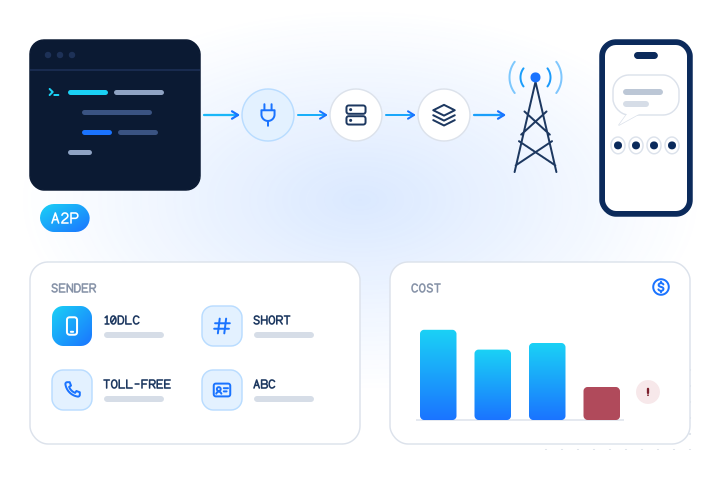
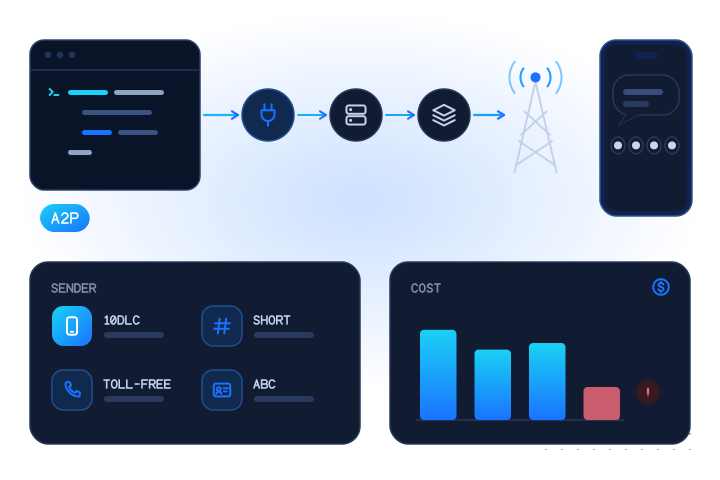
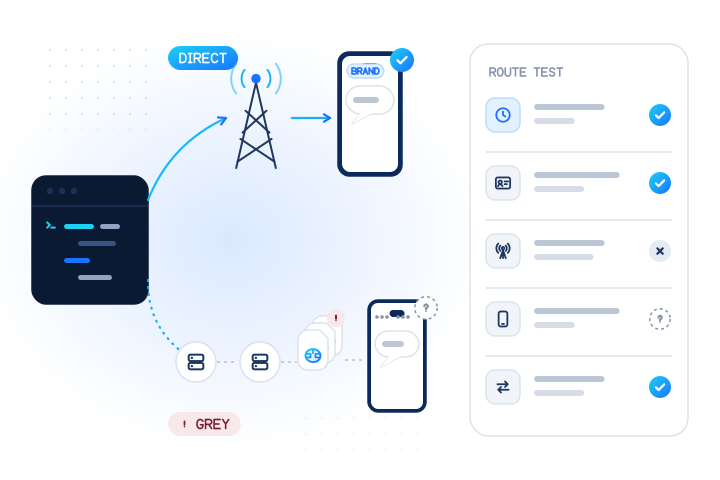
Direct-to-carrier SMS means your SMS provider hands each message straight to the mobile operator that serves the recipient, over a connection it has contracted with that operator, usually an SMPP bind to the operator's SMS centre or A2P gateway. No other aggregator sits in between. The alternative is an indirect route through one or more wholesale aggregators, and at the bottom of the market a grey route that the operator never authorised, often a SIM farm sending your business messages as if they were personal texts.
The difference shows up in delivery rates, speed, sender ID handling, delivery receipts you can trust, and fraud risk. This guide explains the route types in plain terms, what "direct" can and cannot promise, how regulators in the UK, India, Singapore and the US treat unauthorised routes, and six tests you can run to find out whether a route is really direct. If you need the basics of business messaging first, start with A2P SMS explained.
What is a direct-to-carrier SMS connection?
A direct-to-carrier connection is a contracted link between an SMS provider and one mobile operator. The operator accepts business (A2P) traffic on that link, applies its A2P price, and delivers the messages to its own subscribers.
In practice the link is almost always one of these:
- An SMPP bind to the operator's SMS centre (SMSC) or A2P gateway. SMPP is the protocol most of the industry uses to submit messages and receive delivery receipts (SMPP v3.4).
- An HTTP API that the operator, or its official A2P partner, runs in front of its SMSC.
- A signalling-level interconnect that a few large hubs and operators run between each other. The SMS itself is defined in 3GPP TS 23.040.
"Direct" always means direct to a named operator. No provider is direct to every network in the world. A provider can be direct to the three largest operators in one country and buy everything else from partners. That is normal. The question to ask is not "are you direct?" but "which operators are you direct to, and what happens to the rest of my traffic?"
How is direct different from an aggregator, a grey route or a SIM farm?
Most business SMS travels through some mix of these four route types:
| Route type | Who hands the message to the operator | Authorised for A2P? | Typical signs |
|---|---|---|---|
| Direct to carrier | Your provider, over its own contract with that operator | Yes | Sender ID kept as registered, prompt and specific delivery receipts, errors with real codes |
| Authorised aggregator | A wholesale partner with its own direct or hub connection | Yes | Similar to direct, sometimes slower; one more company in the chain |
| Grey route | Someone using a path the operator did not authorise for business traffic, for example a cheap person-to-person or roaming interconnect | No | Sender ID replaced, inconsistent receipts, sudden drops when the operator's filter catches up |
| SIM farm | Hardware holding many consumer SIM cards, sending your messages as ordinary texts | No | Messages arrive from random local mobile numbers, very low price, receipts that say delivered for phones that are off |
An aggregator is not a problem in itself. Many reputable providers use authorised aggregators for destinations where they have no direct link. The problem starts when somewhere in the chain the message leaves the authorised A2P path.
A grey route is defined by authorisation, not by price. The US wireless industry body CTIA puts it this way: "A Grey Route is a setting, method, or path that is not authorized by Service Providers for Non-Consumer messages," and message senders "should not utilize Grey Routes to send messages" (CTIA Messaging Principles, section 5.5.3).
A SIM farm is the most common grey route at the bottom of the market. Operators usually price A2P termination well above the price of a consumer text bundle. A SIM farm exploits that gap: it inserts dozens or hundreds of prepaid SIM cards into a device and sends business messages as if each were a person texting a friend. The sender pays less, the operator loses its A2P fee, and the recipient sees a message from a random mobile number instead of the brand.
Why does a direct route matter for OTP and fraud teams?
For one-time passcodes, a lost or late message is a lost user. Every extra hop is another queue, another retry policy and another place where a message can be dropped. Teams that send passcodes care about four things that route type affects directly:
- Delivery speed. A passcode that arrives after two minutes is often useless. Fewer hops means fewer queues.
- Receipts you can trust. You decide whether to retry, switch channel or show "resend" based on delivery receipts. A route that invents receipts breaks that logic.
- Sender ID. Users are taught to trust the brand name on a passcode message. A message from a random number looks like phishing, and some users ignore it.
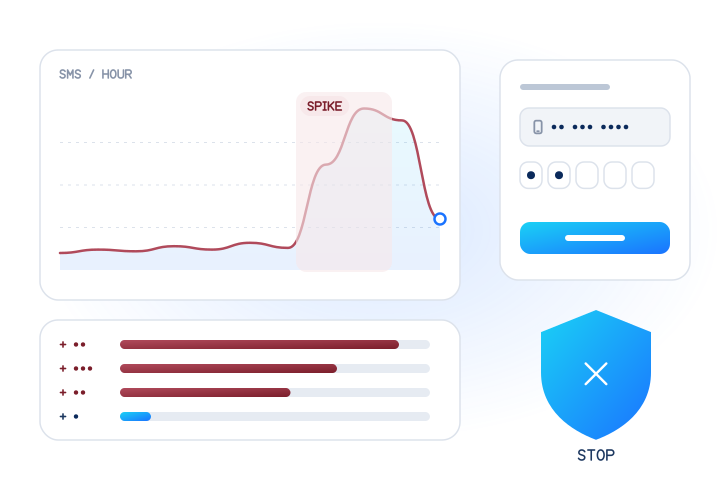
- Fraud exposure. The longer and murkier the chain, the harder it is to see who earns money from your traffic. That is exactly the gap SMS pumping schemes exploit.
For marketing and service messages, the risk is filtering. Operators run messaging firewalls that classify incoming traffic by volume, content, sender and source. Traffic that arrives on a path not authorised for A2P can be blocked without notice, often after days of apparently normal delivery.
What do regulators say about unauthorised SMS routes?
Regulators increasingly push A2P traffic onto known, accountable paths. Four examples, current as of October 2026:
| Market | Rule | What it means for routes |
|---|---|---|
| United Kingdom | Crime and Policing Act 2026, sections 151 to 153, in force on 29 October 2026 | Possessing or supplying a SIM farm without a good reason or lawful authority becomes an offence |
| United Kingdom | Ofcom statement on mobile messaging scams, 15 July 2026 | New duties for operators and A2P aggregators, with the A2P rules applying from 15 July 2027 |
| India | TRAI direction on traceability of commercial messages, 2024 | Commercial SMS whose chain of senders and telemarketers is not declared, or doesn't match, is rejected |
| Singapore | SMS Sender ID Registry, mandatory since 31 January 2023 | Unregistered alphanumeric sender IDs are labelled "Likely-SCAM" |
United Kingdom: SIM farms become an offence
From 29 October 2026, possessing or supplying a SIM farm without good reason is a criminal offence in the UK. The Crime and Policing Act 2026 defines a SIM farm as "a device which is capable of using five or more SIM cards simultaneously or interchangeably", used for calls or messages to numbers in national or international numbering plans (section 153). The offences start on 29 October 2026 under the Commencement No. 3 Regulations.
Separately, Ofcom's July 2026 statement on mobile messaging scams adds duties for mobile operators and A2P aggregators. They include know-your-customer checks when a business sender is onboarded, checking sender IDs against what the sender is entitled to use, monitoring traffic, and blocking scam messages in transit. The person-to-person rules apply from 18 January 2027 and the A2P rules from 15 July 2027. If you send to UK numbers, expect your provider to ask more questions about who you are and which sender IDs you use.
India: every hop in the chain must be declared
In India, a commercial SMS must travel through a declared chain, or it is rejected. TRAI required the businesses that send messages (principal entities) and the telemarketers that carry them to register the exact chain of companies between them with the operators. In its 30 November 2024 direction, TRAI set 11 December 2024 as the date from which messages whose chain is undefined or doesn't match the declared chain are rejected. In other words, "who touched this message" became a delivery requirement, which leaves little room for undisclosed resellers.
Singapore: registered sender IDs only
In Singapore, organisations must register alphanumeric sender IDs, and unregistered ones are labelled "Likely-SCAM". Registration with the SMS Sender ID Registry became mandatory on 31 January 2023, and organisations must work with SMS aggregators that are licensed by IMDA. A route that strips or rewrites your sender ID defeats the registration you paid for.
United States: direct connect aggregators and 10DLC
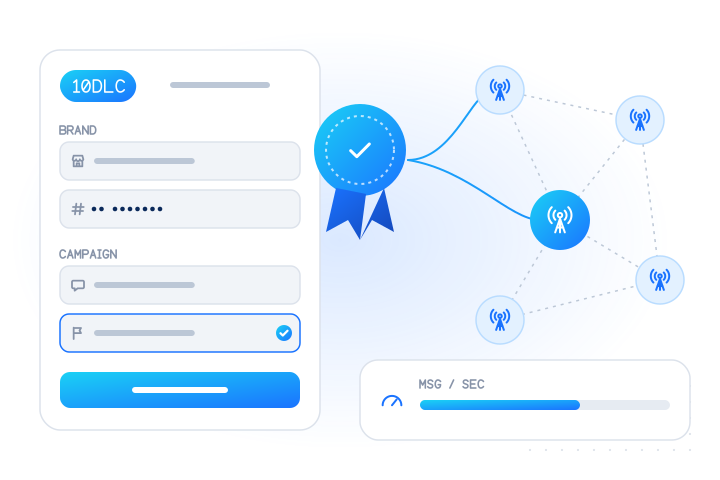
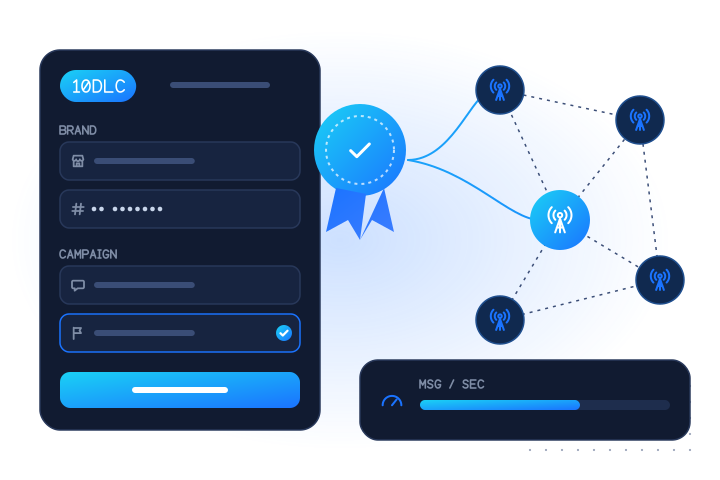
In the US, "direct" has a specific name: direct connect aggregator (DCA). The Campaign Registry describes a DCA as a company that has a direct connection to a mobile network operator's gateway and transmits messages on behalf of its customers (The Campaign Registry). Your messaging provider registers your brand and campaigns, and a DCA carries the traffic to the carriers. US carriers expect application traffic on registered 10DLC, toll-free or short code numbers, not on unregistered paths. The details are in our guide to 10DLC registration.
How can you test whether an SMS route is really direct?
You can't see a route from the outside, but you can test how it behaves. These six tests need a handful of test phones, one SIM on each major operator in the country you care about, and a few hours.
1. Does a switched-off phone still get a "delivered" receipt?
This is the single most revealing test. Turn one test phone off, or put it in flight mode, and send it a message. On an honest route the receipt should not say delivered while the phone is off: you should see an intermediate state, a delay, then either delivered when the phone comes back or an expiry. If the route returns DELIVRD within seconds for a phone that is off, the receipts are being generated somewhere in the chain, not by the handset's network. A route that fakes receipts will also hide real failures.
2. How long do delivery receipts take, and how do they vary?
Real receipts track real delivery. Send the same message to all your test phones at once, several times a day, and record the time between your submission and each receipt. Look for patterns rather than single values: receipts that always arrive in exactly the same fraction of a second, regardless of operator, time of day or whether the phone is busy, are a warning sign. So are receipts that arrive before the message appears on the phone.
The SMPP specification describes a common text format for receipts with id, sub, dlvrd, submit date, done date, stat and err fields, and notes that the exact format varies between SMSC implementations (SMPP v3.4, Appendix B). Compare the submit date and done date with what you observed on the phone. What each status means is covered in SMS delivery report statuses explained.
3. Does your sender ID arrive unchanged?
Check what the recipient actually sees. Send with your registered alphanumeric sender ID (or your registered number) and look at each test phone:
- Brand name shown as registered: consistent with an authorised A2P path.
- Random local mobile number: the message almost certainly left the A2P path and was sent from a consumer SIM.
- A generic or numeric replacement that matches the country's rules: some countries don't support alphanumeric sender IDs, or replace them on purpose. Check the destination's rules before you blame the route.
Run this test per operator. A provider can be direct to one network and grey on another.
4. Does the provider know the recipient's current network?
A direct connection only helps if the message goes to the right operator. After mobile number portability, a number's prefix shows the operator that originally held the range, not the one serving it today. Port one of your test SIMs, or borrow a ported number, and send to it. Then ask the provider which operator it routed the message to, or check the network code in the receipt or webhook if the provider includes one (SMPP doesn't require it, so not every provider does).
If the provider routed by prefix, the message went to the old operator's connection. Inside the networks, porting is handled with lookups described in 3GPP TS 23.066, but whether a direct bind into the old operator accepts and forwards a message for a subscriber who has left, at what price and how quickly, depends on that operator's agreements. Providers that do it properly look up the current network before they choose a connection.
5. Do failures come back with specific reasons?
Honest routes fail loudly. Send to a number you know is disconnected, to a landline, and to a well-formed number that was never assigned. A route close to the operator usually returns distinct failures with error codes. A route that reports everything as delivered, or everything as the same generic error, is hiding what happens further down the chain.
6. What does the contract actually say?
Put the claim in writing. Ask for:
- A list of operators the provider connects to directly, per country, and the name of the partner for the rest.
- A statement that no traffic is sent over grey routes or SIM farms, with the right to audit or to terminate if it is.
- Receipt guarantees: that receipts come from the terminating network and are not generated locally.
- Sender ID handling: that registered sender IDs are never replaced except where the destination's rules require it.
- Notice of route changes for your main destinations.
And look at the price. If one provider's price for a destination is far below every other quote, ask how. A2P termination fees are set by the operators, so a price well under the operator's A2P rate has to be paid for somewhere, often by sending the traffic as person-to-person messages.
Where do phone number checks fit into direct routing?
A direct route delivers well only if you send to numbers that can receive the message, on the network that serves them today. Three checks answer that before you pay for the message. MobileValidate doesn't send SMS; these checks run before you hand numbers to whichever provider you use.
| Question before sending | Check | What you get |
|---|---|---|
| Which network serves this number now? | MNP lookup | porting (ported or not_ported) and the current mcc_mnc, so you or your provider can pick the right connection |
| Can this number receive SMS at all? | Carrier lookup | line_type (mobile, fixed line, VoIP, toll-free…) so you skip landlines and toll-free numbers |
| Is the phone reachable right now? | HLR lookup | status (reachable, unreachable, invalid) plus porting and network, so you stop paying for dead numbers |
Prices as of October 2026, per conclusive answer: MNP lookup $0.002 (real time or bulk), carrier lookup $0.003 in real time and $0.0015 in bulk, HLR lookup $0.006 in real time and $0.005 in bulk. Unknown answers are free. Current prices are on the pricing page.
Routing by the current network takes a few lines. With a test key, +447700900006 is a ported test number that returns porting: "ported" and mcc_mnc: "23410" (see test mode):
import os, requests

def current_network(numbers):
    r = requests.post(
        "https://api.mobilevalidate.com/v1/lookup",
        headers={"Authorization": f"Bearer {os.environ['MOBILEVALIDATE_API_KEY']}"},
        json={"numbers": numbers, "checks": ["mnp"], "wait": 10},
        timeout=40,
    )
    r.raise_for_status()
    routes = {}
    for item in r.json()["results"]:
        mnp = item["checks"].get("number.mnp", {})
        if mnp.get("status") == "completed":
            routes[item["e164"]] = mnp["attributes"]["mcc_mnc"]   # route by the network that serves it today
        else:
            routes[item["e164"]] = None                           # unknown: not billed, use your default route
    return routes
Two rules keep this safe. Treat unknown as "no evidence" and fall back to your normal route; don't drop the number. And cache the answer only for as long as it stays useful: porting changes slowly, but reachability doesn't. Our guide on how long phone check results stay valid gives practical refresh intervals, and the SMS routing with MNP and HLR use case shows a full workflow.
These checks are for messages people asked for: passcodes, service messages and consented marketing. They must not be used to build lists for unsolicited messaging, and our acceptable use policy forbids range scanning and enumeration.
Direct-to-carrier SMS: common questions buyers ask
Is "Tier-1" the same as direct?
Not necessarily. "Tier-1" is a marketing label with no standard definition in SMS. Some providers use it for direct operator connections, others for large wholesale partners. Ask which operators the route connects to directly, as in test 6.
Can a provider be direct and still use grey routes?
Yes. A provider can hold direct connections in some countries and buy cheap routes elsewhere, or fall back to a cheaper route when a direct link is congested. That is why the tests above should be run per country and per operator, and repeated after any change in delivery rates.
Does a direct route stop SMS pumping?
No. A direct route makes it easier to see where traffic goes, but pumping is triggered on your side, by bots requesting passcodes to numbers that earn the attacker money. You still need rate limits and pre-send checks; see how SMS pumping works and how to stop it.
Is direct-to-carrier always more expensive?
Per message, often not. One fewer company in the chain means one fewer margin. What a genuine route can't do is undercut the operator's own A2P rate. Total cost also falls when you stop sending to landlines, disconnected numbers and the wrong network, which pre-send checks handle.
Key takeaways
- Direct-to-carrier SMS means your provider hands messages straight to the recipient's operator over its own contracted connection. It is always direct to named operators, never to the whole world.
- Authorised aggregators are normal for the long tail. Grey routes and SIM farms are not: they are paths the operator never authorised for business traffic.
- Regulators are closing those paths: SIM farms become an offence in the UK on 29 October 2026, India rejects commercial SMS with an undeclared chain, and Singapore labels unregistered sender IDs "Likely-SCAM".
- Test a route yourself: fake receipts for switched-off phones, odd receipt timing, rewritten sender IDs, routing by prefix after porting, vague errors and too-good prices are the warning signs.
- Send to numbers that can receive the message, on the network that serves them today: an MNP lookup for routing, a carrier lookup for line type, and an HLR lookup for reachability.
Sources
- Messaging Principles and Best Practices (May 2023), section 5.5.3 Grey Routes — CTIA, 2023
- Short Message Peer to Peer Protocol Specification v3.4, Issue 1.2 (Appendix B, delivery receipt format) — SMPP Developers Forum, 1999
- 3GPP TS 23.040: Technical realization of the Short Message Service (SMS) — 3GPP, 2026
- 3GPP TS 23.066: Support of Mobile Number Portability (MNP); Technical realization; Stage 2 — 3GPP, 2026
- Crime and Policing Act 2026, section 153 (meaning of SIM farm) — UK Parliament, legislation.gov.uk, 2026
- The Crime and Policing Act 2026 (Commencement No. 3 and Saving Provisions) Regulations 2026, regulation 5 — legislation.gov.uk, 2026
- Statement: Combatting mobile messaging scams (15 July 2026) — Ofcom, 2026
- Direction on traceability of commercial messages (PE-TM chain binding), 30 November 2024 — Telecom Regulatory Authority of India (TRAI), 2024
- Singapore SMS Sender ID Registry (SSIR) — SGNIC, a subsidiary of IMDA, 2026
- About The Campaign Registry — The Campaign Registry, 2026
Frequently asked questions
What does direct-to-carrier SMS mean?
It means the SMS provider hands your messages straight to the mobile operator that serves the recipient, over its own contracted connection (usually an SMPP bind to the operator's SMS centre or A2P gateway). No other aggregator sits between your provider and that operator, so there is one fewer margin and one fewer place for a message to be lost, delayed or rewritten.
Is a direct connection always better than an aggregator?
Not always. A direct connection matters most for the countries and operators where most of your traffic goes. For the long tail, a reputable aggregator with authorised routes is normal and fine. What you must avoid is an unauthorised path: grey routes and SIM farms.
What is a grey route in SMS?
A grey route is a path the terminating operator has not authorised for business (A2P) traffic. CTIA defines it as 'a setting, method, or path that is not authorized by Service Providers for Non-Consumer messages'. Typical examples are business messages disguised as person-to-person traffic, often sent from consumer SIM cards in a SIM farm, to avoid A2P termination fees.
How can I tell if my SMS route is really direct?
Test it. Send to your own test phones on each major operator and check six things: whether a switched-off phone still gets a 'delivered' receipt, how long receipts take, whether your sender ID arrives unchanged, whether the provider knows the recipient's current network after porting, whether failures come back with specific error codes, and whether the contract names the operators it connects to directly.
Are SIM farms illegal?
It depends on the country. In the United Kingdom, possessing or supplying a SIM farm without a good reason or lawful authority becomes an offence on 29 October 2026 under the Crime and Policing Act 2026. The Act defines a SIM farm as a device capable of using five or more SIM cards simultaneously or interchangeably. Many operators also forbid sending business traffic from consumer SIMs in their terms.
Does porting affect direct-to-carrier SMS routing?
Yes. A direct connection reaches one operator. When a number has been ported away, its prefix still points at the old operator. A provider that routes by prefix sends that message to the wrong connection, where it may be forwarded at a higher cost, delayed or rejected. Routing by the current network from a number portability (MNP) lookup avoids that.
Does MobileValidate send SMS?
No. MobileValidate does not send messages. It answers questions before you send: is the number mobile, which network serves it now, and is it reachable. You use those answers with whichever SMS provider you choose.
Related services and guides
More from the blog
All articlesDeliverability
A2P SMS explained: what application-to-person messaging is and how it works
A2P SMS is text messaging sent by software for a business. How it differs from P2P, sender types, what drives cost, deliverability and SMS pumping risk.
8 min read
Deliverability
10DLC registration explained for developers
How US 10DLC registration works: brands, campaigns, timelines, published fees, throughput, why registered messages still get blocked, and list hygiene.
7 min read
Fraud prevention
SMS pumping: how it works and how to stop it
How SMS pumping (artificially inflated traffic) drains OTP budgets, the signals that give it away, and a layered checklist to stop it before you pay.
8 min read