On this page
To check if a number is on LINE, run the numbers you already hold through a bulk registration check. Each one comes back registered, not registered or unknown, with the time of the check. That is all a LINE number check can legitimately tell you: it never returns a LINE ID, display name, profile photo or friend list. With MobileValidate the check is line in a bulk job, at $0.0015 per conclusive answer as of 2026-11-15, and unknown answers are free.
It matters most in Japan, Thailand and Taiwan, where LINE is the main messenger. For marketers and CRM teams in those markets the real question is usually "which channel can reach this customer?": LINE, SMS or WhatsApp. This guide covers that decision, how the three countries' number formats trip up a mixed list, what a 10,000-number job costs, and the data protection rules in each country.
What does a LINE number check answer?
One question per number: is a LINE account associated with it? The result for each row, from checks["line.registered"]:
| Answer | Meaning | How to read it |
|---|---|---|
registered: true | A LINE account was found through this number at checked_at | The channel exists for this customer. It is not permission to use it |
registered: false | A conclusive answer that no account was found | Weak to moderate: in JP, TH or TW it's unusual for a mobile; elsewhere it's normal |
registered: null (unknown) | No conclusive answer | Missing data, not a "no". Never charged |
The check accepts numbers from every country except Puerto Rico, which the live catalog lists as unsupported for LINE (unsupported_country, free). Sanctioned countries are never checked. Outside LINE's core markets you'll mostly see false, which tells you little.
What doesn't it answer?
- Who the person is. No LINE ID, display name, status message, photo or friends. There is no reverse lookup from a number to a person.
- Whether they'd accept your message. People on LINE choose which business accounts they follow and can block them.
- Whether they are active. Registration isn't daily use.
- Whether a
falseperson has LINE at all. LINE lets people connect by LINE ID or QR code as well as by phone number, and people change numbers. Afalsemeans "not reachable through this number", as our LINE check page explains.
Why does LINE matter in Japan, Thailand and Taiwan?
Because nearly everyone with a smartphone in those markets uses it, according to the figures LY Corporation, which runs LINE, publishes itself:
| Market | What LY Corporation says | Date |
|---|---|---|
| Japan | "LINE's monthly users in Japan surpassed 100 million" (LY Corporation) | December 2025 |
| Thailand | About 54 million users, "around 80% of the population", and "some 6 million LINE Official Accounts are utilized by businesses and government agencies" (LY Corporation) | Article of 5 December 2025 |
| Taiwan | "Out of Taiwan's population of 23.42 million, LINE's monthly active users have reached 22 million as of 2024" (LY Corporation) | Article of 26 February 2025 |
These are the company's own figures, not independent measurements, and they describe whole populations, not your list. Your customers may skew older, younger, more corporate or more international than average. A bulk check on your own opted-in customers measures the number that matters to you: what share of your list is reachable on LINE.
LINE, SMS or WhatsApp: which channel should you use?
Each channel reaches people in a different way. That, more than price, decides how you use it:
| LINE Official Account | LINE notification messages | SMS | WhatsApp Business Platform | |
|---|---|---|---|---|
| How you address the person | They add your account as a friend; you message them in LINE | By phone number, through LY Corporation's notification service | Phone number | Phone number |
| Who can use it | Any business with an Official Account | Corporate users who applied to LINE, for numbers issued in Japan, Thailand and Taiwan | Any sender, through an SMS provider | Any business on the platform |
| Consent | Following the account; people can block it | The user agrees inside LINE to receive these messages | Your own consent records, under local law | Your own opt-in, under Meta's rules and local law |
| Typical use | Marketing, coupons, customer service | Service notices: deliveries, bookings, payments | OTP, alerts, fallback for everyone | Service and marketing where customers use WhatsApp |
| What a registration check adds | Which customers to invite to follow your account | Which numbers can get a notice at all | Not needed: every active mobile receives SMS | Which numbers have WhatsApp |
What LINE's official pages say about costs and rules
All as read on 2026-11-15 on LY Corporation's own pages:
- Official Account plans differ by country. LINE's developer documentation says: "Pricing plans vary by country or region, so check the plans for your region." For Japan it lists a free Communication Plan with up to 200 messages a month, a Light Plan at JPY 5,000 a month with up to 5,000 messages, and a Standard Plan at JPY 15,000 a month with up to 30,000 messages, with extra messages at up to JPY 3 each (excluding tax). Push, multicast, broadcast and narrowcast messages count; replies don't. Messages are counted per recipient (LINE Developers, Messaging API pricing). Thailand and Taiwan have their own plans, linked from that page.
- Notification messages go by phone number, with the user's consent. "A LINE notification message is sent to the account of the user whose phone number is registered to LINE." The number must be "issued in Japan, Thailand, and Taiwan", sent as a SHA-256 hash of the E.164 form, and the conditions include that the "user agrees to receive LINE notification messages". Only "corporate users who have submitted the required applications" can use it (LINE Developers).
- In Thailand the same idea is called LINE Official Notification. It is "available for Verified or Premium Accounts", limited to templates LINE defines (delivery, reservation, payment and similar), and the number must match the one in LINE's records (LINE for Business Thailand).
What WhatsApp costs in these markets
Japan, Thailand and Taiwan have no country row on Meta's WhatsApp rate card. All three sit in the Rest of Asia Pacific region (Meta). On the card effective 1 October 2026, that region's list rates per delivered message are $0.0842 for marketing and $0.0113 each for utility, authentication and service messages, from our rate-card dataset. Check what a campaign would cost with the WhatsApp cost calculator.
We don't quote SMS prices here: they depend on your provider and on the network, and we have no primary source to cite. SMS remains the channel that reaches every active mobile, which is why it stays the fallback for one-time passcodes and for customers without LINE.
A practical routing rule
- Keep the customer's channel opt-ins in your CRM. A check never replaces them.
- Run a LINE check (and a WhatsApp check where your customers also use WhatsApp) on the numbers.
- Customers with
line: truewho haven't followed your Official Account yet: invite them through channels you already use, for example a QR code on receipts or in the order e-mail. - Customers with
line: falseor unknown: keep SMS or e-mail, and don't spend LINE-specific budget on them. - Re-check every few months, because numbers change hands. Our channel selection use case and the channel-by-country guide cover the wider picture.
Who uses a bulk LINE check, and for what?
The uses fall into five groups. The companies below are examples, not customers:
- CRM enrichment for consented lists. A retailer entering Thailand has 40,000 loyalty members who agreed to marketing by SMS or "messaging apps". Checking which have LINE tells them how big an Official Account audience could become before they pay for a plan.
- Channel routing. A Taiwanese logistics firm sends delivery notices. Customers on LINE who follow the account get them there; the rest get SMS. The check decides which customers get the invite to follow.
- List hygiene. A Japanese contact list that has sat for two years has numbers that no longer belong to the customer. A number with no LINE, no WhatsApp and no live network status may need re-verification. Pair the check with a carrier lookup.
- Sign-up fraud and multi-accounting signals. For a Japanese or Thai mobile number, no LINE account is unusual, but it is not proof of anything. The same number on several sign-ups is a stronger pattern, and the job flags it as a duplicate. Use LINE as one input to a score, never as a block on its own.
- Agencies running campaigns. An agency planning a LINE campaign for a client checks the client's own opted-in list to size the audience and split the budget between LINE and SMS. The client must have the lawful basis; the agency checks on their behalf.
Why do Japanese, Thai and Taiwanese numbers break mixed lists?
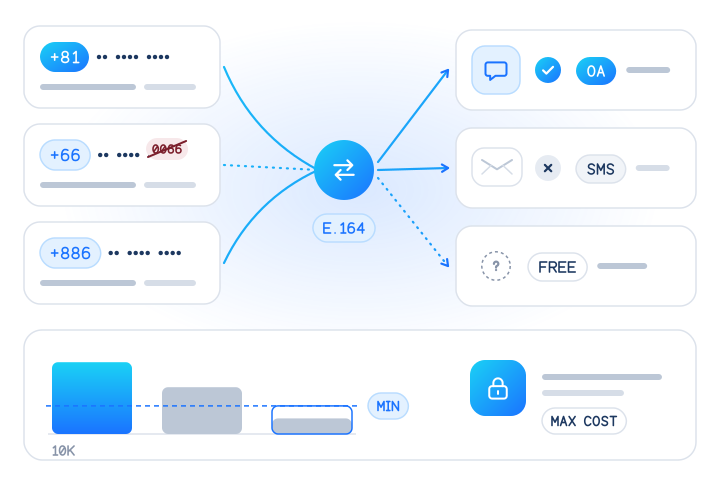
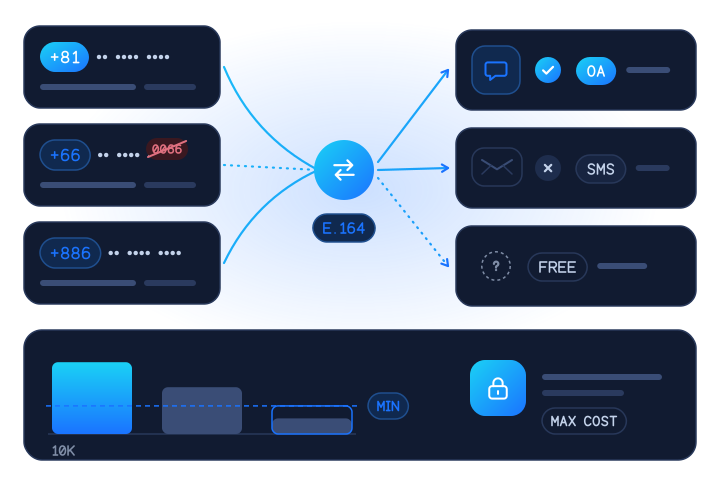
All three countries write mobile numbers with a leading 0 at home, and the patterns overlap. A CRM export that mixes them in local format can't be read with one default country:
| Country | Code | Mobile at home | E.164 | Quirk |
|---|---|---|---|---|
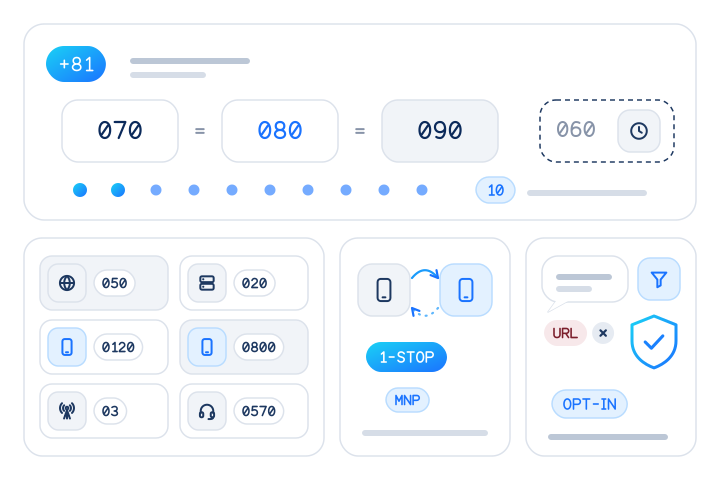
| Japan | +81 | 090-1234-5678 (11 digits, 070/080/090) | +819012345678 | 0120 is toll-free, and libphonenumber also types 0066… as toll-free |
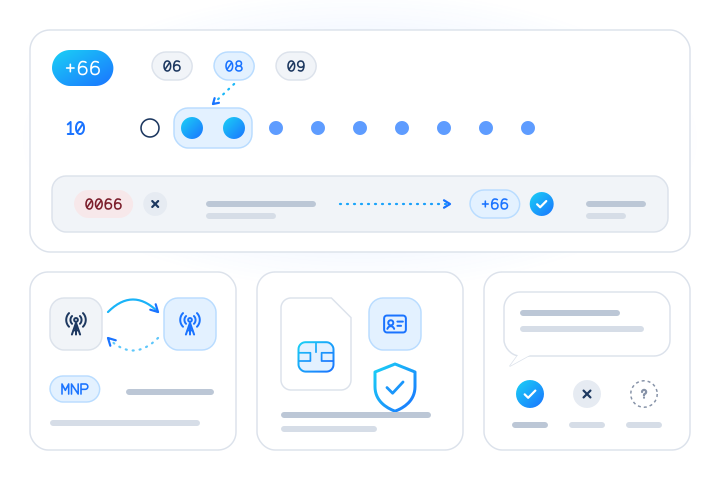
| Thailand | +66 | 081 234 5678 (10 digits, 06/08/09) | +66812345678 | A leading 0066 (the exit code written in front of the country code) is misread by parsers |
| Taiwan | +886 | 0912 345 678 (10 digits, 09) | +886912345678 | 0969 is a satellite range, not a mobile |
We ran this with libphonenumber-js 1.13.15 (metadata 9.0.41) on 2026-11-15, using the library's own example numbers, which are for testing only. Each row is parsed twice: once with Japan as the single default for the file, and once with the row's own country:
import { parsePhoneNumberFromString as parse } from "libphonenumber-js/max";

// One CRM export, three markets, numbers typed the local way.
const rows = [
  { phone: "090-1234-5678", country: "JP" },
  { phone: "081 234 5678", country: "TH" },
  { phone: "0912 345 678", country: "TW" },
  { phone: "0066812345678", country: "TH" },
];

const show = (n) => (n ? `${n.number} ${n.isValid() ? n.getType() : "INVALID"}` : "unparsed");
const fix0066 = (s) => s.replace(/^\s*0066/, "+66"); // see the Thailand guide

for (const r of rows) {
  const allJp = parse(r.phone, "JP");                      // one default country for the file
  const perRow = parse(fix0066(r.phone), r.country);       // the row's own country
  console.log(r.phone.padEnd(15), "| all JP:", show(allJp).padEnd(26), "| per row:", show(perRow));
}
Output:
090-1234-5678   | all JP: +819012345678 MOBILE       | per row: +819012345678 MOBILE
081 234 5678    | all JP: +81812345678 INVALID       | per row: +66812345678 MOBILE
0912 345 678    | all JP: +81912345678 INVALID       | per row: +886912345678 MOBILE
0066812345678   | all JP: +810066812345678 TOLL_FREE | per row: +66812345678 MOBILE
Two failure modes show up. The Thai and Taiwanese mobiles become invalid Japanese numbers, so they'd be dropped. Worse, the Thai number written with 0066 becomes a "valid" Japanese toll-free number, because libphonenumber's Japanese metadata types numbers starting 0066 as toll-free. In a LINE job that row would be checked as a Japanese number and come back false.
The fix: keep a country column, convert to E.164 per row before you upload, or split the export by country and give each file its own default_country. The free phone list cleaner does one country per run. The country guides go deeper: Japan, Thailand (including the 0066 trap) and Taiwan.
How do you run a bulk LINE number check?
The LINE check runs in bulk jobs only. We tried a real-time call with the public sandbox key on 2026-11-15, and the API answered 403 service_disabled with "The check 'line.registered' is available in bulk jobs only (POST /v1/jobs)." You can upload a CSV in the dashboard without code, or use the API:
- Clean the list. E.164 per row, as above. Remove numbers without a lawful basis.
- Estimate for free.
POST /v1/jobs/estimatetakes the same body as a job, checks nothing and returns the maximum cost, country minimums included. - Create the job with a CSV that has a
phonecolumn. Other columns are ignored; results come back with arow_noso you can join them to your file. - Download the results as CSV or NDJSON. The bulk jobs guide covers formats, webhooks and limits.
Worked example: CSV in, columns out
This is a real test-mode job, run on 2026-11-15 with the public sandbox key and the test values from the +44 7700 900xxx range, which is reserved for drama and never assigned to anyone. In a real job these would be +81, +66 and +886 numbers. The input is a CRM export with the customer's channel opt-in, and the last row repeats the first number:
phone,customer_ref,channel_optin
+447700900001,C-2001,line+sms
+447700900002,C-2002,sms
+447700900003,C-2003,line+sms
+447700900005,C-2004,sms
+447700900006,C-2005,line+whatsapp
+447700900001,C-2006,smscurl https://api.mobilevalidate.com/v1/jobs \
-H "Authorization: Bearer $MOBILEVALIDATE_API_KEY" \
-H "Idempotency-Key: line-crm-2026-11-15" \
-F file=@crm.csv -F checks=line,whatsapp
# then: GET /v1/jobs/{id}?wait=30 and GET /v1/jobs/{id}/download?format=csvThe job reported "progress": {"total": 6, "checks_total": 12, "done": 12, "conclusive": 6, "non_billable": 12}, since test keys never bill. Selected columns of the downloaded CSV:
| row_no | e164 | number_status | line.registered.status | line.registered.registered | whatsapp.registered.registered |
|---|---|---|---|---|---|
| 1 | +447700900001 | valid | completed | true | true |
| 2 | +447700900002 | valid | completed | false | false |
| 3 | +447700900003 | valid | unknown | ||
| 4 | +447700900005 | valid | unsupported_country | ||
| 5 | +447700900006 | valid | completed | true | true |
| 6 | +447700900001 | duplicate |
(Test values give each number the same fixed answer on every app. Real answers differ by app.)
Reading it as a CRM team: C-2001 and C-2005 are on LINE and opted in to it, so invite them to follow the Official Account. C-2002 is not on LINE and only opted in to SMS: keep SMS. C-2003 has no answer, which costs nothing; try again in the next run. Row 6 is the same number as row 1 under a second customer record (C-2006). That's a duplicate to merge in the CRM, and it's never checked or charged twice. Join back to customer_ref with row_no.
The job's cost breakdown also showed two pricing rules at work: a country_minimum line for LINE ("each country with fewer than 2000 numbers is billed at least $3.00 … when it returns at least one answer") and a small_batch line for WhatsApp, which gets the bulk price only for groups of at least 132 numbers from one country.
What does it cost to check 10,000 numbers?
As of 2026-11-15 the live catalog (GET /v1/services) lists the LINE check at $0.0015 per conclusive answer, bulk only. Unknown, unsupported-country, invalid and duplicate rows are free.
- Ceiling for 10,000 numbers: 10,000 × $0.0015 = $15.00, reached only if every number gets a conclusive answer.
- Country minimum: each country in a job is billed at least the price of 2,000 checks ($3.00), and only if it returns at least one conclusive answer. A country whose answers are all unknown costs nothing. See minimum per country.
A regional list rarely sits in one country. An illustrative split across the three markets, with made-up answer rates:
| Country in the job | Numbers | Conclusive answers | Billed |
|---|---|---|---|
| Japan | 5,400 | 5,100 | 5,100 × $0.0015 = $7.65 |
| Thailand | 3,400 | 3,200 | 3,200 × $0.0015 = $4.80 |
| Taiwan | 1,200 | 1,150 | 1,150 × $0.0015 = $1.725, so the $3.00 minimum applies |
| Total | 10,000 | 9,450 | $15.45 |
Taiwan's 1,200 numbers fall below the 2,000-check minimum, which adds $1.275. Collect a month of Taiwanese numbers into one job, or send them together with the next batch, and each answer goes back to the plain $0.0015. The free estimate shows the minimum country by country before you start, and you can pass its max_cost on the job as a hard cap. A card top-up of $100 or more adds bonus credit (+5% from $100, +8% from $500, +10% from $2,000).
What are the limits?
- Bulk only, no real-time answers. Results arrive when the job finishes.
- Up to 50,000 numbers and e-mails per job, 20 checks per request and at most 100,000 numbers × checks per job. A daily cap per account applies (
GET /v1/limits). - Phone numbers only. There is no LINE ID search and no e-mail check for LINE.
- Not Puerto Rico, and never sanctioned countries. Both come back unsupported and free.
- No enumeration. Requests with 20 or more consecutive numbers, or lists that look like generated ranges, are refused with
403 suspected_enumeration. See rate limits and abuse. - Answers age. Store
checked_atwith each answer, and don't overwrite a storedtrueorfalsewith a later unknown. - Cache. Numbers your account checked recently can be answered from its cache for free; send
max_age: 0to force fresh, billed checks.
What are the legal rules in Japan, Thailand and Taiwan?
In all three countries a phone number in a customer record is personal data, and a registration check is a use of it. Check only numbers you hold for a stated purpose, and keep only the answer and its date. This is our reading of the primary texts on 2026-11-15, not legal advice; ask local counsel how they apply to you.
Japan: APPI
The Act on the Protection of Personal Information is enforced by the Personal Information Protection Commission (e-Gov text; PPC English translation, where only the Japanese text has legal effect):
| Article | What it requires |
|---|---|
| Art. 17(1) | Specify the purpose of use as far as possible |
| Art. 18(1) | Don't handle personal information beyond that purpose without the person's prior consent |
| Art. 21(1) | On acquiring personal information, notify or publish the purpose, unless it was published beforehand |
| Art. 27(1), 27(5)(i) | No provision of personal data to a third party without prior consent; a recipient handling it on your behalf, within your purpose, is not a third party (entrustment) |
| Art. 28(1) | Providing personal data to a third party in a foreign country needs prior consent, unless the country is on the PPC's list or the recipient has an equivalent system in place |
For a LINE check, the practical points are: write "choosing the contact channel" into your published purpose of use, and decide with counsel how Articles 27 and 28 apply when the check provider is outside Japan.
Thailand: PDPA
The Personal Data Protection Act B.E. 2562 (2019), as published in the Government Gazette (unofficial English translation):
| Section | What it requires |
|---|---|
| s. 19 | No collection, use or disclosure without consent unless the Act allows it; consent is asked for explicitly, in writing or electronically, with the purpose |
| s. 21 | Use data for the purpose notified at collection; a new purpose needs notice and consent, unless the law allows it |
| s. 23 | Tell people the purpose, the data, how long it's kept and who it may be disclosed to |
| s. 24 | Bases without consent include performance of a contract and "legitimate interests", unless the person's rights override them |
| s. 28 | Transfers abroad need adequate protection in the destination, or an exception such as informed consent |
| s. 32 | People can object at any time to use for direct marketing |
Our Thailand guide adds the marketing rules: direct-marketing registration and the *137 SMS opt-out.
Taiwan: PDPA
The Personal Data Protection Act, in the Ministry of Justice database (English text):
| Article | What it requires |
|---|---|
| Art. 2 | Personal data includes "contact information" |
| Art. 19(1) | A business collects or processes personal data only "for specific purposes" and on a listed basis, such as a contract or "where consent has been given by the data subject" |
| Art. 20(1) | Use stays "within the necessary scope of the specific purpose of collection" |
| Art. 20(2) | On objection, the business "shall cease using the data subject's personal data for marketing" |
A broad amendment, promulgated on 11 November 2025, creates a new Personal Data Protection Commission. Our Taiwan guide tracks when it takes effect.
Rules that apply everywhere
- Registration is not consent. A
truegives no right to message anyone, on LINE or elsewhere. LINE's own notification service asks the user for consent separately. - No people-finding. Checking whether a particular person, an ex-partner, a debtor or an applicant is on LINE is forbidden by our acceptable use policy. So are bought or scraped lists, profiling, and eligibility decisions (credit, housing, employment, insurance) based on app presence. By using the service you confirm you have the authority to check the numbers you submit.
- Objections. Anyone can object to checks on their number through the opt-out form. Suppressed numbers are skipped and never charged.
- Baseline. Our consent guide explains the approach we work to, in more detail.
LINE is named here descriptively. MobileValidate is not affiliated with, endorsed by or connected to LY Corporation or LINE, and the check does not use an official LINE API.
How do I start?
- Test for free. Get a free test key with fixed test answers, or use the public sandbox key from test mode.
- Try real numbers. Every account gets 100 real phone checks and 20 real e-mail checks on the dashboard's Try it page. LINE itself runs in bulk, so price your list with the free estimate.
- Request access at /request-access, upload your consented list, review the estimate and run the job. The result fields are on the LINE number check page; prices for every check are on pricing. The messaging-app checks guide compares LINE with the other apps.
What are the key takeaways?
- A LINE number check answers registered, not registered or unknown, with
checked_at, and nothing else: no LINE ID, name or photo. - It matters in Japan, Thailand and Taiwan, where LY Corporation reports 100 million monthly users, about 54 million users and 22 million monthly users respectively.
- Use it to decide which channel reaches each consented customer: LINE Official Account invites for
true, SMS or e-mail forfalseand unknown. Never treat it as consent. - Convert mixed JP/TH/TW lists to E.164 per row. One default country turns Thai and Taiwanese mobiles into invalid Japanese numbers, and
0066…into a Japanese toll-free number. - It runs in bulk jobs only, at $0.0015 per conclusive answer (2026-11-15): at most $15.00 for 10,000 numbers, with a $3.00 minimum per country that returns answers. Unknowns are free.
- APPI, Thailand's PDPA and Taiwan's PDPA all require a stated purpose and a lawful basis, and all three restrict transfers abroad.
Sources
- History of LY Corporation (December 2025: LINE's monthly users in Japan surpass 100 million) — LY Corporation, 2025
- How LINE Has Become Thailand's Everyday Life (5 December 2025) — LY Corporation, 2025
- Continue to evolve without fearing failure: LINE Taiwan's key to success (26 February 2025) — LY Corporation, 2025
- Messaging API pricing — LINE Developers (LY Corporation), 2026
- Technical specifications of the LINE notification messages API — LINE Developers (LY Corporation), 2026
- LINE Official Notification (Thailand) — LINE for Business Thailand, 2026
- Pricing on the WhatsApp Business Platform (market and region list) — Meta for Developers, 2026
- Act on the Protection of Personal Information (Act No. 57 of 2003, as amended) — e-Gov law database (Digital Agency, Japan), 2026
- Laws and Policies: Act on the Protection of Personal Information (English translation) — Personal Information Protection Commission (Japan), 2023
- Personal Data Protection Act B.E. 2562 (2019), unofficial English translation of Government Gazette Vol. 136, Chapter 69 Gor — King Mongkut's University of Technology Thonburi (hosting the translation), 2019
- Personal Data Protection Act (English, amended 11 November 2025) — Laws & Regulations Database of the Republic of China (Taiwan), Ministry of Justice, 2025
Frequently asked questions
How do I check if a phone number is on LINE?
For numbers you already hold with a lawful basis, run a bulk registration check. With MobileValidate, upload a CSV in the dashboard or send it to POST /v1/jobs with checks set to line. Each number comes back registered, not registered or unknown, with the time of the check. No LINE ID, display name or photo is ever returned.
Can I check LINE numbers in real time?
No. The LINE check (line.registered) runs in bulk jobs only. POST /v1/lookup refuses it with 403 service_disabled. If you need an instant answer during sign-up, use a real-time check such as WhatsApp or Telegram and run LINE on the batch afterwards.
What does a bulk LINE number check cost?
As of 2026-11-15 the live catalog lists $0.0015 per conclusive answer, so 10,000 numbers cost at most $15.00. Each country in a job is billed at least the price of 2,000 checks ($3.00) when it returns at least one answer. Unknown, unsupported, invalid and duplicate rows are free.
Which countries does the LINE check cover?
It accepts numbers from every country except Puerto Rico, which the catalog lists as unsupported, and except sanctioned countries, which are never checked. It is most useful in Japan, Thailand and Taiwan, where LINE is the main messenger. Elsewhere most answers will be not registered.
Does a positive LINE check mean I can message the customer on LINE?
No. A LINE Official Account reaches people who added it as a friend, and LINE's phone-number notification service needs a LINE application from the business and the user's own consent inside LINE. A registered answer tells you the channel exists for that number. Permission to use it comes from the customer.
Why do some LINE users come back as not registered?
LINE accounts are normally tied to a phone number, but people change numbers, connect by LINE ID or QR code, and may have signed up with a number they no longer use. A not registered answer means no account was found through this number at checked_at. It does not prove the person has no LINE account.
Is it legal to check whether customers are on LINE in Japan, Thailand or Taiwan?
It can be, for your own customers' numbers and a stated purpose. Japan's APPI requires a specified purpose of use, Thailand's PDPA a lawful basis such as consent or legitimate interests, and Taiwan's PDPA a specific purpose and a listed basis. Cross-border transfer rules apply to a check provider outside the country. This is general information, not legal advice.
How do I write Japanese, Thai and Taiwanese numbers for a LINE check?
In E.164: +81 for Japan, +66 for Thailand and +886 for Taiwan, each followed by the national number without its leading 0. 090-1234-5678 becomes +819012345678, 081 234 5678 becomes +66812345678 and 0912 345 678 becomes +886912345678. If your file mixes countries in local format, convert per row first.
Related services and guides
More from the blog
All articlesGuides
Japanese phone numbers: format, 070/080/090 mobiles, validation and messaging rules
Japanese phone number format: +81 and 11-digit 070/080/090 mobiles, 050, 020 and 0120 ranges, tested code, one-stop porting and opt-in SMS rules.
22 min read
Guides
Thailand phone numbers: format, mobile prefixes, validation and messaging rules
Thailand phone number format: +66 and 10-digit mobiles (06, 08, 09), the 0066 parsing trap, tested code, porting, SIM identity rules and LINE checks.
17 min read
Guides
Taiwan phone numbers: format, 09 mobiles, validation and messaging rules
Taiwan phone number format: +886 and 10-digit 09 mobiles, area codes, 0800 and 070 ranges, tested code, porting since 2005 and the anti-fraud SMS rules.
24 min read