On this page
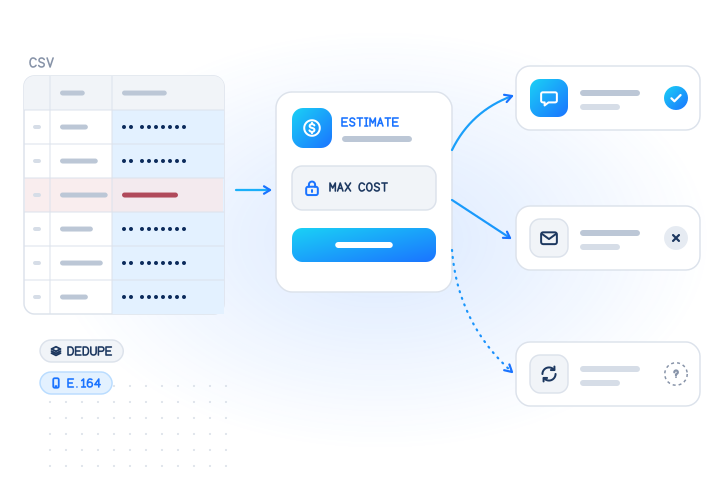
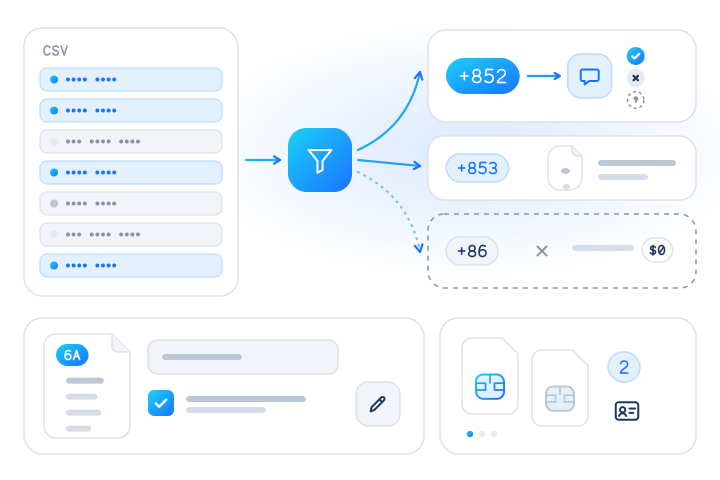
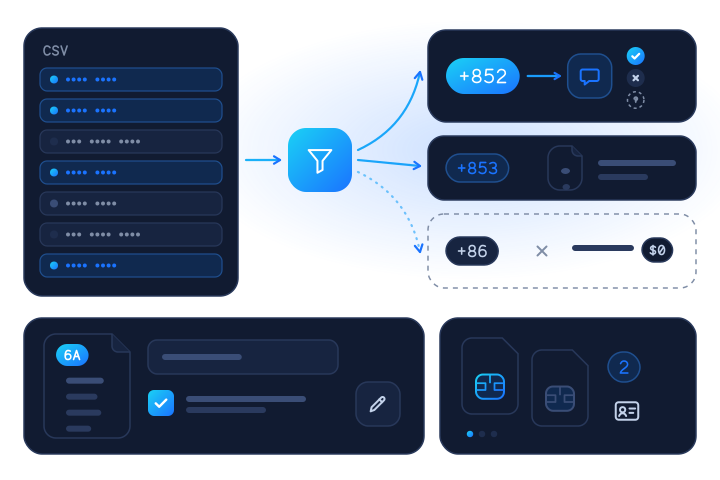
To check a list of Hong Kong numbers for WhatsApp, convert every row to E.164 (+852 and eight digits), split off the mainland China (+86) and Macau (+853) rows, remove duplicates, upload the file as a bulk job with the whatsapp check, read the free estimate, and download one answer per number: registered, not registered or unknown. On 20 November 2026 the bulk price was US$0.00025 per conclusive answer, so 10,000 numbers cost at most US$2.50. Our bulk WhatsApp check does not cover mainland China numbers, and in Hong Kong any marketing message you send afterwards needs consent under Part 6A of the Personal Data (Privacy) Ordinance.
This guide covers what is specific to Hong Kong. The general flow is in our bulk WhatsApp number check guide, and the numbering plan, mobile blocks and porting rules are in our Hong Kong phone number format guide. Facts are as of 20 November 2026, and every price carries its date. This is general guidance, not legal advice.
How do you format Hong Kong numbers for a WhatsApp check?
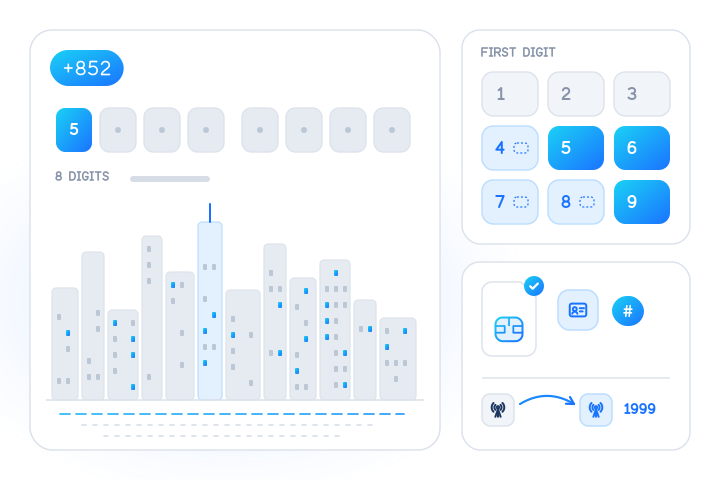
Hong Kong is the easy case for the number itself: eight digits, no area code, no trunk 0, so the international form is just +852 in front of what the customer typed. The hard part is that a Hong Kong customer list is rarely only Hong Kong. Shops, schools, banks and logistics firms collect numbers from people who live across the border or in Macau, and all three plans end up in one column. These cells are typical:
| Cell in your file | What it is | Fix |
|---|---|---|
5XXX XXXX | Hong Kong mobile, as dialled at home | Add +852 |
+852 5XXX-XXXX | Hong Kong, international, with a dash | Remove the spaces and dash |
852 5XXXXXXX | International without the plus | Add +. Safe, because OFCA reserves the local block 852, so no local number starts with it |
00852 5XXX XXXX | Dialled from abroad with 00 | Rewrite 00852 to +852 before parsing (see below) |
+86 13X XXXX XXXX | Mainland China mobile, 11 digits | Own group: not covered by the bulk WhatsApp check |
13XXXXXXXXX | Mainland mobile typed without a code | Own group, as +86 |
+853 6XXX XXXX | Macau mobile | Own group, as +853 |
6XXX XXXX with no code | Hong Kong or Macau: both use eight digits and mobiles starting 6 | Treated as Hong Kong by default; ask the country on the form |
8.52512E+10 | A spreadsheet stored the number as a value | Can't be fixed: re-export the column as text |
The 00852 row is a Hong Kong trap. OFCA assigns 008 as an international access code, and libphonenumber's dialling-prefix rule for Hong Kong accepts 00 plus an optional digit. So 00852 5XXX XXXX is read as 008, then country code 52 (Mexico), and fails. Our format guide shows the raw library result.
This sorter rewrites 00 for the three codes, tries a bare 11-digit mainland mobile as +86, and returns the E.164 number with its group, so each group can go into its own file:
import { parsePhoneNumberFromString } from "libphonenumber-js/max";

/** One Hong Kong list cell → { e164, group }, group = "HK" | "CN" | "MO" | null. */
export function sortHkCell(raw) {
  let s = String(raw).trim();
  if (/^\d(\.\d+)?E\+\d+$/i.test(s)) return { e164: null, group: null };        // 8.52E+10: digits lost
  s = s.replace(/^00(?=\s*(852|853|86))/, "+");               // 00852 would parse as 008 + 52
  let p = parsePhoneNumberFromString(s, "HK");
  if (!p?.isValid() && /^1[3-9]\d{9}$/.test(s.replace(/[\s-]/g, ""))) p = parsePhoneNumberFromString(s, "CN"); // bare 11-digit mainland mobile
  if (!p?.isValid()) return { e164: null, group: null };
  if (p.country === "HK" && p.getType() === "MOBILE") return { e164: p.number, group: "HK" };
  if (p.country === "CN" || p.country === "MO") return { e164: p.number, group: p.country };
  return { e164: null, group: null };
}
We ran it on 2026-11-20 with Node 24 and libphonenumber-js 1.13.15 (metadata 9.0.41), on libphonenumber's example numbers. Digits are masked with X:
| Input | e164 | group |
|---|---|---|
51XX XXXX | +85251XXXXXX | HK |
+852 51XX XXXX | +85251XXXXXX | HK |
00852 51XX XXXX | +85251XXXXXX | HK |
852-51XX-XXXX | +85251XXXXXX | HK |
(852) 51XXXXXX | +85251XXXXXX | HK |
51XXXXX (seven digits) | null | null |
41XX XXXX (spare block) | null | null |
21XX XXXX (fixed line) | null | null |
81XX XXXX (personal number) | null | null |
+86 139 XXXX XXXX | +86139XXXXXXXX | CN |
0086139XXXXXXXX | +86139XXXXXXXX | CN |
139XXXXXXXX | +86139XXXXXXXX | CN |
+853 66XX XXXX | +85366XXXXXX | MO |
66XX XXXX | +85266XXXXXX | HK |
8.52512E+10 | null | null |
The first five rows are one customer and collapse into one number, so the duplicate count is honest. The 66XX XXXX row shows the one ambiguity left: without a code, an eight-digit 6 number is read as Hong Kong, which may be wrong for a Macau customer. If your form serves both cities, store the country next to the number.
Which Hong Kong numbers should you drop before the check?
Drop everything that isn't a Hong Kong mobile, and don't rely on the first digit. OFCA's allocation dataset (OFCA numbering plan) mixes services under the same leading digits:
| First digits | What they are | Keep for a WhatsApp check? |
|---|---|---|
5, 6, 9 (most blocks) | The original mobile ranges | Yes |
4, 7, 8 (some blocks) | Mobile blocks opened from 2018 as 5, 6 and 9 ran short | Yes, if your library knows the block |
58 | Fixed services | No |
81–83 | Mostly personal numbers | No |
Parts of 7 (for example 710, 711, 716) | Pagers | No |
2, 3 | Fixed lines | No |
Spare blocks such as 43, 45, 48, 49, 72, 73 | Right shape, nobody holds them | No |
Two consequences for an old list. A regex written before 2018, such as "eight digits starting 5, 6 or 9", silently drops real customers on 4, 7 and 8 mobiles. And a regex that accepts any 4–9 start lets personal numbers and spare blocks through. OFCA keeps assigning spare blocks, so update your validation library at least monthly; the format guide has the full block table. The free phone list cleaner runs the same metadata in your browser.
Don't read the operator from the prefix either. Mobile number portability has run in Hong Kong since 1 March 1999, and OFCA counted 50,987 successful ports in March 2026 alone (figures in our format guide). For a WhatsApp check the operator doesn't matter.
Why does the WhatsApp check not cover mainland China numbers?
Because the check we sell isn't available for +86 in bulk jobs. Our public catalog (GET /v1/services), fetched on 2026-11-20, lists CN under unsupported_countries for the WhatsApp registration check in batch mode. In a job those rows are answered unsupported_country and are never billed, so a mixed file doesn't cost you more. It just doesn't tell you anything about the mainland rows.
What to do with them:
- Split them off before upload. The sorter above puts them in group
CN. Keeping them out of the Hong Kong file also keeps the estimate readable. - Use the channel the customer gave you. If a mainland customer opted in to SMS or e-mail, keep using it. Don't assume they can or can't be reached on WhatsApp.
- Check that the number works, not the app. A live network status (HLR) check tells you whether a
+86mobile is reachable. Our China phone number format guide covers the 11-digit plan.
Macau (+853) is a different case: it is not on the unsupported list, so Macau rows are checked. They count as their own country for the bulk minimum, though, so a few dozen Macau customers inside a Hong Kong file run at the real-time price. Our Macau phone number format guide covers the plan; put Macau rows in their own job once you have 132 or more.
How do you check a list of Hong Kong numbers on WhatsApp?
Five steps, from export to answers:
- Export only customers who gave you their number, for a purpose they would expect. Format the phone column as text. Leave out bought lists, scraped numbers and number ranges.
- Sort and dedupe. Run every cell through a sorter like the one above. Keep
HKrows for this job, setCNandMOrows aside, and fixnullrows by hand. - Estimate for free. Upload the file in the dashboard (Bulk jobs › Upload a list), or send the numbers to
POST /v1/jobs/estimate. Nothing is checked or charged; you see the maximum cost, the duplicates and any country group below the bulk minimum. - Run with a cost cap. Start the job with
max_costset to the estimate, and choosewhatsapp, orwhatsapp.businessif you also want to know which numbers use a WhatsApp Business account. - Download and join back. The result file keeps a
row_noper input row, so join it to your own file by row number. Store each answer with itschecked_atdate.
A job holds up to 50,000 numbers, and a dashboard file can be up to 10 MB. Larger exports go into several jobs. The bulk jobs docs cover formats and limits.
Worked example: CSV in, columns out
This is a real test-mode job, run on 2026-11-20 with the public sandbox key. The sandbox accepts only our test values, which are UK numbers from the +44 7700 900xxx drama range, so it shows the file format and the answer types, not Hong Kong data. With a live key you upload the HK rows from the sorter. The input has a duplicate in its last row:
phone,crm_ref
+447700900001,HK-0001
+447700900002,HK-0002
+447700900003,HK-0003
+447700900005,HK-0004
+447700900006,HK-0005
+447700900002,HK-0006curl https://api.mobilevalidate.com/v1/jobs \
-H "Authorization: Bearer $MOBILEVALIDATE_API_KEY" \
-H "Idempotency-Key: hk-customers-2026-11-20" \
-F file=@customers.csv -F checks=whatsapp
# then: GET /v1/jobs/{id}?wait=30 and GET /v1/jobs/{id}/download?format=csvThe job reported "progress": {"total": 6, "checks_total": 6, "done": 6, "conclusive": 3, "non_billable": 6}; test keys never bill. Selected columns of the downloaded CSV:
| row_no | e164 | number_status | whatsapp.registered.status | whatsapp.registered.registered | whatsapp.registered.billed |
|---|---|---|---|---|---|
| 1 | +447700900001 | valid | completed | true | false |
| 2 | +447700900002 | valid | completed | false | false |
| 3 | +447700900003 | valid | unknown | false | |
| 4 | +447700900005 | valid | unsupported_country | false | |
| 5 | +447700900006 | valid | completed | true | false |
| 6 | +447700900002 | duplicate |
Row 4 is what a +86 row looks like in a live Hong Kong job: unsupported_country, no answer, no charge. Row 3 is an unknown: no conclusive answer, never billed, worth a retry later. Keep the empty registered cell apart from false. Row 6 is the duplicate, which is not checked twice. The crm_ref column isn't returned, so row_no is how you join back. With a live key, each conclusive row is billed once.
What does it cost?
From our public catalog, fetched on 2026-11-20:
| Check | Bulk job, per answer | 10,000 Hong Kong numbers, at most |
|---|---|---|
WhatsApp registration (whatsapp) | US$0.00025 | US$2.50 |
WhatsApp Business account (whatsapp.business) | US$0.0003 | US$3.00 |
The bulk price needs at least 132 numbers from the same country in one job. Smaller country groups, such as a handful of Macau rows, run at the real-time price, which is on the pricing page, and the estimate lists them first. Only conclusive answers are billed: unknown, unsupported (all +86 rows), invalid and duplicate rows are free, and so are repeats served from your account's cache.
A worked example with made-up figures: a retailer exports 12,400 membership rows. The sorter keeps 10,000 unique Hong Kong mobiles, finds 1,600 +86 and 140 +853 numbers, and drops 660 duplicates, landlines and broken cells. The Hong Kong job costs at most 10,000 × US$0.00025 = US$2.50. The 140 Macau numbers clear the 132 minimum and cost at most 140 × US$0.00025 = US$0.035 in their own job. The mainland rows aren't sent at all.
Is WhatsApp worth it for messaging Hong Kong customers?
It depends on the message type. Hong Kong has its own row on Meta's rate card, and it is cheaper than the regional rate for marketing but dearer for everything else. From our rate-card dataset, transcribed from Meta's USD rate cards:
| WhatsApp category, per delivered message | 1 July 2026 (Hong Kong) | 1 October 2026 (Hong Kong) | 1 October 2026 (Rest of Asia Pacific, for comparison) |
|---|---|---|---|
| Marketing | US$0.0732 | US$0.0732 | US$0.0842 |
| Utility | US$0.0260 | US$0.0260 | US$0.0113 |
| Authentication | US$0.0260 | US$0.0260 | US$0.0113 |
| Authentication-international | none | none | none |
| Service | free | US$0.0260 | US$0.0113 |
Three things follow. Hong Kong's rates didn't change on the October card, apart from service messages becoming chargeable. Since 1 October 2026 Meta charges service messages after a free tier of 1,000 delivered service messages per business phone number per month (details in our WhatsApp Business API pricing guide). And a Hong Kong utility or authentication message lists at more than twice the Rest of Asia Pacific rate, so for OTPs compare it with the SMS rate on your own invoice; our WhatsApp OTP vs SMS OTP cost guide shows how.
Meta charges only delivered messages, so a template sent to a number without WhatsApp costs nothing on the Meta side. The check pays off elsewhere: you know before a campaign or an OTP flow which customers need SMS from the start, so you don't wait for a failed delivery before falling back, and you can size the WhatsApp budget. With the figures above, if 6,000 of the 10,000 checked customers are registered and opted in to offers, one marketing template to them lists at 6,000 × US$0.0732 = US$439.20, against US$2.50 for the check. The WhatsApp cost calculator does this sum for your own volumes.
How many Hong Kong numbers are on WhatsApp?
We don't quote a share, and you shouldn't plan with one. DataReportal's Digital 2026 report for Hong Kong counts 20.9 million cellular mobile connections at the end of 2025, equal to 283% of the population, with 7.16 million internet users (96.8%) and 6.24 million social media user identities (84.4%) (DataReportal, 2025). It gives no WhatsApp figure.
Nearly three connections per resident is the useful fact for a list. Many people carry a second SIM, often a mainland or travel SIM, and some connections are data-only or machine-to-machine. The number a customer typed into your form may not be the one their WhatsApp account uses, so a not-registered answer can belong to a working number. Checking your own list beats any national average.
What do Hong Kong's laws require before you check or message?
Summaries of the primary texts, read on 2026-11-20. Not legal advice; ask Hong Kong counsel how they apply to you.
PDPO Part 6A: direct marketing needs notice and consent
Part 6A of the Personal Data (Privacy) Ordinance (Cap. 486), sections 35A to 35M, has governed direct marketing since 1 April 2013. The Privacy Commissioner's Guidance on Direct Marketing (April 2023 revision) explains it:
- What it covers. Offering or advertising goods, facilities or services, or soliciting donations, by sending information to specific persons by name, by mail, fax, e-mail or "other means of communication", or by calling specific persons. A WhatsApp offer sent to a named customer in your CRM fits that description.
- Before you use the data. Tell the customer that you intend to use their personal data in direct marketing and may not do so without consent, which kinds of data you will use and which classes of products or services you will market, and give them a free response channel to consent (section 35C).
- Consent must be explicit. Consent includes an "indication of no objection", but the customer must have indicated it explicitly: in the guidance's words, "silence does not constitute consent". Don't bundle it with the terms of service; the guidance recommends a separate tick box or signature.
- First message and opt-out. The first time you use the data in direct marketing, tell the customer they can ask you to stop, free of charge (section 35F), and stop when they ask, at any time (section 35G). Keep an opt-out list that every team and agent reads.
- Penalties. Each of these offences carries a maximum fine of HK$500,000 and three years' imprisonment. Providing personal data to another person for their direct marketing has its own written-consent rules, with up to HK$1,000,000 and five years where it is done for gain.
A WhatsApp registration check is not itself a marketing message. Our view is that you should run it only on numbers you hold for a purpose the customer would expect, such as choosing the channel that reaches them for a service they signed up to, and that the answer doesn't replace the Part 6A consent for any offer you send afterwards. Our consent and law guide covers the same reasoning in other regions.
The Unsolicited Electronic Messages Ordinance (Cap. 593)
The Unsolicited Electronic Messages Ordinance governs commercial electronic messages with a Hong Kong link and is enforced by OFCA. The Government's summary for businesses (InfoSec, 2026) lists the core duties: include accurate sender information, provide a working unsubscribe facility with a clear and conspicuous statement, honour unsubscribe requests, don't send to telephone or fax numbers on the do-not-call registers without the registered user's consent, and don't hide caller line identification. The PCPD guidance points to this Ordinance for messages that aren't addressed to a person by name. Both regimes can apply to the same campaign, so meet both.
Real-name SIMs and WhatsApp's own opt-in rule
Since 24 February 2023 every SIM card issued and used locally must complete real-name registration before activation or continued service; about 12 million cards had registered by the deadline (Hong Kong Government, 2023). That makes a working Hong Kong mobile a registered one, but the operators hold the records. A check returns no name or ID, and a registered SIM is not consent.
WhatsApp's Business Messaging Policy (last updated 23 September 2026) says you may only contact people on WhatsApp if they have given you their number and you have received opt-in permission to message them, and that you must respect every request, on or off WhatsApp, to block, discontinue or opt out (WhatsApp, 2026). A registered: true answer is a fact about the number, not permission to message it.
On our side, requests with 20 or more consecutive numbers are refused as suspected enumeration, each account has a daily cap, and our acceptable use policy forbids unsolicited bulk messaging and checking ranges to find out who uses an app. Anyone can object through the opt-out form.
What do you do with the answers?
Route each customer to a channel that reaches them, and keep the answer with its date:
| Answer | What it means | What to do |
|---|---|---|
registered: true, opted in under Part 6A | Account exists, consent on file | Send what they asked for on WhatsApp; keep SMS as the fallback |
registered: true, no marketing consent | Account exists | Service messages only; ask for consent at the next contact they expect |
registered: false | No account on this number | SMS (registered # sender IDs for alerts), e-mail or a call |
unknown | No conclusive answer | Keep the current channel, re-check later; free |
unsupported_country | A +86 row in the file | Move it to the mainland group; free |
null from your sorter | Not a valid Hong Kong mobile | Fix the record by hand, or ask the customer |
For the not-registered group, an HLR check answers the next question: is the number reachable on its network at all? With so many second SIMs in Hong Kong, an unreachable number is often a SIM the customer no longer uses, so confirm the number before you pay for SMS to it. Treat unknown as missing data, never as a dead number, and don't overwrite a stored conclusive answer with an unknown one. Our list cleaning guide shows how to combine the checks.
Re-check before each campaign to opted-in customers, oldest answers first. With tens of thousands of ports a month and SIMs lapsing, a list from last year has drifted.
How do you start with MobileValidate?
The checks for this guide are WhatsApp number check, WhatsApp Business check and live network status (HLR). All three take Hong Kong numbers in bulk jobs and in real time; for lists, use bulk jobs. You don't need a WhatsApp account, a phone or a QR pairing.
- Free, today. Get a free test key to build against fixed test answers, and run the free estimate on any file before you pay. To look at one number without an account, the free carrier lookup answers three a day.
- Real checks free. Every live account can check 100 phone numbers and 20 e-mail addresses for real, free, on the dashboard's Try it page. Request access to open one.
- Then prepay. Top-ups of US$100 or more get a 5% bonus, US$500 or more 8%, and US$2,000 or more 10%. Current prices are on the pricing page.
Results are kept for your account's retention setting, 30 days by default, and you can delete a job's results at any time. A check returns registration facts only, never a name, ID card number or address. WhatsApp is named descriptively; MobileValidate is not affiliated with WhatsApp, Meta, OFCA or the PCPD.
What are the key takeaways?
- Hong Kong numbers are
+852plus eight digits with nothing dropped; rewrite00852to+852before parsing, or it is read as008plus Mexico's52. - Sort
+852,+86and+853rows into separate files. Our bulk WhatsApp check does not cover mainland China; those rows answerunsupported_countryand are free. - Validate with current metadata: mobiles sit under
4to9, but58,81–83, pager blocks and spare blocks are not mobiles. - Bulk WhatsApp checks cost US$0.00025 per conclusive answer (catalog, 2026-11-20): at most US$2.50 for 10,000 numbers, with at least 132 numbers per country in a job.
- On the 1 October 2026 card, a delivered WhatsApp marketing message to Hong Kong lists at US$0.0732 and utility, authentication and service messages at US$0.0260.
- Marketing under PDPO Part 6A needs notice, a free response channel and explicit consent, an opt-out notice on first use and a working opt-out list; Cap. 593 adds sender information, unsubscribe and do-not-call duties.
Sources
- Guidance on Direct Marketing (April 2023, first revision) — Office of the Privacy Commissioner for Personal Data, Hong Kong, 2023
- Unsolicited Electronic Messages Ordinance (Cap. 593) — Hong Kong e-Legislation, Department of Justice, 2026
- Observing UEMO (page reviewed November 2026) — InfoSec, Hong Kong SAR Government, 2026
- The Numbering Plan for Telecommunications Services in Hong Kong: allocation and assignment of Hong Kong telephone numbers (dataset) — Office of the Communications Authority (via DATA.GOV.HK), 2026
- Service reactivation arrangements for deactivated pre-paid SIM cards not having completed real-name registration before deadline (press release, 24 February 2023) — Hong Kong SAR Government, 2023
- WhatsApp Business Messaging Policy (last updated 23 September 2026) — WhatsApp, 2026
- Digital 2026: Hong Kong — DataReportal (Kepios), 2025
Frequently asked questions
How do I format Hong Kong numbers for a WhatsApp check?
Put +852 in front of the eight local digits and drop nothing: 5XXX XXXX becomes +8525XXXXXXX. Hong Kong has no area codes and no trunk 0. Rewrite a leading 00852 to +852 before parsing, because libphonenumber reads 00852 as the access code 008 followed by 52, Mexico's country code.
Does the bulk WhatsApp check cover mainland China numbers?
No. As of 20 November 2026 our public catalog lists mainland China (+86) as unsupported for the WhatsApp registration check in bulk jobs. Those rows come back unsupported_country and are never billed. Split +86 customers into their own file and reach them on the channel they gave you.
How much does a bulk WhatsApp check of Hong Kong numbers cost?
On 20 November 2026 our catalog listed the WhatsApp registration check at US$0.00025 per conclusive answer in bulk jobs, so 10,000 Hong Kong numbers cost at most US$2.50. The bulk price needs at least 132 numbers from the same country in one job. Unknown, unsupported, invalid and duplicate rows are free.
Which Hong Kong numbers are mobile numbers?
Mobile blocks sit under the first digits 4, 5, 6, 7, 8 and 9, but not every block under those digits is mobile. 58 is a fixed service, 81 to 83 are mostly personal numbers, parts of 7 are pagers and many blocks are still spare. Validate with an up-to-date library and the region HK, not a first-digit rule.
Do I need consent under the PDPO to message Hong Kong customers on WhatsApp?
For marketing, yes. Part 6A of the Personal Data (Privacy) Ordinance requires you to tell customers how you will use their data in direct marketing, give them a free response channel and get their consent first. Silence is not consent. You must also tell them of their opt-out right the first time you use their data, and stop when asked.
What does a WhatsApp marketing message to Hong Kong cost?
On Meta's USD rate card effective 1 October 2026, as transcribed in our dataset, a delivered marketing template to a Hong Kong number lists at US$0.0732, and utility, authentication and service messages at US$0.0260. Hong Kong has no authentication-international rate on that card. Meta charges only delivered messages.
Is a Hong Kong number on WhatsApp proof of who owns it?
No. Every SIM used locally has been real-name registered since 24 February 2023, but the operators hold those records and no lookup, ours included, returns a name or ID. Our check answers only whether the number has a WhatsApp account: registered, not registered or unknown.
Related services and guides
- ServiceCheck if a phone number is registered on WhatsApp
- ServiceCheck if a number is a WhatsApp Business account
- ServiceHLR lookup API: live mobile network status
- DatasetWhatsApp Business Platform rate cards (USD), 2026-07 and 2026-10
- Free toolPhone list cleaner: dedupe and normalize to E.164
- DocsBulk jobs
More from the blog
All articlesGuides
Hong Kong phone number format: +852, mobile prefixes, validation and messaging rules
Hong Kong phone number format: +852 and 8 digits, no area codes or trunk 0, which first digits are mobile, tested validation code, porting and SIM rules.
13 min read
Guides
Bulk WhatsApp number check: how to verify a customer list (CSV upload or API)
Check WhatsApp numbers in bulk: prepare a CSV, get a free estimate, cap the cost, run the job in the dashboard or API, and act on each answer.
8 min read
Guides
China phone number format (+86): how to validate Chinese mobile numbers
Chinese mobiles are +86 plus 11 digits starting with 1 (blocks 13-19), no trunk 0; landlines use area codes. Operator blocks, tested code and porting.
11 min read