On this page
To check a list of South African numbers for WhatsApp, convert every row to E.164 (+27 and 9 digits, without the leading 0), drop the rows that aren't ordinary mobiles, remove duplicates, upload the file as a bulk job with the whatsapp check, read the free estimate, and download one answer per number: registered, not registered or unknown. South African mobiles start 06, 07 or 08 at home. The traps are short numbers that a phone library still calls mobile, 087 and 086 business numbers mixed into customer files, and numbers that ICASA's rules let operators recycle within about four months of going quiet. Check only numbers your customers gave you: POPIA needs a lawful basis for every check, and section 69 limits direct marketing to consenting people and your own customers.
This guide covers what is specific to a South African list. The general flow is in our bulk WhatsApp number check guide, and our number recycling and list decay post explains why old numbers drift. Facts are as of 8 November 2026, and every price below carries its date. This is general guidance, not legal advice.
How do you format South African numbers for a WhatsApp check?
Use the international form: +27, then the 9-digit number without its leading 0. South Africa dials out with 00, like most of the world, so 0027… is read correctly by phone libraries; the common problems are elsewhere:
| Cell in your file | What happened | Fix |
|---|---|---|
071 XXX XXXX | National format, as dialled at home (10 digits) | Drop the 0, add +27 |
+27 71 XXX XXXX | International, with spaces | Remove the spaces |
2771XXXXXXX | International without the plus (the wa.me link style), 11 digits | Add + |
+27 071 XXX XXXX or +27 (0)71 XXX XXXX | The trunk 0 kept after the country code | Drop the 0 |
0027 71 XXX XXXX | Dialled from South Africa or Europe with 00 | Replace 0027 with +27 (libraries do it) |
71XXXXXXX | A spreadsheet dropped the leading 0 | Add +27 |
083 XXXX | Truncated during data entry | Can't be fixed: ask the customer |
2.77112E+10 | A spreadsheet stored the number as a value and the export kept the display text | Can't be fixed: re-export the column as text |
The truncated row is the South African trap. libphonenumber's metadata for ZA accepts a few 5- to 8-digit numbers inside the 081 to 084 blocks as mobile. So a cell that lost its last digits, such as 083 1234, passes "is it a valid mobile?" in most validators. Every ordinary South African mobile has 9 digits after +27, so check the length as well.
Our free phone list cleaner converts and dedupes a file of up to 50,000 rows in your browser; pick South Africa as the default country, then filter out anything shorter than 9 digits after +27. For your own pipeline, this converter does both and returns null for anything that isn't an ordinary South African mobile:
import { parsePhoneNumberFromString } from "libphonenumber-js/max";

/** One South African list cell → E.164 mobile (+27 and 9 digits), or null. */
export function toE164Za(raw) {
  const s = String(raw).trim();
  if (/^\d(\.\d+)?E\+\d+$/i.test(s)) return null;  // 2.77112E+10: the spreadsheet already lost digits
  const p = parsePhoneNumberFromString(s, "ZA");    // 07…, 27…, +27 0…, 0027…, 7…
  return p?.isValid() && p.country === "ZA" && p.getType() === "MOBILE"
    && p.nationalNumber.length === 9                // the metadata also accepts 5- to 8-digit numbers in 081–084
    ? p.number : null;
}
We ran it on 2026-11-08 with Node 24 and libphonenumber-js 1.13.15 (metadata 9.0.41), on libphonenumber's own example numbers for South Africa and Zimbabwe:
| Input | Output |
|---|---|
071 123 4567 | +27711234567 |
+27 71 123 4567 | +27711234567 |
27711234567 | +27711234567 |
+27 (0)71 123 4567 | +27711234567 |
0027 71 123 4567 | +27711234567 |
711234567 | +27711234567 |
2.77112E+10 | null |
060 123 4567 (the newer 06 range) | +27601234567 |
085 123 4567 | +27851234567 |
083 1234 (truncated) | null (valid MOBILE without the length check) |
052 123 4567 (open for mobile in ICASA's plan, no numbers in the library yet) | null |
080 123 4567 (toll-free) | null |
087 123 4567 (VoIP) | null |
010 123 4567 (a Johannesburg-area landline) | null |
+263 71 123 4567 (a Zimbabwean mobile) | null |
The first six rows are the same customer and collapse into one number after conversion. Rows from other countries return null on purpose. South African customer files often hold Zimbabwean (+263), Lesotho (+266), Botswana (+267) or Mozambican (+258) numbers; keep them in their own file, or keep their + form and let the job read their country.
Which South African numbers should you set aside before the check?
From ICASA's numbering plan and libphonenumber's metadata for ZA:
| Range | What it is | What to do |
|---|---|---|
060–079, 081–085 | Mobile | Check |
050, 0191, 0192 | Smaller mobile blocks | Check |
052, 055, 059 | Open for mobile in the plan, not yet in the library | Log and keep for a re-run after a library update |
080 | Toll-free | Drop |
086 | Inbound services | Drop |
087 | VoIP | Drop: usually an office line, not a person's mobile |
090–092 | Premium rate | Drop |
096–098 | Machine-related services | Drop |
010–058 area codes | Landlines | Drop for a WhatsApp check |
087 deserves a second look in business-to-business files, where it often appears as a company's main line. Our converter returns null for it because it isn't a mobile number. If you need to know how a business customer prefers to be reached on WhatsApp, ask for the number; don't guess from the range.
Don't use the prefix to name the network either. Numbers have been portable for years, and "082 is network A" only tells you who the block was first given to. For a WhatsApp check the operator doesn't matter; for SMS routing it does, which is what an MNP lookup is for.
How do you check a list of South African numbers on WhatsApp?
Five steps, from export to answers:
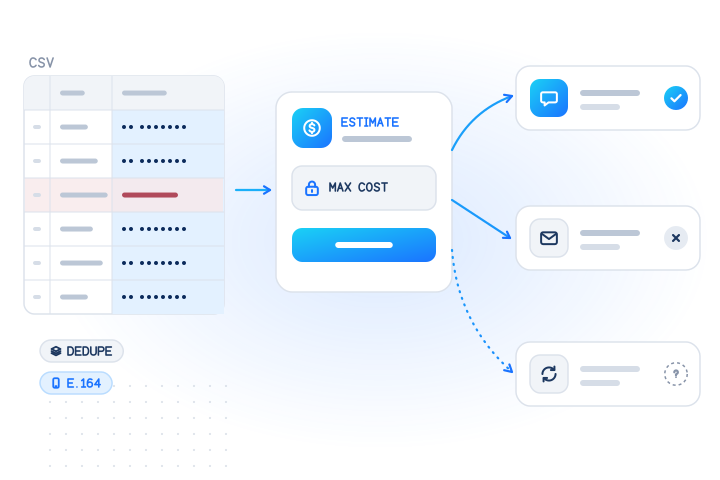
- Export only customers who gave you their number, with your own ID column. Format the phone column as text. Leave out bought lists, lead-generator files and number ranges.
- Convert and dedupe. Run every cell through a converter like the one above, or the free list cleaner. Set the
nullrows aside. - Estimate. Upload the file in the dashboard (Bulk jobs › Upload a list) and pick South Africa for numbers written without
+, or send the numbers toPOST /v1/jobs/estimatewith"default_country": "ZA". The estimate is free, checks nothing and stores nothing. - Run with a cost cap. Start the job with
max_costset to the estimate. For a list older than a few months, addnumber.hlr, which tells you whether each line still works. - Download and join back by row number. The result file keeps your row order (
row_no), not your own IDs, and masks the input. Store each answer with itschecked_atdate.
A job holds up to 50,000 numbers, and a dashboard file can be up to 10 MB. Bigger exports go into several jobs.
How do you sort the results into channels?
Here is a real job run with the public sandbox key on 2026-11-08. The sandbox accepts only our test values, which are UK drama-range numbers, so this shows the format, not South African data. The file has five rows, and the last one repeats row 2:
printf 'phone\n+447700900001\n+447700900002\n+447700900006\n+447700900003\n+447700900002\n' > za-list.csv

curl https://api.mobilevalidate.com/v1/jobs \
  -H "Authorization: Bearer mv_test_publicSandboxn9ZgneuhR1B9CRfKG3fulym" \
  -F file=@za-list.csv -F checks=whatsapp.business,number.hlr -F max_cost=5 -F default_country=ZA
The job's estimate counted 5 rows, 4 valid and 1 duplicate. We downloaded the results with GET /v1/jobs/{id}/download?format=ndjson into results.ndjson and sorted them with jq, putting a line that no longer answers ahead of anything else, because in South Africa a dead line may soon be someone else's:
jq -r '[.row_no,
  (if .number_status == "duplicate" then "skip: duplicate of an earlier row"
   elif ."number.hlr.status" == "unreachable" then "confirm the number first"
   elif ."whatsapp.business.registered" == true then "whatsapp"
   elif ."whatsapp.business.registered" == false then "sms"
   else "unknown: keep current channel" end)] | @tsv' results.ndjson
It printed:
1	whatsapp
2	confirm the number first
3	whatsapp
4	unknown: keep current channel
5	skip: duplicate of an earlier row
Row 3 is also a WhatsApp Business account ("whatsapp.business.business": true in the file). Row 4 is unknown for both checks and row 5 is a duplicate; neither is ever billed (nothing is billed here because test keys never bill). The estimate also put the four test numbers on a small_batch line at the real-time price, because the bulk price needs at least 132 numbers from the same country in one job. A South African list clears that easily; the handful of Zimbabwean or Botswana customers in it may not. Details are in the bulk jobs docs.
What does it cost?
From our public catalog (GET /v1/services), fetched on 2026-11-08:
| Check | Bulk job, per 1,000 | Real time, per 1,000 |
|---|---|---|
WhatsApp registration (whatsapp) | US$0.25 | US$4.00 |
WhatsApp Business account (whatsapp.business) | US$0.30 | US$4.00 |
Number portability, MNP (number.mnp) | US$2.00 | US$2.00 |
Live network status, HLR (number.hlr) | US$5.00 | US$6.00 |
Only conclusive answers are billed. Unknown, invalid, duplicate and unsupported rows are free, and so are repeats served from your account's cache. Prices can change; the pricing page always has the current ones.
A worked example with made-up figures: an insurer's 60,000-row lead file from 2025 converts to 51,000 unique valid mobiles; the rest are duplicates, 087 switchboards, landlines and truncated cells. Because the file is old, the insurer runs both checks. The WhatsApp job costs at most 51,000 × US$0.00025 = US$12.75, and the HLR job at most 51,000 × US$0.005 = US$255.00. The HLR answers are what separate customers who still hold their number from numbers that may have been reissued.
Why does a South African list go stale so fast?
Because the regulator sets a short recycling clock. ICASA's Numbering Plan Fourth Amendment Regulations were published in Government Gazette 54930 on 1 July 2026 and announced on 2 July (ICASA, 2026; Gazette 54930). For prepaid mobile numbers (postpaid is excluded), regulation 6A now says:
- after 60 consecutive days without revenue-generating activity (a call, SMS, data or a value-added service), the operator notifies the subscriber that it intends to deactivate the number;
- a 30-day grace period follows, with at least two reminders, the last on the day before deactivation;
- a deactivated number is quarantined for one month and then returns to the pool;
- a subscriber who expects not to use the number can ask for an exemption of up to 183 days.
ICASA gave operators six months to adapt their systems, so the new clock applies fully from about January 2027. The rule it replaces was shorter still. Either way, a customer who stopped topping up a SIM in the spring can have lost that number, and a stranger can have it, before the year is out.
For a WhatsApp check, that has two consequences. First, registered: true says an account exists on the number today, not that it belongs to the customer who gave it to you; the new holder may have registered it. Second, the HLR check is the cheap guard: a number that is unreachable now is one to confirm before you send anything personal to it. Our post on checking recycled numbers before reuse goes through the method.
Two more ICASA moves are on the way: draft Fifth Amendment Regulations published in late October 2026 would require biometric checks against Home Affairs records for activations, reactivations and SIM swaps, and cap each subscriber at five numbers per operator. As of 8 November 2026 they are a draft for comment.
How big is the pool? ICASA's State of the ICT Sector report counted 117.3 million mobile subscriptions at 30 September 2025, 96.5 million of them prepaid, and 91.4 million active in the previous 90 days (ICASA, 2026). DataReportal counts 127 million cellular connections against a population of 64.9 million, 51.7 million internet users and 29.1 million social media user identities in late 2025 (DataReportal, 2025). Neither gives a WhatsApp figure, and neither describes your list. More connections than people means many customers carry two or more SIMs, so a not-registered answer can be a working second line.
How much do WhatsApp messages to South Africa cost?
South Africa has its own row on Meta's rate card, and it went up on 1 October 2026. From our rate-card dataset, transcribed from Meta's USD rate cards:
| WhatsApp category, South Africa | 1 July 2026 | 1 October 2026 |
|---|---|---|
| Authentication | US$0.0076 | US$0.0095 |
| Authentication-international | US$0.0200 | US$0.0200 |
| Utility | US$0.0076 | US$0.0095 |
| Marketing | US$0.0379 | US$0.0379 |
| Service (after 1,000 free per number per month) | free | US$0.0095 |
Prices are per delivered message, and a message to a number without WhatsApp isn't delivered or charged. Authentication and utility rose by 25% on the October card, and service messages beyond the free tier became paid.
The authentication-international gap is smaller here than in other markets. South Africa has had that rate since 1 February 2025. It applies to a business based in another country once it sends more than 750,000 messages outside customer service windows in a moving 30-day period to users in markets with such a rate, with 30 days' notice; Meta decides the business's country from public information such as where it or its parent company is listed (Meta, 2026). For South Africa it costs about twice the local rate on the October card, compared with about 11 times for Nigeria and 18 times for Egypt.
Marketing is the line to plan around: at US$0.0379, a marketing template costs four times a utility message. Our free WhatsApp cost calculator applies the October 2026 card to your own volumes, and our OTP cost by country research compares the international gap across markets. We don't quote South African SMS prices: they vary by route, sender ID and contract.
What do POPIA and section 69 require before you check or message?
These summarise the Protection of Personal Information Act 4 of 2013 (POPIA), its regulations as amended in 2025, and the Information Regulator's guidance, as read on 2026-11-08. We read the Act from a copy of Government Gazette 37067, because government sites refused our connections that day. Not legal advice.
Checking the list
POPIA applies to a responsible party domiciled in South Africa, and to one outside it that uses automated or non-automated means in South Africa (section 3). A customer's phone number is personal information, and checking it is processing, so it needs a lawful basis and a purpose your customers were told about, such as choosing the channel for messages they expect.
Sending the list abroad for a check is a transfer under section 72. MobileValidate's main servers are in the European Union (privacy policy); ask your counsel which section 72 ground applies, and ask us for the DPA.
Section 69: who you may market to
Section 69(1) prohibits direct marketing "by means of any form of electronic communication, including automatic calling machines, facsimile machines, SMSs or e-mail" unless the person:
- has consented, or
- is your customer, and then only if you got their details in the context of a sale of a product or service, you market your own similar products or services, and you gave them a free, simple chance to object when you collected the details and in every message since (section 69(3)).
You may approach a non-customer only once to ask for consent, and not at all if they refused before (section 69(2)). Every marketing message must identify the sender and give an address or other contact details where the person can ask you to stop (section 69(4)).
WhatsApp is named in the 2025 regulations
The amended POPIA Regulations, published on 17 April 2025 with immediate effect (Government Notice 6126, Gazette 52523), change how consent is collected:
- Consent may be obtained on a form substantially similar to Form 4, or in any manner that is expedient, free and reasonably accessible, and the listed channels include "SMS or WhatsApp" (regulation 6.1).
- A consent request made by phone must be recorded, and the recording or a transcript given to the person on request (regulations 6.2 and 6.3).
- "Opt-out shall not constitute consent" (regulation 6.4).
- Objections can be made by SMS or WhatsApp too (regulation 2.3).
So a one-time WhatsApp message asking for consent can be lawful, if the number is one you hold lawfully and the person hasn't refused before. A second ask after silence is not. The Regulator's Guidance Note on Direct Marketing of 3 December 2024 adds that the first message to a non-customer must be the consent request, that "silence cannot mean consent", and that you should keep a database of people who refused or objected (paragraphs 7.2.1, 7.3.3 and 7.3.5).
Enforcement so far
- First direct-marketing enforcement notice, February 2024. The Regulator found that FT Rams Consulting sent persistent marketing e-mails without consent, and that an opt-out link didn't cure it (Information Regulator, 2024). In its November 2025 briefing, the Regulator said the company was fined R100,000 for not complying with the notice and that it had gone to court to recover the fine (Information Regulator, 2025).
- A complaints channel for marketing. The same briefing said a direct-marketing category was added to the Regulator's online complaints portal in October 2025.
- Test cases in 2026. Law firms reported that at an August 2026 briefing the Regulator referred two section 69 matters, about telephone marketing, to its Enforcement Committee (Werksmans, 2026). We found no outcome as of 8 November 2026.
Administrative fines under section 109 go up to R10 million.
What does the National Opt-Out Registry change?
The Consumer Protection Act (CPA) has allowed for a national register to block direct marketing since 2008 (section 11(3)), but for years there was none. That changed in 2026:
- The CPA Amendment Regulations, 2026 were gazetted on 15 April 2026. A law firm's summary says they require direct marketers to register with the National Consumer Commission (NCC), renew each year, and clean their lists against the registry every month, for "telephone, email, SMS or other electronic communication", with penalties of up to R1 million or 10% of annual turnover (ENS via Legal 500, 2026).
- The NCC launched the National Opt-Out Registry on 7 October 2026. Marketer registration opened on 15 September 2026 and runs until December 2026, free list cleaning runs from December 2026 to April 2027, and consumers can register their block from May 2027 (NCC, 2026).
- The Information Regulator's position: POPIA consent is required "irrespective of whether" a person is on the block list, and opting out can never count as consent (Information Regulator, 2026).
So from 2027 a South African marketing list needs two filters: POPIA consent (or the customer exception) and a clean against the NCC registry. A WhatsApp check is neither. Run it on numbers that have passed both, to decide the channel, not the permission.
When may you send?
The CPA bans direct marketing to a consumer at home at prohibited times unless they agreed otherwise (section 12). The prohibited times are Sundays and public holidays, Saturdays before 09:00 and after 13:00, and other days between 20:00 and 08:00 (CPA notice R.293). The WASPA Code of Conduct, which binds its members' SMS and messaging traffic, applies the same windows, requires a free opt-out confirmation and "STOP" handling, and lets recipients ask where the sender got their number (WASPA Code 17.15, clauses 16.8 to 16.15). Schedule WhatsApp marketing inside the same hours, South African Standard Time (UTC+2). One-time passcodes and order updates aren't marketing and can go at any hour.
WhatsApp's own rules sit on top. Its Business Messaging Policy (last updated 23 September 2026) says you may only contact people on WhatsApp if they gave you their number and opted in to receive your messages (WhatsApp, 2026). A registered: true answer is a fact about a number, not permission. Our consent and law guide covers other regions.
What do you do with numbers that are not on WhatsApp?
Route them to a channel that reaches them, and keep the answer:
| Answer | What it means | What to do |
|---|---|---|
registered: true, consent or customer exception | Account exists | Send what they asked for on WhatsApp; keep SMS as the fallback |
registered: true, no marketing basis | Account exists | Service messages only; one consent request at most |
registered: false, HLR reachable | Working line without an account | SMS or a call; it may be a second SIM |
| HLR unreachable | Line off or deactivated | Confirm the number before you send; it may be reissued |
| Unknown | No conclusive answer | Keep the current channel, re-check later; free |
null from your converter | Truncated, non-mobile or not South African | Fix the record with the customer |
For SMS routing, an MNP lookup gives the current network, because the prefix doesn't. Treat unknown as missing data, never as a dead number, and don't overwrite a stored conclusive answer with an unknown one. Our list cleaning guide shows how to combine the checks.
On our side, a request with long runs of consecutive numbers is refused as suspected enumeration, each account has a daily cap, and our acceptable use policy forbids unsolicited bulk messaging and checking ranges to find out who uses an app. Anyone can object through the opt-out form.
How do you start with MobileValidate?
The checks for this guide are WhatsApp number check, WhatsApp Business check, live network status (HLR) and number portability (MNP). All four take South African numbers in real time and in bulk jobs. You don't need a WhatsApp account, a phone or a QR pairing.
- Free tools, no sign-up. Clean and dedupe the export with the phone list cleaner, check a few numbers' type with the phone number validator, look up a network code with the MCC/MNC lookup, write an opt-out line that fits with the WhatsApp text formatter, and price your messages with the WhatsApp cost calculator. They run in your browser; the tools page lists the rest. To look up one number's network without an account, the free carrier lookup answers three numbers a day.
- Free to build. Get a free test key to build against fixed test answers, and use the free estimate on any file before you pay.
- Real checks free. Every live account can check 20 phone numbers and 10 e-mail addresses for real, free, on the dashboard's Try it page. Request access to open one.
- Then prepay. Top-ups of US$100 or more get a 5% bonus, US$500 or more 8%, and US$2,000 or more 10%.
Results are kept for your account's retention setting, 30 days by default, and you can delete a job's results at any time. A check returns registration and network facts only, never a name, ID number or address. WhatsApp is named descriptively; MobileValidate is not affiliated with WhatsApp, Meta, ICASA, the Information Regulator, the NCC or WASPA.
What are the key takeaways?
- Convert every row to
+27and 9 digits before upload.07…,27…,+270…,0027…and7…are the same customer, and libraries handle0027because South Africa dials out with00. - Check the length: the metadata accepts some 5- to 8-digit numbers in
081–084as mobile, so truncated cells pass a plain validity check. Drop080,086,087and09xnumbers. - Bulk WhatsApp checks cost US$0.25 per 1,000 (catalog, 2026-11-08), with a minimum of 132 numbers per country group in one job. Unknowns and duplicates are free. Join results back by
row_no. - From 1 October 2026, WhatsApp authentication and utility messages to South Africa cost US$0.0095, marketing US$0.0379, and authentication-international US$0.0200, about twice the local rate.
- ICASA's 2026 rules let a quiet prepaid number be reissued within about four months, so re-check old lists with HLR before you send.
- POPIA section 69 allows marketing only with consent or to your own customers for similar products; the 2025 regulations accept consent by WhatsApp, and the NCC's opt-out registry adds a second filter from 2027. Never check bought or scraped lists.
Sources
- Protection of Personal Information Act 4 of 2013 (Government Gazette 37067, 26 November 2013) — Government of South Africa (copy hosted by SWGC), 2013
- Regulations relating to the Protection of Personal Information: amendment (Government Notice 6126, Gazette 52523, 17 April 2025) — Department of Justice and Constitutional Development, 2025
- Guidance Note on Direct Marketing in terms of POPIA (3 December 2024) — Information Regulator (South Africa), 2024
- Media statement: enforcement notice on a direct marketing complaint (27 February 2024) — Information Regulator (South Africa), 2024
- Media statement: the Information Regulator's latest update (13 November 2025) — Information Regulator (South Africa), 2025
- Media statement: Regulator notes the published Consumer Protection Act Amendment Regulations, 2026 (21 April 2026) — Information Regulator (South Africa), 2026
- The Regulator is watching: new enforcement signals for POPIA and PAIA compliance (31 August 2026) — Werksmans Attorneys, 2026
- NCC launches the National Opt-Out Registry to curb unwanted direct marketing (7 October 2026) — National Consumer Commission, 2026
- Newsflash: Consumer Protection Act Amendment Regulations, 2026 (29 April 2026) — ENS, via Legal 500, 2026
- Consumer Protection Act: prohibited time for contacting consumers (Notice R.293 of 2011) — Acts Online, 2011
- WASPA Code of Conduct, version 17.15 (September 2026) — Wireless Application Service Providers' Association (WASPA), 2026
- ICASA publishes final amendments to the Numbering Plan Regulations (2 July 2026) — Independent Communications Authority of South Africa (ICASA), 2026
- Numbering Plan Regulations, Fourth Amendment (Government Gazette 54930, Notice 3997, 1 July 2026) — ICASA, 2026
- The State of the ICT Sector Report of South Africa (31 March 2026) — ICASA, 2026
- Digital 2026: South Africa — DataReportal (Kepios), 2025
- Pricing on the WhatsApp Business Platform — Meta for Developers, 2026
- Authentication-international rates — Meta for Developers, 2026
- WhatsApp Business Messaging Policy (last updated 23 September 2026) — WhatsApp, 2026
Frequently asked questions
How do I convert 06, 07 and 08 numbers to +27 for a WhatsApp check?
Drop the leading 0 and add +27: 071 XXX XXXX becomes +27 71 XXX XXXX, and the same goes for 06 and 08 mobiles. Every ordinary South African mobile has 9 digits after +27, or 10 digits when written at home with the 0. A cell that starts with 27 only needs the plus, and 0027 becomes +27.
Why does my validator accept a 7-digit South African number?
libphonenumber's metadata for South Africa accepts some 5- to 8-digit numbers inside the 081 to 084 blocks as mobile. In our test with libphonenumber-js 1.13.15 on 2026-11-08, a truncated cell such as 083 1234 came back valid and typed as mobile. Add a check that the national number has exactly 9 digits before you upload.
How much does a bulk WhatsApp check of South African numbers cost?
On 2026-11-08 our public catalog listed the WhatsApp registration check at US$0.25 per 1,000 numbers in bulk jobs and US$4.00 per 1,000 in real time. The bulk price needs at least 132 numbers from the same country in one job. Unknown, invalid and duplicate rows are never billed. Current prices are on the pricing page.
How much does a WhatsApp message to South Africa cost?
South Africa has its own row on Meta's rate card. From 1 October 2026, authentication, utility and paid service messages cost US$0.0095 per delivered message, up from US$0.0076 on the July card, and marketing messages US$0.0379. A business based abroad that crosses Meta's volume threshold pays US$0.0200 for authentication, about twice the local rate.
Does POPIA allow WhatsApp marketing to my customers?
Section 69 of POPIA allows direct marketing by electronic communication only with the person's consent, or to your own customer whose details you got in a sale, for your own similar products, with a free chance to object at collection and in every message. You may ask a non-customer for consent once, and never again if they refused.
Is there a national do-not-contact register in South Africa?
Yes, from 2026. The National Consumer Commission launched the National Opt-Out Registry on 7 October 2026 under the Consumer Protection Act. Direct marketers register and clean their lists against it, and consumers can register a block from May 2027. Being off the registry is never consent under POPIA.
Why do South African numbers go stale so quickly?
ICASA sets the recycling clock. Under the Numbering Plan amendment published in July 2026, a mobile number with no revenue-generating activity for 60 days gets a notice, then a 30-day grace period, and a deactivated number is quarantined for one month before reuse. A quiet number can belong to someone else about four months later.
Can I check whether my South African customers are on WhatsApp?
Yes, for numbers you hold with a lawful basis, such as your own customers or sign-ups. A check is processing of personal information under POPIA, so it needs a purpose your customers were told about. A MobileValidate check answers registered, not registered or unknown with a checked_at date, and unknown is never billed.
Related services and guides
- ServiceCheck if a phone number is registered on WhatsApp
- ServiceCheck if a number is a WhatsApp Business account
- ServiceHLR lookup API: live mobile network status
- ServiceMNP lookup API: has a mobile number been ported?
- DatasetWhatsApp Business Platform rate cards (USD), 2026-07 and 2026-10
- Free toolPhone list cleaner: dedupe and normalize to E.164
More from the blog
All articlesGuides
Bulk WhatsApp number check: how to verify a customer list (CSV upload or API)
Check WhatsApp numbers in bulk: prepare a CSV, get a free estimate, cap the cost, run the job in the dashboard or API, and act on each answer.
8 min read
Guides
Is it legal to check if a number is on WhatsApp? Consent and data-protection rules for businesses (2026)
Is a WhatsApp number check legal? GDPR, India's DPDP Act, Brazil's LGPD, Malaysia's PDPA and US rules, and why registration is not permission to message.
10 min read
Deliverability
Number recycling and phone-list decay: how often to re-check your list
Disconnected phone numbers are reassigned to new people, so every list decays. How recycling works, what the US rules say, and a re-check cadence recipe.
7 min read