On this page
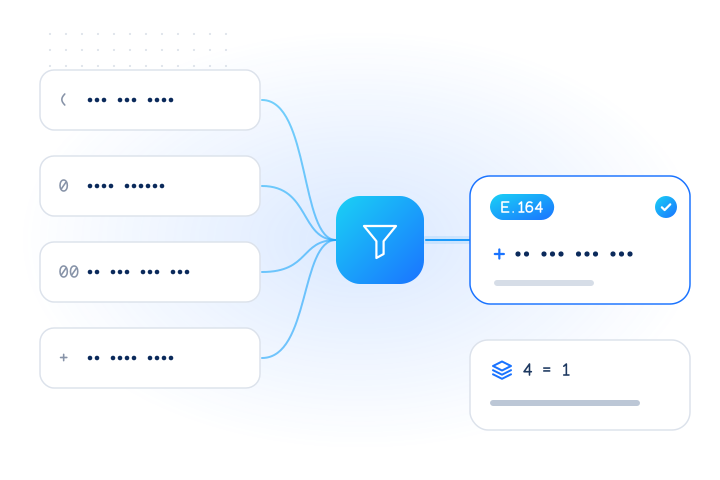
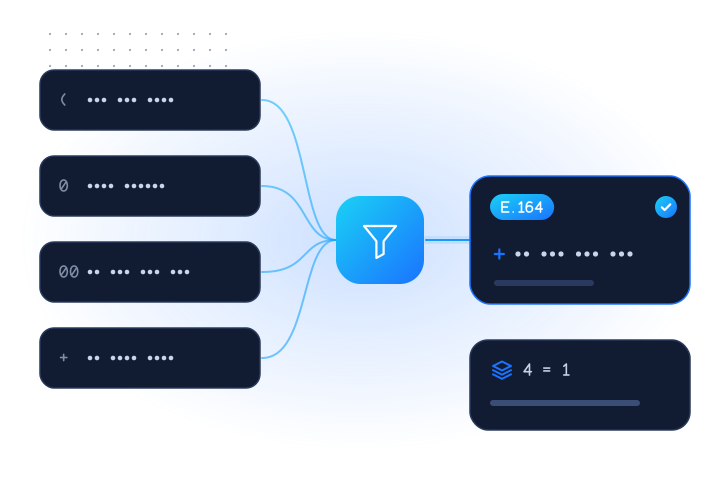
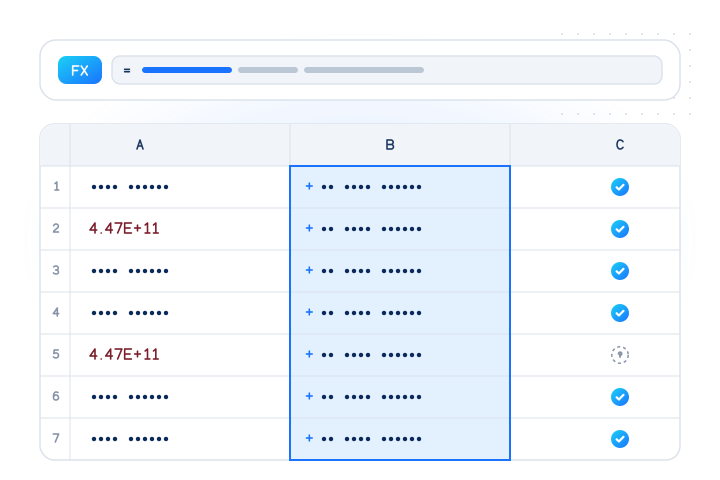
Every country numbers its phones by its own national plan, but internationally they all use one format, E.164: a +, the country calling code, then the national number without the trunk prefix, 15 digits at most. The table below gives the calling code, international and trunk prefixes, mobile and fixed-line lengths and a masked mobile format for 238 regions in libphonenumber: all of them except seven sanctioned countries, which we don't serve.
The table is generated from open-source numbering-plan metadata (libphonenumber 9.0.41, via libphonenumber-js 1.13.15), not typed by hand. How it's built is explained below.
How do I write any phone number in international format?
Take three parts and join them without spaces:
+, which stands for "whatever your international prefix is".- The country calling code, one to three digits, assigned by the ITU (ITU, 2026).
- The national significant number, which is the national number without the trunk prefix.
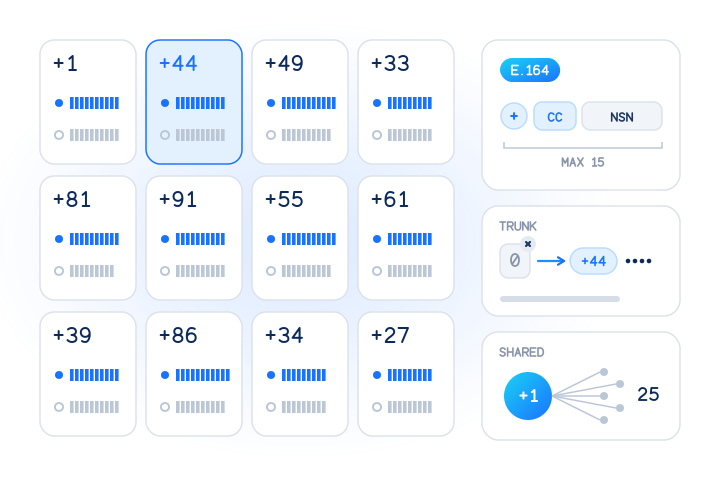
Recommendation E.164 caps the whole international number at 15 digits, not counting the + (ITU-T E.164). A UK mobile written 07XXX XXXXXX at home becomes +447XXXXXXXXX. A US number written (2XX) XXX-XXXX becomes +12XXXXXXXXX.
For display you can add spaces (+44 7XXX XXXXXX). For storage, deduplication and API calls, keep the compact form. Our E.164 guide for developers covers the standard itself. This page is the per-country reference.
What is a trunk prefix, and when do I drop it?
The trunk (national) prefix is what you dial before a number inside the country. You always drop it in E.164.
To look up the trunk and exit prefix of a single country, or find which country a full number belongs to, use the free calling code lookup and the phone number country lookup.
Across the 238 regions in the table:
| Trunk prefix | Regions | Examples |
|---|---|---|
0 | 108 | United Kingdom, Germany, India, Nigeria |
| none | 101 | Italy, Mexico, Portugal, Singapore |
1 | 26 | The 25 +1 regions (United States, Canada, much of the Caribbean) and the Marshall Islands |
8 | 2 | Kazakhstan, Turkmenistan |
06 | 1 | Hungary |
Two traps are common:
- "None" doesn't mean "starts with anything". In Italy there is no trunk prefix, and the leading
0of a landline is part of the number, so it stays: Rome is+39 06…, not+39 6…. - The international prefix differs too. 182 regions dial
00to call abroad, the +1 regions and the Marshall Islands dial011, and some countries have several carrier-specific prefixes (shown as "varies" in the table). Never store a number with00or011in front. Store the+form.
How long is a mobile number in each country?
Lengths below count the national significant number only, without the calling code or trunk prefix. Among the 197 regions with a single mobile length, the most common is 9 digits (70 regions), then 8 (52) and 10 (45). 40 regions allow more than one mobile length, and Austria allows up to 13 digits. "Mobile format" keeps the calling code and the first national digit and masks the rest, so it shows shape, not a dialable number. In some countries (for example the US and Chile) mobile and fixed-line numbers share the same ranges, so the first digit is only indicative.
| Country or region | Code | Calling code | Int'l prefix | Trunk prefix | Mobile digits | Fixed-line digits | Mobile format (E.164, masked) |
|---|---|---|---|---|---|---|---|
| Afghanistan | AF | +93 | 00 | 0 | 9 | 9 | +93 7X XXX XXXX |
| Åland Islands | AX | +358 | 00 | 0 | 6–10 | 6–9 | +358 4X XXXXXXX |
| Albania | AL | +355 | 00 | 0 | 9 | 8 | +355 6X XXX XXXX |
| Algeria | DZ | +213 | 00 | 0 | 9 | 8, 9 | +213 5XX XX XX XX |
| American Samoa | AS | +1 | 011 | 1 | 10 | 10 | +1 6XX XXX XXXX |
| Andorra | AD | +376 | 00 | — | 6, 9 | 6 | +376 3XX XXX |
| Angola | AO | +244 | 00 | — | 9 | 9 | +244 9XX XXX XXX |
| Anguilla | AI | +1 | 011 | 1 | 10 | 10 | +1 2XX XXX XXXX |
| Antigua & Barbuda | AG | +1 | 011 | 1 | 10 | 10 | +1 2XX XXX XXXX |
| Argentina | AR | +54 | 00 | 0 | 10, 11 | 10 | +54 9 XX XXXX XXXX |
| Armenia | AM | +374 | 00 | 0 | 8 | 8 | +374 7X XXXXXX |
| Aruba | AW | +297 | 00 | — | 7 | 7 | +297 5XX XXXX |
| Ascension Island | AC | +247 | 00 | — | 5 | 5 | +247 4XXXX |
| Australia | AU | +61 | 0011 | 0 | 9 | 9 | +61 4XX XXX XXX |
| Austria | AT | +43 | 00 | 0 | 7–13 | 4–13 | +43 6XX XXXXXX |
| Azerbaijan | AZ | +994 | 00 | 0 | 9 | 9 | +994 4X XXX XX XX |
| Bahamas | BS | +1 | 011 | 1 | 10 | 10 | +1 2XX XXX XXXX |
| Bahrain | BH | +973 | 00 | — | 8 | 8 | +973 3XXX XXXX |
| Bangladesh | BD | +880 | 00 | 0 | 10 | 6–10 | +880 1XXX XXXXXX |
| Barbados | BB | +1 | 011 | 1 | 10 | 10 | +1 2XX XXX XXXX |
| Belgium | BE | +32 | 00 | 0 | 9 | 8 | +32 4XX XX XX XX |
| Belize | BZ | +501 | 00 | — | 7 | 7 | +501 6XX XXXX |
| Benin | BJ | +229 | 00 | — | 10 | 10 | +229 0X XX XX XX XX |
| Bermuda | BM | +1 | 011 | 1 | 10 | 10 | +1 4XX XXX XXXX |
| Bhutan | BT | +975 | 00 | — | 8 | 7 | +975 1X XX XX XX |
| Bolivia | BO | +591 | varies | 0 | 8 | 8 | +591 7XXXXXXX |
| Bosnia & Herzegovina | BA | +387 | 00 | 0 | 8, 9 | 8 | +387 6X XXX XXX |
| Botswana | BW | +267 | 00 | — | 8 | 7 | +267 7X XXX XXX |
| Brazil | BR | +55 | varies | 0 | 10, 11 | 10 | +55 1X XXXXX XXXX |
| British Indian Ocean Territory | IO | +246 | 00 | — | 7 | 7 | +246 3XX XXXX |
| British Virgin Islands | VG | +1 | 011 | 1 | 10 | 10 | +1 2XX XXX XXXX |
| Brunei | BN | +673 | 00 | — | 7 | 7 | +673 7XX XXXX |
| Bulgaria | BG | +359 | 00 | 0 | 8, 9 | 6–8 | +359 4X XXX XXX |
| Burkina Faso | BF | +226 | 00 | — | 8 | 8 | +226 7X XX XX XX |
| Burundi | BI | +257 | 00 | — | 8 | 8 | +257 7X XX XX XX |
| Cambodia | KH | +855 | varies | 0 | 8, 9 | 8, 9 | +855 9X XXX XXX |
| Cameroon | CM | +237 | 00 | — | 9 | 9 | +237 6 XX XX XX XX |
| Canada | CA | +1 | 011 | 1 | 10 | 10 | +1 5XX XXX XXXX |
| Cape Verde | CV | +238 | 0 | — | 7 | 7 | +238 9XX XX XX |
| Caribbean Netherlands | BQ | +599 | 00 | — | 7 | 7 | +599 3XX XXXX |
| Cayman Islands | KY | +1 | 011 | 1 | 10 | 10 | +1 3XX XXX XXXX |
| Central African Republic | CF | +236 | 00 | — | 8 | 8 | +236 7X XX XX XX |
| Chad | TD | +235 | 00 | — | 8 | 8 | +235 6X XX XX XX |
| Chile | CL | +56 | varies | — | 9 | 9 | +56 2 XXXX XXXX |
| China | CN | +86 | 00 | 0 | 11 | 7–11 | +86 1XX XXXX XXXX |
| Christmas Island | CX | +61 | 0011 | 0 | 9 | 9 | +61 4XX XXX XXX |
| Cocos (Keeling) Islands | CC | +61 | 0011 | 0 | 9 | 9 | +61 4XX XXX XXX |
| Colombia | CO | +57 | varies | 0 | 10 | 8, 10 | +57 3XX XXXXXXX |
| Comoros | KM | +269 | 00 | — | 7 | 7 | +269 3XX XX XX |
| Congo - Brazzaville | CG | +242 | 00 | — | 9 | 9 | +242 0X XXX XXXX |
| Congo - Kinshasa | CD | +243 | 00 | 0 | 7, 9 | 7–10 | +243 9XX XXX XXX |
| Cook Islands | CK | +682 | 00 | — | 5 | 5 | +682 7X XXX |
| Costa Rica | CR | +506 | 00 | — | 8 | 8 | +506 8XXX XXXX |
| Côte d’Ivoire | CI | +225 | 00 | — | 10 | 10 | +225 0X XX XX XXXX |
| Croatia | HR | +385 | 00 | 0 | 8, 9 | 8, 9 | +385 9X XXX XXXX |
| Curaçao | CW | +599 | 00 | — | 7, 8 | 7, 8 | +599 9 XXX XXXX |
| Cyprus | CY | +357 | 00 | — | 8 | 8 | +357 9X XXXXXX |
| Czechia | CZ | +420 | 00 | — | 9 | 9 | +420 6XX XXX XXX |
| Denmark | DK | +45 | 00 | — | 8 | 8 | +45 3X XX XX XX |
| Djibouti | DJ | +253 | 00 | — | 8 | 8 | +253 7X XX XX XX |
| Dominica | DM | +1 | 011 | 1 | 10 | 10 | +1 7XX XXX XXXX |
| Dominican Republic | DO | +1 | 011 | 1 | 10 | 10 | +1 8XX XXX XXXX |
| Ecuador | EC | +593 | 00 | 0 | 9 | 8 | +593 9X XXX XXXX |
| Egypt | EG | +20 | 00 | 0 | 10 | 8, 9 | +20 1X XXXXXXXX |
| El Salvador | SV | +503 | 00 | — | 8 | 8 | +503 7XXX XXXX |
| Equatorial Guinea | GQ | +240 | 00 | — | 9 | 9 | +240 2XX XXX XXX |
| Eritrea | ER | +291 | 00 | 0 | 7 | 7 | +291 7 XXX XXX |
| Estonia | EE | +372 | 00 | — | 7, 8 | 7 | +372 5XXX XXXX |
| Eswatini | SZ | +268 | 00 | — | 8 | 8 | +268 7XXX XXXX |
| Ethiopia | ET | +251 | 00 | 0 | 9 | 9 | +251 9X XXX XXXX |
| Falkland Islands | FK | +500 | 00 | — | 5 | 5 | +500 5XXXX |
| Faroe Islands | FO | +298 | 00 | — | 6 | 6 | +298 2X XX XX |
| Fiji | FJ | +679 | 00 | — | 7 | 7 | +679 7XX XXXX |
| Finland | FI | +358 | 00 | 0 | 6–10 | 5–9 | +358 4X XXXXXXX |
| France | FR | +33 | 00 | 0 | 9 | 9 | +33 6 XX XX XX XX |
| French Guiana | GF | +594 | 00 | 0 | 9 | 9 | +594 6XX XX XX XX |
| French Polynesia | PF | +689 | 00 | — | 8 | 8 | +689 8X XX XX XX |
| Gabon | GA | +241 | 00 | — | 7, 8 | 8 | +241 0X XX XX XX |
| Gambia | GM | +220 | 00 | — | 7, 9 | 7, 9 | +220 3XX XXXX |
| Georgia | GE | +995 | 00 | 0 | 9 | 9 | +995 5XX XX XX XX |
| Germany | DE | +49 | 00 | 0 | 10, 11 | 5–15 | +49 1XXX XXXXXXX |
| Ghana | GH | +233 | 00 | 0 | 9 | 9 | +233 2X XXX XXXX |
| Gibraltar | GI | +350 | 00 | — | 8 | 8 | +350 5XXXXXXX |
| Greece | GR | +30 | 00 | — | 10 | 10 | +30 6XX XXX XXXX |
| Greenland | GL | +299 | 00 | — | 6 | 6 | +299 2X XX XX |
| Grenada | GD | +1 | 011 | 1 | 10 | 10 | +1 4XX XXX XXXX |
| Guadeloupe | GP | +590 | 00 | 0 | 9 | 9 | +590 6XX XX XX XX |
| Guam | GU | +1 | 011 | 1 | 10 | 10 | +1 6XX XXX XXXX |
| Guatemala | GT | +502 | 00 | — | 8 | 8 | +502 5XXX XXXX |
| Guernsey | GG | +44 | 00 | 0 | 10 | 10 | +44 7XXX XXXXXX |
| Guinea | GN | +224 | 00 | — | 9 | 8 | +224 6XX XX XX XX |
| Guinea-Bissau | GW | +245 | 00 | — | 9 | 9 | +245 9XX XXX XXX |
| Guyana | GY | +592 | 001 | — | 7 | 7 | +592 6XX XXXX |
| Haiti | HT | +509 | 00 | — | 8 | 8 | +509 3X XX XXXX |
| Honduras | HN | +504 | 00 | — | 8 | 8 | +504 9XXX XXXX |
| Hong Kong SAR China | HK | +852 | 00 | — | 8 | 8 | +852 5XXX XXXX |
| Hungary | HU | +36 | 00 | 06 | 9 | 8 | +36 2X XXX XXXX |
| Iceland | IS | +354 | 00 | — | 7, 9 | 7 | +354 6XX XXXX |
| India | IN | +91 | 00 | 0 | 10 | 10 | +91 8XXXX XXXXX |
| Indonesia | ID | +62 | varies | 0 | 9–12 | 7–11 | +62 8XX XXX XXX |
| Iraq | IQ | +964 | 00 | 0 | 10 | 8, 9 | +964 7XX XXX XXXX |
| Ireland | IE | +353 | 00 | 0 | 9 | 7–10 | +353 8X XXX XXXX |
| Isle of Man | IM | +44 | 00 | 0 | 10 | 10 | +44 7XXX XXXXXX |
| Israel | IL | +972 | varies | 0 | 9 | 8, 11, 12 | +972 5X XXX XXXX |
| Italy | IT | +39 | 00 | — | 9, 10 | 6–12 | +39 3XX XXX XXXX |
| Jamaica | JM | +1 | 011 | 1 | 10 | 10 | +1 8XX XXX XXXX |
| Japan | JP | +81 | 010 | 0 | 10 | 9 | +81 9X XXXX XXXX |
| Jersey | JE | +44 | 00 | 0 | 10 | 10 | +44 7XXX XXXXXX |
| Jordan | JO | +962 | 00 | 0 | 9 | 8 | +962 7 XXXX XXXX |
| Kazakhstan | KZ | +7 | 8 (tone) 10 | 8 | 10 | 10 | +7 7XX XXX XXXX |
| Kenya | KE | +254 | 000 | 0 | 9 | 7–9 | +254 7XX XXXXXX |
| Kiribati | KI | +686 | 00 | 0 | 8 | 5, 8 | +686 7XXXXXXX |
| Kosovo | XK | +383 | 00 | 0 | 8 | 8–12 | +383 4X XXX XXX |
| Kuwait | KW | +965 | 00 | — | 8 | 8 | +965 5XX XXXXX |
| Kyrgyzstan | KG | +996 | 00 | 0 | 9 | 9 | +996 7XX XXX XXX |
| Laos | LA | +856 | 00 | 0 | 9, 10 | 8 | +856 2X XX XXX XXX |
| Latvia | LV | +371 | 00 | — | 8 | 8 | +371 2X XXX XXX |
| Lebanon | LB | +961 | 00 | 0 | 7, 8 | 7, 8 | +961 7X XXX XXX |
| Lesotho | LS | +266 | 00 | — | 8 | 8 | +266 5XXX XXXX |
| Liberia | LR | +231 | 00 | 0 | 7, 9 | 8 | +231 7X XXX XXXX |
| Libya | LY | +218 | 00 | 0 | 9 | 9 | +218 9X XXXXXXX |
| Liechtenstein | LI | +423 | 00 | 0 | 7, 9 | 7 | +423 6XX XXX XXX |
| Lithuania | LT | +370 | 00 | 0 | 8 | 8 | +370 6XX XXXXX |
| Luxembourg | LU | +352 | 00 | — | 9 | 4–11 | +352 6XX XXX XXX |
| Macao SAR China | MO | +853 | 00 | — | 8 | 8 | +853 6XXX XXXX |
| Madagascar | MG | +261 | 00 | 0 | 9 | 9 | +261 3X XX XXX XX |
| Malawi | MW | +265 | 00 | 0 | 9 | 7 | +265 9XX XX XX XX |
| Malaysia | MY | +60 | 00 | 0 | 9, 10 | 8, 9 | +60 1X XXX XXXX |
| Maldives | MV | +960 | 00 | — | 7 | 7 | +960 7XX XXXX |
| Mali | ML | +223 | 00 | — | 8 | 8 | +223 6X XX XX XX |
| Malta | MT | +356 | 00 | — | 8 | 8 | +356 9XXX XXXX |
| Marshall Islands | MH | +692 | 011 | 1 | 7 | 7 | +692 2XX XXXX |
| Martinique | MQ | +596 | 00 | 0 | 9 | 9 | +596 6XX XX XX XX |
| Mauritania | MR | +222 | 00 | — | 8 | 8 | +222 2X XX XX XX |
| Mauritius | MU | +230 | 020 | — | 8 | 7, 8 | +230 5XXX XXXX |
| Mayotte | YT | +262 | 00 | 0 | 9 | 9 | +262 6XX XX XX XX |
| Mexico | MX | +52 | 00 | — | 10 | 10 | +52 2XX XXX XXXX |
| Micronesia | FM | +691 | 00 | — | 7 | 7 | +691 3XX XXXX |
| Moldova | MD | +373 | 00 | 0 | 8 | 8 | +373 6XX XX XXX |
| Monaco | MC | +377 | 00 | 0 | 8, 9 | 8 | +377 6 XX XX XX XX |
| Mongolia | MN | +976 | 001 | 0 | 8 | 8–10 | +976 8XXX XXXX |
| Montenegro | ME | +382 | 00 | 0 | 8 | 8 | +382 6X XXX XXX |
| Montserrat | MS | +1 | 011 | 1 | 10 | 10 | +1 6XX XXX XXXX |
| Morocco | MA | +212 | 00 | 0 | 9 | 9 | +212 6 XX XX XX XX |
| Mozambique | MZ | +258 | 00 | — | 9 | 8 | +258 8X XXX XXXX |
| Myanmar (Burma) | MM | +95 | 00 | 0 | 7–10 | 6–9 | +95 9 XXX XXXX |
| Namibia | NA | +264 | 00 | 0 | 9 | 8, 9 | +264 8X XXX XXXX |
| Nauru | NR | +674 | 00 | — | 7 | 7 | +674 5XX XXXX |
| Nepal | NP | +977 | 00 | 0 | 10 | 8 | +977 9XX XXXXXXX |
| Netherlands | NL | +31 | 00 | 0 | 9, 11 | 9 | +31 6 XXXXXXXX |
| New Caledonia | NC | +687 | 00 | — | 6 | 6 | +687 7X XX XX |
| New Zealand | NZ | +64 | 00 | 0 | 8–10 | 8 | +64 2X XXX XXXX |
| Nicaragua | NI | +505 | 00 | — | 8 | 8 | +505 8XXX XXXX |
| Niger | NE | +227 | 00 | — | 8 | 8 | +227 9X XX XX XX |
| Nigeria | NG | +234 | 009 | 0 | 10 | 10 | +234 8XX XXX XXXX |
| Niue | NU | +683 | 00 | — | 4, 7 | 4 | +683 8XX XXXX |
| Norfolk Island | NF | +672 | 00 | — | 6 | 6 | +672 3 XXXXX |
| North Macedonia | MK | +389 | 00 | 0 | 8 | 8 | +389 7X XXX XXX |
| Northern Mariana Islands | MP | +1 | 011 | 1 | 10 | 10 | +1 6XX XXX XXXX |
| Norway | NO | +47 | 00 | — | 8 | 8 | +47 4X XX XX XX |
| Oman | OM | +968 | 00 | — | 8 | 8 | +968 9XXX XXXX |
| Pakistan | PK | +92 | 00 | 0 | 10 | 9, 10 | +92 3XX XXXXXXX |
| Palau | PW | +680 | varies | — | 7 | 7 | +680 6XX XXXX |
| Palestinian Territories | PS | +970 | 00 | 0 | 9 | 8 | +970 5XX XXX XXX |
| Panama | PA | +507 | 00 | — | 7, 8 | 7 | +507 6XXX XXXX |
| Papua New Guinea | PG | +675 | 00 | — | 8 | 7 | +675 7XXX XXXX |
| Paraguay | PY | +595 | 00 | 0 | 9 | 7–9 | +595 9XX XXXXXX |
| Peru | PE | +51 | 00 | 0 | 9 | 8 | +51 9XX XXX XXX |
| Philippines | PH | +63 | 00 | 0 | 10 | 6, 8, 9, 10 | +63 9XX XXX XXXX |
| Poland | PL | +48 | 00 | — | 9 | 7, 9 | +48 5XX XXX XXX |
| Portugal | PT | +351 | 00 | — | 9 | 9 | +351 9XX XXX XXX |
| Puerto Rico | PR | +1 | 011 | 1 | 10 | 10 | +1 7XX XXX XXXX |
| Qatar | QA | +974 | 00 | — | 8 | 8 | +974 3XXX XXXX |
| Réunion | RE | +262 | 00 | 0 | 9 | 9 | +262 6XX XX XX XX |
| Romania | RO | +40 | 00 | 0 | 9 | 6, 9 | +40 7XX XXX XXX |
| Rwanda | RW | +250 | 00 | 0 | 9 | 8, 9 | +250 7XX XXX XXX |
| Samoa | WS | +685 | 0 | — | 7, 10 | 5, 6 | +685 7X XXXXX |
| San Marino | SM | +378 | 00 | — | 8 | 10 | +378 6X XX XX XX |
| São Tomé & Príncipe | ST | +239 | 00 | — | 7 | 7 | +239 9XX XXXX |
| Saudi Arabia | SA | +966 | 00 | 0 | 9 | 9 | +966 5X XXX XXXX |
| Senegal | SN | +221 | 00 | — | 9 | 9 | +221 7X XXX XX XX |
| Serbia | RS | +381 | 00 | 0 | 8–10 | 7–12 | +381 6X XXXXXXX |
| Seychelles | SC | +248 | 00 | — | 7 | 7 | +248 2 XXX XXX |
| Sierra Leone | SL | +232 | 00 | 0 | 8 | 8 | +232 2X XXXXXX |
| Singapore | SG | +65 | varies | — | 8 | 8 | +65 8XXX XXXX |
| Sint Maarten | SX | +1 | 011 | 1 | 10 | 10 | +1 7XX XXX XXXX |
| Slovakia | SK | +421 | 00 | 0 | 9 | 6, 7, 9 | +421 9XX XXX XXX |
| Slovenia | SI | +386 | 00 | 0 | 8 | 8 | +386 3X XXX XXX |
| Solomon Islands | SB | +677 | varies | — | 5, 7 | 5 | +677 7X XXXXX |
| Somalia | SO | +252 | 00 | 0 | 7–9 | 6, 7 | +252 7 XXXXXXX |
| South Africa | ZA | +27 | 00 | 0 | 5–9 | 9 | +27 7X XXX XXXX |
| South Korea | KR | +82 | varies | 0 | 9, 10 | 5, 6, 8, 9, 10 | +82 1X XXXX XXXX |
| South Sudan | SS | +211 | 00 | 0 | 9 | 9 | +211 9XX XXX XXX |
| Spain | ES | +34 | 00 | — | 9 | 9 | +34 6XX XX XX XX |
| Sri Lanka | LK | +94 | 00 | 0 | 9 | 9 | +94 7X XXX XXXX |
| St. Barthélemy | BL | +590 | 00 | 0 | 9 | 9 | +590 6XX XX XX XX |
| St. Helena | SH | +290 | 00 | — | 5 | 4, 5 | +290 5XXXX |
| St. Kitts & Nevis | KN | +1 | 011 | 1 | 10 | 10 | +1 8XX XXX XXXX |
| St. Lucia | LC | +1 | 011 | 1 | 10 | 10 | +1 7XX XXX XXXX |
| St. Martin | MF | +590 | 00 | 0 | 9 | 9 | +590 6XX XX XX XX |
| St. Pierre & Miquelon | PM | +508 | 00 | 0 | 6, 9 | 6, 9 | +508 5X XX XX |
| St. Vincent & Grenadines | VC | +1 | 011 | 1 | 10 | 10 | +1 7XX XXX XXXX |
| Sudan | SD | +249 | 00 | 0 | 9 | 9 | +249 9X XXX XXXX |
| Suriname | SR | +597 | 00 | — | 7 | 6 | +597 7XX XXXX |
| Svalbard & Jan Mayen | SJ | +47 | 00 | — | 8 | 8 | +47 4X XX XX XX |
| Sweden | SE | +46 | 00 | 0 | 9 | 7–9 | +46 7X XXX XX XX |
| Switzerland | CH | +41 | 00 | 0 | 9 | 9 | +41 7X XXX XX XX |
| Taiwan | TW | +886 | varies | 0 | 9 | 8, 9 | +886 9XX XXX XXX |
| Tajikistan | TJ | +992 | 8 (tone) 10 | — | 9 | 9 | +992 9X XXX XXXX |
| Tanzania | TZ | +255 | varies | 0 | 9 | 9 | +255 6XX XXX XXX |
| Thailand | TH | +66 | varies | 0 | 9 | 8 | +66 8X XXX XXXX |
| Timor-Leste | TL | +670 | 00 | — | 8 | 7 | +670 7XXX XXXX |
| Togo | TG | +228 | 00 | — | 8 | 8 | +228 9X XX XX XX |
| Tokelau | TK | +690 | 00 | — | 4–7 | 4–7 | +690 7XXX |
| Tonga | TO | +676 | 00 | — | 7 | 5 | +676 7XX XXXX |
| Trinidad & Tobago | TT | +1 | 011 | 1 | 10 | 10 | +1 8XX XXX XXXX |
| Tristan da Cunha | TA | +290 | 00 | — | — | 4 | +290 8XXX |
| Tunisia | TN | +216 | 00 | — | 8 | 8 | +216 2X XXX XXX |
| Türkiye | TR | +90 | 00 | 0 | 10 | 10 | +90 5XX XXX XX XX |
| Turkmenistan | TM | +993 | 8 (tone) 10 | 8 | 8 | 8 | +993 6X XXXXXX |
| Turks & Caicos Islands | TC | +1 | 011 | 1 | 10 | 10 | +1 6XX XXX XXXX |
| Tuvalu | TV | +688 | 00 | — | 6, 7 | 5 | +688 9X XXXX |
| U.S. Virgin Islands | VI | +1 | 011 | 1 | 10 | 10 | +1 3XX XXX XXXX |
| Uganda | UG | +256 | varies | 0 | 9 | 9 | +256 7XX XXXXXX |
| Ukraine | UA | +380 | 0 (tone) 0 | 0 | 9 | 9 | +380 5X XXX XXXX |
| United Arab Emirates | AE | +971 | 00 | 0 | 9 | 8 | +971 5X XXX XXXX |
| United Kingdom | GB | +44 | 00 | 0 | 10 | 9, 10 | +44 7XXX XXXXXX |
| United States | US | +1 | 011 | 1 | 10 | 10 | +1 2XX XXX XXXX |
| Uruguay | UY | +598 | 00 | 0 | 8 | 8 | +598 9X XXX XXX |
| Uzbekistan | UZ | +998 | 00 | — | 9 | 9 | +998 9X XXX XX XX |
| Vanuatu | VU | +678 | 00 | — | 7 | 5 | +678 5XX XXXX |
| Vatican City | VA | +39 | 00 | — | 9, 10 | 6–11 | +39 3XX XXX XXXX |
| Vietnam | VN | +84 | 00 | 0 | 9 | 10 | +84 9XX XXX XXX |
| Wallis & Futuna | WF | +681 | 00 | — | 6 | 6 | +681 8X XX XX |
| Western Sahara | EH | +212 | 00 | 0 | 9 | 9 | +212 6 XX XX XX XX |
| Yemen | YE | +967 | 00 | 0 | 9 | 7, 8 | +967 7XX XXX XXX |
| Zambia | ZM | +260 | 00 | 0 | 9 | 9 | +260 9X XXXXXXX |
| Zimbabwe | ZW | +263 | 00 | 0 | 9 | 7, 9 | +263 7X XXX XXXX |
Region names follow the Unicode CLDR English names. 25 regions share +1 (the North American Numbering Plan), and four share +44 (the UK, Guernsey, Jersey and the Isle of Man). Shared codes are why you can't infer the country from the calling code alone.
Which countries have a full guide?
Each country guide gives the number format and digit counts, mobile prefixes and their range holders, tested validation code, number portability and the local rules for SMS, WhatsApp and marketing, with the regulator's own documents as sources.
| Region | Country guides (calling code) |
|---|---|
| Asia-Pacific | Australia (+61), Bangladesh (+880), Cambodia (+855), China (+86), Hong Kong (+852), India (+91), Indonesia (+62), Japan (+81), Macau (+853), Malaysia (+60), Myanmar (+95), Nepal (+977), Pakistan (+92), Philippines (+63), Singapore (+65), South Korea (+82), Sri Lanka (+94), Taiwan (+886), Thailand (+66), Uzbekistan (+998), Vietnam (+84) |
| Americas | Argentina (+54), Brazil (+55), Canada (+1), Chile (+56), Colombia (+57), Dominican Republic (+1), Ecuador (+593), Mexico (+52), Peru (+51), United States (+1) |
| Europe | France (+33), Germany (+49), Italy (+39), Netherlands (+31), Poland (+48), Spain (+34), Türkiye (+90), United Kingdom (+44) |
| Middle East and Africa | Algeria (+213), Angola (+244), Cameroon (+237), Côte d’Ivoire (+225), DR Congo (+243), Egypt (+20), Ethiopia (+251), Ghana (+233), Iraq (+964), Jordan (+962), Kenya (+254), Kuwait (+965), Morocco (+212), Mozambique (+258), Nigeria (+234), Qatar (+974), Rwanda (+250), Saudi Arabia (+966), Senegal (+221), South Africa (+27), Tanzania (+255), Tunisia (+216), Uganda (+256), United Arab Emirates (+971), Zambia (+260), Zimbabwe (+263) |
Which countries have the shortest and longest numbers?
Small territories have the shortest numbers, and a few European and Asian plans the longest. From the table:
| Regions (national significant number) | |
|---|---|
| Shortest mobile numbers | Niue and Tokelau (from 4 digits); Ascension Island, the Cook Islands, the Falkland Islands, Saint Helena and the Solomon Islands (from 5) |
| Longest mobile numbers | Austria (up to 13 digits), Indonesia (up to 12), China (11), and Argentina, Brazil, Germany and the Netherlands (up to 11) |
| Widest fixed-line range | Germany (5 to 15 digits), Austria (4 to 13), then Israel, Italy, Kosovo and Serbia (up to 12) |
| Same lengths for mobile and fixed | 153 of 238 regions |
For the most populous markets, the mobile lengths are: India 10 (after +91), China 11 (+86), the United States 10 (+1), Indonesia 9 to 12 (+62), Pakistan 10 (+92), Nigeria 10 (+234), Brazil 10 or 11 (+55), Bangladesh 10 (+880), Mexico 10 (+52) and Ethiopia 9 (+251).
Two practical consequences. First, a single "10 digits" rule in a form rejects real users in most of the world. Validate per country, or don't validate length at all before parsing. Second, variable lengths within one country (Austria, Indonesia, Germany) mean you can't tell whether a number is complete by counting digits. A library that knows the ranges can tell you whether a number is possible (right length) and valid (in an allocated range). These are two different checks, and forms should use both.
Which countries changed their formats recently?
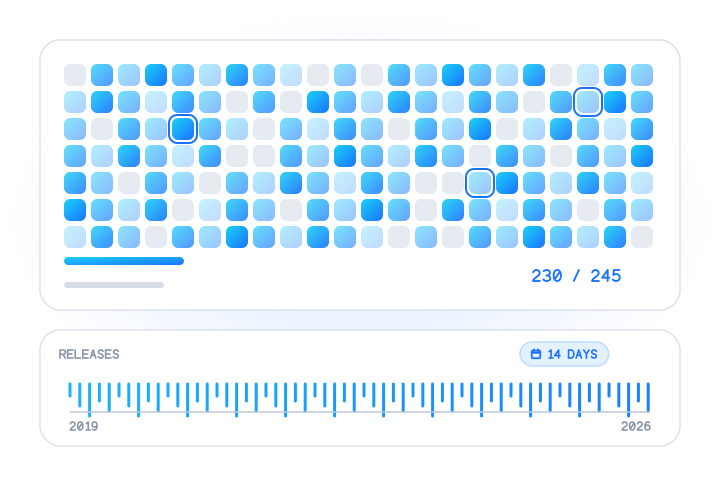
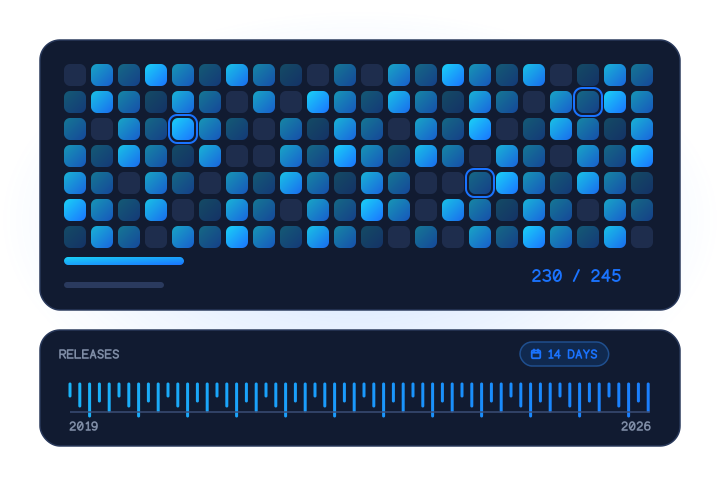
Numbering plans change all the time, just rarely all at once. In our study of libphonenumber release notes, the metadata was updated a median of every 14 days between 2019 and September 2026. 223 of the 238 regions changed at least once, and Singapore, the United States and Hong Kong changed most often (numbering-plan research; dataset at /datasets/numbering-plan-changes-2019-2026).
The metadata version behind this table (9.0.41) updated the phone rules for China, Nigeria and the United States (libphonenumber release notes, 2026). Most such changes open new ranges rather than change lengths. But a validation library that is a few months old will reject some valid new numbers. Update it at least monthly, and regenerate references like this one when you do.
National regulators publish the authoritative plans, and many notify the ITU, which keeps a page per country (ITU, 2026). When a customer says a valid number is rejected, check there before overriding validation.
How do I convert local numbers to E.164 in code?
Parse with a library and a default country, then format. Don't concatenate strings: the trunk prefix, number length and area-code rules differ by country, and the library already knows them.
JavaScript (libphonenumber-js), using the UK's reserved drama range:
import { parsePhoneNumber } from "libphonenumber-js/max";

const n = parsePhoneNumber("07700 900123", "GB");
n.number;               // "+447700900123"  (E.164, trunk 0 dropped)
n.formatInternational(); // "+44 7700 900123"
n.isPossible();         // true: right length for the UK
n.isValid();            // false: 07700 900xxx is reserved for fiction, so no real range matches
Python (phonenumbers 9.0.40):
import phonenumbers

n = phonenumbers.parse("07700 900123", "GB")
phonenumbers.format_number(n, phonenumbers.PhoneNumberFormat.E164)  # '+447700900123'
phonenumbers.is_possible_number(n)                                   # True
phonenumbers.is_valid_number(n)                                      # False (reserved fictional range)
The reserved range is a useful test: it formats correctly but fails validation, which is exactly what should happen to a number no one can hold. Validity means "the number fits an allocated range". It doesn't mean the number is in service. For whether a number is mobile or VoIP and which network it is on, use a carrier and line type lookup. For normalizing whole spreadsheets, see normalize phone numbers in Excel and Sheets. Our E.164 regex is not enough post shows what a pattern alone misses.
A practical rule for messaging links and APIs: store and send the E.164 form, and let each platform's own documentation tell you whether it wants the +. Stripping a trunk 0 by hand is how +4407… numbers end up in databases.
How was the table generated?
By a script in our repository, apps/web/scripts/gen-phone-formats-table.mjs, which reads the metadata bundled with libphonenumber-js 1.13.15. That is libphonenumber metadata release 9.0.41, derived from Google's PhoneNumberMetadata.xml (Apache License 2.0) (libphonenumber, 2026). It covers the metadata's 245 regions minus seven sanctioned countries, which MobileValidate doesn't serve. For each of the 238 regions it takes:
- Calling code, international prefix and trunk prefix from the region's numbering plan. Where the plan defines the international prefix as a pattern of carrier codes with no single preferred value, the table says "varies". "8 (tone) 10" means: dial 8, wait for a second tone, then dial 10.
- Mobile and fixed-line digits: the possible lengths of the national significant number for the
MOBILEandFIXED_LINEtypes. - Mobile format: the library's example mobile number, formatted internationally, with every digit after the first national digit replaced by X. We never publish the example digits themselves: example numbers come from valid ranges and could belong to someone.
- Names from
Intl.DisplayNames(Unicode CLDR, English).
Limits: possible lengths are the metadata's view, not a regulator's statement. The metadata doesn't separate every special range (M2M, pager, shared-cost). And a region's first digit can be misleading where mobile and fixed ranges overlap. We regenerate the table when we update the library.
What are the key takeaways?
- The international format is E.164:
+, calling code, national number without the trunk prefix, up to 15 digits. - Drop the trunk prefix (
0in 108 regions,1in the +1 countries). But where there is no trunk prefix, as in Italy, a leading0is part of the number and stays. - Mobile numbers are most often 9, 8 or 10 national digits, but lengths vary by country and sometimes within one.
- 25 regions share +1 and four share +44, so don't infer the country from the calling code alone.
- Parse and format with a maintained library and a default country, and update its metadata often. Numbering rules change about every two weeks somewhere in the world.
Sources
- Recommendation ITU-T E.164: The international public telecommunication numbering plan — International Telecommunication Union, 2010
- List of ITU-T Recommendation E.164 assigned country codes — International Telecommunication Union, 2026
- National Numbering Plans — International Telecommunication Union (ITU-T), 2026
- libphonenumber PhoneNumberMetadata.xml — libphonenumber project (Apache License 2.0), 2026
- libphonenumber release_notes.txt — libphonenumber project, 2026
- libphonenumber-js 1.13.15 (metadata 9.0.41) — libphonenumber-js project (MIT), 2026
Frequently asked questions
What is the international format for a phone number?
E.164: a plus sign, the country calling code, then the national number without any trunk prefix such as a leading 0, with no spaces and at most 15 digits in total. A UK mobile written 07XXX XXXXXX nationally becomes +447XXXXXXXXX.
What is a trunk prefix?
The digit or digits you dial before a national number inside the country, most often 0 (UK, Germany, India) or 1 (the US and Canada). It is not part of the number itself, so you drop it when you write the number in international format.
How many digits does a mobile number have?
It depends on the country. In our table, generated from libphonenumber metadata for 238 regions, 197 regions have a single mobile length, and among them the most common is 9 digits (70 regions), then 8 (52) and 10 (45). The national number excludes the calling code and trunk prefix.
Are the example numbers in the table real phone numbers?
No. The format column is masked: only the calling code and first national digit are kept, and every other digit is shown as X. It shows the shape of a mobile number, not a number anyone can dial.
How do I convert a local number to E.164 in code?
Parse it with a numbering-plan library and a default country, then format it as E.164. In JavaScript, parsePhoneNumber('07700 900123', 'GB').number from libphonenumber-js returns +447700900123. Then check isValid() separately. Don't build the result with string concatenation, because trunk-prefix rules differ between countries.
Related services and guides
More from the blog
All articlesDevelopers
E.164 phone number format: a practical guide for developers
How to normalize phone numbers to E.164 in JavaScript and Python, the pitfalls that break deduplication, and how the MobileValidate API normalizes input.
9 min read
Research
How often do phone numbering plans change? 2019–2026 data
We counted 182 phone-metadata releases from 2019 to 2026: a median of 14 days apart, and 223 of 238 regions changed. Why validation goes stale.
8 min read
Developers
How to normalize phone numbers in Excel and Google Sheets
Clean phone numbers in Excel and Google Sheets: keep leading zeros, avoid 15-digit rounding, convert to E.164 with formulas or Apps Script, then validate.
8 min read