On this page
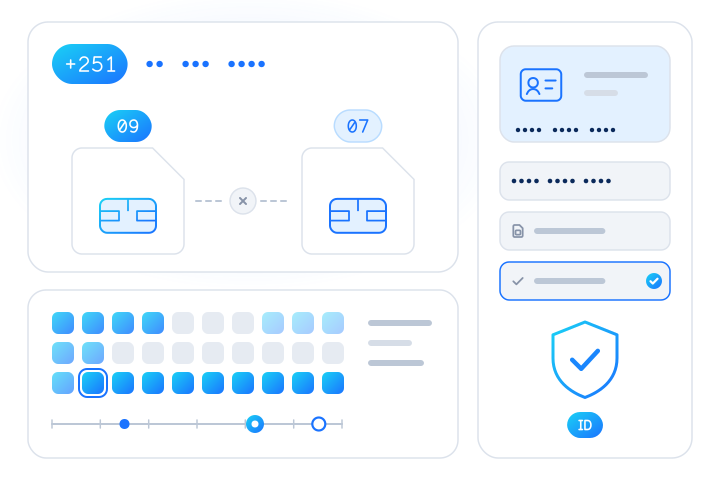
Ethiopian phone numbers use the country code +251 and have 9 digits after it, for mobiles and landlines alike. At home they are written with a trunk 0: 09X XXX XXXX for Ethio Telecom mobiles, 07X XXX XXXX for Safaricom Ethiopia. From abroad you drop the 0: +251 91 XXX XXXX, stored in E.164 as +25191XXXXXXX. As of November 2026 numbers can't be ported between the networks, so the prefix still shows the operator.
This guide is part of our phone numbers by country series. The tables are generated from libphonenumber's metadata, our MNP atlas and our public catalog. Example numbers are masked with X. The code samples use libphonenumber's own example numbers, which are for testing only; don't call or text them. On 2026-11-09 we read the Ethiopian Communications Authority's (ECA) directives on numbering, SIM registration and consumer protection, the Communications Service Proclamation, the Personal Data Protection Proclamation and the numbering plan filed with the International Telecommunication Union (ITU). The ECA doesn't publish its current numbering plan table online, so some block details rest on press reports and libphonenumber's data; we say where. Ethio Telecom's website didn't load from our location, so we read its ID page in a dated archive copy. This is a summary, not legal advice.
What does an Ethiopian phone number look like?
Every Ethiopian number has nine digits after +251: a two-digit code and a seven-digit subscriber number. Ethiopia's current plan dates from 17 September 2005, when the then regulator notified the ITU that the national number would be "nine (9) digits" and that "every local subscriber must dial a ten-digit number (i.e., including the area code)" (ITU, 2005). That makes Ethiopia a closed dialling plan: even a local call inside Addis Ababa is dialled with 011.
Code after the trunk 0 | Use | Shape at home |
|---|---|---|
11 | Addis Ababa landlines (Ethio Telecom) | 011 XXX XXXX |
22, 25, 33, 34, 46, 47, 57, 58 | Regional landlines, from the 2005 plan | 0AA XXX XXXX |
9 | Ethio Telecom mobile | 09X XXX XXXX |
7 | Safaricom Ethiopia mobile | 07X XXX XXXX |
8 | 080 and 081 mobile in libphonenumber (see below) | 08X XXX XXXX |
9XX (3 digits, no trunk 0) | Emergency and special numbers, such as 911 police and 912 fire | short number |
The ECA says short codes are "usually 3 to 5 digits" (ECA services). We found no published toll-free range for Ethiopia, and libphonenumber has none.
| Item | Value |
|---|---|
| Country calling code | +251 |
| International call prefix (dialling out) | 00 |
| Trunk prefix (dialling at home) | 0 |
| Mobile: digits after +251 | 9 |
| Fixed line: digits after +251 | 9 |
| Mobile, national format (masked) | 091 XXX XXXX |
| Mobile, international (masked) | +251 91 XXX XXXX |
| Mobile, E.164 (masked) | +25191XXXXXXX |
| Fixed line, national format (masked) | 011 XXX XXXX |
| Fixed line, international (masked) | +251 11 XXX XXXX |
| Fixed line, E.164 (masked) | +25111XXXXXXX |
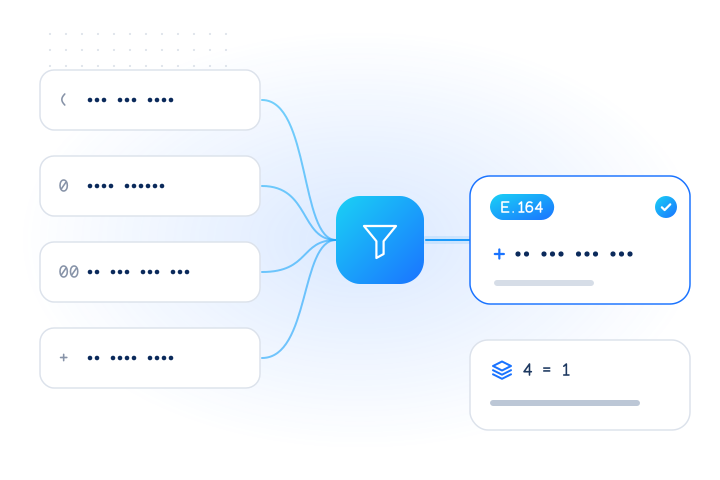
Store only the E.164 form: +251, then the nine digits without the 0. 091 123 4567, +251 91 123 4567, 00251 91 123 4567, 251911234567 and the bare 911234567 are the same number. Two input habits are common in Ethiopian lists: the nine digits without any prefix, as people type them into a form that already shows +251, and +251 09… with the trunk 0 kept. libphonenumber handles both, as the code below shows.
Which prefixes are mobile numbers?
The generator counted every 9-digit number that libphonenumber's mobile pattern for ET accepts:
| National prefix | International | Share of the block that is mobile (9-digit numbers) | 3-digit sub-blocks that aren't fully mobile |
|---|---|---|---|
070 | +251 70 | 99.0% | partly mobile: 0700 (90.0%) |
071 | +251 71 | 90.0% | not mobile: 0719 |
072 | +251 72 | 70.0% | not mobile: 0720, 0724, 0728 |
073 | +251 73 | 100% | — |
077 | +251 77 | 10.0% | not mobile: 0770–0776, 0778, 0779 |
078 | +251 78 | 10.0% | not mobile: 0780–0785, 0787–0789 |
079 | +251 79 | 10.0% | not mobile: 0790–0798 |
080 | +251 80 | 100% | — |
081 | +251 81 | 100% | — |
090 | +251 90 | 100% | — |
091 | +251 91 | 100% | — |
092 | +251 92 | 100% | — |
093 | +251 93 | 100% | — |
094 | +251 94 | 100% | — |
095 | +251 95 | 100% | — |
096 | +251 96 | 100% | — |
097 | +251 97 | 100% | — |
098 | +251 98 | 100% | — |
099 | +251 99 | 100% | — |
09 and 07 by operator
Ethiopia has two mobile operators. Ethio Telecom, the state-owned incumbent, uses 09: the 2005 plan already listed 091 for its GSM network, and libphonenumber now accepts every 09 block. In December 2021 the ECA designated 07 for Safaricom Ethiopia, the first private operator, which had received its licence that July and started commercial service in October 2022 (Addis Fortune, 2021). The same report says Safaricom's landlines in Addis Ababa would use 012.
| Prefix (national) | Holder | What libphonenumber accepts as mobile |
|---|---|---|
090–099 | Ethio Telecom | all of 09 |
070–073 | Safaricom Ethiopia | most of 070–072, all of 073 |
0777, 0786, 0799 | Safaricom Ethiopia | only these sub-blocks of 077–079 |
080, 081 | Ethio Telecom in libphonenumber's carrier data | all of 080 and 081 |
libphonenumber's carrier file (251.txt) names Safaricom for every 7 number and Ethio Telecom for 8 and 9. The 08 row is uncertain: Addis Fortune reported in 2021 that 08 was being kept for a third operator, while the library lists 080 and 081 as Ethio Telecom mobile. We found no ECA document that settles it, and the third licence was shelved in November 2023 (Developing Telecoms, 2023). No published source explains the partial 077–079 sub-blocks. A number like 0741… in an unused block fails validation.
Who is the carrier of an Ethiopian number?
For now, the prefix holder: 09 means Ethio Telecom and 07 means Safaricom Ethiopia, because numbers can't move between them. That is simpler than in Kenya, where Safaricom's own home market has porting. The prefix still can't tell you whether the line is active.
How do I validate an Ethiopian number in code?
Remove spaces and punctuation, parse with full metadata and the default region ET, and keep only numbers typed as mobile. Ethiopia needs no rewrites: 00251 is a normal international prefix, and the library handles the bare nine digits and a stray 0 after +251. To try a batch of inputs without writing code, paste them into our free phone number validator.
Python (pip install phonenumbers):
import re

import phonenumbers
from phonenumbers import PhoneNumberType


def normalize_et(raw: str) -> str | None:
    """E.164 for an Ethiopian mobile number (07, 08 or 09 + 8 digits), or None."""
    s = re.sub(r"[\s().-]", "", raw)
    try:
        n = phonenumbers.parse(s, "ET")
    except phonenumbers.NumberParseException:
        return None
    if (not phonenumbers.is_valid_number(n) or phonenumbers.region_code_for_number(n) != "ET"
            or phonenumbers.number_type(n) != PhoneNumberType.MOBILE):
        return None
    return phonenumbers.format_number(n, phonenumbers.PhoneNumberFormat.E164)


for raw in ["091 123 4567", "+251 91 123 4567", "00251 91 123 4567", "251911234567",
            "+251 0911 234 567", "911234567", "011 111 2345", "074 123 4567", "091 123 456"]:
    print(f"{raw!r:22} -> {normalize_et(raw)}")
JavaScript (npm install libphonenumber-js):
import { parsePhoneNumberFromString } from "libphonenumber-js/max";

/** "091…", "9…", "+251 9…", "00251…" or "251…" → E.164 for an Ethiopian mobile number, or null. */
export function normalizeEt(raw) {
  const input = String(raw).replace(/[\s().-]/g, "");
  const phone = parsePhoneNumberFromString(input, "ET");
  if (!phone?.isValid() || phone.country !== "ET" || phone.getType() !== "MOBILE") return null;
  return phone.number;
}

for (const raw of ["091 123 4567", "+251 91 123 4567", "00251 91 123 4567", "251911234567",
                   "+251 0911 234 567", "911234567", "011 111 2345", "074 123 4567", "091 123 456"]) {
  console.log(JSON.stringify(raw).padEnd(22), "->", normalizeEt(raw));
}
The inputs are libphonenumber's example numbers for Ethiopia (mobile 091 123 4567, landline 011 111 2345), plus a number in the unused 074 block and a mobile one digit short. They aren't real subscribers. We ran both on 2026-11-09 (Python 3.12 with phonenumbers 9.0.40, Node.js 24 with libphonenumber-js 1.13.13). Both printed the same answers; Python prints None and single quotes, JavaScript null and double quotes:
'091 123 4567'         -> +251911234567
'+251 91 123 4567'     -> +251911234567
'00251 91 123 4567'    -> +251911234567
'251911234567'         -> +251911234567
'+251 0911 234 567'    -> +251911234567
'911234567'            -> +251911234567
'011 111 2345'         -> None
'074 123 4567'         -> None
'091 123 456'          -> None
The first six are one number written six ways, including the bare nine digits and +251 09…. The landline is valid but not mobile, 074 isn't in use, and the last input is too short.
The generated test table runs the same idea over masked inputs with the raw library call. The shape regex column tests the pattern most tutorials give, after spaces, dashes and brackets are removed:
| # | Case | Input (masked) | Shape regex ^(?:\+251|00251|0)?[7-9]\d{8}$ | libphonenumber (ET) |
|---|---|---|---|---|
| 1 | National, with trunk prefix | 091 XXX XXXX | passes | valid, MOBILE |
| 2 | International, with spaces | +251 91 XXX XXXX | passes | valid, MOBILE |
| 3 | International dialling prefix 00 | 00251 91 XXX XXXX | passes | valid, MOBILE |
| 4 | E.164 | +25191XXXXXXX | passes | valid, MOBILE |
| 5 | Dashes and brackets | (091) XXX-XXXX | passes | valid, MOBILE |
| 6 | One digit short | 091XXXXXX | fails | invalid |
| 7 | One digit too many | 091XXXXXXXX | fails | invalid |
| 8 | Mobile shape, unused block 074 | 074XXXXXXX | passes | invalid |
| 9 | Fixed line | 011 XXX XXXX | fails | valid, FIXED_LINE |
Row 8 is the one to remember: 074 has the shape of a mobile number and passes the regex, but no operator uses it, so an OTP sent there is wasted. The regex also accepts every 08 number, while the library accepts only 080 and 081. Our post on why an E.164 regex is not enough shows the same problem in other countries, and our Python and JavaScript guides cover more cases. For a whole spreadsheet, our free phone list cleaner normalises and deduplicates a column in the browser.
Does number portability change the carrier?
No: as of November 2026, Ethiopians can't keep their number when they switch between Ethio Telecom and Safaricom Ethiopia. The legal frame exists, but we found no sign that porting has started:
- The law. The Communications Service Proclamation No. 1148/2019 gives the ECA the power "to prescribe Directives for the implementation of number portability between Telecommunications Operators" (article 28(4), Proclamation 1148/2019).
- The numbering directive. The Telecommunications Numbering Directive No. 795/2021, in force since 9 July 2021, allows a number to be ported only in a block "for which Number Portability has been introduced" (articles 34 to 36, Directive 795/2021).
- A directive without published text. The ECA's services page lists a Number Portability Directive No. 831/2021 among its numbering instruments (ECA services), but we couldn't find its text on the ECA's site or in web archives. A 2020 consultation draft proposed a central clearinghouse and porting in at most 48 hours; we don't know what the adopted text says.
- No service. Neither operator offers porting, and messaging providers list number portability for Ethiopia as not supported (Clickatell).
Our MNP atlas has no verified row for Ethiopia yet.
For the atlas we would add Ethiopia as "no mobile number portability", with the proclamation and the two directives as the legal basis. Our MNP atlas compares portability across countries. Without porting, the useful lookup in Ethiopia is not "which network?" but "is this number still in service?", which the next section explains.
How are SIM cards registered in Ethiopia?
The ECA's SIM Card Registration Directive No. 799/2021, in force since 9 July 2021, sets the rules (Directive 799/2021):
- ID at sign-up. An Ethiopian registers with a residence (kebele) ID, a driving licence or a passport (article 9).
- No unregistered SIMs. A SIM without complete registration "shall be considered unregistered and shall be deactivated" (article 19).
- Six months of silence. A SIM is deactivated after six months without use (article 20).
The numbering directive adds a second clock: a number idle for more than 90 days is "in quarantine" (Directive 795/2021, article 15) before it can be reissued.
Where does Fayda fit in?
Fayda is Ethiopia's national digital ID, set up under the Digital Identification Proclamation No. 1284/2023. The 2021 SIM directive predates it and doesn't name it. Ethio Telecom is one of the largest enrolment channels: it had enrolled 32 million people, and 47.8 million Fayda IDs had been issued in total by late July 2026 (Biometric Update, 2026). Ethio Telecom's own answer to "Is Fayda ID mandatory?" is "No. Fayda ID is a right but not mandatory", with the note that a relying party may make it a requirement for its service as the proclamation allows (Ethio Telecom, archived). We found no ECA rule, as of November 2026, that makes Fayda compulsory for a SIM.
What it means for your data: Ethiopian numbers go quiet quickly. A SIM unused for six months is deactivated and its number can be reissued after quarantine, so a number collected two years ago may now belong to someone else. A live network status (HLR) check before an OTP or a campaign catches dead numbers; our post on number recycling and list decay explains the rest.
What are the rules for SMS marketing and personal data?
These summarise the ECA's directives and the data protection proclamation as we read them on 2026-11-09. Not legal advice; ask counsel how they apply to you.
The ECA's consumer protection directive
The Telecommunications Consumer Rights and Protection Directive No. 832/2021, in force since 26 August 2021, binds operators rather than senders, and it has no article on unsolicited messages or telemarketing (Directive 832/2021). Two of its rules still matter if you handle Ethiopian numbers through an operator:
- No sharing without consent. Operators may not share consumer data without the consumer's explicit consent (article 15).
- Data stays in Ethiopia. "Consumers' Personal Data shall only be processed in a server or data center located in the Federal Democratic Republic of Ethiopia" (article 16(6)).
Sender names and promotional traffic
Business SMS reaches Ethiopian phones through the operators' filters; we found no ECA directive on sender names or short codes among its published resources. One large messaging provider documents that "sender ID registration is required for company and product names", that unregistered names are replaced with a generic sender, that numeric senders and short codes aren't supported, and that "promotional, gambling and adult content is prohibited" (Clickatell). Rules differ between providers and change often, so ask yours before a campaign. Amharic is written in Ge'ez script, which doesn't fit the 160-character GSM alphabet: an Amharic SMS is sent as UCS-2 with 70 characters per part. Our SMS character counter shows how many parts a message will take.
The Personal Data Protection Proclamation No. 1321/2024
The Personal Data Protection Proclamation was published in the Federal Negarit Gazette (No. 35) on 24 July 2024 and entered into force that day (article 70, Proclamation 1321/2024). Its regulator is the ECA itself (article 2(36)), so the same body oversees telecoms and personal data. The parts that matter for messaging lists and number checks:
| Article | Rule |
|---|---|
| Art. 7, 8 | Processing needs a lawful basis; consent must meet the conditions in article 8 |
| Art. 2(28), 29 | Direct marketing is defined, and anyone may object to it; after an objection the data "shall no longer be processed for that purpose" |
| Art. 11 | Children's personal data may not be processed for marketing |
| Art. 19, 20 | Transfers abroad need an adequate level of protection or another listed condition, such as explicit consent |
| Art. 33, 35 | Data controllers and processors must register with the ECA; a certificate lasts two years |
| Art. 60 | Administrative fines of up to 4% of worldwide turnover of the previous year for an institution, or for breaches involving sensitive data or minors |
| Art. 64 | Criminal penalties from one to three years' simple imprisonment or fines of 60,000 to 100,000 birr, and more for serious cases |
Registration is the easy rule to miss: under article 33, a controller must be registered with the ECA to process personal data. If you send customer numbers to a check service outside Ethiopia, decide with counsel how articles 19 and 20 apply. Our posts on whether a phone number is personal data and on consent for WhatsApp checks give the baseline we work to: your own customers, a stated purpose, minimal data and honoured objections.
Which messaging apps and channels reach people in Ethiopia?
Ethio Telecom is by far the larger network. Safaricom Ethiopia reported 15 million 90-day active customers in September 2026 (Safaricom Ethiopia, 2026); Ethio Telecom reported 90.12 million customers in total, 72.09 million of them active mobile users, for its 2025/26 financial year (TechAfrica News, 2026). The ECA publishes no subscriber statistics on its site, and we found no official figures on messaging-app use, so we don't quote shares.
For WhatsApp, Meta doesn't price Ethiopia as a separate market: it is one of the 40 "Rest of Africa" markets on its rate card (Meta pricing, read on 2026-11-09). Our WhatsApp cost calculator shows what a campaign would cost. You can check Telegram registration alongside WhatsApp for customers who opted in; our Telegram number check works the same way.
The method is the same as in our channel-by-country guide: check which apps your opted-in customers are registered on, route each one to the channel they use, and keep SMS as the fallback where your provider can deliver. To open a chat with a customer who wrote to you first, our WhatsApp link generator builds a wa.me link from the E.164 number.
How do I check WhatsApp and Telegram registration for an Ethiopian customer list?
Normalise every row with normalize_et() first. A check tells you whether a number is registered at the time of the check. It can't tell you whether the person wants your messages:
| Answer | What it means | What to do |
|---|---|---|
registered: true | The number has an account at checked_at | Offer that app to customers who opted in to it |
registered: false | No account at checked_at | Use another channel |
unknown | No conclusive answer (not billed) | Keep the current channel; retry later |
invalid_number | Failed format validation (not billed) | Fix the data at the source |
For lists, use a bulk job. Upload a CSV with numbers written the Ethiopian way (091 XXX XXXX, bare nine digits or 251… also work) and default_country=ET:
curl https://api.mobilevalidate.com/v1/jobs \
  -H "Authorization: Bearer $MOBILEVALIDATE_API_KEY" \
  -F file=@customers.csv -F checks=whatsapp,telegram,hlr -F default_country=ET
Send the same body to POST /v1/jobs/estimate first: it is free, checks nothing and shows the maximum cost before anything runs.
What changed recently?
The rows for ET and +251 in our numbering-plan changes dataset, built from libphonenumber's release notes:
| Change named in the release notes (2019-01-08 to 2026-09-23) | Releases |
|---|---|
| Numbering-plan metadata (validation, lengths, types) | 15 |
| Geocoding (area names) | 5 |
| Short numbers | 2 |
| Original-carrier prefix data | 2 |
| All | 24 |
Latest numbering-plan updates for ET: 2026-05-20 (v9.0.31), 2025-12-17 (v9.0.21), 2025-11-06 (v9.0.18), 2025-07-17 (v9.0.10), 2024-09-04 (v8.13.45).
Ethiopia's metadata has changed often for a two-operator country, and the release notes don't say which blocks each change touched. An old copy of the library may reject valid Safaricom numbers, so update it at least monthly and log the numbers it rejects instead of dropping them silently.
The bigger changes were in the market and the rules:
- 2005: the nine-digit national number and closed dialling (17 September).
- 2019: the Communications Service Proclamation No. 1148/2019, with the power to set portability rules.
- 2021: Safaricom's licence; the numbering, SIM registration and consumer protection directives (July and August);
07designated for Safaricom (December). - 2022: Safaricom Ethiopia's commercial launch (October).
- 2023: the Digital Identification Proclamation (Fayda); the third operator licence shelved (November).
- 2024: the Personal Data Protection Proclamation No. 1321/2024 (24 July).
What can MobileValidate check for Ethiopian numbers?
Generated from our public catalog:
Catalog data as of 2026-11-07.
| Check | Accepts Ethiopia numbers | Notes |
|---|---|---|
| Format and country (every lookup) | Yes | Each number is parsed first; an invalid number returns invalid_number and is never billed. |
| Carrier lookup (beta) | Yes | Line type and current network where data exists; no data means unknown, not billed. Real time and bulk. |
| US/CA carrier lookup (premium) | No (US, CA only) | Answers unsupported_country for other countries, not billed. |
| Live network status (HLR) | Yes | Live reachability, porting, roaming (true or false) and current network; unknown is free. Real time and bulk. |
| Number portability (MNP) | Yes | Ported or not ported, and the current network code; unknown is free. Real time and bulk. |
| Spam reputation | Limited access | All countries except sanctioned ones; report coverage is strongest in North America and Europe. |
| Messaging apps | Yes: WhatsApp, Telegram, Viber*, Signal*, iMessage*, RCS*, LINE*, Zalo*, Botim*, Facebook Messenger* | Registered, not registered or unknown; unknown is free. |
| Social networks | Yes: Facebook, Instagram, Threads, X (Twitter), TikTok*, Snapchat* | Not for Ethiopia numbers: LinkedIn (US, IN only). |
| Online accounts (Apple, Amazon, Microsoft, Netflix) | Yes: Apple, Amazon, Microsoft, Netflix | Registered, not registered or unknown; unknown is free. |
* bulk jobs only. The live list is at GET /v1/services.
A lookup returns network and registration facts. It never returns a subscriber's name, ID number or address, and we don't offer "number details" searches.
In Ethiopia the prefix already shows the network, so the lookup that adds most is the live network status (HLR) check: it shows whether a number is reachable right now, which catches the SIMs deactivated after six months. The carrier lookup gives line type and network in one call, and our free MCC-MNC lookup turns a network code into an operator name. For channels, WhatsApp and Telegram run in real time and in bulk; the starred checks in the table run in bulk jobs only.
How do I start for free?
- 100 free real checks. Every live account can run 100 phone numbers and 20 e-mail addresses through the real checks for free on the dashboard's Try it page. Use them on your own number first.
- A free carrier lookup. The carrier lookup page has a public form for 3 lookups a day, no sign-up needed.
- Free tools. The phone number validator, phone list cleaner and number-to-country lookup work in your browser; all of them are on the tools page.
- A free test key. Get a test key for the sandbox. It gives fixed test answers so you can build every branch of your code; see test mode.
- A free estimate.
POST /v1/jobs/estimatetakes the same body as a job, checks nothing and shows the maximum cost before you start. - Then add credit. Create your account; approval is automatic. Top-ups of larger amounts get 5% to 10% bonus credit; see pricing. Unknown, invalid and duplicate results are never charged.
Here is a small reachability check against the real-time endpoint. It asks for the live network status and Telegram and WhatsApp registration in one call. It uses the public sandbox key mv_test_publicSandboxn9ZgneuhR1B9CRfKG3fulym and our test values. The sandbox accepts only those UK drama numbers, so the example uses them; with a live key, pass the output of normalize_et().
import os

import requests  # pip install requests

API = "https://api.mobilevalidate.com/v1/lookup"
KEY = os.environ["MOBILEVALIDATE_API_KEY"]


def reach(numbers: list[str]) -> dict[str, dict]:
    """Live status, network code and Telegram/WhatsApp registration per number. None means unknown."""
    r = requests.post(API, headers={"Authorization": f"Bearer {KEY}"}, timeout=15,
                      json={"numbers": numbers, "checks": ["hlr", "telegram", "whatsapp"], "wait": 5})
    r.raise_for_status()
    out = {}
    for row in r.json()["results"]:
        c = row["checks"]
        hlr = (c["number.hlr"]["attributes"] or {}) if c["number.hlr"]["status"] == "completed" else {}
        app = lambda key: c[key]["registered"] if c[key]["status"] == "completed" else None
        out[row["e164"]] = {"status": hlr.get("status"), "network": hlr.get("mcc_mnc"),
                            "telegram": app("telegram.registered"), "whatsapp": app("whatsapp.registered")}
    return out


for number, info in reach(["+447700900001", "+447700900002", "+447700900005"]).items():
    print(number, info)
We ran it against the sandbox on 2026-11-09. It printed:
+447700900001 {'status': 'reachable', 'network': '23415', 'telegram': True, 'whatsapp': True}
+447700900002 {'status': 'unreachable', 'network': '23415', 'telegram': False, 'whatsapp': False}
+447700900005 {'status': None, 'network': None, 'telegram': None, 'whatsapp': None}
The second test value is the case that matters most in Ethiopia: the number exists but is unreachable, so an OTP or a campaign message would be wasted. The third stands for an unsupported country, so every field is None and nothing is billed. Keep None apart from False: None means we don't know. Requests with 20 or more consecutive numbers are refused (403 suspected_enumeration), and our acceptable use policy forbids finding recipients for unsolicited messages. People can object through our opt-out form.
What are the key takeaways?
- Ethiopian numbers have nine digits after
+251, written with a trunk0at home:09X XXX XXXXfor Ethio Telecom,07X XXX XXXXfor Safaricom Ethiopia,011 XXX XXXXfor Addis Ababa landlines. Store the E.164 form. - Dialling is closed: the area code is always dialled, even for local calls.
- libphonenumber accepts all of
09, most of070–073, three special077–079sub-blocks, and080–081;074and most of077–079aren't in use. - There is no number portability as of November 2026, so the prefix shows the network, but not whether the SIM is still active.
- SIMs must be registered with an ID and are deactivated after six months without use; Fayda isn't required by the 2021 directive.
- The 2024 data protection law, enforced by the ECA, gives a right to object to direct marketing and requires controllers to register. Business SMS needs a registered sender name, and promotional content isn't accepted.
Platform, regulator and company names are used descriptively. MobileValidate is not affiliated with any of them.
Sources
- Ethiopia (country code +251): new national numbering plan from 17 September 2005 — International Telecommunication Union, Operational Bulletin (notification by the Ethiopian Telecommunications Agency), 2005
- Telecommunications Numbering Directive No. 795/2021 — Ethiopian Communications Authority, 2021
- Services: numbering and the national telecommunications numbering plan — Ethiopian Communications Authority, 2026
- Authority designates 07 for Safaricom Ethiopia calls (11 December 2021) — Addis Fortune, 2021
- Communications Service Proclamation No. 1148/2019 — Federal Negarit Gazette, via the Ethiopian Communications Authority, 2019
- SIM Card Registration Directive No. 799/2021 — Ethiopian Communications Authority, 2021
- National ID (Fayda): frequently asked questions — Ethio Telecom, archived copy (29 September 2026), 2026
- Ethio Telecom enrols 32M for Fayda as telecoms take bigger DPI role (July 2026) — Biometric Update, 2026
- Telecommunications Consumer Rights and Protection Directive No. 832/2021 — Ethiopian Communications Authority, 2021
- Personal Data Protection Proclamation No. 1321/2024 (Federal Negarit Gazette No. 35, 24 July 2024) — Federal Negarit Gazette, via the Ethiopian Communications Authority, 2024
- SMS country regulations: Ethiopia (sender ID registration, content rules, number portability) — Clickatell, 2026
- Safaricom surpasses 15 million subscribers as it marks five years (September 2026) — Safaricom Ethiopia, 2026
- Ethio Telecom reports record revenue growth, tops 90 million customers (23 July 2026) — TechAfrica News, 2026
- Ethiopia confirms shelving of third telecoms licence (20 November 2023) — Developing Telecoms, 2023
- Pricing: rate card regions and markets — Meta (WhatsApp Business Platform documentation), 2026
- libphonenumber carrier prefix data for +251 (251.txt) and PhoneNumberMetadata.xml (region ET) — libphonenumber project (Apache License 2.0), 2026
Frequently asked questions
How many digits is an Ethiopian phone number?
Nine after the country code, ten with the leading 0. Mobile and landline numbers have the same length: a mobile is written 091 XXX XXXX at home and +251 91 XXX XXXX from abroad, stored in E.164 as +25191XXXXXXX. A landline in Addis Ababa looks like 011 XXX XXXX.
What is the +251 country code and how do I write an Ethiopian number for WhatsApp?
+251 is Ethiopia's country calling code. Drop the leading 0 and put +251 in front: 091 123 4567 becomes +251 91 123 4567, stored as +251911234567. The same E.164 form works for WhatsApp, wa.me links and SMS APIs. From abroad you can also dial 00251.
Is 07 Safaricom and 09 Ethio Telecom?
Yes. Ethio Telecom's mobiles start with 09, and the Ethiopian Communications Authority (ECA) gave Safaricom Ethiopia the 07 block in 2021, before its launch in October 2022. Because numbers can't be ported between the two networks, the prefix still tells you the network in November 2026.
Does Ethiopia have mobile number portability?
No, not as of November 2026. The 2019 Communications Service Proclamation tells the ECA to issue portability rules, and the ECA's 2021 numbering directive only allows porting in blocks where it has been introduced. We found no sign that any block has been opened for porting, and no launch date.
Do I need a Fayda ID to register a SIM in Ethiopia?
Not under the ECA's SIM Card Registration Directive No. 799/2021, which accepts a residence (kebele) ID, a driving licence or a passport, and requires unregistered SIMs to be deactivated. Ethio Telecom says Fayda, the national digital ID, is a right but not mandatory, although a service provider may make it a requirement where the law allows.
What are the rules for marketing SMS in Ethiopia?
The Personal Data Protection Proclamation No. 1321/2024 gives everyone the right to object to direct marketing; after an objection, the data must no longer be used for it. Business SMS also needs a registered sender name, and messaging providers report that promotional content is not accepted on Ethiopian routes, so plan for transactional messages such as OTPs and alerts.
Can I check whether Ethiopian customers are on WhatsApp or Telegram?
Yes, for numbers you hold with consent or another lawful basis, such as your own customers. A MobileValidate check answers registered, not registered or unknown with a checked_at date; unknown is never billed. It returns no name or profile, and requests that look like scans of number ranges are refused.
Related services and guides
More from the blog
All articlesGuides
Phone numbers by country: formats, portability, channels and rules
How phone numbers differ by country: formats and E.164, numbering changes, portability, line types, messaging channels, and a dated tracker of calling and texting rules.
11 min read
Developers
International phone number formats by country: a 2026 reference table
Calling code, international and trunk prefix, mobile and fixed-line number lengths and a masked E.164 mobile format for 238 regions, generated from libphonenumber.
19 min read
Developers
E.164 phone number format: a practical guide for developers
How to normalize phone numbers to E.164 in JavaScript and Python, the pitfalls that break deduplication, and how the MobileValidate API normalizes input.
9 min read