On this page
Chilean phone numbers use the country code +56 and have 9 digits, with no trunk prefix. Mobile numbers start with 9, such as 9 XXXX XXXX; from abroad you put +56 in front, +56 9 XXXX XXXX, stored in E.164 as +569XXXXXXXX. Landlines start with an area code from 2 to 8, such as 2 2XXX XXXX in Santiago. Since 2016 numbers can be ported between fixed and mobile lines, so libphonenumber can't tell the two apart and returns FIXED_LINE_OR_MOBILE for both.
This guide is part of our phone numbers by country series. The tables are generated from libphonenumber's metadata, our MNP atlas and our public catalog. Example numbers are masked with X, or are built from libphonenumber's example numbers, not real subscribers. On 2026-11-07 we read Chile's numbering plan and the related resolutions of the Subsecretaría de Telecomunicaciones (SUBTEL), the portability rules and statistics, the consumer law and the new data protection law. Where we rely on press reports, we say so. This is a summary, not legal advice.
What does a Chilean phone number look like?
Every Chilean subscriber number has nine digits. Chile's Fundamental Technical Numbering Plan, Decreto 747, says a subscriber number "será de 9 dígitos, donde el primer dígito no podrá ser '0' ni '1'": nine digits, never starting with 0 or 1 (Decreto 747, article 9(a)). Mobiles are written 9 XXXX XXXX, Santiago landlines 2 2XXX XXXX and other landlines AA XXX XXXX with a two-digit area code, such as 32 for Valparaíso or 41 for Concepción.
| Item | Value |
|---|---|
| Country calling code | +56 |
| International call prefix (dialling out) | (?:0|1(?:1[0-69]|2[02-5]|5[13-58]|69|7[0167]|8[018]))0 (pattern: more than one prefix is used) |
| Trunk prefix (dialling at home) | none |
| Mobile: digits after +56 | 9 |
| Fixed line: digits after +56 | 9 |
| Toll-free: digits after +56 | 9, 11 |
| Shared cost: digits after +56 | 10, 11 |
| VoIP: digits after +56 | 9 |
| Mobile, national format (masked) | 9 2XXX XXXX |
| Mobile, international (masked) | +56 9 2XXX XXXX |
| Mobile, E.164 (masked) | +5692XXXXXXX |
| Fixed line, national format (masked) | (2) 2XXX XXXX |
| Fixed line, international (masked) | +56 2 2XXX XXXX |
| Fixed line, E.164 (masked) | +5622XXXXXXX |
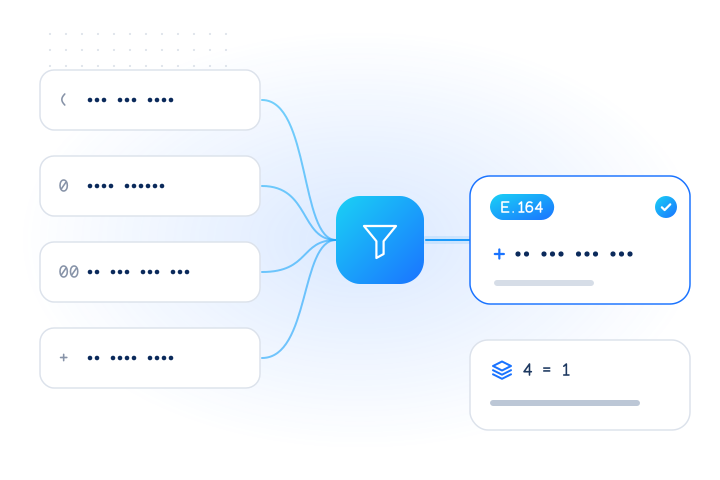
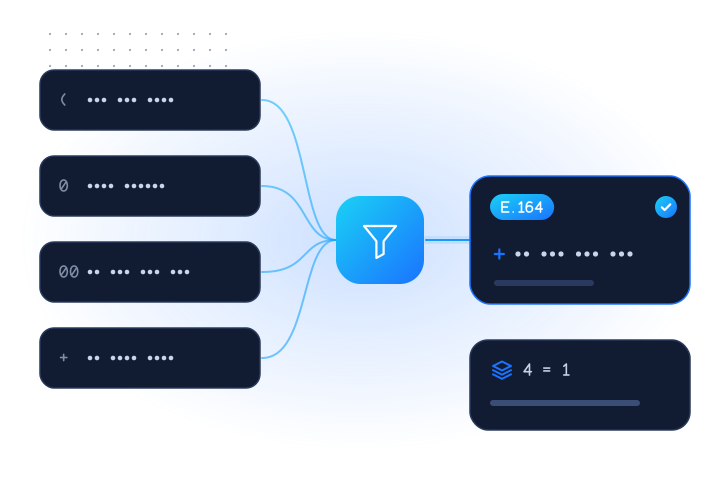
Store only the E.164 form: +56 and the nine digits. There is no trunk 0 to drop: 9 2123 4567, +56 9 2123 4567 and 0056 9 2123 4567 are the same number. The international-prefix pattern in the table looks odd because Chile has two ways to dial abroad: 00 through your contracted carrier, or 1XY 0 to pick a carrier per call, where 1XY is the carrier's code (Decreto 747, article 15.1). In August 2025 SUBTEL consulted on removing the per-call option (SUBTEL, 2025); either way, write numbers with +56.
Why do old Chilean numbers fail validation?
Because Chile changed its numbers and its dialling four times in ten years, and old forms still sit in CRMs and spreadsheets:
| Date | Change | Old form you may still see |
|---|---|---|
| 19 August 2006 | Mobiles went from 8 to 9 digits with a leading 9 (SUBTEL to the ITU, 2006) | 8XXX XXXX, 7XXX XXXX (8-digit mobile) |
| October 2012 to July 2013 | Fixed numbers got an extra 2 after the area code, region by region; Santiago on 24 November 2012 (SUBTEL to the ITU) | (2) XXX XXXX (7-digit Santiago number) |
| 2014 | Ley 20.704 made all fixed calls inside Chile local calls, ending national long distance (Ley 20.704) | carrier-selection digits before an area code |
| 6 February 2016 | Everyone dials nine digits; the 0 before mobile and landline numbers was dropped (SUBTEL, 2016) | 09 XXXX XXXX, 02 2XXX XXXX |
SUBTEL's own examples for 2016 were a mobile-to-mobile call that went from 8 dialled digits to 9 by adding the 9, and a call to a landline that lost its leading 0. Two of these old forms can be fixed mechanically: a 10-digit number starting 09 or 02 to 08 is the 2016 form with the 0 still in front, so drop the 0. An 8-digit number can't: it may be a pre-2006 mobile or a pre-2013 landline, and the number may have changed hands since. Ask the customer.
Why can't libphonenumber tell a mobile from a landline in Chile?
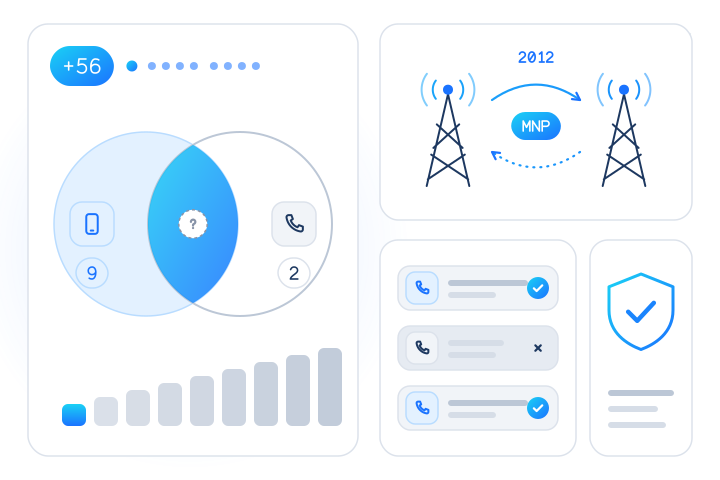
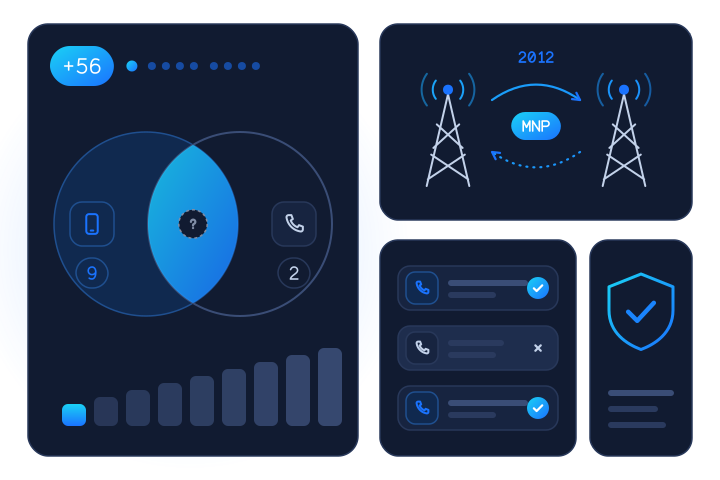
Because Chile allows it to change. On 5 September 2016 full portability started: "fixed-mobile portability", with both fixed and mobile numbers in one format, +56 YXX XXX XXX with Y from 2 to 9, as SUBTEL told the ITU (SUBTEL to the ITU, 2016). A Santiago landline number can now ring on a mobile, and a 9 number can end up on a fixed line.
libphonenumber reflects that: its metadata for CL gives mobile and fixed lines the same pattern, so a valid Chilean geographic or mobile number is typed FIXED_LINE_OR_MOBILE, never MOBILE. Even the library's own mobile example for Chile is 2 2123 4567, a Santiago-style number. Code that keeps only MOBILE numbers, which works in most countries, drops every Chilean number. Mexico has the same effect for a different reason; see our Mexico phone number guide.
The practical rule:
- Accept
FIXED_LINE_OR_MOBILEas a valid Chilean number. - Use the leading
9as the mobile range. Most numbers starting with9are mobiles, and most others are landlines, but ports between the two make this a hint. - Use a lookup when it matters. A carrier lookup gives the current line type; an HLR check says whether a mobile is reachable now.
Which prefixes are mobile numbers?
The generator counted every 9-digit number that libphonenumber's "mobile" pattern for CL accepts. Because that pattern is also the fixed-line pattern, the table lists landline area codes as well as the 9 blocks:
| National prefix | International | Share of the block that is mobile (9-digit numbers) | 3-digit sub-blocks that aren't fully mobile |
|---|---|---|---|
AA, for 37 blocks AA = 22, 32–35, 41–43, 45, 51–53, 55, 57, 58, 61, 63–65, 67, 71–73, 75, 81–89, 92, 94, 95, 98 | +56 AA | 100% | — |
23 | +56 23 | 30.9% | not mobile: 230, 231, 237–239; partly mobile: 233 (97.6%), 235 (10.0%), 236 (1.0%) |
80 | +56 80 | 80.0% | not mobile: 800, 809 |
91 | +56 91 | 3.0% | not mobile: 911–919; partly mobile: 910 (30.0%) |
93 | +56 93 | 99.9% | partly mobile: 936 (99.0%) |
96 | +56 96 | 98.6% | partly mobile: 969 (86.0%) |
97 | +56 97 | 90.0% | not mobile: 970 |
99 | +56 99 | 98.8% | partly mobile: 991 (89.0%), 992 (99.0%) |
| 2 other blocks: 21, 26 | — | under 1% each | a few mobile sub-ranges each: 211, 219, 264 |
Read it in two parts. The 9X rows are the mobile range: 92, 94, 95 and 98 are fully valid, 93, 96, 97 and 99 almost fully, and 91 only in small slices (910). The other rows are landline area codes, such as 22 for Santiago, 32 for Valparaíso and 41 for Concepción. The 80 row is 801 to 808, which both patterns also accept; we found no SUBTEL description of these blocks, so treat a sign-up from one as unusual. A common tutorial example such as 9 1234 5678 is not valid: the 912 block isn't in the plan. It passes a 9\d{8} regex, but libphonenumber rejects it.
Who holds a mobile block?
libphonenumber's carrier file names an original holder for many Chilean blocks (56.txt), such as Entel, Movistar, Claro or WOM. After more than 43 million ports, that name is history for many numbers. SUBTEL counted 23.7 million mobile subscriptions in June 2026, 82% of them on contracts: Entel 34.3%, Movistar 22.8%, Claro 21.6% and WOM 20.4%, with Mundo Pacífico, Virgin and others sharing the rest (SUBTEL, June 2026).
Two ownership changes explain new names in carrier answers. Telefónica's Chilean business, which runs Movistar, was sold to NJJ and Millicom, a deal completed on 10 February 2026 (InvestChile, 2026). WOM completed its financial restructuring and left Chapter 11 on 21 March 2025 under new owners (WOM, 2025). Numbers didn't change in either case.
What are 600, 800, 809 and the other special numbers?
These are valid Chilean numbers, but not personal lines. SUBTEL's Resolution 1.319 of 2004 sets the special-service blocks (current text):
| Range | Use (SUBTEL) | libphonenumber 9.0.39 |
|---|---|---|
800 XXX XXX | Toll-free (reverse charge) | TOLL_FREE |
600 XXX XXXX | Mass communications the person asked for or agreed to (10 digits) | SHARED_COST |
809 XXX XXX | Unsolicited mass calls and messages, since 2025 | FIXED_LINE |
702 XXX XXXX | Mass communications from State bodies, from 2 March 2027 | invalid |
700 XXXX | Information and entertainment services | invalid |
44 XXX XXXX | VoIP numbers (a separate format since the 2014 dialling plan) | VOIP |
Two of these come from SUBTEL's fight against nuisance calls, which the next section covers. libphonenumber's types lag behind: it still calls the 10-digit 600 numbers "shared cost", the category SUBTEL abolished in 2025, and it types 809 as fixed line. If you filter sign-ups, reject 600, 800 and 809 numbers explicitly: none of them belongs to a person.
How do I validate a Chilean number in code?
Remove spaces and punctuation, drop the 0 of a 10-digit pre-2016 number, parse with full metadata and the default region CL, then accept the number as mobile only if it starts with 9. Before you write code, you can paste a few numbers into our free phone number validator to see the same result.
Python (pip install phonenumbers):
import re

import phonenumbers


def normalize_cl(raw: str) -> str | None:
    """E.164 for a number in Chile's mobile range (+56 9XXXX XXXX), or None."""
    s = re.sub(r"[\s().-]", "", raw)
    if re.fullmatch(r"0[2-9]\d{8}", s):  # pre-2016 domestic form: 09… for mobiles, 02… for Santiago
        s = s[1:]
    try:
        n = phonenumbers.parse(s, "CL")
    except phonenumbers.NumberParseException:
        return None
    if not phonenumbers.is_valid_number(n) or phonenumbers.region_code_for_number(n) != "CL":
        return None
    # libphonenumber types Chilean geographic and mobile numbers alike (FIXED_LINE_OR_MOBILE),
    # so the type can't pick out mobiles. The mobile range is the numbers that start with 9.
    if not str(n.national_number).startswith("9"):
        return None
    return phonenumbers.format_number(n, phonenumbers.PhoneNumberFormat.E164)


for raw in ["9 2123 4567", "+56 9 2123 4567", "56921234567", "0056 9 2123 4567",
            "09 2123 4567", "2123 4567", "2 2123 4567", "800 123 456", "9 1234 5678"]:
    print(f"{raw!r:20} -> {normalize_cl(raw)}")
JavaScript (npm install libphonenumber-js):
import { parsePhoneNumberFromString } from "libphonenumber-js/max";

/** "9 …", "+56 9…", "56 9…", "0056 9…" or the old "09 …" → E.164 in Chile's mobile range, or null. */
export function normalizeCl(raw) {
  let s = String(raw).replace(/[\s().-]/g, "");
  if (/^0[2-9]\d{8}$/.test(s)) s = s.slice(1); // pre-2016 domestic form: 09… / 02…
  const phone = parsePhoneNumberFromString(s, "CL");
  if (!phone?.isValid() || phone.country !== "CL") return null;
  // getType() is FIXED_LINE_OR_MOBILE for both; the mobile range is the numbers starting with 9.
  return phone.nationalNumber.startsWith("9") ? phone.number : null;
}

for (const raw of ["9 2123 4567", "+56 9 2123 4567", "56921234567", "0056 9 2123 4567",
  "09 2123 4567", "2123 4567", "2 2123 4567", "800 123 456", "9 1234 5678"]) {
  console.log(JSON.stringify(raw).padEnd(20), "->", normalizeCl(raw));
}
The inputs are built from libphonenumber's own example numbers for Chile (the landline 2 2123 4567, reused with the mobile 9 in front of the same digits, and the toll-free 800 123 456), plus the unallocated 9 1234 5678. They are not real subscribers. We ran both on 2026-11-07 (Python 3.12 with phonenumbers 9.0.40, Node.js 24 with libphonenumber-js 1.13.13). Both printed the same answers; Python prints None and single quotes, JavaScript null and double quotes:
'9 2123 4567'        -> +56921234567
'+56 9 2123 4567'    -> +56921234567
'56921234567'        -> +56921234567
'0056 9 2123 4567'   -> +56921234567
'09 2123 4567'       -> +56921234567
'2123 4567'          -> None
'2 2123 4567'        -> None
'800 123 456'        -> None
'9 1234 5678'        -> None
The first five are one number written five ways, including the pre-2016 09 form. The 8-digit 2123 4567 is rejected rather than guessed, the Santiago landline and the toll-free number are valid but outside the mobile range, and 9 1234 5678 is in an unallocated block.
The generated test table runs the same idea over masked inputs, with the raw library call. The shape regex column tests the pattern a generator builds from libphonenumber's mobile pattern for CL, after spaces, dashes and brackets are removed; because that pattern covers landlines too, the regex accepts any first digit from 2 to 9:
| # | Case | Input (masked) | Shape regex ^(?:\+56|0056)?[2-9]\d{8}$ | libphonenumber (CL) |
|---|---|---|---|---|
| 1 | National (no trunk prefix) | 9 2XXX XXXX | passes | valid, FIXED_LINE_OR_MOBILE |
| 2 | International, with spaces | +56 9 2XXX XXXX | passes | valid, FIXED_LINE_OR_MOBILE |
| 3 | International dialling prefix 00 | 0056 9 2XXX XXXX | passes | valid, FIXED_LINE_OR_MOBILE |
| 4 | E.164 | +5692XXXXXXX | passes | valid, FIXED_LINE_OR_MOBILE |
| 5 | Dashes and brackets | (9) 2XXX-XXXX | passes | valid, FIXED_LINE_OR_MOBILE |
| 6 | One digit short | 92XXXXXX | fails | invalid |
| 7 | One digit too many | 92XXXXXXXX | fails | invalid |
| 8 | Mobile shape, unused block 20 | 20XXXXXXX | passes | invalid |
| 9 | Fixed line | (2) 2XXX XXXX | passes | valid, FIXED_LINE_OR_MOBILE |
| 10 | VoIP range | 44 XXX XXXX | passes | valid, VOIP |
Rows 8 and 9 are the ones to remember:
- Row 8:
20…has the right shape and passes the regex, but no number starts with20, so libphonenumber rejects it. A regex can't know which blocks exist. - Row 9: the Santiago landline is typed
FIXED_LINE_OR_MOBILE, exactly like the mobile in row 1. The library gives you no way to tell them apart; the first digit and a lookup do.
Our post on why an E.164 regex is not enough shows the same problem elsewhere, and our Python and JavaScript guides cover more languages. For a whole file, the free phone list cleaner normalises numbers to E.164 and removes duplicates in your browser.
Does number portability change the carrier?
Yes, and in Chile it can change the line type too. Ley 20.471 of December 2010 added portability to the General Telecommunications Law, with a single central database of ported numbers run by an independent administrator, the Organismo Administrador de la Portabilidad (OAP), which no operator may own (Ley 20.471, article 25 bis). SUBTEL's timeline (SUBTEL, 2016):
| Date | What became portable |
|---|---|
| 5 December 2011 | Fixed lines in Arica y Parinacota; other regions from 12 March to 27 August 2012 |
| 16 January 2012 | Mobile numbers |
| 16 March 2013 | VoIP and rural numbers |
| 13 October 2014 | 600 and 800 numbers |
| 2 November 2015 | Geographic portability: a landline number can move to another area |
| 5 September 2016 | Full portability: fixed to mobile and back |
The current rules, from the portability regulation as amended by Decreto 6 of 2024 (Decreto 6/2024) and the OAP's FAQ (OAP):
- Next business day. A mobile port "should be completed the next business day"; business days are Monday to Saturday, except holidays.
- 120 days between ports. Since 3 February 2025 a number must wait 120 days, not 60, before it can be ported again.
- A code for postpaid ports. Since 2 August 2025 a postpaid mobile port needs a portability activation code, valid for five calendar days, which the customer gets from the current operator.
- Any line type. A number can move between local, mobile and VoIP operators.
Volumes are large. SUBTEL counted 844,415 ports in the first quarter of 2026, 835,994 of them mobile, and more than 43 million ports since 2012 (SUBTEL, 2026). That is almost two ports for every mobile subscription SUBTEL counts today.
| Item | Value |
|---|---|
| Mobile number portability | Yes |
| Mobile porting since | 2012-01-16 |
| Maximum porting time | next business day (mobile) |
| Governing rule | Ley 20.471 (art. 25 bis Ley 18.168); Decreto 379/2010 as amended by Decreto 6/2024 (120 days between ports from 2025-02-03) |
| Published porting volume | quarterly (Q1 2026): 844,415 ported (835,994 mobile); cumulative 2012–Mar 2026: more than 43 million (2026) |
| Source | subtel.gob.cl, subtel.gob.cl |
| Checked | 2026-11-07 |
The atlas row is older than this guide; the facts above would update its porting time (next business day for mobiles), its fixed-mobile porting field (yes, since 5 September 2016) and its volume (Q1 2026). Our MNP atlas compares Chile with other countries, and how to check if a phone number is ported shows the lookup.
What are the rules for calls, SMS and personal data?
These summarise the law and SUBTEL resolutions as we read them on 2026-11-07. Not legal advice; ask counsel how they apply to you.
The 809 and 600 prefixes for mass communications
SUBTEL's Resolution 286, published on 13 February 2025, created two numbering blocks for automated or mass communications (Res. 286/2025):
809 XXX XXXfor unsolicited communications: information or advertising sent automatically or in bulk that the person did not ask for or authorise. "Toda comunicación masiva no solicitada deberá utilizar esta numeración", every unsolicited mass communication must use it, in a way the person can see.600 XXX XXXXfor solicited communications: the same kind of traffic when the person asked for or authorised it.
Both definitions cover "todo tipo de comunicación, verbal, escrita, pre grabada, generada por inteligencia artificial": spoken, written, recorded or AI-generated. Operators had six months to implement the blocks, and since 13 August 2025 all commercial and mass calls, wanted or not, must carry 600 or 809. Breaches can be fined from 5 to 5,000 UTM, a Chilean inflation-indexed unit (SUBTEL, 2025).
Two changes followed in 2026. After a Supreme Court ruling, SUBTEL's Resolution 900 of May 2026 added out-of-court debt collection to the exceptions (Res. 900/2026). Resolution 1.031, published on 5 June 2026, limits 600 to communications about what the person asked for or contracted, not offers of new products, and creates 702 XXX XXXX for State bodies from 2 March 2027 (Res. 1.031/2026).
For a business, the effect is simple: Chilean customers now see from the number whether a call is a campaign. Keep your service calls and OTP voice calls on numbers that match their purpose, and ask your provider which range your traffic needs.
Opt-out and "No Molestar" under the consumer law
Article 28 B of the consumer protection law, Ley 19.496, says promotional communications by phone or message must give the recipient an expedited way to ask that they stop, and once someone has asked, sending more is forbidden (Ley 19.496). SERNAC, the national consumer service, runs the "No Molestar" register through which people make that request to companies. It is an opt-out system: the Economy Ministry describes Chile's current regime as opt-out through SERNAC's "No Molestar" and backs a bill (Boletines 15.610-03 and 16.041-03) that would require prior express consent for advertising calls and messages, including SMS and WhatsApp, with fines of up to 1,000 UTM (Ministerio de Economía, 2026). As of November 2026 that bill is still in Congress.
Suppress every number registered in "No Molestar" or that asked you to stop, on every channel. A list check can't tell you that; your own records must.
Personal data: Ley 19.628 and the new Ley 21.719
Chile's data protection law since 1999 is Ley 19.628. Ley 21.719, published on 13 December 2024, replaces most of it and creates a Personal Data Protection Agency. It enters into force on the first day of the 24th month after publication, 1 December 2026 (Ley 21.719). Among other rights, it gives people a right to object to processing of their data for direct marketing.
That date may move. On 28 October 2026 the Senate approved a bill postponing the law to 15 October 2027, by 33 votes to 6; it then went to the Chamber of Deputies (Emol, 2026). Check the status before you plan around either date. If you send Chilean customer numbers to a check service abroad, ask counsel which basis and transfer rules apply under both laws. Our posts on whether a phone number is personal data and on consent for WhatsApp checks give the baseline we work to.
Prepaid lines are now registered
Ley 21.729 of February 2025 requires operators to keep a register of subscribers. Since 20 August 2026, activating a prepaid line, and topping up an existing one, requires identity validation with an identity card or passport; a line that doesn't complete it within 10 calendar days can't be topped up. SUBTEL counted 4,425,012 prepaid users in the first quarter of 2026, almost 19% of mobile numbers (SUBTEL, 2026). Expect some unvalidated prepaid numbers to go quiet in late 2026; re-check old prepaid numbers before you rely on them for OTP.
Which messaging apps and channels reach people in Chile?
We found no official statistics on messaging-app use in Chile that we could verify, so measure your own customers instead of trusting a market average. SMS still reaches every active mobile and remains the fallback for OTP. Spanish text with accents (á, é, í, ó, ú, ñ) partly fits the GSM alphabet; our SMS character counter shows how many parts a message takes, and our WhatsApp cost calculator compares WhatsApp campaign costs.
The method is the same as in our channel-by-country guide: check which apps your opted-in customers are registered on, route each one to the channel they use, and keep SMS as the fallback. Because a Chilean number can be a landline even when it looks like a mobile, a WhatsApp check is also a quick test of whether a number is used on a phone at all. To open a chat without saving a contact, our WhatsApp link generator builds a wa.me link from the E.164 number.
How do I check WhatsApp registration for a Chilean customer list?
Normalise every row first. For Chile, don't drop numbers outside the 9 range blindly: a landline number may have been ported to a mobile. A check tells you whether a number is registered at the time of the check. It can't tell you whether the person wants your messages:
| Answer | What it means | What to do |
|---|---|---|
registered: true | The number has a WhatsApp account at checked_at | Offer WhatsApp to customers who opted in to it |
registered: false | No account at checked_at | Use SMS or another channel |
unknown | No conclusive answer (not billed) | Keep the current channel; retry later |
invalid_number | Failed format validation (not billed) | Fix the data at the source |
See WhatsApp number check for the fields. It runs in real time and in bulk jobs.
What changed recently?
The rows for CL and +56 in our numbering-plan changes dataset, built from libphonenumber's release notes:
| Change named in the release notes (2019-01-08 to 2026-09-23) | Releases |
|---|---|
| Numbering-plan metadata (validation, lengths, types) | 18 |
| Original-carrier prefix data | 12 |
| Geocoding (area names) | 2 |
| All | 32 |
Latest numbering-plan updates for CL: 2026-08-13 (v9.0.37), 2026-05-06 (v9.0.30), 2025-12-17 (v9.0.21), 2025-07-17 (v9.0.10), 2023-04-14 (v8.13.10).
Chile's metadata changed four times between July 2025 and August 2026, so update the library regularly. The bigger changes were in rules:
- 2016: nine-digit dialling everywhere (6 February) and full fixed-mobile portability (5 September).
- 2024: Ley 21.719 on personal data (13 December); new portability rules (Decreto 6, 5 November).
- 2025: the
809and600mass-communication ranges (Resolution 286, 13 February; in force 13 August); 120 days between ports (3 February); activation codes for postpaid ports (2 August); Ley 21.729 on subscriber registers (February). - 2026: Telefónica Chile sold to NJJ and Millicom (10 February); debt collection exempted from the
809/600rule (May);600limited and702created for State bodies (5 June); prepaid identity validation (20 August); a Senate vote to postpone Ley 21.719 to October 2027 (28 October).
What can MobileValidate check for Chilean numbers?
Generated from our public catalog:
Catalog data as of 2026-11-07.
| Check | Accepts Chile numbers | Notes |
|---|---|---|
| Format and country (every lookup) | Yes | Each number is parsed first; an invalid number returns invalid_number and is never billed. |
| Carrier lookup (beta) | Yes | Line type and current network where data exists; no data means unknown, not billed. Real time and bulk. |
| US/CA carrier lookup (premium) | No (US, CA only) | Answers unsupported_country for other countries, not billed. |
| Live network status (HLR) | Yes | Live reachability, porting, roaming (true or false) and current network; unknown is free. Real time and bulk. |
| Number portability (MNP) | Yes | Ported or not ported, and the current network code; unknown is free. Real time and bulk. |
| Spam reputation | Limited access | All countries except sanctioned ones; report coverage is strongest in North America and Europe. |
| Messaging apps | Yes: WhatsApp, Telegram, Viber*, Signal*, iMessage*, RCS*, LINE*, Zalo*, Botim*, Facebook Messenger* | Registered, not registered or unknown; unknown is free. |
| Social networks | Yes: Facebook, Instagram, Threads, X (Twitter), TikTok*, Snapchat* | Not for Chile numbers: LinkedIn (US, IN only). |
| Online accounts (Apple, Amazon, Microsoft, Netflix) | Yes: Apple, Amazon, Microsoft, Netflix | Registered, not registered or unknown; unknown is free. |
* bulk jobs only. The live list is at GET /v1/services.
A lookup returns network and registration facts. It never returns a subscriber's name or address, and we don't offer "number details" searches.
In Chile the useful lookup is the one libphonenumber can't do: the line type. A carrier lookup gives the current line type and network, an MNP lookup says whether a number has been ported and to which network, and a live network status (HLR) check adds whether a mobile is reachable now. Our free MCC-MNC lookup turns the network code into an operator name. For channels, WhatsApp and Telegram run in real time and in bulk; the starred checks run in bulk jobs only.
How do I start for free?
- 100 free real checks. Every live account can run 100 phone numbers and 20 e-mail addresses through the real checks for free on the dashboard's Try it page. Use them on your own number first.
- A free carrier lookup. The carrier lookup page has a public form for 3 lookups a day, no sign-up needed.
- Free tools. The phone number validator and phone list cleaner check format in your browser; all of them are on the tools page.
- A free test key. Get a test key for the sandbox. It gives fixed test answers so you can build every branch of your code; see test mode.
- A free estimate.
POST /v1/jobs/estimatetakes the same body as a job, checks nothing and shows the maximum cost before you start. - Then add credit. Create your account; approval is automatic. Top-ups of larger amounts get 5% to 10% bonus credit; see pricing. Unknown, invalid and duplicate results are never charged.
A bulk flow for a Chilean customer list
- Export the numbers you hold with consent or another lawful basis, one per row, and remove those that opted out.
- Normalise them, or upload them as they are with
default_country=CL, so9 XXXX XXXXis read as Chilean. Fix 8-digit numbers with the customer first. - Run
POST /v1/jobs/estimatewith your checks, for examplecarrierandmnp, and read the cost breakdown. - Start the job, then download the results as CSV or NDJSON.
curl https://api.mobilevalidate.com/v1/jobs \
  -H "Authorization: Bearer $MOBILEVALIDATE_API_KEY" \
  -F file=@customers.csv -F checks=carrier,mnp -F default_country=CL
For single numbers, here is the same pair of checks against the real-time endpoint: the line type, which libphonenumber can't give you for Chile, and the porting state. It uses the public sandbox key mv_test_publicSandboxn9ZgneuhR1B9CRfKG3fulym and our test values. The sandbox accepts only those UK drama numbers, so the example uses them; with a live key, pass the output of normalize_cl().
import os

import requests  # pip install requests

API = "https://api.mobilevalidate.com/v1/lookup"
KEY = os.environ["MOBILEVALIDATE_API_KEY"]


def line_and_porting(numbers: list[str]) -> dict[str, tuple]:
    """Per E.164 number: (line type, porting state). None means we don't know."""
    r = requests.post(API, headers={"Authorization": f"Bearer {KEY}"}, timeout=15,
                      json={"numbers": numbers, "checks": ["carrier", "mnp"], "wait": 5})
    r.raise_for_status()
    out = {}
    for row in r.json()["results"]:
        net, mnp = row["checks"]["network.carrier"], row["checks"]["number.mnp"]
        line = (net["attributes"] or {}).get("line_type") if net["status"] == "completed" else None
        porting = (mnp["attributes"] or {}).get("porting") if mnp["status"] == "completed" else None
        out[row["e164"]] = (line, porting)
    return out


for number, hints in line_and_porting(["+447700900001", "+447700900002", "+447700900003"]).items():
    print(number, hints)
We ran it against the sandbox on 2026-11-07. It printed:
+447700900001 ('mobile', 'not_ported')
+447700900002 (None, 'not_ported')
+447700900003 (None, None)
The first test value is a mobile line that hasn't been ported. The second hasn't been ported, but its carrier lookup has no data, so the line type is None. The third stands for a timeout, so both answers are None and neither is billed. Keep None apart from a real answer: None means we don't know. Requests with 20 or more consecutive numbers are refused (403 suspected_enumeration), and our acceptable use policy forbids finding recipients for unsolicited messages. People can object through our opt-out form.
What are the key takeaways?
- Chilean numbers have 9 digits and no trunk prefix. Mobiles start with
9, landlines with an area code from2to8. In E.164, put+56in front and change nothing else. - Old forms come from 2006 (8-digit mobiles), 2012–2013 (Santiago's extra
2) and 2016 (the dropped0). Strip the0of09…and02…; confirm 8-digit numbers with the customer. - libphonenumber types every Chilean geographic and mobile number
FIXED_LINE_OR_MOBILE. Accept that type, use the leading9as the mobile range, and look up the line type when it matters. - Numbers have been portable since 2012 for mobiles and between fixed and mobile since 5 September 2016. More than 43 million ports mean the carrier name in a prefix list is often out of date.
- Since 13 August 2025, mass and commercial calls must come from
809(unsolicited) or600(solicited) numbers; promotional messages must offer an opt-out, and "No Molestar" requests must be honoured. - Ley 21.719 on personal data is due on 1 December 2026, but a postponement to 15 October 2027 has passed the Senate. Prepaid lines need identity validation since 20 August 2026.
Platform, regulator and company names are used descriptively. MobileValidate is not affiliated with any of them.
Sources
- Decreto 747 de 1999, Plan Técnico Fundamental de Numeración Telefónica (current text, as amended by Decreto 279 of 2018) — Biblioteca del Congreso Nacional de Chile (LeyChile), 2018
- Chile: change of the national numbering plan for mobile numbers (communication to the ITU, 27 April 2006) — Subsecretaría de Telecomunicaciones (SUBTEL), via the ITU, 2006
- Chile: numbering plan changes and fixed-mobile portability (communications to the ITU, 2014 and 8 September 2016) — SUBTEL, via the ITU, 2016
- Ley 20.704, Todo Chile a llamada local (2013) — Biblioteca del Congreso Nacional de Chile (LeyChile), 2013
- De manera exitosa ya opera en Chile la nueva forma de marcar desde teléfonos móviles (6 February 2016) — SUBTEL, 2016
- Resolución Exenta 1.319 de 2004 on special-service numbering (current text, in force since 5 June 2026) — Biblioteca del Congreso Nacional de Chile (LeyChile), 2026
- Resolución Exenta 286 (13 February 2025): numbering for solicited (600) and unsolicited (809) mass communications — SUBTEL, 2025
- Desde este miércoles las llamadas comerciales y masivas deberán llevar los prefijos 600 y 809 (12 August 2025) — SUBTEL, 2025
- Resolución Exenta 900 de 2026: exceptions to the mass-communication numbering (debt collection) — SUBTEL, 2026
- Resolución Exenta 1.031 de 2026 (Diario Oficial, 5 June 2026): use of 600 numbers and the 702 range for State bodies — Diario Oficial de la República de Chile, 2026
- Ley 20.471 (2010), number portability: article 25 bis of the General Telecommunications Law — Biblioteca del Congreso Nacional de Chile (LeyChile), 2010
- Comienza la portabilidad completa (5 September 2016), with the portability start dates — SUBTEL, 2016
- Decreto 6 de 2024, amending the number portability regulation (Diario Oficial, 5 November 2024) — Diario Oficial de la República de Chile, 2024
- Preguntas frecuentes: portabilidad numérica — Organismo Administrador de la Portabilidad, 2026
- Informe de portabilidad: más de 844 mil números fijos y móviles cambiaron de compañía durante el primer trimestre (2026) — SUBTEL, 2026
- Abonados móviles, junio 2026 (statistics workbook) — SUBTEL, 2026
- Millicom and NJJ complete the acquisition of Telefónica Chile (2026) — InvestChile, 2026
- WOM Chile completes its financial restructuring and exits Chapter 11 (March 2025) — WOM Chile, 2025
- Fin a los números anónimos: entra en vigencia el registro obligatorio de teléfonos prepago (20 August 2026) — SUBTEL, 2026
- Ley 19.496 on consumer protection, article 28 B (current text) — Biblioteca del Congreso Nacional de Chile (LeyChile), 2021
- Proyecto de ley que prohíbe llamadas publicitarias sin consentimiento del consumidor (Boletines 15.610-03 y 16.041-03), presentation of 6 January 2026 — Ministerio de Economía, Fomento y Turismo, 2026
- Ley 21.719 on the protection of personal data (2024) — Biblioteca del Congreso Nacional de Chile (LeyChile), 2024
- Senado aprueba aplazar la Ley de Datos Personales: regiría desde el 15 de octubre de 2027 (28 October 2026) — Emol, 2026
- libphonenumber carrier prefix data for +56 (56.txt) and PhoneNumberMetadata.xml (region CL) — libphonenumber project (Apache License 2.0), 2026
Frequently asked questions
How many digits is a Chilean phone number?
Nine, for mobiles and landlines alike, with no trunk prefix. A mobile looks like 9 XXXX XXXX and a Santiago landline like 2 2XXX XXXX. In international form you add +56: +56 9 XXXX XXXX, stored as +569XXXXXXXX. Chile's numbering plan (Decreto 747, article 9) fixes subscriber numbers at 9 digits, and since 6 February 2016 everyone dials all nine.
What is the +56 country code and how do I write a Chilean number for WhatsApp?
+56 is Chile's country calling code. Put +56 in front of the 9-digit number and change nothing else: 9 2123 4567 becomes +56 9 2123 4567, stored as +56921234567. Don't add a 0. Old forms such as 09 2123 4567 or an 8-digit mobile without the 9 date from before 2016 and 2006 and must be rewritten first.
Do Chilean mobile numbers start with 9?
Yes. Mobile numbers have started with 9 since 19 August 2006, when the 8-digit mobile numbers got a leading 9. Landlines start with 2 to 8 by area, for example 2 for Santiago and 32 for Valparaíso. But since 5 September 2016 numbers can be ported between fixed and mobile lines, so the first digit is a strong hint, not proof of the line type.
Why does libphonenumber return FIXED_LINE_OR_MOBILE for Chilean numbers?
Because Chile's mobile and fixed ranges share one structure and numbers move between them. libphonenumber gives both types the same pattern for Chile, so every geographic or mobile number comes back as FIXED_LINE_OR_MOBILE, even 9-prefixed ones. Use the leading 9 as the mobile range and a carrier or HLR lookup for the actual line type.
Can I keep my number when I change operator in Chile?
Yes. Mobile number portability started on 16 January 2012, and since 5 September 2016 numbers can also move between fixed and mobile lines. A mobile port should be done the next business day. Since February 2025 a number must wait 120 days before it can be ported again. SUBTEL counted more than 43 million ports by March 2026.
What are the 809 and 600 prefixes on calls in Chile?
Since 13 August 2025, SUBTEL's Resolution 286 of 2025 requires mass and commercial calls to come from special numbers: 809 XXX XXX for unsolicited mass communications and 600 XXX XXXX for ones the person asked for or agreed to. The rule covers written, recorded and AI-generated communications too. A 702 range for State bodies follows from March 2027.
Can I check whether Chilean customers are on WhatsApp?
Yes, for numbers you hold with consent or another lawful basis, such as your own customers. A MobileValidate check answers registered, not registered or unknown with a checked_at date; unknown is never billed. It returns no name or profile, and requests that look like scans of number ranges are refused.
Related services and guides
More from the blog
All articlesGuides
Phone numbers by country: formats, portability, channels and rules
How phone numbers differ by country: formats and E.164, numbering changes, portability, line types, messaging channels, and a dated tracker of calling and texting rules.
11 min read
Developers
International phone number formats by country: a 2026 reference table
Calling code, international and trunk prefix, mobile and fixed-line number lengths and a masked E.164 mobile format for 238 regions, generated from libphonenumber.
19 min read
Developers
E.164 phone number format: a practical guide for developers
How to normalize phone numbers to E.164 in JavaScript and Python, the pitfalls that break deduplication, and how the MobileValidate API normalizes input.
9 min read