On this page
The best OTP channel is the one that gets the most users verified for the least money and risk. Compare channels by cost per completed verification, not price per message: a cheap message on an app the user doesn't have costs you a fallback and some drop-offs. Pre-check which channels a number can receive, then send there first.
Why compare channels by completed verifications?
Because a message price hides three things: whether the user can receive the message at all, how many users give up while waiting, and what you pay for fallbacks. A channel that is cheap per message but reaches only part of your users can end up costing more per verified user than SMS.
The metric that captures all of it is cost per completed verification:
cost per verified user = (pre-check cost + cost of every attempt you pay for) ÷ share of users who complete verification
Every term is measurable in your own data. The rest of this guide is about how each channel moves those terms.
How do the channels compare?
| SMS | RCS | Voice call | ||
|---|---|---|---|---|
| Reach | Almost any mobile phone | Users with a WhatsApp account | Devices and operators with RCS business messaging | Any phone, including landlines |
| Billing model | Per message, set by route and country | Per delivered template message, by recipient country code | Varies by market and programme | Per minute |
| Undelivered attempts | Often billed, depending on your provider | Not charged if not delivered | Depends on the programme | Depends on your provider; long calls cost more |
| Speed | Seconds, sometimes delayed by filtering | Seconds | Seconds | Tens of seconds including the call |
| Code autofill | Supported by common phone platforms | Depends on the app and template | Platform-dependent | No |
| Main risks | Pumping, SIM swap, filtering | Account takeover of the app, users without the app | Uneven availability | Toll fraud, poor UX |
| Needs a pre-check? | Line type | Account presence | Capability | Line type and country |
Meta has charged per message on the WhatsApp Business Platform since 1 July 2025, with separate categories including authentication and authentication-international, and rate cards that change by market during the year (Meta). Our WhatsApp OTP vs SMS OTP guide has the rates, the October 2026 changes and a calculator.
On iPhone, Apple added RCS support to Messages with iOS 18, "for richer media and more reliable group messaging compared to SMS and MMS" when messaging contacts who don't have an Apple device (Apple, 2024). Whether a business can reach a given user over RCS still depends on the operator, the device and the business messaging programme in that country. See RCS capability check: what it tells senders.
How does the cost model work in practice?
Take one country and three routing strategies. The prices below are illustrative units, not market prices. Plug in your own.
Assume an SMS costs 5 units, a WhatsApp authentication message 1 unit, a messenger pre-check 0.5 units, 70 % of users have WhatsApp, and 90 % of users who receive a code complete verification.
| Strategy | What happens | Cost per user who starts | Verified | Cost per verified user |
|---|---|---|---|---|
| SMS only | Everyone gets an SMS | 5.00 | 90 % | 5.56 |
| WhatsApp first, SMS on failure | 70 % get WhatsApp (1). 30 % wait for the failure, then get SMS (5); some give up | 0.70 + 1.50 = 2.20 | 85 % (assumed drop-off while waiting) | 2.59 |
| Pre-check, then the right channel | Everyone checked (0.5). 70 % get WhatsApp, 30 % get SMS at once | 0.50 + 0.70 + 1.50 = 2.70 | 90 % | 3.00 |
In this example, "WhatsApp first" is cheapest per verified user even with the drop-off, because an undelivered WhatsApp message isn't charged. The pre-check strategy costs a little more but keeps completion at the SMS level. Which one wins for you depends on the real waiting-time drop-off, which you can only measure. Two practical points shift the balance towards pre-checking:
- Check once, not on every login. Repeat checks of the same number within the freshness window come from your account's cache and are free, which spreads the check cost over many logins.
- Inconclusive answers are free. You're not charged for inconclusive results (unknown, unsupported country, timeout, invalid, duplicate). An unknown answer simply routes the user to your default channel.
Where does the pre-check fit?
Before the first send, to choose the channel. One lookup can check several channels and the line type at once. A test-mode example:
curl https://api.mobilevalidate.com/v1/lookup \
  -H "Authorization: Bearer $MOBILEVALIDATE_API_KEY" \
  -H "Content-Type: application/json" \
  -d '{"numbers": ["+447700900001", "+447700900002"], "checks": ["carrier", "whatsapp"], "max_age": 2592000, "wait": 3}'
The first test number returns line_type: "mobile" and whatsapp.registered: true. The second returns carrier unknown (NO_DATA, not billed) and whatsapp.registered: false. Routing then takes a few lines:
function firstChannel(r, userPrefers) {
  if (r.number_status !== "valid") return "ask_correction";
  const c = r.checks ?? {};
  const line = c["network.carrier"]?.attributes?.line_type;          // undefined when unknown
  if (["premium_rate", "shared_cost", "uan"].includes(line)) return "refuse";
  if (line === "fixed_line") return "voice_if_chosen";
  const wa = c["whatsapp.registered"]?.registered;                  // true | false | null
  if (userPrefers === "whatsapp" && wa === true) return "whatsapp";
  if (wa === true && !userPrefers) return "whatsapp";
  return "sms";                                                      // false or unknown → SMS
}
RCS capability runs in bulk jobs rather than real time, so it suits refreshing a known customer base more than a sign-up form. The channel selection use case shows the same routing at list level.
What fallback order works?
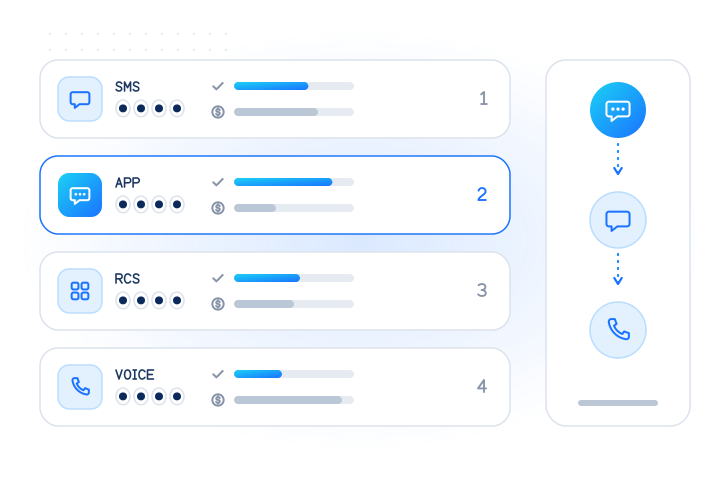
A sensible default for most consumer apps:
- An app-based factor for returning users: passkey or authenticator app. No message cost, no phone-network risk.
- The messaging channel the user has and chose, confirmed by a pre-check.
- SMS, as the universal fallback, protected by rate limits and a line-type check.
- Voice, only as an explicit choice after a delay, with tight per-number and per-country caps.
Two rules keep it safe. Never fall back automatically from SMS to voice: bots can make SMS "fail" on purpose to trigger paid calls, as described in toll fraud in voice OTP. And never let a fallback reset your rate limits or failed-attempt counts.
NIST's guidance supports the app-first order. It treats one-time codes over the phone network as a restricted authenticator and requires services that accept one to offer "at least one alternative authenticator that is not restricted" (NIST, 2025). Newer options such as silent network authentication change the picture again in some markets. See silent authentication and flash call, explained.
How do fraud and cost risks differ by channel?
Each channel moves risk rather than removing it:
| Channel | Main cost risk | Main account risk | Key control |
|---|---|---|---|
| SMS | Pumping to expensive destinations | SIM swap and port-out | Country allow-list, line type, rate limits |
| Low per message; still abusable at volume | Takeover of the messaging account | Rate limits, number-change checks | |
| RCS | Depends on the programme | Similar to SMS for the number | Capability check, fallback limits |
| Voice | Toll fraud billed per minute | Social engineering of the user | Explicit choice, duration and country caps |
OWASP's MFA guidance reminds teams that calls and SMS "may cost money to send", so endpoints must be protected "against attackers requesting a large number of messages to exhaust funds" (OWASP). That applies to every paid channel.
How do you measure which mix works?
Instrument the flow once, then compare strategies with real numbers:
- Per channel and country: attempts, deliveries, codes entered, time to entry.
- Drop-off while waiting: users who start and leave before a code arrives. This is the hidden cost of "try, then fall back".
- Cost per verified user: all message, call and check costs divided by completed verifications.
- Fallback rate: how often the first channel fails. A high rate means your routing or pre-check needs work.
- Fraud signals: verification rate per country and prefix, sends per number.
Run a controlled split, for example half your sign-ups with the pre-check and half without, for two to four weeks. Delivery issues on the SMS side are covered in why SMS messages aren't delivered, and receipts in SMS delivery receipts vs HLR lookup.
What about consent and stale numbers?
A one-time passcode is a message the user asked for, so consent is usually not the issue at the moment of sign-up. It can become one later, when the same number is used for login codes, alerts or reminders years after it was collected.
- Let users choose the channel and remember the choice. A code on an app the user picked is expected. A code on an app they never mentioned can feel intrusive.
- Check only numbers you hold for the purpose you told users about. Channel checks answer registered, not registered or unknown, and never return names or profiles.
- Re-check old numbers. Numbers are disconnected and reassigned, so a number that was right at sign-up may reach someone else today. See number recycling and phone-list decay for a re-check cadence.
- Respect objections. People can object to checks through our opt-out form, and suppressed numbers are never checked or billed.
Consent rules differ by country and by message type, so treat this as general guidance and consult counsel for your markets.
What are the key takeaways?
- Compare OTP channels by cost per completed verification, not by message price.
- SMS reaches almost everyone. WhatsApp and RCS are often cheaper or richer but reach only users with the app or capability. Voice is a last, explicit resort.
- An undelivered WhatsApp message isn't charged, but users wait for the failure. A pre-check picks the right channel first, and cached and inconclusive checks are free.
- Put app-based factors first for returning users, then the user's messaging channel, then SMS, and voice only by choice.
- Measure drop-off, fallback rate and cost per verified user per country before settling on a mix.
For the country view of channel choice, read choosing a messaging channel by country. The SMS cost reduction use case shows the budget side.
Sources
- Pricing on the WhatsApp Business Platform — Meta, 2026
- iOS 18 is available today, making iPhone more personal and capable than ever — Apple Newsroom, 2024
- NIST SP 800-63B-4: Digital Identity Guidelines — Authentication and Authenticator Management — NIST, 2025
- Multifactor Authentication Cheat Sheet — OWASP
Frequently asked questions
Which channel is cheapest for OTP?
It depends on the country and on your users. Per message, a messaging app is often cheaper than SMS, but only users who have that app can receive it. Compare the cost per completed verification, which includes the share of users each channel can reach and the fallbacks you pay for.
What is the best fallback order?
Start with the channel the user can receive on and prefers, then fall back to SMS, and offer voice only as an explicit choice with tight limits. A pre-check of messenger presence lets you pick the first channel without a failed attempt.
Is RCS ready for OTP?
In some markets. iPhones support RCS since iOS 18, and Android support is widespread, but availability depends on operators, devices and the business messaging programme in each country. Check capability per number and keep SMS as a fallback.
Should we still offer SMS codes?
Usually yes, as a fallback, because it reaches almost any mobile phone. Offer app-based factors such as passkeys or authenticator apps as well: NIST treats phone-delivered codes as a restricted authenticator and requires an unrestricted alternative.
Related services and guides
More from the blog
All articlesDeliverability
WhatsApp OTP vs SMS OTP: cost per verified user, with a calculator
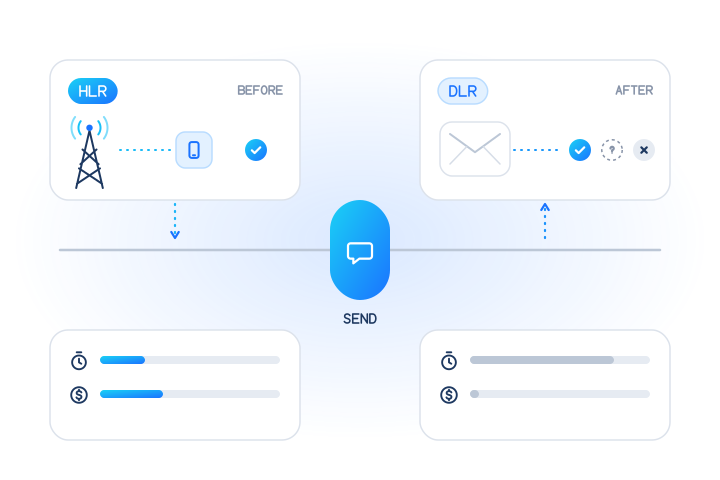
WhatsApp OTP pricing in 2026: Meta charges $0.0008 to $0.0550 per delivered authentication message, by country. Rates vs SMS and a cost-per-user calculator.
9 min read
Deliverability
Why SMS messages aren't delivered: a cause tree with fixes
A cause tree for undelivered SMS: invalid numbers, unreachable phones, wrong line types, carrier filtering and handsets, with a fix for each.
7 min read
Deliverability
SMS delivery receipts vs HLR lookup: before or after you send
A delivery receipt reports what happened after you sent an SMS. An HLR lookup asks the network before you send. What each can see, miss and cost.
7 min read