On this page
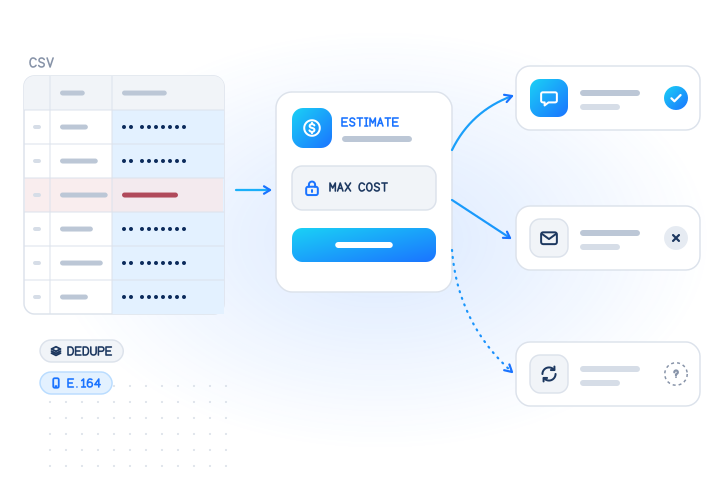
To check a list of Egyptian numbers for WhatsApp, convert every row to E.164 (+20 and 10 digits, without the leading 0), turn Arabic-Indic digits such as ٠١٠ into 010 first, drop the rows that aren't valid mobiles, remove duplicates, upload the file as a bulk job with the whatsapp check, read the free estimate, and download one answer per number: registered, not registered or unknown. Egyptian mobiles are regular: 010, 011, 012 or 015 plus eight digits at home. The traps are digits typed in Arabic script, invisible direction marks copied from Arabic text, and numbers cancelled in NTRA's 2026 re-registration drive. Check only numbers your customers gave you: Egypt's Personal Data Protection Law (Law No. 151 of 2020) needs a lawful basis for every check, and its executive regulations took full effect in November 2026.
This guide covers what is specific to Egypt. The general flow is in our bulk WhatsApp number check guide, and checking a single number is covered in how to check if a number is on WhatsApp without saving it. Facts are as of 9 November 2026, and every price below carries its date. This is general guidance, not legal advice.
How do you format Egyptian numbers for a WhatsApp check?
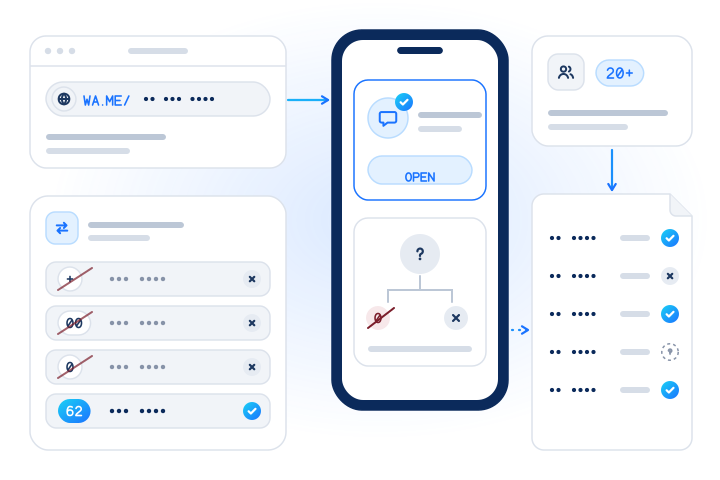
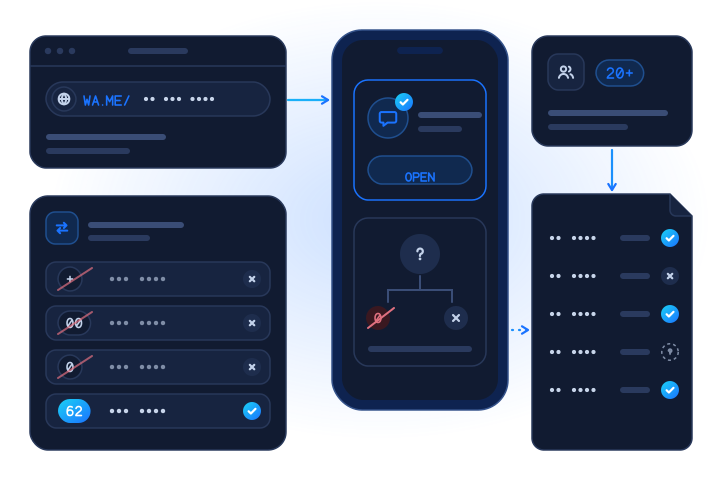
Use the international form: +20, then the number without its leading 0. An Egyptian CRM, form or chat export usually holds the same mobile written several ways:
| Cell in your file | What happened | Fix |
|---|---|---|
010 XXXX XXXX | National format, as dialled at home (11 digits) | Drop the 0, add +20 |
+20 10 XXXX XXXX | International, with spaces | Remove the spaces |
2010XXXXXXXX | International without the plus (the wa.me link style) | Add + |
0020 10 XXXX XXXX | Dialled from abroad with 00 | Replace 0020 with +20 |
+20 010 XXXX XXXX | The trunk 0 kept after the country code | Drop the 0 |
10XXXXXXXX | A spreadsheet dropped the leading 0 | Add +20 |
٠١٠ XXXX XXXX | Typed in Arabic-Indic digits | Map to 0–9 first, then as above |
۰۱۰ XXXX XXXX | Typed in extended Arabic-Indic (Persian-style) digits | Map to 0–9 first |
٠١٠ 0XXX XXXX | Mixed: prefix in Arabic digits, the rest in ASCII | Map, then as above |
invisible marks around +20 10 … | Copied from an Arabic page, PDF or app | Remove the direction marks |
The mobile prefixes are simple. 010, 011, 012 and 015 are mobile in full in libphonenumber's metadata for Egypt; 013, 014 and 016 to 019 aren't mobile ranges. Each block was first assigned to one of the four mobile operators, but Egypt has mobile number portability, so the prefix doesn't tell you the current network (our MNP atlas has the details). For a WhatsApp check the operator doesn't matter.
Why do Arabic-Indic digits break Egyptian lists?
Because most cleanup code only knows the ASCII digits 0 to 9. Egyptians type phone numbers in Arabic-Indic digits (٠١٢٣٤٥٦٧٨٩, Unicode U+0660 to U+0669) on Arabic keyboards, and some phones and apps insert the extended set (۰۱۲۳۴۵۶۷۸۹, U+06F0 to U+06F9) instead. Text copied from Arabic pages and apps can also carry invisible bidirectional marks (U+200E, U+200F, U+061C, U+202A to U+202E, U+2066 to U+2069) around a number.
We tested one Egyptian mobile in these forms on 2026-11-07 with Node 24, libphonenumber-js 1.13.13 and Python 3.12 with phonenumbers 9.0.40:
| What we ran | Arabic-Indic input ٠١٠٠ XXX XXXX | Result |
|---|---|---|
s.replace(/\D/g, "") in JavaScript (the usual "keep digits" step) | all 11 digits are Arabic-Indic | "": every digit deleted |
the same, on a mixed cell ٠١٠ 0XXX XXXX | 3 Arabic, 8 ASCII digits | an 8-digit number that is not the customer's |
Number() or parseInt() in JavaScript | NaN | |
the tutorial regex ^(?:\+20|0020|0)?1[0125]\d{8}$ (JS and Python) | no match: row rejected | |
int() in Python | a number without its leading 0 | |
| a set of the ASCII and the Arabic spelling (dedupe) | 2 entries for 1 customer | |
libphonenumber-js and Python phonenumbers, region EG | +2010XXXXXXXX, valid mobile | |
the same, with direction marks around +20 … | +2010XXXXXXXX, valid mobile |
So the phone libraries are fine, and the damage happens in the steps before them: a "digits only" filter that silently deletes Arabic digits, a regex that drops real customers, and a dedupe that counts the same customer twice. Map the digits yourself as the very first step, so every later tool sees the same ASCII value.
Our free phone list cleaner converts and dedupes a file of up to 50,000 rows in your browser; pick Egypt as the default country. For your own pipeline, this converter does the job and returns null for anything that isn't a valid Egyptian mobile:
import { parsePhoneNumberFromString } from "libphonenumber-js/max";
/** One Egyptian list cell → E.164 mobile (+20 and 10 digits), or null. */
export function toE164Eg(raw) {
const s = String(raw)
.replace(/[٠-٩]/g, (d) => String(d.charCodeAt(0) - 0x0660)) // Arabic-Indic digits ٠–٩
.replace(/[۰-۹]/g, (d) => String(d.charCodeAt(0) - 0x06F0)) // Extended Arabic-Indic ۰–۹
.replace(/[--]/g, "") // invisible direction marks
.trim();
const p = parsePhoneNumberFromString(s, "EG"); // 01X…, 1X…, 20…, +20…, 0020…, +20 01X…
return p?.isValid() && p.country === "EG" && p.getType() === "MOBILE" ? p.number : null;
}We ran it on 2026-11-07 with Node 24 and libphonenumber-js 1.13.13, on libphonenumber's own example number for Egypt. Digits are masked with X here:
| Input | Output |
|---|---|
0100 XXX XXXX | +2010XXXXXXXX |
+20 100 XXX XXXX | +2010XXXXXXXX |
2010XXXXXXXX | +2010XXXXXXXX |
0020 100 XXX XXXX | +2010XXXXXXXX |
+20 0100 XXX XXXX | +2010XXXXXXXX |
100XXXXXXX (leading 0 lost) | +2010XXXXXXXX |
٠١٠٠ XXX XXXX (Arabic-Indic) | +2010XXXXXXXX |
+٢٠ ١٠٠ XXX XXXX (Arabic-Indic, international) | +2010XXXXXXXX |
۰۱۰۰ XXX XXXX (extended Arabic-Indic) | +2010XXXXXXXX |
٠١٠ 0XXX XXXX (mixed digits) | +2010XXXXXXXX |
+20 100 XXX XXXX wrapped in direction marks | +2010XXXXXXXX |
0100 XXX XXX (one digit short) | null |
013 XXXX XXXX (mobile shape, not a mobile block) | null |
02 XXXX XXXX (a Cairo landline) | null |
0800 XXX XXXX (toll-free) | null |
+966 50 XXX XXXX (a Saudi mobile) | null |
The first eleven rows are the same customer, so after conversion they collapse into one number, which keeps the duplicate count honest. Rows from other countries return null here on purpose: if your Egyptian list also holds customers with Gulf or European numbers, put those in their own file or keep their + form.
Which Egyptian numbers should you drop before the check?
Every Egyptian mobile has 10 digits after +20 and starts with 10, 11, 12 or 15, so the shape check is reliable. Three groups need attention:
- Numbers from before October 2011. Egypt added a digit to mobile numbers in 2011, mapping each old operator code to a new third digit. An old
012 XXX XXXX, for example, became012 2XXX XXXX. Records that old are one digit short, and libraries reject them. Don't pad them by guessing; ask the customer. - Landlines and service numbers. Cairo landlines (
02plus 8 digits) and other area codes have 8 or 9 digits after+20, and0800numbers are toll-free. A customer who gave you a landline can still be reached by phone, just not checked as a mobile. - National rows without a country. If you upload without setting the country, the API reads a row of 8 to 15 digits without
+as an international number. Egypt is lucky here: in our test of 40,112 valid Egyptian mobiles on 2026-11-07, none became another country's valid number when read that way. They became invalid instead, which means they are dropped and not billed, but also not checked. Set the country to Egypt (default_country: "EG") or convert first.
How do you check a list of Egyptian numbers on WhatsApp?
Five steps, from export to answers:
- Export only customers who gave you their number, with your own ID column (for example
crm_id,phone). Format the phone column as text. Leave out bought lists, scraped numbers and number ranges. - Convert and dedupe. Run every cell through a converter like the one above, or the free list cleaner. Keep the rows that return
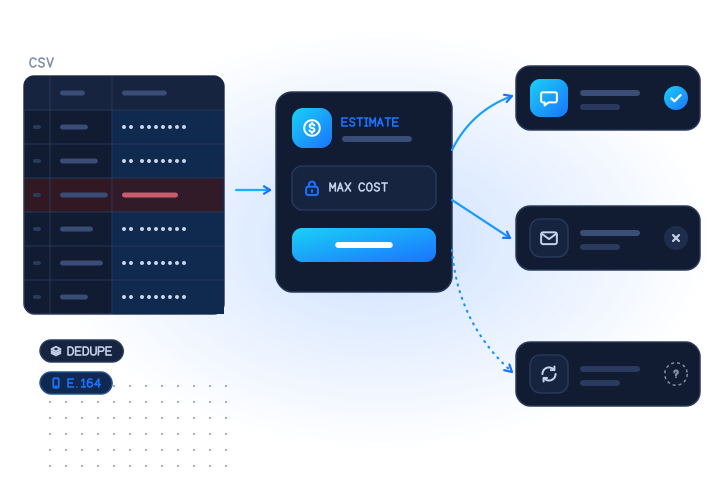
nullaside for a manual fix. - Estimate. Upload the file in the dashboard (Bulk jobs › Upload a list) and pick Egypt for numbers written without
+, or send the numbers toPOST /v1/jobs/estimatewith"default_country": "EG". The estimate is free, checks nothing and stores nothing. - Run with a cost cap. Start the job with
max_costset to the estimate. Choosewhatsapp, orwhatsapp.businessif you also need to know whether the account is a WhatsApp Business account. - Download and join back by row number. The result file keeps your row order (
row_no), not your own IDs, so joincrm_idback by row number. Store each answer with itschecked_atdate.
A job holds up to 50,000 numbers, and a dashboard file can be up to 10 MB. Bigger exports go into several jobs.
What does the estimate tell you?
Here is a real estimate run with the public sandbox key mv_test_publicSandboxn9ZgneuhR1B9CRfKG3fulym on 2026-11-07. The sandbox accepts only our test values, which are UK drama-range numbers written in ASCII digits, so this shows the response format, not Egyptian data. Five rows, one of them a duplicate:
curl https://api.mobilevalidate.com/v1/jobs/estimate \
  -H "Authorization: Bearer mv_test_publicSandboxn9ZgneuhR1B9CRfKG3fulym" \
  -H "Content-Type: application/json" \
  -d '{"numbers":["+447700900001","+447700900002","+447700900003","+447700900001","+447700900006"],"checks":["whatsapp.business"]}'
The response, shortened to the useful fields:
{
  "object": "estimate",
  "total": 5, "valid": 4, "invalid": 0, "duplicate": 1, "cached": 0, "unsupported": 0,
  "breakdown": [
    { "check": "whatsapp.business", "price_mode": "batch", "reason": null, "checks": 0,
      "unit_price": { "amount": "0.0003", "currency": "USD" } },
    { "check": "whatsapp.business", "price_mode": "realtime", "reason": "small_batch", "checks": 4,
      "unit_price": { "amount": "0.004", "currency": "USD" }, "countries": ["GB"], "batch_minimum": 132 }
  ]
}
Two things to read. The duplicate is counted and dropped before anything is billed. And the four valid numbers sit on a small_batch line at the real-time price, because the bulk price needs at least 132 numbers from the same country in one job (batch_minimum). An Egyptian list clears that easily; the handful of Saudi or UAE customers in the same export may not, and the estimate shows them on their own line before you spend anything (max_cost is zero here only because test keys never bill). Details are in the bulk jobs docs.
What does it cost?
From our public catalog (GET /v1/services), fetched on 2026-11-07:
| Check | Bulk job, per 1,000 | Real time, per 1,000 |
|---|---|---|
WhatsApp registration (whatsapp) | US$0.25 | US$4.00 |
WhatsApp Business account (whatsapp.business) | US$0.30 | US$4.00 |
Number portability, MNP (number.mnp) | US$2.00 | US$2.00 |
Live network status, HLR (number.hlr) | US$5.00 | US$6.00 |
Only conclusive answers are billed. Unknown, invalid, duplicate and unsupported rows are free, and so are repeats served from your account's cache. Prices can change; the pricing page always has the current ones.
A worked example with made-up figures: a 30,000-row export from an Egyptian e-commerce shop holds 4,000 cells typed in Arabic-Indic digits. With a "digits only" cleanup, those 4,000 rows come out empty or wrong; with the converter, the file becomes 26,500 unique valid Egyptian mobiles. The WhatsApp job then costs at most 26,500 × US$0.00025 = US$6.63, and the 4,000 customers who typed in Arabic are checked like everyone else.
What share of Egyptians are on WhatsApp?
We don't quote one, and you shouldn't plan with one. DataReportal's Digital 2026 report for Egypt counts 121 million cellular mobile connections in late 2025, equal to 102% of the population, 98.2 million internet users (82.7%) and 51.6 million social media user identities in October 2025 (43.4%) (DataReportal, 2025). It gives no WhatsApp figure.
More connections than people means that many Egyptians carry more than one line, and WhatsApp is registered on only one number per account. A not-registered answer for an Egyptian customer can therefore be a working second line. Ask for the WhatsApp number at sign-up instead of assuming the number you have is the one they use.
Is WhatsApp cheaper than SMS for OTP in Egypt?
For a business based in Egypt, usually. From our rate-card dataset, transcribed from Meta's USD rate cards:
| WhatsApp category, Egypt | 1 July 2026 | 1 October 2026 |
|---|---|---|
| Authentication | US$0.0036 | US$0.0036 |
| Authentication-international | US$0.0650 | US$0.0650 |
| Utility | US$0.0036 | US$0.0036 |
| Marketing | US$0.0644 | US$0.0644 |
| Service (after 1,000 free per number per month) | free | US$0.0036 |
Prices are per delivered message. Meta charges only for delivered messages, so a code sent to a number without WhatsApp costs nothing but time. Meta's pricing page records the earlier moves: lower authentication rates for Egypt from 1 February 2025, lower authentication-international rates from 1 April 2025, lower utility and authentication rates from 1 October 2025, and lower marketing rates from 1 January 2026; the July and October 2026 cards didn't change Egypt (Meta pricing).
The international line is the one to watch. Egypt has had an authentication-international rate since 1 February 2025. It applies to businesses based outside Egypt once they send more than 750,000 messages outside customer service windows in a moving 30-day period to users in markets with such a rate, with 30 days' notice; Meta determines the business's country from public information such as where it or its parent is listed (Meta, 2026). For a large Gulf or European app with Egyptian users, a code to +20 then costs about 18 times the local rate. Our OTP cost by country research compares that gap across markets, and the free WhatsApp cost calculator applies the October 2026 card to your own volumes.
Marketing is the other number to notice: at US$0.0644, a marketing template to Egypt costs about 18 times a utility message. Keep the expensive templates for opted-in customers that a check shows are on WhatsApp.
We don't quote SMS prices here: they vary by route, sender ID and contract. Put the rate from your own invoice next to the table above.
What do the PDPL and its 2025 regulations require before you check or message?
Egypt's Personal Data Protection Law (PDPL) was issued by Law No. 151 of 2020. Its executive regulations, Decree No. 816 of 2025 of the Minister of Communications and Information Technology, were issued on 1 November 2025 and set up the licensing system run by the Personal Data Protection Center (PDPC) (CMS, 2026). Article 6 of the issuing law gave businesses one year from the regulations' issue to bring themselves into line, so on a strict reading that period ended on 1 November 2026; CMS notes some uncertainty about how the PDPC will treat it. We read an unofficial English translation of the law and the regulations (Andersen, 2026); the Arabic text in the Official Gazette prevails.
What the law says
- Scope. The law applies to personal data processed electronically, in whole or in part (issuing article 1). A phone number in a customer file is personal data. Data held by the Central Bank of Egypt and the banks it supervises is excluded, except money transfer and exchange companies, which follow the Central Bank's own rules (issuing article 3).
- Lawful basis (article 6). Processing is lawful with explicit consent for one or more specific purposes, or where it is necessary for a contract with the person, a legal obligation, or the legitimate rights of the controller that don't conflict with the person's fundamental rights.
- Purpose and retention (article 3). Data must be collected for legitimate, specific and declared purposes known to the person, and kept no longer than needed.
- Rights (article 2). People can withdraw consent, ask for deletion, restrict processing and object.
- Penalties. Processing without legal authorisation or consent carries a fine of EGP 100,000 to EGP 1 million, and up to six months' prison and EGP 2 million where it is for gain (article 36). Breaking the marketing rules carries EGP 200,000 to EGP 2 million (article 43).
Direct electronic marketing (articles 17 and 18)
The law defines electronic marketing broadly: any promotional message sent by any technological means to specific people. A WhatsApp template is covered. A marketing message is allowed only if:
- the person gave prior consent;
- it clearly identifies its originator and sender, with a valid and accessible address;
- it says plainly that it is for direct marketing;
- it gives a clear, easy way to opt out or withdraw consent.
The sender must also keep electronic records of the consent, and of any changes, for three years from the last message sent, and must not disclose the person's contact details.
The 2025 regulations add more (article 18 of the regulations): the sender needs a valid licence from the PDPC for direct electronic marketing, consent must be explicit, data collected for marketing can't be used for anything else without new explicit consent, and data must be erased when consent is withdrawn or the purpose ends. A marketing intermediary must verify that the business it sends for holds that consent and keep records of the data's source, or stop.
Sending data abroad
Under article 16 of the regulations, a controller or processor that transfers personal data to another country needs a licence or permit from the PDPC, based on the PDPC's view of that country's protection level, and the person's consent before the transfer. That touches any checking service outside Egypt, including ours: MobileValidate's main servers are in the European Union (privacy policy). If you are an Egyptian controller, ask your counsel what the transfer needs before you upload, and ask us for the DPA.
What it means for a WhatsApp list
- A check is processing. Check only numbers of your own customers, for a purpose your privacy notice states, such as choosing the channel for messages they expect.
- Marketing needs its own consent. A number collected for order updates doesn't carry marketing consent. A
registered: trueanswer doesn't either. - Keep the evidence. Store how and when each person agreed, next to the number, for at least three years after your last marketing message.
WhatsApp's own rules sit on top. Its Business Messaging Policy (last updated 23 September 2026) says you may only contact people on WhatsApp if they gave you their mobile number or username and opted in to receive your messages (WhatsApp, 2026). Our consent and law guide covers other regions.
What do NTRA's 2026 measures mean for your list?
Egypt's telecom regulator, the National Telecom Regulatory Authority (NTRA), ties every mobile line to an ID. In August 2026, after people found lines registered in their names without their knowledge, NTRA referred all four mobile operators to the Public Prosecution and ordered urgent measures (Zawya, 2026):
- immediate suspension of the sale or activation of new lines for companies and other entities;
- text messages to all existing lines, telling holders to sign new contracts in the name of the person who actually has the line;
- permanent cancellation of lines not re-contracted by the deadline;
- faster biometric identity checks in the operators' apps.
When we checked on 2026-11-07, we found no single published deadline for the re-contracting. For your list, that means:
- Registered isn't reachable. A WhatsApp check tells you an account exists for the number, not that the line is still active. Before an important SMS or call, an HLR check tells you whether the line still works.
- Old answers age faster. Re-check Egyptian numbers you haven't reached in months before the next campaign. Cancelled numbers go back to the operators and can later reach someone else; our post on number recycling and list decay explains the risk.
- Bulk corporate lines are frozen. If your business sends from company SIMs, new ones can't be activated while the suspension lasts.
SMS has its own registration layer: sender IDs for Egypt are registered in advance. A large cloud provider's public form for Egypt, for example, asks for a letter of authorisation, company registration and tax documents from local companies, and an acknowledgement that the sender ID carries transactional messages only (AWS documentation). Ask your SMS provider how it registers yours. WhatsApp messages don't pass through that layer; consent and Meta's template review still apply.
What do you do with numbers that are not on WhatsApp?
Route them to a channel that reaches them, and keep the answer:
| Answer | What it means | What to do |
|---|---|---|
registered: true, customer opted in | Account exists | Send what they asked for on WhatsApp; keep SMS as the fallback |
registered: true, no marketing consent | Account exists | Service messages only; ask for marketing consent at the next contact they expect |
registered: false | No account on this number | Use SMS or a call; it may be the customer's second line |
| Unknown | No conclusive answer | Keep the current channel, re-check later; free |
null from your converter | Not a valid Egyptian mobile | Fix the record by hand, or ask the customer |
For the not-registered group, an HLR check answers the next question: is the line reachable at all, or was it cancelled? An MNP lookup gives the current network for SMS routing, because the 010 or 012 prefix doesn't. Treat unknown as missing data, never as a dead number, and don't overwrite a stored conclusive answer with an unknown one. Our list cleaning guide shows how to combine the checks.
On our side, a request with long runs of consecutive numbers is refused as suspected enumeration, each account has a daily cap, and our acceptable use policy forbids unsolicited bulk messaging and checking ranges to find out who uses an app. Anyone can object through the opt-out form.
How do you start with MobileValidate?
The checks for this guide are WhatsApp number check, WhatsApp Business check, number portability (MNP) and live network status (HLR). All four take Egyptian numbers in real time and in bulk jobs. You don't need a WhatsApp account, a phone or a QR pairing.
- Free tools, no sign-up. Clean and dedupe the export with the phone list cleaner, check a few numbers with the phone number validator, build a click-to-chat link for your own business number with the WhatsApp link generator, and price templates with the WhatsApp cost calculator. The tools page lists the rest. To look up one number's network without an account, the free carrier lookup answers three numbers a day.
- Free to build. Get a free test key to build against fixed test answers, and use the free estimate on any file before you pay.
- Real checks free. Every live account can check 100 phone numbers and 20 e-mail addresses for real, free, on the dashboard's Try it page. Request access to open one.
- Then prepay. Top-ups of US$100 or more get a 5% bonus, US$500 or more 8%, and US$2,000 or more 10%.
Results are kept for your account's retention setting, 30 days by default, and you can delete a job's results at any time. A check returns registration and network facts only, never a name or national ID. WhatsApp is named descriptively; MobileValidate is not affiliated with WhatsApp, Meta, NTRA or the PDPC.
What are the key takeaways?
- Convert every row to
+20and 10 digits before upload.010…,20…,0020…,+20 0…and10…are the same customer. - Map Arabic-Indic (
٠–٩) and extended (۰–۹) digits to ASCII and strip direction marks first. In our test, a "digits only" cleanup deleted Arabic digits entirely, and a dedupe counted one customer twice. - Mobiles start with
10,11,12or15after +20. Numbers from before 2011 can be a digit short; ask the customer rather than guess. - Bulk WhatsApp checks cost US$0.25 per 1,000 (catalog, 2026-11-07), with at least 132 numbers per country group in one job. A WhatsApp authentication message to Egypt lists at US$0.0036, or US$0.0650 for eligible senders based abroad.
- The PDPL's one-year compliance period after the 2025 executive regulations ended in November 2026: marketing needs prior consent, a PDPC licence and three years of consent records, and transfers abroad need a PDPC permit.
- NTRA's 2026 re-contracting cancels lines not re-registered by their real holders. Re-check old lists, and pair WhatsApp with HLR before important messages.
Sources
- Law No. 151 of 2020 issuing the Personal Data Protection Law, with the Executive Regulation (Decree of the Minister of Communications and Information Technology No. 816 of 2025), unofficial English translation — Andersen in Egypt, 2026
- Egypt's PDPL: Executive regulations issued, one-year compliance countdown begins (13 January 2026) — CMS, 2026
- Egypt telecom regulator refers four mobile operators to public prosecution over unauthorised line registrations — Zawya, 2026
- Egypt sender ID registration in AWS End User Messaging SMS — Amazon Web Services documentation, 2026
- Pricing on the WhatsApp Business Platform — Meta for Developers, 2026
- Authentication-international rates — Meta for Developers, 2026
- WhatsApp Business Messaging Policy (last updated 23 September 2026) — WhatsApp, 2026
- Digital 2026: Egypt — DataReportal (Kepios), 2025
Frequently asked questions
How do I convert 010, 011, 012 and 015 numbers to +20 for a WhatsApp check?
Drop the leading 0 and add +20: 010 XXXX XXXX becomes +20 10 XXXX XXXX, and the same goes for 011, 012 and 015. Every Egyptian mobile has 10 digits after +20, or 11 digits when written at home with the 0. A cell that starts with 20 only needs the plus, and 0020 becomes +20.
Can I upload Egyptian numbers written in Arabic-Indic digits?
Convert them to ASCII digits first. In our test on 2026-11-07, the phone libraries read ٠١٠… correctly, but a JavaScript cleanup with replace(/\D/g, '') deleted every Arabic-Indic digit, regex checks rejected them, and the same customer in two digit systems counted as two numbers. Map ٠–٩ and ۰–۹ to 0–9 and remove invisible direction marks before you dedupe.
How much does a bulk WhatsApp check of Egyptian numbers cost?
On 2026-11-07 our public catalog listed the WhatsApp registration check at US$0.25 per 1,000 numbers in bulk jobs and US$4.00 per 1,000 in real time. The bulk price needs at least 132 numbers from the same country in one job. Unknown, invalid and duplicate rows are never billed.
Does Egypt's data protection law apply to a WhatsApp number check?
Yes. Law No. 151 of 2020 covers any electronic processing of personal data, and a phone number linked to a customer is personal data. Its executive regulations, Ministerial Decree No. 816 of 2025, were issued on 1 November 2025, and the one-year period to comply ran from that date. Processing needs a lawful basis such as explicit consent or a contract.
What does the PDPL require for WhatsApp marketing in Egypt?
Articles 17 and 18 of the law require prior consent, a clearly identified sender with a valid address, a statement that the message is marketing, an easy way to opt out, and records of consent kept for three years from the last message. The 2025 executive regulations add a licence from the Personal Data Protection Center for direct electronic marketing. Fines run from EGP 200,000 to EGP 2 million.
Is WhatsApp cheaper than SMS for OTP in Egypt?
Meta's authentication rate for Egypt is US$0.0036 per delivered message on the rate cards of 1 July and 1 October 2026. A business based outside Egypt that crosses Meta's volume threshold pays the authentication-international rate of US$0.0650 instead, about 18 times more. Compare both with the SMS rate on your own invoice.
Why are some old Egyptian mobile numbers rejected?
Egypt added a digit to every mobile number in 2011, so records from before then can be one digit short, and libraries reject them. NTRA's August 2026 re-contracting drive also cancels lines that holders don't re-register in their own names, so some numbers on old lists no longer work. Fix short numbers with the customer, and re-check lists you haven't used recently.
Related services and guides
- ServiceCheck if a phone number is registered on WhatsApp
- ServiceCheck if a number is a WhatsApp Business account
- ServiceHLR lookup API: live mobile network status
- ServiceMNP lookup API: has a mobile number been ported?
- DatasetWhatsApp Business Platform rate cards (USD), 2026-07 and 2026-10
- Free toolPhone list cleaner: dedupe and normalize to E.164
More from the blog
All articlesGuides
Bulk WhatsApp number check: how to verify a customer list (CSV upload or API)
Check WhatsApp numbers in bulk: prepare a CSV, get a free estimate, cap the cost, run the job in the dashboard or API, and act on each answer.
8 min read
Guides
How to check if a number is on WhatsApp without saving it as a contact
Three free ways to check if a number is on WhatsApp without adding a contact, what the wa.me 'invalid' message means, and how to format numbers by country.
11 min read
Guides
Is it legal to check if a number is on WhatsApp? Consent and data-protection rules for businesses (2026)
Is a WhatsApp number check legal? GDPR, India's DPDP Act, Brazil's LGPD, Malaysia's PDPA and US rules, and why registration is not permission to message.
10 min read