On this page
Phone numbers follow one global framework, ITU-T E.164, but every country fills it differently: its own lengths and prefixes, its own porting rules, its own dominant messaging apps and its own rules for calling and texting. So a number is only useful once you know its country and what that country allows. This hub explains the differences that matter for validation, delivery and compliance, and keeps a dated tracker of the rules.
Each section summarises one topic and links to the detailed guide, glossary entry or service. The tracker table has a primary source for every row and was last checked on 2026-09-26. It's a summary, not legal advice.
In this guide:
- Formats and E.164
- How often numbering plans change
- Number portability
- Mobile, landline and VoIP by country
- Messaging channels by country
- Per-message costs
- United States and Canada
- European Union
- India and other markets
- Regulatory tracker
- What to check, by country
Which page answers which question?
| Question | Where the full answer is |
|---|---|
| How do I store and normalize numbers? | E.164 format: a developer's guide |
| Why isn't a regex enough? | E.164 regex: why a pattern is not enough |
| How often do country rules change? | Numbering plans change every 2 weeks |
| Why does the prefix show the wrong network? | Number portability: why carrier lookups go wrong |
| Which channel should I use in which country? | Choosing a messaging channel by country |
| What does WhatsApp OTP cost compared with SMS? | WhatsApp OTP vs SMS OTP |
| Is a phone number personal data in the EU? | Is a phone number personal data under GDPR? |
| How do I avoid calling a reassigned US number? | The Reassigned Numbers Database, explained |
| What do US complaint data show? | US nuisance-call complaints |
How do phone number formats differ by country?
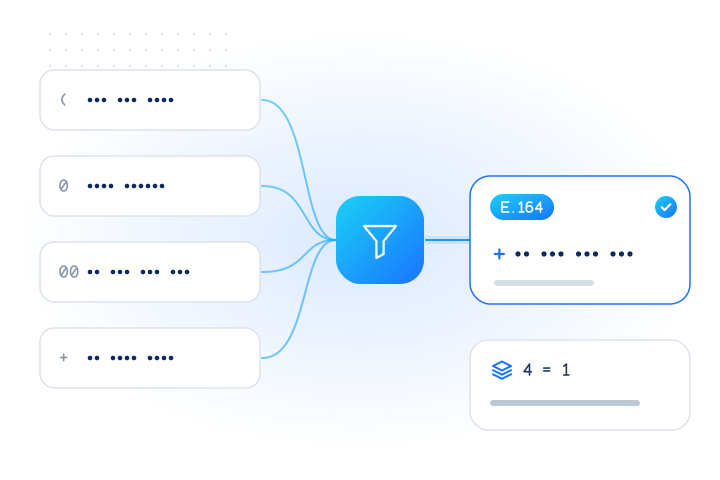
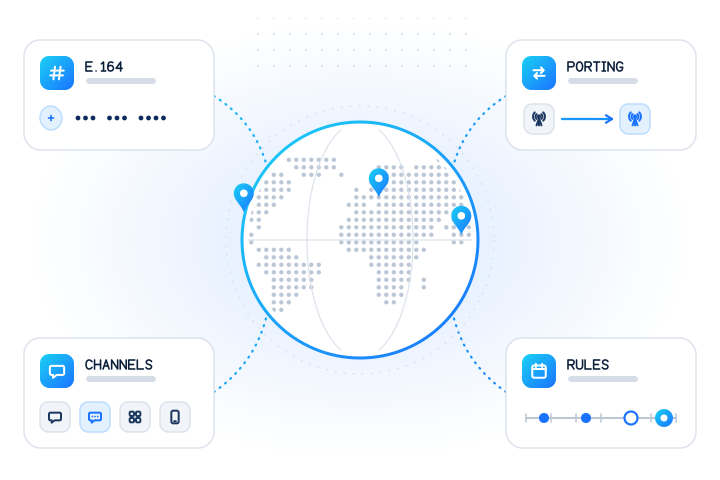
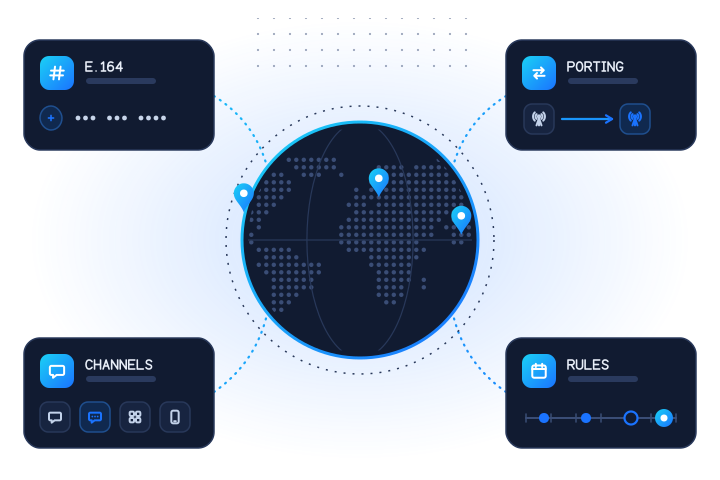
Every international number has the same outer shape under ITU-T E.164: a country code of one to three digits, then a national number, at most 15 digits in all [1]. Inside that shape, countries differ in almost everything: number lengths, whether a trunk prefix such as 0 is dialled at home, which ranges are mobile, and how numbers are grouped when written.
Those differences are why "strip non-digits and add a plus" fails. A national number typed without its country is ambiguous, and one country code can cover several territories: +1 spans the US, Canada and many Caribbean countries, and some +44 7 ranges belong to Guernsey or Jersey rather than the UK. Store every number in E.164, parse with a maintained library that knows each country's plan, and ask for the country on forms. Our E.164 guide has tested code, and the E.164 glossary entry has the definition.
How often do numbering plans change?
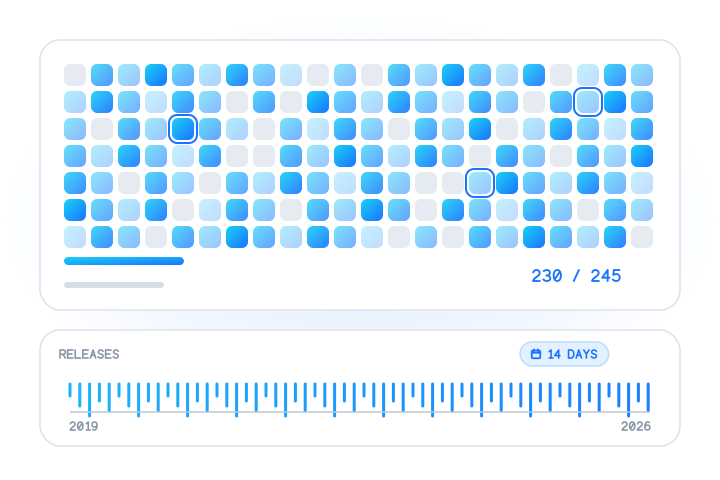
Constantly. Regulators open new ranges, add digits, retire prefixes and reassign blocks, and validation libraries have to follow. Google's libphonenumber, which most validation libraries build on, lists 25 metadata releases in 2025 and 19 more between January and 23 September 2026 in its release notes, and each one updates phone metadata for at least one region [2].
The practical consequence is simple: a library you installed a year ago rejects some valid new numbers and accepts some retired ones. Pin the version, update it on a schedule (monthly is a sensible default), and re-validate stored numbers after major updates in the countries you serve. Our numbering-plan research counts releases since 2019 and shows which regions change most often.
Why does number portability matter?
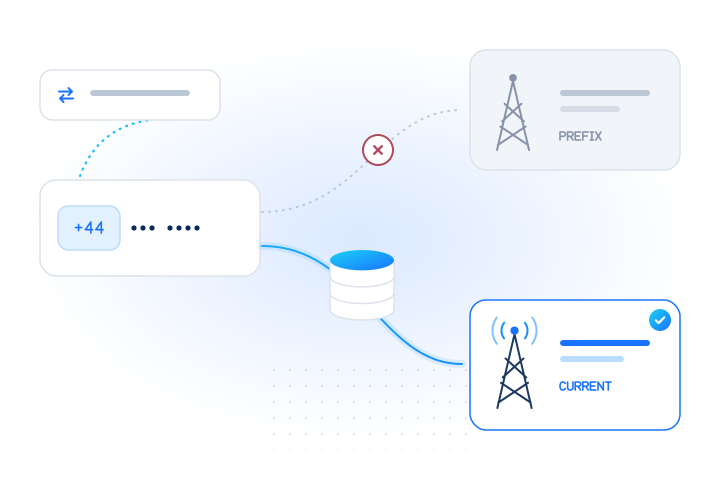
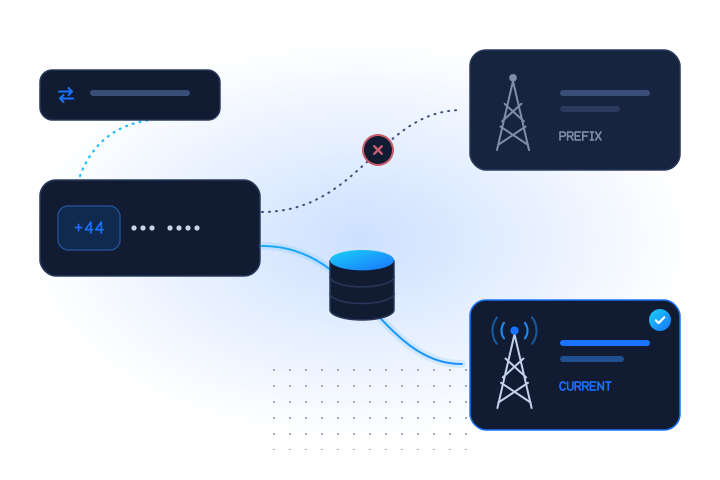
Portability lets people keep their number when they change operator. That's good for consumers and awkward for anyone reading the prefix: the digits show which network a range was originally given to, not which network serves the number today.
In the EU, the European Electronic Communications Code gives everyone with a number from a national plan the right to keep it when switching, and requires activation within one working day of the agreed date (Article 106) [3]. Member States had to apply the code from 21 December 2020 (Article 124). The US has had wireless porting for years and routes ported numbers with a local routing number.
For senders, porting means prefix-based routing and pricing go stale. A carrier lookup on the number itself gives the current network. The portability guide explains the ways a lookup can still be wrong, and the MNP glossary entry covers the basics.
Can you tell a mobile from a landline by its digits?
In many countries the numbering plan reserves separate ranges for mobile and fixed lines, so a validation library can report MOBILE or FIXED_LINE from the digits. In the US and Canada it can't: the North American plan mixes both in the same area codes, and libphonenumber returns FIXED_LINE_OR_MOBILE for them, as our JavaScript validation tests show. Porting adds a second problem everywhere, because a number can move from a mobile network to a VoIP service without changing its digits.
When line type drives a decision, such as whether to send an SMS or whether a sign-up number is a VoIP number, look it up. Our carrier lookup (in beta) accepts numbers from any country and returns the line type and current network where data exists (coverage varies by country), and the US and Canada carrier lookup is a bulk-only option for those two countries, where porting is common. The line type guide explains each value and what to do with it.
Which messaging channels matter in which countries?
SMS reaches every mobile number, but it isn't where people read messages in every country. WhatsApp dominates many markets, while other apps lead elsewhere: LINE in Japan and Taiwan, Zalo in Vietnam, Viber in parts of Eastern Europe and Southeast Asia. RCS and iMessage depend on the handset rather than the country.
Country patterns tell you which channels to offer at all. Your own customers tell you which ones work. The reliable method is to check which apps the numbers of opted-in customers are registered on, per country, and route from that data with SMS as the fallback. The channel-by-country guide shows how to measure it on your base. Per-app detail is in the WhatsApp, Telegram, Viber, LINE and Zalo check pages, and the registration checks guide compares them. All messaging checks accept numbers from every country.
How do message costs vary by country?
Price follows the recipient's country on most channels. WhatsApp's business platform charges per delivered template message, with the rate set by the category (marketing, utility, authentication or authentication-international) and the recipient's country calling code [20]. SMS prices also vary by destination country and often by network, which is one more reason to know the current network after porting.
For one-time passcodes the useful comparison is cost per verified user, not price per message, because users without WhatsApp still need SMS. Our WhatsApp OTP vs SMS OTP post works through that calculation. A registration check before sending avoids paying for a WhatsApp attempt that can't arrive, and a line-type check avoids texting landlines. The SMS cost reduction use case shows both in one flow.
What rules apply in the US and Canada?
The US regulates calls and texts mainly through the Telephone Consumer Protection Act and FCC rules. Three themes matter most for senders.
- Consent and opt-outs. Since 11 April 2025, consumers can revoke consent by any reasonable means, and callers must honour it within ten business days [8]. The broader "revoke-all" requirement is waived until 31 January 2027, and an FCC draft order would narrow it [9][10].
- Caller ID authentication. Providers had to implement STIR/SHAKEN in the IP parts of their networks by 30 June 2021 [5], and Canada followed on 30 November 2021 [6]. See STIR/SHAKEN.
- Reassigned numbers. The FCC's database lets callers check whether a number was disconnected after consent was given, with a limited safe harbor [7]. See the RND guide.
Business texting over ordinary 10-digit numbers also requires carrier registration, known as 10DLC. That is an industry rule rather than a regulation. The tracker below lists the dated changes.
What rules apply in the EU?
Two EU laws shape how businesses handle phone numbers. The GDPR has applied since 25 May 2018 (Article 99) [4]. A number that can be linked to a person is personal data, and so is the result of a lookup on it. That means a documented purpose, a lawful basis, minimal retention and respect for objections. Our GDPR post works through business numbers, hashing and automated decisions, and the privacy checklist turns it into steps.
The European Electronic Communications Code covers portability and consumer rights in telecoms [3]. National regulators add their own rules on top. France is a current example: since 1 January 2026, when a call from abroad shows a French mobile number (06 or 07) that couldn't be authenticated, the operator must hide the caller ID [15]. Rules like that change what a recipient sees, so a legitimate business calling from outside a country should check local authentication requirements first.
What about India and other markets?
India has a detailed anti-spam regime, enforced through operators. Senders register headers and message templates, consent is recorded on operator platforms, and dedicated number series separate commercial calls: 140 for promotional calls and 1600 for service and transactional calls from regulated financial entities. TRAI set 1600-series deadlines for banks, lenders, fund houses, brokers and pension bodies between 1 January and 15 March 2026 [16]. On 18 September 2026 it adopted a third amendment covering AI-based spam flagging, declaration of automated (A2P) calls, suspension of misused headers within six hours, and a seven-day window for messages based on a customer's inquiry [17]. Parts take effect 30, 60 and 90 days after Gazette publication [18].
Australia is a second example: from 1 July 2026, texts that show an organisation's name as the sender need that sender ID registered [19]. Our sender ID entry explains how alphanumeric senders work.
Regulatory tracker: calling and texting rules by country
Status as of 2026-09-26. Dates are when a rule applied or applies. Each row links to its primary source. Summaries only, not legal advice.
| Jurisdiction | Rule | Effective date | Status | Source |
|---|---|---|---|---|
| EU | GDPR applies to personal data, including numbers linked to a person | 2018-05-25 | In force | Regulation (EU) 2016/679, Art. 99 |
| EU | EECC: right to keep your number; activation within one working day (Art. 106) | 2020-12-21 (Art. 124 application date) | In force through national laws | Directive (EU) 2018/1972 |
| US | STIR/SHAKEN in the IP portions of voice networks | 2021-06-30 | In force; a 2026 proposal would codify attestation levels (91 FR 42602) | FCC |
| Canada | STIR/SHAKEN for IP-based voice calls | 2021-11-30 | In force | CRTC 2021-123 |
| US | Reassigned Numbers Database open to callers; safe harbor for correct queries | 2021-11-01 | Operational | FCC |
| US | TCPA: revoke consent by any reasonable means; honour within 10 business days | 2025-04-11 | In force | 89 FR 82518 |
| US | TCPA "one-to-one" consent rule for lead generation | Vacated 2025-04-30; rules conformed 2025-08-29 | Vacated by court | 90 FR 42137 |
| US | TCPA "revoke-all": an opt-out from one message type covers all robocalls and robotexts (§64.1200(a)(10)) | Waived until 2027-01-31 | Delayed; a draft order (2026-09-09) would limit it to the category opted out of | DA 26-12, draft |
| US | Robocall Mitigation Database: accuracy rules and annual recertification | 2026-02-05; first recertification 2026-03-01 | In force | 91 FR 5242 |
| US | Robocall Mitigation Database: stricter filing, screening and removal | Comments due 2026-10-09, replies 2026-11-09 | Proposed | 91 FR 57454 |
| France | Unauthenticated calls from abroad showing French mobile numbers (06, 07): caller ID masked | 2026-01-01 | In force | Arcep |
| India | 1600 series mandatory for RBI-, SEBI- and PFRDA-regulated entities' service and transactional calls | 2026-01-01 to 2026-03-15 (by entity type) | Deadlines passed | TRAI PR 135/2025 |
| Australia | Branded (alphanumeric) SMS sender IDs must be registered | 2026-07-01 | In force | ACMA |
| India | TCCCPR Third Amendment: A2P call declaration, 6-hour header suspension, 7-day inquiry window, appeals | 30, 60 and 90 days after Gazette publication | Adopted 2026-09-18; phasing in | TRAI PR 119/2026, regulation |
We refresh this table monthly and add a row when a rule with a firm date is published. Scheduled guides on several rows appear under related reading as they go live.
What should you check for each country?
| Where the number is | Before storing | Before texting or calling | Extra for sign-up risk |
|---|---|---|---|
| Any country | Parse to E.164 with current metadata | Line type, so you don't text landlines | Messaging-app presence as one signal |
| US and Canada | Parse; +1 isn't only the US | US/CA carrier lookup; RND for reassigned numbers; consent records | Spam reputation (limited access) |
| EU | Parse; record purpose and lawful basis | Current network after porting; local caller-ID rules | Keep the decision, not the raw lookup |
| India | Parse; confirm the 10-digit mobile | Registered header and template; consent on operator platforms | Line type and messaging presence |
| Markets led by one app | Parse | Registration check for that app, SMS fallback | Registration on more than one app |
Germany is the third country covered by spam reputation, alongside the US and Canada. For everything else, the checks in the first row apply. See pricing for per-check prices.
What are the key takeaways?
- Store every number in E.164 and parse with current metadata. Country rules change about every two weeks.
- The prefix shows where a range was allocated, not the network or line type today. Look them up when they matter.
- Channel choice is country-shaped but customer-specific: measure registration on your own opted-in base.
- US rules centre on consent, opt-outs, caller ID authentication and reassigned numbers. The revoke-all date is 2027-01-31 unless the FCC changes it.
- EU rules centre on the GDPR and portability. India and Australia added sender-side rules in 2026.
- Check the tracker's primary sources before acting, and ask counsel how a rule applies to you.
Platform, regulator and company names are used descriptively. MobileValidate is not affiliated with any of them.
Sources
- ITU-T Recommendation E.164: The international public telecommunication numbering plan — ITU, 2010
- libphonenumber release notes — Google, 2026
- Directive (EU) 2018/1972 establishing the European Electronic Communications Code (Articles 106 and 124) — European Union, 2018
- Regulation (EU) 2016/679 (General Data Protection Regulation), Article 99 — European Union, 2016
- Combating Spoofed Robocalls with Caller ID Authentication — FCC, 2026
- Compliance and Enforcement and Telecom Decision CRTC 2021-123: STIR/SHAKEN implementation for IP-based voice calls — CRTC, 2021
- Reassigned Numbers Database — FCC, 2026
- Strengthening the Ability of Consumers To Stop Robocalls (effective-date notice, 89 FR 82518) — Federal Register, 2024
- Order extending the waiver of section 64.1200(a)(10) (DA 26-12) — FCC, 2026
- Fact sheet and draft Report and Order, CG Docket No. 02-278 (FCC-CIRC 2609-05) — FCC, 2026
- Targeting and Eliminating Unlawful Text Messages: rule conformed to court decision (90 FR 42137) — Federal Register, 2025
- Improving the Effectiveness of the Robocall Mitigation Database; effective dates (91 FR 5242) — Federal Register, 2026
- Improving the Effectiveness of the Robocall Mitigation Database: proposed rule (91 FR 57454) — Federal Register, 2026
- Enhancing Know-Your-Upstream-Provider Requirements and Strengthening STIR/SHAKEN: proposed rule (91 FR 42602) — Federal Register, 2026
- Authentification des numéros de téléphone fixe ou mobile : que dois-je faire en tant qu'opérateur téléphonique ? — Arcep, 2026
- Press release No. 135/2025: phase-wise adoption of the 1600 series by BFSI entities — TRAI, 2025
- Press release No. 119/2026: TRAI strengthens framework for curbing unsolicited commercial communications — TRAI, 2026
- Telecom Commercial Communications Customer Preference (Third Amendment) Regulations, 2026 (5 of 2026) — TRAI, 2026
- SMS Sender ID Register — ACMA, 2026
- WhatsApp Business Platform pricing — Meta for Developers, 2026
Frequently asked questions
How do phone number formats differ by country?
Each country sets its own number lengths, prefixes and ranges inside the ITU E.164 framework. Written in E.164, every number is a plus sign, a country code and a national number of at most 15 digits in total, which is the form to store and compare.
Can I tell a mobile number from a landline by its digits?
In many countries you can tell from the range, but not everywhere. US and Canadian ranges don't separate mobiles from landlines, and porting can change the line type after allocation. A carrier and line type lookup answers for the number itself.
Does number portability exist in every country?
It exists in most competitive markets. In the EU, the European Electronic Communications Code requires a ported number to be activated within one working day of the agreed date. Because of porting, the prefix no longer reliably shows the current network.
Which calling and texting rules changed in 2026?
Among others: France began masking unauthenticated calls from abroad that show French mobile numbers on 1 January 2026, Australia's SMS Sender ID Register applied from 1 July 2026, and India's TRAI adopted a third amendment to its anti-spam regulations on 18 September 2026. The tracker table in this guide lists each with its source.
Is this guide legal advice?
No. It summarises public rules with links to the primary sources, dated 2026-09-26. Ask your counsel how a rule applies to your business.
Related services and guides
More from the blog
All articlesDevelopers
E.164 phone number format: a practical guide for developers
How to normalize phone numbers to E.164 in JavaScript and Python, the pitfalls that break deduplication, and how the MobileValidate API normalizes input.
8 min read
Research
How often do phone numbering plans change? 2019–2026 data
We counted 182 phone-metadata releases from 2019 to 2026: a median of 14 days apart, and 230 of 245 regions changed. Why validation goes stale.
8 min read
Guides
Mobile number portability: why carrier lookups can be wrong
A number's prefix shows the network its range was given to, not the one serving it today. How porting works, where lookups fail and how to handle it.
7 min read