On this page
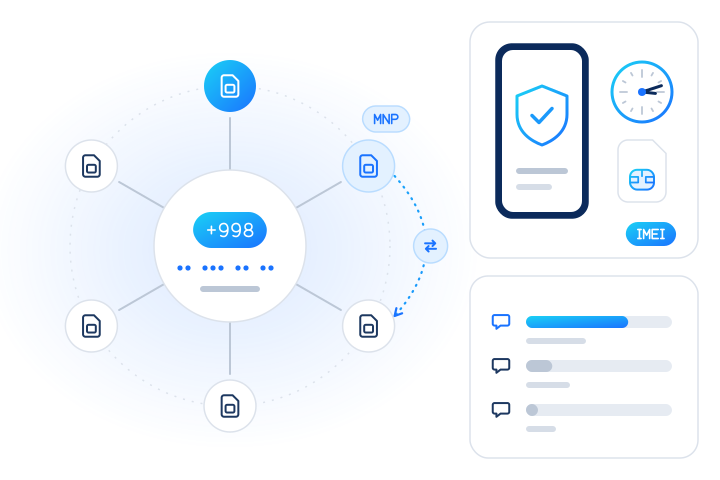
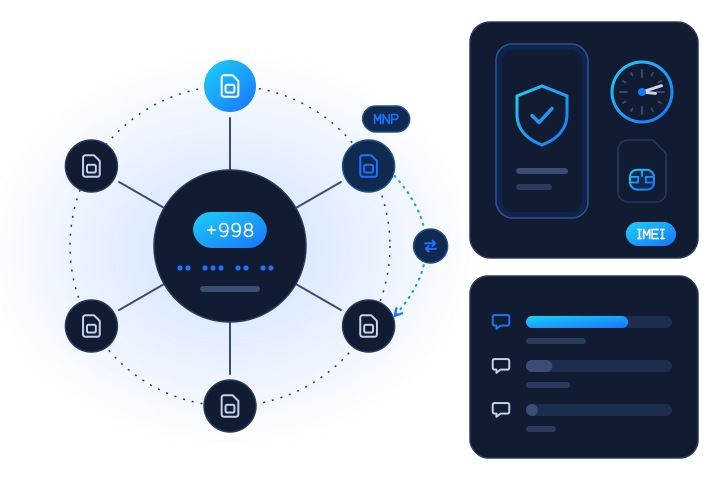
Uzbek phone numbers use the country code +998 and have 9 digits after it, for mobiles and landlines alike: a two-digit code, then seven digits. There is no trunk 0, so a mobile is written 90 XXX XX XX at home and +998 90 XXX XX XX from abroad, and stored in E.164 as +99890XXXXXXX. Since October 2023 numbers can be ported between operators, so the two-digit code shows the original operator, not necessarily the current one.
This guide is part of our phone numbers by country series. The tables are generated from libphonenumber's metadata, our MNP atlas and our public catalog. Example numbers are masked with X. The code samples use libphonenumber's own example numbers, which are for testing only; don't call or text them. On 2026-11-22 we read the national numbering plan that Uzbekistan's Telecommunication Management Center filed with the International Telecommunication Union (ITU) in 2023, the 2024 Law on Telecommunications, the Law on Personal Data, the Ministry of Digital Technologies' notices on porting and SIM rules, and the UzIMEI rules. Some newer facts, such as the 2026 advertising rules, rest on press reports of documents whose text we couldn't find; we say where. This is a summary, not legal advice.
What does an Uzbek phone number look like?
Every Uzbek number has nine digits after +998. The format dates from 1 October 1998, when Uzbekistan moved to its own country code and, in the words of its notice to the ITU, "the length of the national (significant) number for Uzbekistan will now be nine digits", written +998 BC XXXXXXX (ITU, 1998). At home people kept dialling seven digits inside a region until 2018, when Uzbektelecom moved the whole country to nine-digit dialling (UzDaily, 2018); in Tashkent and the Tashkent region only nine-digit numbers have worked since 1 October 2018 (Golden Pages). Today every call is dialled with the two-digit code, and the ITU filing of February 2023 lists a minimum and maximum of nine digits after the country code and 00 as the international prefix (ITU, 2023).
The first two digits tell you what kind of number it is. From the 2023 filing:
| Code | Use in the 2023 ITU filing | Shape |
|---|---|---|
33, 50, 77, 88, 90, 91, 93, 94, 95, 97, 98, 99 | Mobile, assigned to an operator (see below) | 9X XXX XX XX |
71 | Tashkent city landlines | 71 XXX XX XX |
61, 62, 65, 66, 67, 69, 70, 72–76, 79 | Landlines of the other regions (70 is the Tashkent region) | AA XXX XX XX |
55 | Uztelecom SIP (internet telephony) numbers | 55 XXX XX XX |
78 | Non-geographic numbers of other fixed-network operators | 78 XXX XX XX |
| Item | Value |
|---|---|
| Country calling code | +998 |
| International call prefix (dialling out) | 00 |
| Trunk prefix (dialling at home) | none |
| Mobile: digits after +998 | 9 |
| Fixed line: digits after +998 | 9 |
| Mobile, national format (masked) | 91 XXX XX XX |
| Mobile, international (masked) | +998 91 XXX XX XX |
| Mobile, E.164 (masked) | +99891XXXXXXX |
| Fixed line, national format (masked) | 55 XXX XX XX |
| Fixed line, international (masked) | +998 55 XXX XX XX |
| Fixed line, E.164 (masked) | +99855XXXXXXX |
Store only the E.164 form: +998, then the nine digits. 91 234 56 78, (91) 234-56-78, +998 91 234 56 78, 00998 91 234 56 78 and 998912345678 are the same number. Uzbek forms and spreadsheets often carry the brackets-and-dashes style +998 (9X) XXX-XX-XX; strip the punctuation before parsing. The one input habit to watch is a leading 8 or 0 in front of the nine digits. It isn't part of the number, and libphonenumber rejects the ten-digit string, as the code below shows.
Which codes are mobile numbers?
The generator counted every 9-digit number that libphonenumber's mobile pattern for UZ accepts:
| National prefix | International | Share of the block that is mobile (9-digit numbers) | 3-digit sub-blocks that aren't fully mobile |
|---|---|---|---|
AA, for 17 blocks AA = 20, 33, 50, 70, 77, 80, 87, 88, 90–95, 97–99 | +998 AA | 100% | — |
61 | +998 61 | 4.2% | not mobile: 610, 611, 614, 618, 619; partly mobile: 612 (3.0%), 613 (5.0%), 615 (10.0%), 616 (2.0%), 617 (22.0%) |
62 | +998 62 | 15.2% | not mobile: 620, 623, 624, 626, 628, 629; partly mobile: 621 (10.0%), 622 (7.0%), 625 (35.0%) |
65 | +998 65 | 12.5% | not mobile: 650, 654, 656, 658, 659; partly mobile: 651 (2.0%), 652 (3.0%), 653 (10.0%), 655 (10.0%) |
66 | +998 66 | 11.3% | not mobile: 660, 661, 665, 666, 668; partly mobile: 662 (13.0%), 663 (20.0%), 664 (2.0%), 667 (38.0%), 669 (40.0%) |
67 | +998 67 | 4.7% | not mobile: 670, 671, 673, 674, 676, 678; partly mobile: 672 (14.0%), 675 (6.0%), 677 (14.0%), 679 (13.0%) |
72 | +998 72 | 4.7% | not mobile: 720, 721, 724, 726, 728, 729; partly mobile: 722 (3.0%), 723 (12.0%), 725 (10.0%), 727 (22.0%) |
73 | +998 73 | 15.1% | not mobile: 730, 731, 734, 736, 738; partly mobile: 732 (14.0%), 733 (10.0%), 735 (18.0%), 737 (79.0%), 739 (30.0%) |
74 | +998 74 | 10.4% | not mobile: 740, 741, 743, 744, 746, 748; partly mobile: 742 (19.0%), 745 (20.0%), 747 (38.0%), 749 (27.0%) |
75 | +998 75 | 10.7% | not mobile: 750, 754, 756, 758, 759; partly mobile: 751 (1.0%), 752 (14.0%), 753 (40.0%), 755 (4.0%), 757 (48.0%) |
79 | +998 79 | 4.9% | not mobile: 790, 791, 794, 796, 798, 799; partly mobile: 792 (3.0%), 793 (15.0%), 795 (5.0%), 797 (26.0%) |
Mobile codes by operator
Uzbekistan has four mobile network operators, one virtual operator and a fifth network that is being sold. The 2023 ITU filing names the holder of each code; libphonenumber's carrier file (998.txt) adds codes that came into use after it:
| Operator | Codes in the 2023 ITU filing | Further codes in libphonenumber's data | Notes |
|---|---|---|---|
| Beeline | 90, 91 | 92, 20 | Run by VEON, which also launched the digital operator brand OQ on Beeline in 2023 |
| Ucell | 50, 93, 94 | none | |
| Mobiuz | 88, 97 | 87, and parts of the regional codes 61–79 | |
| Uzmobile (Uzbektelecom) | 77, 95, 99 | 70 (see below) | 95 is listed as CDMA and GSM |
| Humans | 33 | none | A virtual operator, since 2020, on Uzbektelecom's network (Daryo, 2025) |
| Perfectum Mobile | 98 (CDMA) | 80 | VEON agreed in October 2026 to buy its operator, Rubicon Wireless |
Three details are worth knowing before you route traffic by code:
70is both. The 2023 ITU filing lists70as the Tashkent region's landline code. libphonenumber types the whole70block as mobile and names Uzbektelecom as its carrier. If your data shows70numbers, check the line type with a lookup rather than trusting either source.- Mobile sub-blocks inside regional codes. libphonenumber accepts some numbers under the regional codes
61–79as mobile and names Mobiuz as their carrier, the rows with a small share in the table above. The ITU filing doesn't mention them, and we found no public source that explains them. They are small, but a "starts with 9" rule rejects them. - Perfectum is changing hands. VEON, which runs Beeline Uzbekistan, announced on 19 October 2026 that it would buy 100% of Rubicon Wireless, the operator of the Perfectum network, for about USD 207 million including debt, and said the regulatory approvals had been obtained (VEON release, 2026). The numbers stay valid; which network brand answers them may change.
Codes that appear in neither list, such as 96, 21 or anything starting with 4, are not in use according to libphonenumber and fail validation. OQ, Beeline's digital brand launched on 31 October 2023 (Daryo, 2023), is listed by Ucell as a separate brand customers can port from; some directories give it the 20 range, while libphonenumber names Beeline for it.
Who is the carrier of an Uzbek number?
Only a lookup can tell you. The code shows the operator the block was assigned to, but since October 2023 a subscriber can take the number to another operator, and the ministry notes that "transferred numbers keep their original format". A 90 number may now be on Ucell. The next sections explain porting and what a lookup returns.
How do I validate an Uzbek number in code?
Remove spaces and punctuation, parse with full metadata and the default region UZ, and keep only numbers typed as mobile. Uzbekistan needs no rewrites: there is no trunk prefix to drop, 00998 is a normal international prefix, and the bare nine digits parse as a national number. To try a batch of inputs without writing code, paste them into our free phone number validator.
Python (pip install phonenumbers):
import re

import phonenumbers
from phonenumbers import PhoneNumberType


def normalize_uz(raw: str) -> str | None:
    """E.164 for an Uzbek mobile number (9 digits after +998), or None."""
    s = re.sub(r"[\s().-]", "", raw)
    try:
        n = phonenumbers.parse(s, "UZ")
    except phonenumbers.NumberParseException:
        return None
    if (not phonenumbers.is_valid_number(n) or phonenumbers.region_code_for_number(n) != "UZ"
            or phonenumbers.number_type(n) != PhoneNumberType.MOBILE):
        return None
    return phonenumbers.format_number(n, phonenumbers.PhoneNumberFormat.E164)


for raw in ["91 234 56 78", "+998 91 234 56 78", "+998 (91) 234-56-78", "00998 91 234 56 78",
            "998912345678", "8 91 234 56 78", "66 905 01 23", "96 234 56 78", "91 234 56 7"]:
    print(f"{raw!r:24} -> {normalize_uz(raw)}")
JavaScript (npm install libphonenumber-js):
import { parsePhoneNumberFromString } from "libphonenumber-js/max";

/** "91 234 56 78", "+998 …", "00998…" or "998…" → E.164 for an Uzbek mobile number, or null. */
export function normalizeUz(raw) {
  const input = String(raw).replace(/[\s().-]/g, "");
  const phone = parsePhoneNumberFromString(input, "UZ");
  if (!phone?.isValid() || phone.country !== "UZ" || phone.getType() !== "MOBILE") return null;
  return phone.number;
}

for (const raw of ["91 234 56 78", "+998 91 234 56 78", "+998 (91) 234-56-78", "00998 91 234 56 78",
                   "998912345678", "8 91 234 56 78", "66 905 01 23", "96 234 56 78", "91 234 56 7"]) {
  console.log(JSON.stringify(raw).padEnd(24), "->", normalizeUz(raw));
}
The inputs are libphonenumber's example numbers for Uzbekistan (mobile 91 234 56 78, a Samarkand landline 66 905 01 23), plus a number in the unused 96 block and a mobile one digit short. They aren't real subscribers. We ran both on 2026-11-22 (Python 3.12 with phonenumbers 9.0.40, Node.js 24 with libphonenumber-js 1.13.15). Both printed the same answers; Python prints None and single quotes, JavaScript null and double quotes:
'91 234 56 78'           -> +998912345678
'+998 91 234 56 78'      -> +998912345678
'+998 (91) 234-56-78'    -> +998912345678
'00998 91 234 56 78'     -> +998912345678
'998912345678'           -> +998912345678
'8 91 234 56 78'         -> None
'66 905 01 23'           -> None
'96 234 56 78'           -> None
'91 234 56 7'            -> None
The first five are one number written five ways. The sixth has a stray 8 in front and is rejected; if your list has many of these, review them by hand instead of dropping the first digit automatically. The landline is valid but not mobile, 96 isn't in use, and the last input is too short.
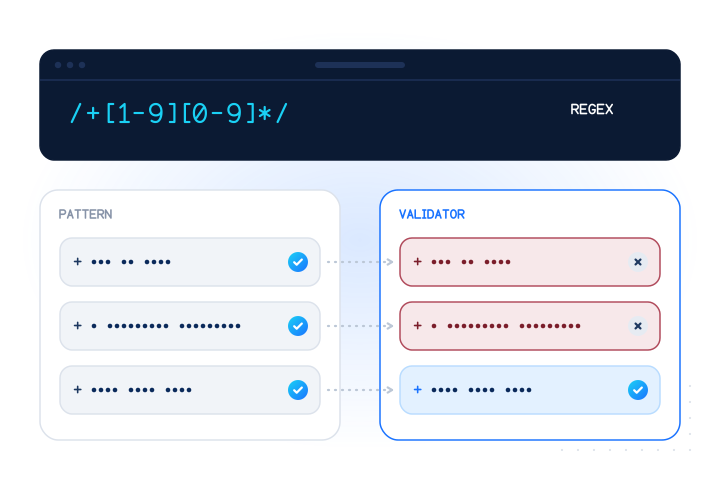
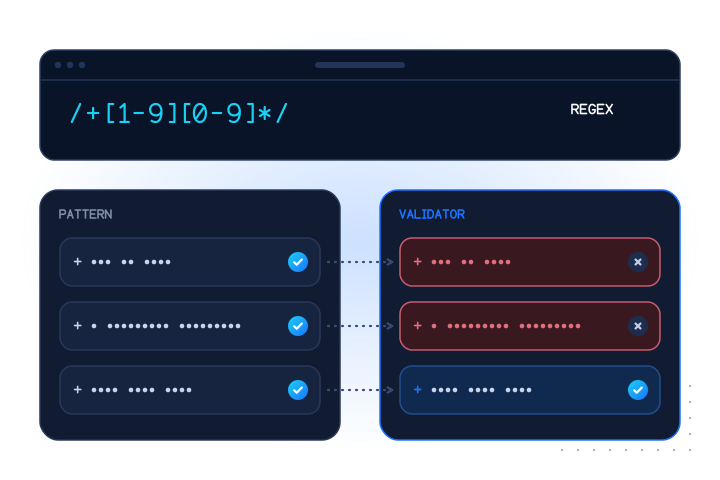
The generated test table runs the same idea over masked inputs with the raw library call. The shape regex column tests the pattern most tutorials give, after spaces, dashes and brackets are removed:
| # | Case | Input (masked) | Shape regex ^(?:\+998|00998)?[235-9]\d{8}$ | libphonenumber (UZ) |
|---|---|---|---|---|
| 1 | National (no trunk prefix) | 91 XXX XX XX | passes | valid, MOBILE |
| 2 | International, with spaces | +998 91 XXX XX XX | passes | valid, MOBILE |
| 3 | International dialling prefix 00 | 00998 91 XXX XX XX | passes | valid, MOBILE |
| 4 | E.164 | +99891XXXXXXX | passes | valid, MOBILE |
| 5 | Dashes and brackets | (91) XXX-XX-XX | passes | valid, MOBILE |
| 6 | One digit short | 91XXXXXX | fails | invalid |
| 7 | One digit too many | 91XXXXXXXX | fails | invalid |
| 8 | Mobile shape, unused block 21 | 21XXXXXXX | passes | invalid |
| 9 | Fixed line | 55 XXX XX XX | passes | valid, FIXED_LINE |
Rows 8 and 9 are the ones to remember. A number in the unused 21 block has the right shape and passes the regex, and so does every landline, because Uzbek mobiles and landlines have the same length. Only the library knows which two-digit codes are mobile. Our post on why an E.164 regex is not enough shows the same problem in other countries. For a whole spreadsheet, our free phone list cleaner normalises and deduplicates a column in the browser.
Does number portability change the carrier?
Yes. Mobile number portability (MNP) started in Uzbekistan on 27 October 2023, during ICTWEEK Uzbekistan. The Ministry of Digital Technologies announced that five operators took part, Beeline, Mobi.uz, Ucell, Uztelecom and Humans, and that a subscriber who wants to switch visits the new operator's office and "receives a new SIM card with the same number" (Ministry of Digital Technologies, 2023). Each operator sets its own one-time fee. Ucell, for example, charges 70,000 sum for a number transfer, and from 26 March to 31 December 2026 waives it for customers of Uzmobile, Mobiuz, Beeline, OQ and Humans who take a plan of 100,000 sum a month or more (Ucell).
The 2024 Law on Telecommunications doesn't mention portability; it gives the regulator control over "accounting, systematization, and control over the use of numbering resources" and makes their use paid (article 16, Law LRU-1015).
Our MNP atlas has no verified row for Uzbekistan yet.
For the atlas we would add Uzbekistan as "mobile number portability since 27 October 2023, all mobile operators, in person at the new operator", with the ministry's notice as the source. Our MNP atlas compares portability across countries.
Numbers can also change owner
Porting moves a number between operators. Uzbekistan also lets a number move between people: as of May 2026 the owner can re-register a number to someone else online through my.gov.uz, with both sides confirming by face identification, and the operator processes it in one to five working days (Kun.uz, May 2026). For a customer list this means a number can stay active, on the same operator, and still belong to a different person. Consent you collected from the previous owner doesn't carry over. Our post on number recycling and list decay explains how to keep lists fresh.
How are SIM cards and phones registered in Uzbekistan?
Uzbekistan registers both the SIM and the handset.
The SIM. A SIM is sold under a contract in the subscriber's name. The Rules for the Provision of Telecommunications Services No. 3762 of 6 January 2026 require operators to verify subscribers by "biometric facial identification (Face ID)" when they sign a contract, so that a SIM can't be issued without the person present, according to the Ministry of Digital Technologies (ministry notice, March 2026). Residents can see every number registered in their name with the "My Numbers" service on my.gov.uz. Since 22 April 2026, new users of payment apps need a phone number, personal ID number and bank card registered to the same person, under a Central Bank rule (Kursiv, 2026).
The phone (IMEI). The Law on Telecommunications says the "international unique identification codes of mobile devices in telecommunication networks must be registered" (article 14, Law LRU-1015). The UzIMEI system that does it rests on Cabinet of Ministers resolutions No. 847 of 2018 and No. 778 of 2019 and is run by the Republican Center for Management of Telecommunication Networks, the same body that filed the numbering plan with the ITU (UzIMEI). An individual has 30 days after first using a local SIM to register a phone; the fee is 82,400 sum within that period and 103,000 sum after it, and an unregistered phone stops connecting to mobile networks until it is registered (Kun.uz, March 2026).
What it means for your data: an Uzbek number is tied to an identified person, but not forever to the same one. Numbers move between operators and between people, and a phone that hasn't been registered can't use the network even when its SIM is valid. A live network status (HLR) check before an OTP or a campaign shows whether a number is reachable now.
What are the rules for SMS marketing and personal data?
These summarise the laws and notices as we read them on 2026-11-22. Not legal advice; ask counsel how they apply to you.
Advertising SMS and calls from 1 November 2026
A presidential resolution announced by the Ministry of Justice in July 2026 sets new rules for advertising over mobile networks (Kun.uz, July 2026). We couldn't find the resolution's number or text, so these points come from two press reports, the second written on the day the rules took effect (Zamin.uz, 1 November 2026):
| Rule from 1 November 2026 | What it means for a sender |
|---|---|
| Advertising SMS only with the recipient's prior written or electronic consent | Keep a record of when and how each person agreed |
| No advertising calls or SMS between 18:00 and 09:00 | Schedule campaigns for Tashkent time (UTC+5) |
| Operators block advertising, fully or partly, at a subscriber's request | Expect some numbers to stop receiving promotions |
| Companies that send advertising calls and SMS register their systems in the state register of personal databases | Register before you start, or use a provider that has |
Uzbek in Latin script uses the letters oʻ and gʻ, written with a turned comma (ʻ), which isn't in the 160-character GSM alphabet; a message that contains it, or any Cyrillic text, is sent as UCS-2 with 70 characters per part. Typing a plain apostrophe (') instead keeps the message in GSM. Our SMS character counter shows how many parts a message will take.
The Law on Personal Data
The Law "On personal data" No. LRU-547 of 2 July 2019 has applied since 1 October 2019 (lex.uz). The parts that matter for messaging lists and number checks:
| Article | Rule |
|---|---|
| Art. 18, 21 | Processing needs a legal basis, such as consent, a contract, a legal duty or a legitimate interest; consent can be withdrawn in the form it was given |
| Art. 15 | Transfers abroad are allowed to countries with adequate protection, or otherwise with the person's consent or under a treaty |
| Art. 27¹ | Biometric and genetic data, and the "data of individuals using the services of telecommunications operators", must be stored in Uzbekistan |
Article 27¹ is the one to read carefully. Since the amendments signed on 26 March 2026, most personal data may be stored abroad under conditions such as adequacy or approved contract clauses, but the data of telecom subscribers must still be "stored and processed exclusively on servers located within the national territory" (Kun.uz, March 2026). How that applies to a business that sends its own customers' phone numbers to a service abroad is a question for counsel. Our posts on whether a phone number is personal data and on consent for WhatsApp checks give the baseline we work to: your own customers, a stated purpose, minimal data and honoured objections.
Which messaging apps reach people in Uzbekistan?
Telegram, by a wide margin. The evidence we could check:
- Preference. A Central Asia Barometer report of December 2023 found that 70% of Uzbeks prefer Telegram, while "only 18% of respondents use WhatsApp most frequently" and 4% IMO (CA Barometer, 2023).
- News. In the National Study on Media Consumption, run with 1,411 adults from 8 to 19 September 2026, Telegram channels were the leading news source, cited by 45.7% of respondents, ahead of social networks (36.9%) and television (33.8%) (Daryo, 2026).
- Audience size. A digital-agency estimate reported in July 2026 put Telegram's audience in Uzbekistan at 25 million users, against 14.1 million for Instagram (Kursiv, 2026). It is an estimate, not an audited count.
Telegram is also part of public life: the Central Bank announced the 2026 payment-app rule on its Telegram channel. WhatsApp still reaches a minority of customers, and SMS remains the channel that reaches every active line, for OTPs too.
For WhatsApp business messages, Meta doesn't price Uzbekistan as a separate market: it is one of the "Rest of Asia Pacific" markets on its rate card (Meta pricing, read on 2026-11-22). On the rate card effective 1 October 2026, that region's list rate is USD 0.0842 per delivered marketing message and USD 0.0113 per utility or authentication message, from our WhatsApp rate-card dataset. Our WhatsApp cost calculator does the sums for a campaign.
The method is the same as in our channel-by-country guide: check which apps your opted-in customers are registered on, send each one where they are, and keep SMS as the fallback.
How do I check Telegram and WhatsApp registration for an Uzbek customer list?
Normalise every row with normalize_uz() first. A check tells you whether a number is registered at the time of the check. It can't tell you whether the person wants your messages:
| Answer | What it means | What to do |
|---|---|---|
registered: true | The number has an account at checked_at | Offer that app to customers who opted in to it |
registered: false | No account at checked_at | Use another channel |
unknown | No conclusive answer (not billed) | Keep the current channel; retry later |
invalid_number | Failed format validation (not billed) | Fix the data at the source |
For lists, use a bulk job. Upload a CSV with a phone column written the Uzbek way (91 XXX XX XX, +998 (9X) XXX-XX-XX and 998… also work) and default_country=UZ:
curl https://api.mobilevalidate.com/v1/jobs \
  -H "Authorization: Bearer $MOBILEVALIDATE_API_KEY" \
  -F file=@customers.csv -F checks=telegram,whatsapp -F default_country=UZ
The result file keeps your rows in order (row_no) and adds one column per answer, such as telegram.registered.status and whatsapp.registered.status. At the bulk prices in our public catalog on 2026-11-22, a Telegram check costs USD 0.0003 and a WhatsApp check USD 0.00025 per conclusive answer, so both checks on 10,000 numbers cost at most USD 5.50 (USD 3.00 for Telegram, USD 2.50 for WhatsApp); unknown answers are free. The WhatsApp bulk price applies to groups of at least 132 numbers from the same country in one job. Real-time checks are priced on the pricing page. Send the same body to POST /v1/jobs/estimate first: it is free, checks nothing and shows the maximum cost before anything runs.
What changed recently?
The rows for UZ and +998 in our numbering-plan changes dataset, built from libphonenumber's release notes:
| Change named in the release notes (2019-01-08 to 2026-09-23) | Releases |
|---|---|
| Numbering-plan metadata (validation, lengths, types) | 18 |
| Original-carrier prefix data | 13 |
| All | 31 |
Latest numbering-plan updates for UZ: 2026-07-02 (v9.0.34), 2025-12-04 (v9.0.20), 2025-03-27 (v9.0.2), 2024-12-11 (v8.13.52), 2024-09-19 (v8.13.46).
Uzbekistan's data changes often: new mobile codes such as 20, 87 and 92 came after the 2023 ITU filing, and libphonenumber's carrier data for +998 changed in 13 releases since 2019. An old copy of the library may reject valid numbers in the newest codes, so update it at least monthly and log the numbers it rejects instead of dropping them silently.
The bigger changes were in the market and the rules:
- 1998: the country code
+998and the nine-digit national number (1 October). - 2018: nine-digit dialling everywhere; Tashkent first (1 October). The UzIMEI system set up (resolution No. 847).
- 2019: the Law on Personal Data (in force 1 October); IMEI registration procedure (resolution No. 778).
- 2020: Humans starts as a virtual operator on Uzbektelecom's network.
- 2023: updated numbering plan filed with the ITU (February); mobile number portability (27 October); Beeline's OQ brand launched.
- 2024: the new Law on Telecommunications (27 December).
- 2026: Face ID at SIM contracts (rules of 6 January); personal data law amended (26 March); online re-registration of numbers to another person (reported in May); advertising SMS only with consent (1 November); VEON's agreement to buy Perfectum's operator (October).
What can MobileValidate check for Uzbek numbers?
Generated from our public catalog:
Catalog data as of 2026-11-22.
| Check | Accepts Uzbekistan numbers | Notes |
|---|---|---|
| Format and country (every lookup) | Yes | Each number is parsed first; an invalid number returns invalid_number and is never billed. |
| Carrier lookup (beta) | Yes | Line type and current network where data exists; no data means unknown, not billed. Real time and bulk. |
| US/CA carrier lookup (premium) | No (US, CA only) | Answers unsupported_country for other countries, not billed. |
| Live network status (HLR) | Yes | Live reachability, porting, roaming (true or false) and current network; unknown is free. Real time and bulk. |
| Number portability (MNP) | Yes | Ported or not ported, and the current network code; unknown is free. Real time and bulk. |
| Spam reputation | Limited access | All countries except sanctioned ones; report coverage is strongest in North America and Europe. |
| Messaging apps | Yes: WhatsApp, Telegram, Viber*, Signal*, iMessage*, RCS*, LINE*, Zalo*, Botim*, Facebook Messenger* | Registered, not registered or unknown; unknown is free. |
| Social networks | Yes: Facebook, Instagram, Threads, X (Twitter), TikTok*, Snapchat* | Not for Uzbekistan numbers: LinkedIn (US, IN only). |
| Online accounts (Apple, Amazon, Microsoft, Netflix) | Yes: Apple, Amazon, Microsoft, Netflix | Registered, not registered or unknown; unknown is free. |
* bulk jobs only. The live list is at GET /v1/services.
A lookup returns network and registration facts. It never returns a subscriber's name, ID number or address, and we don't offer "number details" searches.
Because numbers can be ported, the useful Uzbek lookup is the current network: an MNP lookup answers ported or not ported with the current network code, and a live network status (HLR) check adds reachability. The carrier lookup gives line type and network in one call, which settles the 70 question above, and our free MCC-MNC lookup turns a network code into an operator name. For channels, the Telegram number check and WhatsApp run in real time and in bulk; the starred checks in the table run in bulk jobs only.
How do I start for free?
- 100 free real checks. Every live account can run 100 phone numbers and 20 e-mail addresses through the real checks for free on the dashboard's Try it page. Use them on your own number first.
- A free carrier lookup. The carrier lookup page has a public form for 3 lookups a day, no sign-up needed.
- Free tools. The phone number validator, phone list cleaner and number-to-country lookup work in your browser; all of them are on the tools page.
- A free test key. Get a test key for the sandbox. It gives fixed test answers so you can build every branch of your code; see test mode.
- A free estimate.
POST /v1/jobs/estimatetakes the same body as a job, checks nothing and shows the maximum cost before you start. - Then add credit. Create your account; approval is automatic. Top-ups of USD 100 or more get 5% bonus credit, USD 500 or more 8%, and USD 2,000 or more 10%; see pricing. Unknown, invalid and duplicate results are never charged.
Here is a small reachability check against the real-time endpoint. It asks for the live network status and Telegram and WhatsApp registration in one call. It uses the public sandbox key mv_test_publicSandboxn9ZgneuhR1B9CRfKG3fulym and our test values. The sandbox accepts only those UK drama numbers, so the example uses them; with a live key, pass the output of normalize_uz().
import os

import requests  # pip install requests

API = "https://api.mobilevalidate.com/v1/lookup"
KEY = os.environ["MOBILEVALIDATE_API_KEY"]


def reach(numbers: list[str]) -> dict[str, dict]:
    """Live status, porting flag and Telegram/WhatsApp registration per number. None means unknown."""
    r = requests.post(API, headers={"Authorization": f"Bearer {KEY}"}, timeout=15,
                      json={"numbers": numbers, "checks": ["hlr", "telegram", "whatsapp"], "wait": 5})
    r.raise_for_status()
    out = {}
    for row in r.json()["results"]:
        c = row["checks"]
        hlr = (c["number.hlr"]["attributes"] or {}) if c["number.hlr"]["status"] == "completed" else {}
        app = lambda key: c[key]["registered"] if c[key]["status"] == "completed" else None
        out[row["e164"]] = {"status": hlr.get("status"), "ported": hlr.get("ported"),
                            "telegram": app("telegram.registered"), "whatsapp": app("whatsapp.registered")}
    return out


for number, info in reach(["+447700900001", "+447700900002", "+447700900005"]).items():
    print(number, info)
We ran it against the sandbox on 2026-11-22. It printed:
+447700900001 {'status': 'reachable', 'ported': False, 'telegram': True, 'whatsapp': True}
+447700900002 {'status': 'unreachable', 'ported': False, 'telegram': False, 'whatsapp': False}
+447700900005 {'status': None, 'ported': None, 'telegram': None, 'whatsapp': None}
The first test value is the common Uzbek case: reachable and on Telegram. The second exists but is unreachable, so an OTP or a campaign message would be wasted. The third stands for an unsupported country, so every field is None and nothing is billed. Keep None apart from False: None means we don't know. Requests with 20 or more consecutive numbers are refused (403 suspected_enumeration), and our acceptable use policy forbids finding recipients for unsolicited messages. People can object through our opt-out form.
What are the key takeaways?
- Uzbek numbers have nine digits after
+998, with no trunk prefix:9X XXX XX XXfor most mobiles,71 XXX XX XXfor Tashkent landlines. Store the E.164 form. - Mobile codes in the 2023 ITU filing: Beeline
90,91; Ucell50,93,94; Mobiuz88,97; Uzmobile77,95,99; Humans33; Perfectum98. libphonenumber adds20,80,87,92and treats70as mobile. - A shape regex can't tell mobiles from landlines, because both have nine digits; use libphonenumber and keep it updated.
- Mobile number portability has run since 27 October 2023, and numbers can be re-registered to another person online, so the code shows only the original operator.
- SIM contracts need Face ID since 2026, and every phone's IMEI must be registered within 30 days of first use.
- Since 1 November 2026, advertising SMS needs prior consent and can't be sent between 18:00 and 09:00. Telegram is the main messaging app; check registration only for customers who opted in.
Platform, regulator and company names are used descriptively. MobileValidate is not affiliated with any of them.
Sources
- Uzbekistan (country code +998): updated national numbering plan, communication of 10 February 2023 — International Telecommunication Union, national numbering plans (notification by the Telecommunication Management Center of the Republic of Uzbekistan), 2023
- Uzbekistan: change of country code to +998 and nine-digit national number, communication of 19 May 1998 — International Telecommunication Union (notification by the Post and Telecommunications Agency of Uzbekistan), 1998
- Uzbekistan to move to nine-digit telephone numbers (31 January 2018) — UzDaily, citing Uzbektelecom's press service, 2018
- Phone codes of mobile operators in Uzbekistan, with the 2018 switch to nine-digit numbers in Tashkent — Golden Pages Uzbekistan, 2026
- Law of the Republic of Uzbekistan No. LRU-1015 "On telecommunications" (27 December 2024) — National Database of Legislation (lex.uz), 2024
- Mobile subscribers were provided with the opportunity to use the services of the mobile operator they want (27 October 2023) — Ministry of Digital Technologies of the Republic of Uzbekistan, 2023
- Number transfer (MNP) service: fee and promotion — Ucell, 2026
- VEON launches OQ, transforming digital experiences in Uzbekistan (2 November 2023) — Daryo, 2023
- Uzbektelecom addresses arbitration dispute as Humans fails to pay debts (5 June 2025) — Daryo, 2025
- No grounds for concern: clarification on reports regarding the sale of virtual numbers (19 March 2026) — Ministry of Digital Technologies of the Republic of Uzbekistan, 2026
- About the UzIMEI system: legal basis and registration rules — UzIMEI (Republican Center for Management of Telecommunication Networks), 2026
- How to bring a phone into Uzbekistan and register its IMEI (26 March 2026) — Kun.uz, 2026
- How to transfer a phone number to another person in Uzbekistan (6 May 2026) — Kun.uz, 2026
- Uzbekistan to require SIM, ID and bank card match for new payment app users (9 April 2026) — Kursiv Uzbekistan, 2026
- Law of the Republic of Uzbekistan No. LRU-547 "On personal data" (2 July 2019, as amended) — National Database of Legislation (lex.uz), 2019
- Uzbekistan amends personal data law to facilitate global payment systems (27 March 2026) — Kun.uz, 2026
- Government sets new limits on mobile advertising and strengthens consumer protections (16 July 2026) — Kun.uz, 2026
- Strict restrictions on telephone advertising came into force on November 1 (1 November 2026) — Zamin.uz, 2026
- Which messaging apps are popular in Uzbekistan, Kyrgyzstan and Kazakhstan? (27 December 2023) — Central Asia Barometer, 2023
- Telegram ranks as top news source in Uzbekistan, study shows (3 November 2026) — Daryo, 2026
- Digital market analysis: which social networks Uzbeks use (7 July 2026) — Kursiv Uzbekistan, 2026
- VEON accelerates telecom market consolidation in Uzbekistan (19 October 2026, press release) — VEON, via Finviz, 2026
- Pricing: rate card regions and markets — Meta (WhatsApp Business Platform documentation), 2026
- libphonenumber carrier prefix data for +998 (998.txt) and PhoneNumberMetadata.xml (region UZ) — libphonenumber project (Apache License 2.0), 2026
Frequently asked questions
How many digits is an Uzbekistan phone number?
Nine digits after the country code +998, for mobiles and landlines alike: a two-digit operator or area code and a seven-digit subscriber number. A mobile is written 90 XXX XX XX at home and +998 90 XXX XX XX from abroad, twelve digits in all after the plus. There is no trunk 0 to add or drop.
What is the +998 country code and how do I write an Uzbek number for Telegram or WhatsApp?
+998 is Uzbekistan's country calling code, in use since 1 October 1998. Put +998 in front of the nine national digits and remove spaces, brackets and dashes: (91) 234-56-78 becomes +998912345678. The same E.164 form works for Telegram, WhatsApp, wa.me links and SMS APIs. From abroad you can also dial 00998.
Which operator is 90, 93, 97, 99 or 33 in Uzbekistan?
In the numbering plan Uzbekistan filed with the ITU in 2023, 90 and 91 are Beeline; 50, 93 and 94 are Ucell; 88 and 97 are Mobiuz; 77, 95 and 99 are Uzmobile (Uzbektelecom); 33 is Humans; and 98 is Perfectum Mobile. Newer codes such as 20, 87 and 92 appear in libphonenumber's data. That is the original holder only, because numbers can be ported.
Do Uzbek phone numbers start with 0 or 8?
No. Uzbekistan has no trunk prefix: the nine digits are dialled the same way at home and after +998 from abroad. A string such as 8 90 XXX XX XX or 0 90 XXX XX XX has ten digits and is not a valid Uzbek number as written. Flag such rows for review instead of guessing which digit to drop.
Does Uzbekistan have mobile number portability?
Yes. Mobile number portability started on 27 October 2023 with Beeline, Mobiuz, Ucell, Uzbektelecom and Humans, according to the Ministry of Digital Technologies. A subscriber applies at the new operator's office and gets a new SIM with the same number. Since then, the prefix shows only the original operator, not the current one.
Do I need to register my phone's IMEI in Uzbekistan?
Yes, to use a local SIM. The 2024 Law on Telecommunications requires mobile devices' IMEI codes to be registered, which is done in the UzIMEI system. Individuals have 30 days after first using a local SIM; after that, an unregistered phone stops connecting to mobile networks until it is registered.
Is Telegram more popular than WhatsApp in Uzbekistan?
Yes, by every survey we found. A 2023 Central Asia Barometer report said 70% of Uzbeks prefer Telegram and 18% use WhatsApp most often. In a national media survey of 1,411 adults in September 2026, Telegram channels were the top news source, used by 45.7%. Check registration on both for customers who opted in.
What are the rules for marketing SMS in Uzbekistan?
From 1 November 2026, under a presidential resolution announced in July 2026, advertising SMS may be sent only with the recipient's prior written or electronic consent, and advertising calls and SMS are banned between 18:00 and 09:00. Operators must block advertising for subscribers who ask, and senders must register their systems in the state register of personal databases.
Related services and guides
More from the blog
All articlesGuides
Phone numbers by country: formats, portability, channels and rules
How phone numbers differ by country: formats and E.164, numbering changes, portability, line types, messaging channels, and a dated tracker of calling and texting rules.
11 min read
Developers
International phone number formats by country: a 2026 reference table
Calling code, international and trunk prefix, mobile and fixed-line number lengths and a masked E.164 mobile format for 238 regions, generated from libphonenumber.
19 min read
Developers
E.164 regex: why a pattern is not enough to validate phone numbers
The common E.164 regex accepts impossible numbers. Real counterexamples, the shortest valid international numbers, and what to use a regex for instead.
7 min read