On this page
Ugandan phone numbers use the country code +256 and have 9 digits after it. Mobile numbers start with 7 (07X when dialled at home with the trunk prefix 0), so in E.164 they look like +256 7XX XXXXXX, stored as +2567XXXXXXXX. The first three digits show which operator the Uganda Communications Commission (UCC) gave the range to, mostly MTN, Airtel or Uganda Telecom. Uganda has no mobile number portability yet, so a number usually stays with that operator.
This guide is part of our phone numbers by country series. The tables are generated from libphonenumber's metadata, our MNP atlas and our public catalog. Example numbers are masked with X, or are the example numbers published in libphonenumber. On 2026-11-07 we read UCC's numbering plan as published by the International Telecommunication Union (ITU), the messaging regulations, the interception and data protection laws, and UCC's statistics. Where we rely on press reports, we say so. This is a summary, not legal advice.
What does a Ugandan phone number look like?
A mobile number is 07XX XXXXXX at home: the trunk prefix 0 and nine digits. From abroad it is +256 7XX XXXXXX. UCC's national numbering plan, which the ITU published on 15 July 2026, says "the minimum number length (excluding the country code) is 9 digits" and the maximum is 9 digits too (ITU Operational Bulletin 1344, p. 6). Every number has the same length, so a 10-digit national number without the 0, or an 8-digit one, is always a typing error.
| Item | Value |
|---|---|
| Country calling code | +256 |
| International call prefix (dialling out) | 00[057] (pattern: more than one prefix is used) |
| Trunk prefix (dialling at home) | 0 |
| Mobile: digits after +256 | 9 |
| Fixed line: digits after +256 | 9 |
| Toll-free: digits after +256 | 9 |
| Premium rate: digits after +256 | 9 |
| Mobile, national format (masked) | 071X XXXXXX |
| Mobile, international (masked) | +256 71X XXXXXX |
| Mobile, E.164 (masked) | +25671XXXXXXX |
| Fixed line, national format (masked) | 020X XXXXXX |
| Fixed line, international (masked) | +256 20X XXXXXX |
| Fixed line, E.164 (masked) | +25620XXXXXXX |
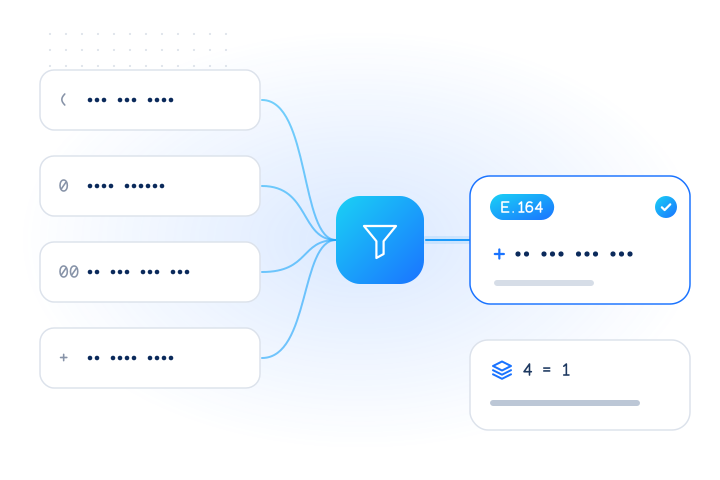
Store only the E.164 form, +2567XXXXXXXX, with no spaces and no 0 after 256. Ugandan forms often collect 07XXXXXXXX, 2567XXXXXXXX without the plus, +256 07… with a stray zero, or 00256…. A numbering-plan library with the default region UG handles most of these. The 00256 form needs one extra step.
Why does 00256 fail validation?
libphonenumber's metadata for Uganda lists 000, 005 and 007 as the international call prefixes, not plain 00. So when the library is told a number comes from Uganda, 00256 7XX XXXXXX doesn't start with an exit code it knows. Both ports we tested read the whole string as one long national number, which isn't valid. Row 3 of the test table below shows the result.
People still type 00256, because 00 is the exit code in most countries, and many Ugandan customers live abroad. The fix is one line: rewrite a leading 00 followed by 256 to + before parsing. Don't rewrite every 00: 000256… already parses.
Which prefixes are mobile numbers?
Every mobile number starts with 07. For each block, the generator counted every 9-digit number that libphonenumber's mobile pattern for UG accepts:
| National prefix | International | Share of the block that is mobile (9-digit numbers) | 3-digit sub-blocks that aren't fully mobile |
|---|---|---|---|
070 | +256 70 | 100% | — |
071 | +256 71 | 100% | — |
072 | +256 72 | 51.0% | not mobile: 0722, 0723, 0725, 0729; partly mobile: 0728 (10.0%) |
073 | +256 73 | 51.0% | not mobile: 0733, 0735, 0738, 0739; partly mobile: 0734 (10.0%) |
074 | +256 74 | 100% | — |
075 | +256 75 | 100% | — |
076 | +256 76 | 100% | — |
077 | +256 77 | 100% | — |
078 | +256 78 | 100% | — |
079 | +256 79 | 80.0% | not mobile: 0796, 0797 |
07X prefixes by operator (UCC plan, July 2026)
UCC's plan names the holder of each range. Airtel, MTN and UTL hold whole codes of 10 million numbers; smaller operators hold slices of 072 and 073:
| National prefix | International | Range holder in UCC's 2026 plan |
|---|---|---|
070, 074, 075 | +256 70, 74, 75 | Airtel Uganda |
0730, 0731 | +256 730, 731 | Airtel Uganda |
076, 077, 078 | +256 76–78 | MTN Uganda |
0790 to 0795 | +256 790–795 | MTN Uganda |
071 | +256 71 | Uganda Telecommunications Corporation (UTL) |
0724 | +256 724 | Hamilton Telecom |
0726, 0727 | +256 726, 727 | Tangerine |
0721 0XXXXX | +256 721 0… | Savanna Fibre (100,000 numbers) |
0728 0XXXXX | +256 728 0… | Talkio Mobile (100,000 numbers) |
0734 0XXXXX | +256 734 0… | Roke Telkom (100,000 numbers) |
0737 0XXXXX, 0737 1XXXXX | +256 737 0…, 737 1… | Blue Crane Communications (200,000 numbers) |
The plan marks every range as operational. Four things moved since the previous edition of July 2023 (ITU Operational Bulletin 1274):
- Airtel's
074grew from0740–0744to the whole074code. - MTN's
076grew from0760–0765to the whole code, and MTN got079. Trade press reported the079grant on 11 March 2025, starting with0790for new customers (PC Tech Magazine, 2025). - Smile left the plan. In 2023
0720was listed for Smile Communications; the 2026 plan doesn't list0720at all. 073opened,072filled up. The 2023 edition had no073range and only0720,07240(Hamilton, then not yet operational) and07260(Tangerine) in072. The 2026 edition adds0730–0731for Airtel, the whole of0724,0726and0727, and the 100,000-number slices for Savanna Fibre, Talkio, Roke Telkom and Blue Crane.
Where the library and the plan disagree
libphonenumber's mobile pattern is broader than UCC's plan in some blocks, and its carrier names are older. Comparing the two on 2026-11-07 (libphonenumber metadata 9.0.39; carrier file in the Python port 9.0.40):
| Block | libphonenumber | UCC plan, July 2026 |
|---|---|---|
0720 | valid mobile; carrier "Smile" | not listed |
0721 | the whole block valid; carrier "LycaMobile" | only 0721 0XXXXX (Savanna Fibre) |
0726, 0727 | carrier "LycaMobile" | Tangerine |
0736 | valid mobile; carrier "Hamilton Telecom" | not listed |
0737 | the whole block valid | only 0737 0 and 0737 1 (Blue Crane) |
0798, 0799 | valid mobile; carrier "Africell" | not listed (MTN holds 0790–0795) |
0724 | carrier "MTN" ("Hamilton Telecom" only for 07240) | Hamilton Telecom |
The practical rule: a number that passes libphonenumber may still sit in a block no operator holds today, and the library's carrier name for 072 and 079 numbers can be years out of date. Neither Lycamobile nor Africell holds a range in the 2026 plan. If a sign-up uses 0720, 0736 or 0798, log it and verify the number with a live lookup before you rely on it.
What are 020, 031, 041 and the other ranges?
Uganda's fixed numbers are also nine digits, and their first digits name the operator, not a town. In the 2026 plan, ranges starting 20 belong to several fixed operators (Airtel, Liquid, Blue Crane, Talkio, Echotel, Roke Telkom, Hamilton and Simbanet), the whole 3 level (031X, 039X) belongs to MTN, and the whole 4 level (041X and the rest) to Uganda Telecom. That is why UCC's own number is written +256 414 XXX XXX: a 041 number is a UTL line, not necessarily a Kampala one.
libphonenumber also types 0800 numbers as toll-free and 0901 to 0903 as premium rate. These ranges don't appear in the ITU notice, so we can't confirm them from UCC. None of these is an ordinary mobile, so a MOBILE check correctly leaves them out.
How do I validate a Ugandan number in code?
Use a libphonenumber port with full metadata and the default region UG, rewrite 00256 to +256 first, then keep only mobiles. To try a batch of inputs without writing code, paste them into our free phone number validator.
Python (pip install phonenumbers):
import re

import phonenumbers


def normalize_ug(raw: str) -> str | None:
    """E.164 for a Ugandan mobile number (07X), or None."""
    s = re.sub(r"[\s().-]", "", raw)
    s = re.sub(r"^00(?=256)", "+", s)  # 00256… is foreign-style dialling; not an exit code libphonenumber knows for UG
    try:
        n = phonenumbers.parse(s, "UG")
    except phonenumbers.NumberParseException:
        return None
    if (not phonenumbers.is_valid_number(n) or phonenumbers.region_code_for_number(n) != "UG"
            or phonenumbers.number_type(n) != phonenumbers.PhoneNumberType.MOBILE):
        return None
    return phonenumbers.format_number(n, phonenumbers.PhoneNumberFormat.E164)


for raw in ["0712 345678", "+256 712 345678", "256712345678", "00256 712 345678",
            "0712 34567", "0722 345678", "0312 345678", "0800 123456"]:
    print(f"{raw!r:20} -> {normalize_ug(raw)}")
JavaScript (npm install libphonenumber-js):
import { parsePhoneNumberFromString } from "libphonenumber-js/max";

/** "0712 …", "+256 7…", "256…" or "00256…" → E.164 for a Ugandan mobile, or null. */
export function normalizeUg(raw) {
  const s = String(raw).replace(/[\s().-]/g, "").replace(/^00(?=256)/, "+"); // 00256… → +256…
  const phone = parsePhoneNumberFromString(s, "UG");
  return phone?.isValid() && phone.country === "UG" && phone.getType() === "MOBILE" ? phone.number : null;
}

for (const raw of ["0712 345678", "+256 712 345678", "256712345678", "00256 712 345678",
  "0712 34567", "0722 345678", "0312 345678", "0800 123456"]) {
  console.log(JSON.stringify(raw).padEnd(20), "->", normalizeUg(raw));
}
The inputs are libphonenumber's own example numbers for Uganda (mobile 0712 345678, fixed line 0312 345678, toll-free 0800 123456), one of them a digit short, plus one number in the 0722 block, which no operator holds. They are not real subscribers. We ran both on 2026-11-07 (Python 3.12 with phonenumbers 9.0.40, Node.js 24 with libphonenumber-js 1.13.13). Both printed the same answers:
'0712 345678'        -> +256712345678
'+256 712 345678'    -> +256712345678
'256712345678'       -> +256712345678
'00256 712 345678'   -> +256712345678
'0712 34567'         -> None
'0722 345678'        -> None
'0312 345678'        -> None
'0800 123456'        -> None
(The JavaScript version prints null instead of None and uses double quotes.) The fourth line only works because of the 00256 rewrite. The shape regex column below tests the pattern most tutorials give, after spaces, dashes and brackets are removed:
| # | Case | Input (masked) | Shape regex ^(?:\+256|00256|0)?7\d{8}$ | libphonenumber (UG) |
|---|---|---|---|---|
| 1 | National, with trunk prefix | 071X XXXXXX | passes | valid, MOBILE |
| 2 | International, with spaces | +256 71X XXXXXX | passes | valid, MOBILE |
| 3 | International dialling prefix 00 | 00256 71X XXXXXX | passes | invalid |
| 4 | E.164 | +25671XXXXXXX | passes | valid, MOBILE |
| 5 | Dashes and brackets | (071X) XXXXXX | passes | valid, MOBILE |
| 6 | One digit short | 071XXXXXX | fails | invalid |
| 7 | One digit too many | 071XXXXXXXX | fails | invalid |
| 8 | Fixed line | 020X XXXXXX | fails | valid, FIXED_LINE |
| 9 | Toll-free range | 0800 XXXXXX | fails | valid, TOLL_FREE |
Rows 3 and 8 are the ones to remember. Row 3 is the 00256 trap above. Row 8 is a landline: it fails the mobile regex, but libphonenumber says it's valid, as FIXED_LINE, so check the type, not only validity, when you need a number that can receive SMS. The regex also passes 0722…, a block nobody holds. Our post on why an E.164 regex is not enough shows the same problem in other countries, and our Python and JavaScript guides cover more cases. For a whole spreadsheet, our free phone list cleaner normalises and deduplicates a column in the browser.
Does Uganda have number portability?
No. As of November 2026 we found no number portability regulation from UCC, no launch date and no portability document on UCC's regulations pages. On 13 March 2025, Nile Post reported that the Mityana Woman MP, Joyce Bagala, had moved a motion asking UCC to implement mobile number portability. She noted that "the National Broadband Policy, 2018, requires mobile number portability as part of licensing conditions. However, it has not been implemented in Uganda" (Nile Post, 2025). We found no later announcement of a start date.
Our MNP atlas has no verified row for Uganda yet.
For your data, no portability means two things:
- The prefix usually names the network. A
077number was given to MTN and, without porting, it is still on MTN. That makes prefix-based routing and cost estimates more reliable than in Kenya or Tanzania, where numbers move. - A changed network means a changed number. Customers who switch operator get a new number. Keep more than one number per customer if they give it, and let them choose which one gets OTPs.
The exceptions are the small blocks above and numbers that went out of service. Uganda isn't yet in our MNP atlas, which compares portability across countries.
How are SIM cards registered in Uganda?
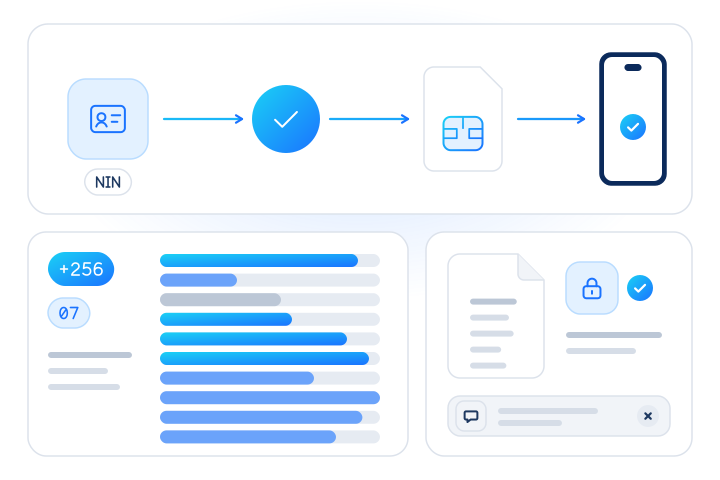
Every SIM is registered to a named person, and the registration is checked against the National Identification and Registration Authority (NIRA) database of national ID numbers.
- The legal basis. Section 9 of the Regulation of Interception of Communications Act, 2010 requires a provider, before it contracts with a customer, to obtain the customer's full name, addresses and "identity number" (Act 18 of 2010, s. 9(1)). Existing subscribers had six months to register (s. 9(2)).
- The 2023 switch-off. From 12 November 2023, SIM cards not linked to their users' biometric registration were deactivated; more than 1.4 million lines were affected within weeks. UCC gave owners 90 days to regularise their SIMs before the numbers could be recycled to new users (Biometric Update, 2023).
- SIM swaps in person. UCC guidelines reported in December 2024 say a SIM replacement or swap is done only at an operator's service centre or authorised agent shop, and "SIM cards will only be reissued to the person in whose name the SIM was registered" (Kampala Post, 2024). People whose biometrics can't be read need a letter from NIRA, or for refugees and asylum seekers, from the Office of the Prime Minister.
What this means for your data: the 2023 deactivations and the 90-day recycling window make old Ugandan lists go stale faster than the format suggests. A number that was valid when you collected it may now belong to someone else. Re-check old numbers before you send them an OTP; our post on number recycling and list decay explains how. The in-person SIM swap rule also helps against SIM-swap fraud, but a recent SIM change is still worth checking before a high-value transaction.
What are the rules for SMS marketing and personal data?
These summarise UCC regulations and the data protection law as we read them on 2026-11-07. Not legal advice; ask counsel how they apply to you.
UCC's text and multimedia messaging regulations
The Uganda Communications (Text and Multimedia Messaging) Regulations, 2019 (S.I. 2019 No. 83, published 8 November 2019) are Uganda's anti-spam rules for SMS and MMS (S.I. 83 of 2019). They apply to operators and to the "authorised parties" that send through them:
| Regulation | Rule |
|---|---|
| Reg. 5 | "A person shall not use an automated system to send an unsolicited SMS or MMS." Unsolicited means sent without the recipient's prior consent (reg. 4). |
| Reg. 10(4)–(6) | Every message carries an identifier that lets the recipient identify the sender, and contact details; an organisation must give its name. Both stay valid for at least 45 days. |
| Reg. 10(7) | On request, the sender says within 36 hours where it got the recipient's contact details. |
| Reg. 11(1)–(2) | No commercial messages without prior consent, except to contacts from a prior commercial transaction who were told at collection that their details may be used for marketing and could object. |
| Reg. 11(4) | No selling or sharing of customers' personal information without their explicit consent. |
| Reg. 12 | A free opt-out based on the word "STOP" (END, CANCEL, UNSUBSCRIBE and QUIT count too), confirmed by message, honoured within 24 hours, with requests kept for at least 12 months. |
| Reg. 19 | No commercial messages between 19:00 and 06:00 unless the recipient agreed; emergency alerts are exempt. |
| Reg. 20 | A commercial message is spam unless the recipient consented, or had a direct commercial relationship with the sender within the last three months. |
The three-month window in regulation 20 is unusual: an old customer you haven't dealt with for longer than that needs fresh consent before a marketing SMS. Regulation 14 lets UCC fine senders and order operators to end their contracts with them, so ask your SMS provider how it registers your sender name with each network and applies these rules. Our SMS character counter shows how many parts a message takes with the sender name and the STOP line included.
The Data Protection and Privacy Act 2019
The Data Protection and Privacy Act, 2019 (Act 9 of 2019) applies to anyone who collects or processes personal data in Uganda, and a phone number tied to a person is personal data (DPPA 2019). The Personal Data Protection Office (PDPO) enforces it. The points that matter for messaging lists:
- Consent first. "A person shall not collect or process personal data without the prior consent of the data subject," unless the law allows it or it is necessary for listed purposes such as a contract (section 7).
- Stop direct marketing. A person may require a data controller in writing to stop processing their data for direct marketing, and the controller must reply within 14 days (section 26). Direct marketing covers "any advertising or marketing material which is directed at an individual", by whatever means (26(6)).
- Data abroad. A Ugandan controller that processes or stores personal data outside Uganda must make sure the country has protection "at least equivalent" to the Act, or have the person's consent (section 19).
- Registration. The PDPO keeps a register of everyone who collects or processes personal data (section 29). Its press release of 2 November 2021 told controllers and processors to register by the end of December 2021, with enforcement from January 2022 (PDPO, 2021).
- Fines. On top of the offences in the Act, a court may fine a company up to 2% of its annual gross turnover (section 38).
If you send Ugandan customer numbers to a check service outside Uganda, section 19 is the one to discuss with counsel. Our posts on whether a phone number is personal data and on consent for WhatsApp checks give the baseline we work to.
What happened to the "unsolicited information" offence?
The Computer Misuse (Amendment) Act, 2022 added section 26B, which made it an offence to send "unsolicited information" through a computer (Amendment Act, 2022). It excluded unsolicited commercial communication, so it never governed marketing SMS. On 17 March 2026 the Constitutional Court declared the amendment Act void, according to a statement by one of the petitioners (Unwanted Witness, 2026). We haven't read the judgment itself. For marketing messages, the 2019 messaging regulations and the DPPA remain the rules to follow.
Which messaging apps and channels reach people?
UCC counted 47.1 million active mobile subscriptions and 36.3 million active mobile money accounts in December 2025 (UCC). Mobile money ties a phone number to a wallet, so a Ugandan number is often both a contact and a payment identity: a typo can send an OTP, or money, to a stranger. Confirm a number by OTP before you store it as a payout or login number.
SMS reaches every active mobile and remains the fallback for OTP. We found no published source that measures messaging-app use in Uganda in a way we can verify, so we don't quote shares. Measure your own opted-in customers instead: check which apps they are registered on, route each person to the channel they use, and keep SMS as the fallback. Our channel-by-country guide shows the method, and our WhatsApp cost calculator shows what a campaign costs by region.
How do I check WhatsApp registration for a Ugandan customer list?
Normalise every row with normalize_ug() first, then run one check per number. A check tells you whether a number is registered at the time of the check. It can't tell you whether the person wants your messages:
| Answer | What it means | What to do |
|---|---|---|
registered: true | The number has a WhatsApp account at checked_at | Offer WhatsApp to customers who opted in to it |
registered: false | No account at checked_at | Use SMS or another channel |
unknown | No conclusive answer (not billed) | Keep the current channel; retry later |
invalid_number | Failed format validation (not billed) | Fix the data at the source |
For lists, use a bulk job. Upload a CSV with numbers written the Ugandan way (0772 XXXXXX, 256… and spaces also work) and default_country=UG:
curl https://api.mobilevalidate.com/v1/jobs \
  -H "Authorization: Bearer $MOBILEVALIDATE_API_KEY" \
  -F file=@customers.csv -F checks=whatsapp,hlr -F default_country=UG
Send the same body to POST /v1/jobs/estimate first: it is free, checks nothing and shows the maximum cost before anything runs. To open a chat with one customer who wrote to you first, our WhatsApp link generator builds the wa.me link from an E.164 number.
What changed recently?
The rows for UG and +256 in our numbering-plan changes dataset, built from libphonenumber's release notes:
| Change named in the release notes (2019-01-08 to 2026-09-23) | Releases |
|---|---|
| Numbering-plan metadata (validation, lengths, types) | 30 |
| Original-carrier prefix data | 20 |
| All | 50 |
Latest numbering-plan updates for UG: 2026-09-23 (v9.0.40), 2026-08-13 (v9.0.37), 2026-07-16 (v9.0.35), 2026-06-17 (v9.0.33), 2026-06-03 (v9.0.32).
Uganda's metadata is among the busiest we track: five numbering-plan updates between June and September 2026 alone. Update your library at least monthly, and log numbers it rejects instead of dropping them silently. On the regulator's side:
- 2019: the Data Protection and Privacy Act (Act 9) and the Text and Multimedia Messaging Regulations (S.I. 83, 8 November).
- 2021: PDPO registration of data controllers and processors, enforced from January 2022.
- 2023: deactivation of SIMs not linked to biometric registration, from 12 November.
- 2024: UCC guidelines: SIM swaps only in person, to the registered owner (December).
- 2025: MTN's new
079code (March); a parliamentary motion for number portability (March). - 2026: the Constitutional Court voided the Computer Misuse (Amendment) Act (17 March); UCC's new numbering plan notice, with whole
074and076codes and the small072/073holders (13 July).
What can MobileValidate check for Ugandan numbers?
Generated from our public catalog:
Catalog data as of 2026-11-07.
| Check | Accepts Uganda numbers | Notes |
|---|---|---|
| Format and country (every lookup) | Yes | Each number is parsed first; an invalid number returns invalid_number and is never billed. |
| Carrier lookup (beta) | Yes | Line type and current network where data exists; no data means unknown, not billed. Real time and bulk. |
| US/CA carrier lookup (premium) | No (US, CA only) | Answers unsupported_country for other countries, not billed. |
| Live network status (HLR) | Yes | Live reachability, porting, roaming (true or false) and current network; unknown is free. Real time and bulk. |
| Number portability (MNP) | Yes | Ported or not ported, and the current network code; unknown is free. Real time and bulk. |
| Spam reputation | Limited access | All countries except sanctioned ones; report coverage is strongest in North America and Europe. |
| Messaging apps | Yes: WhatsApp, Telegram, Viber*, Signal*, iMessage*, RCS*, LINE*, Zalo*, Botim*, Facebook Messenger* | Registered, not registered or unknown; unknown is free. |
| Social networks | Yes: Facebook, Instagram, Threads, X (Twitter), TikTok*, Snapchat* | Not for Uganda numbers: LinkedIn (US, IN only). |
| Online accounts (Apple, Amazon, Microsoft, Netflix) | Yes: Apple, Amazon, Microsoft, Netflix | Registered, not registered or unknown; unknown is free. |
* bulk jobs only. The live list is at GET /v1/services.
A lookup returns network and registration facts. It never returns a subscriber's name, ID number or address, and we don't offer "number details" searches.
With no porting, the network is rarely the question for Ugandan numbers; whether the number is still in service is. A live network status (HLR) check answers reachable or unreachable and gives the network code, which our free MCC-MNC lookup turns into an operator name. The carrier lookup gives line type and network in one call. For channels, WhatsApp and Telegram run in real time and in bulk; the starred checks in the table run in bulk jobs only.
How do I start for free?
- 100 free real checks. Every live account can run 100 phone numbers and 20 e-mail addresses through the real checks for free on the dashboard's Try it page. Use them on your own number first.
- A free carrier lookup. The carrier lookup page has a public form for 3 lookups a day, no sign-up needed.
- Free tools. The phone number validator and phone list cleaner check format in your browser; all of them are on the tools page.
- A free test key. Get a test key for the sandbox. It gives fixed test answers so you can build every branch of your code; see test mode.
- A free estimate.
POST /v1/jobs/estimatetakes the same body as a job, checks nothing and shows the maximum cost before you start. - Then add credit. Create your account; approval is automatic. Top-ups of larger amounts get 5% to 10% bonus credit; see pricing. Unknown, invalid and duplicate results are never charged.
Here is a small in-service check against the real-time endpoint. It asks for the live network status and keeps the network code. It uses the public sandbox key mv_test_publicSandboxn9ZgneuhR1B9CRfKG3fulym and our test values. The sandbox accepts only those UK drama numbers, so the example uses them; with a live key, pass the output of normalize_ug().
import os

import requests  # pip install requests

API = "https://api.mobilevalidate.com/v1/lookup"
KEY = os.environ["MOBILEVALIDATE_API_KEY"]


def live_status(numbers: list[str]) -> dict[str, tuple]:
    """Per E.164 number: (reachable or unreachable, MCC-MNC of the network). None means we don't know."""
    r = requests.post(API, headers={"Authorization": f"Bearer {KEY}"}, timeout=15,
                      json={"numbers": numbers, "checks": ["hlr"], "wait": 5})
    r.raise_for_status()
    out = {}
    for row in r.json()["results"]:
        hlr = row["checks"]["number.hlr"]
        attrs = (hlr["attributes"] or {}) if hlr["status"] == "completed" else {}
        out[row["e164"]] = (attrs.get("status"), attrs.get("mcc_mnc"))
    return out


for number, status in live_status(["+447700900001", "+447700900002", "+447700900003"]).items():
    print(number, status)
We ran it against the sandbox on 2026-11-07. It printed:
+447700900001 ('reachable', '23415')
+447700900002 ('unreachable', '23415')
+447700900003 (None, None)
The first test value is in service, the second isn't, and the third stands for a timeout, so both fields are None and nothing is billed. For a Ugandan list, an unreachable answer on a number collected before November 2023 is a reason to ask the customer for a current number. Keep None apart from False: None means we don't know. Requests with 20 or more consecutive numbers are refused (403 suspected_enumeration), and our acceptable use policy forbids finding recipients for unsolicited messages. People can object through our opt-out form. See WhatsApp number check for the WhatsApp fields.
What are the key takeaways?
- Ugandan mobiles are
+256plus nine digits starting with7, written07XX XXXXXXat home. Store the E.164 form. - libphonenumber doesn't treat
00as a Ugandan exit code, so rewrite a leading00256to+256before parsing. - UCC's July 2026 plan gives
070,074,075and0730–0731to Airtel,076–078and0790–0795to MTN,071to UTL, and slices of072and073to small operators. Lycamobile, Africell and Smile hold no range, though old lists and the library's carrier names still show them. - Uganda has no number portability, so the prefix usually names the network. Changing network means a new number.
- SIMs are registered against the national ID; unverified lines were cut off from November 2023 and can be recycled. Re-check old numbers.
- Marketing SMS needs prior consent (or a customer relationship within three months), sender identification, a free STOP opt-out honoured within 24 hours, and no sending between 19:00 and 06:00.
Platform, regulator and company names are used descriptively. MobileValidate is not affiliated with any of them.
Sources
- Uganda (country code +256): communication of 13 July 2026, national numbering plan (ITU Operational Bulletin No. 1344, pp. 6–8) — International Telecommunication Union, on behalf of the Uganda Communications Commission, 2026
- Uganda (country code +256): communication of 18 July 2023, national numbering plan (ITU Operational Bulletin No. 1274) — International Telecommunication Union, on behalf of the Uganda Communications Commission, 2023
- UCC grants MTN Uganda a new phone prefix, 079 (11 March 2025) — PC Tech Magazine, 2025
- Uganda Communications Commission: a snapshot of gains, impact and progress — Uganda Communications Commission, 2026
- Parliament pushes for mobile number portability to enhance telecom competition (13 March 2025) — Nile Post, 2025
- The Regulation of Interception of Communications Act, 2010 (Act 18 of 2010) — Parliament of Uganda, 2010
- Uganda suspends over 1.4M SIM cards not linked to users' biometrics (November 2023) — Biometric Update, 2023
- UCC issues new guidelines for SIM card replacement and registration (9 December 2024) — Kampala Post, 2024
- The Uganda Communications (Text and Multimedia Messaging) Regulations, 2019 (S.I. 2019 No. 83) — Uganda Communications Commission (Uganda Gazette No. 57, 8 November 2019), 2019
- The Data Protection and Privacy Act, 2019 (Act 9 of 2019) — Parliament of Uganda, 2019
- Press release: requirement to register with the Personal Data Protection Office (2 November 2021) — Personal Data Protection Office, National Information Technology Authority – Uganda, 2021
- The Computer Misuse (Amendment) Act, 2022 — Parliament of Uganda, 2022
- Statement on the Constitutional Court judgment on the Computer Misuse (Amendment) Act, 2022 (March 2026) — Unwanted Witness (one of the petitioners), 2026
- libphonenumber carrier prefix data for +256 (256.txt) and PhoneNumberMetadata.xml (region UG) — libphonenumber project (Apache License 2.0), 2026
Frequently asked questions
How many digits is a Ugandan phone number?
Nine digits after the country code +256, or ten when written at home with the leading 0. A Ugandan mobile looks like 07XX XXXXXX nationally and +256 7XX XXXXXX in E.164. The Uganda Communications Commission's numbering plan of July 2026 sets both the minimum and the maximum length at 9 digits, excluding the country code.
What is the Uganda country code for WhatsApp?
+256. Drop the leading 0 of the national number: 0712 345678 becomes +256 712 345678, stored as +256712345678. Don't keep the 0 after 256. The same E.164 form works for WhatsApp, SMS APIs and every other platform.
Which network is 070, 074, 075, 076, 077, 078 or 079 in Uganda?
In the numbering plan UCC notified to the ITU in July 2026, 070, 074, 075 and 073x (730–731) are Airtel Uganda; 076, 077, 078 and 0790–0795 are MTN Uganda; and 071 is Uganda Telecommunications Corporation (UTL). Smaller holders share parts of 072 and 073. Because Uganda has no number portability, the range holder is usually still the network, but check numbers that matter.
Does Uganda have mobile number portability?
No. As of November 2026 we found no number portability regulation and no launch date from UCC. In March 2025 a Member of Parliament moved a motion asking UCC to implement it, noting that the 2018 National Broadband Policy calls for portability but that it had not been implemented. A Ugandan who changes network gets a new number.
Is Lycamobile or Africell still in Uganda?
Not in UCC's numbering plan. The July 2026 plan lists no range for Lycamobile, Africell or Smile Communications. Old prefix lists, and libphonenumber's carrier names, still map some 072 and 079 blocks to them. Treat those names as history and look up the current network per number.
What are the rules for marketing SMS in Uganda?
The Uganda Communications (Text and Multimedia Messaging) Regulations, 2019 require prior consent for commercial messages, an identifier and contact details in every message, a free STOP opt-out honoured within 24 hours, and no commercial messages between 19:00 and 06:00 unless the recipient agreed. The Data Protection and Privacy Act 2019 lets anyone stop direct marketing by written notice.
Can I check whether Ugandan customers are on WhatsApp?
Yes, for numbers you hold with consent or another lawful basis, such as your own customers. A MobileValidate check answers registered, not registered or unknown with a checked_at date; unknown is never billed. It returns no name or profile, and requests that look like scans of number ranges are refused.
Related services and guides
More from the blog
All articlesGuides
Phone numbers by country: formats, portability, channels and rules
How phone numbers differ by country: formats and E.164, numbering changes, portability, line types, messaging channels, and a dated tracker of calling and texting rules.
11 min read
Developers
International phone number formats by country: a 2026 reference table
Calling code, international and trunk prefix, mobile and fixed-line number lengths and a masked E.164 mobile format for 238 regions, generated from libphonenumber.
19 min read
Developers
E.164 phone number format: a practical guide for developers
How to normalize phone numbers to E.164 in JavaScript and Python, the pitfalls that break deduplication, and how the MobileValidate API normalizes input.
9 min read