On this page
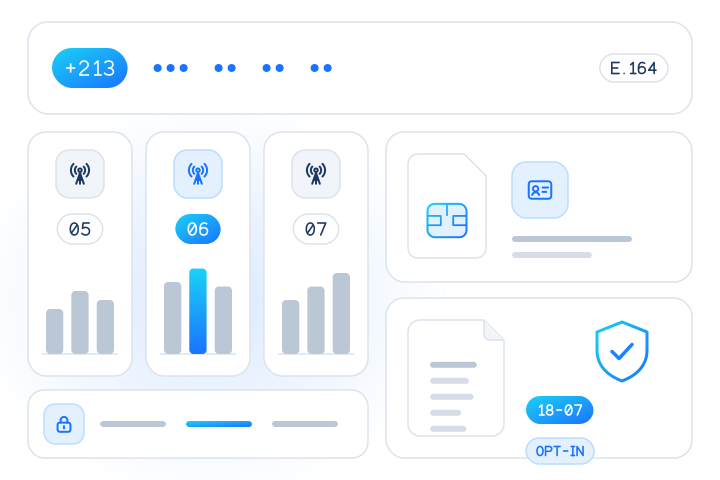
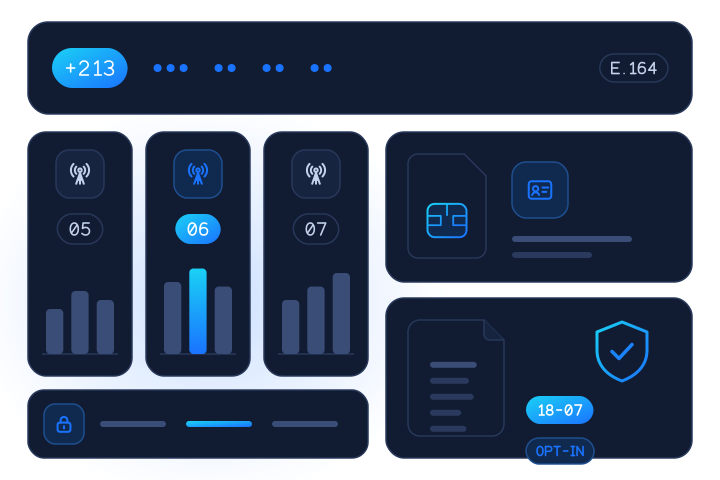
Algerian mobile numbers use the country code +213 and have 9 digits after it: a 5, 6 or 7 followed by eight digits. At home they are written with a trunk 0, such as 0551 XX XX XX; from abroad you drop the 0: +213 551 XX XX XX, stored in E.164 as +213551XXXXXX. The first digit shows the network that holds the block: 05 Ooredoo, 06 Mobilis, 07 Djezzy. As of November 2026 numbers can't be ported between networks, although the rules for it have existed since 2021.
This guide is part of our phone numbers by country series. The tables are generated from libphonenumber's metadata, our MNP atlas and our public catalog. Example numbers are masked with X. The code samples use libphonenumber's own example numbers, which are for testing only; don't call or text them. On 2026-11-10 we read the numbering plan of the regulator, ARPCE (Autorité de Régulation de la Poste et des Communications Électroniques), its decisions on short numbers and portability, its market observatory, the Official Journal (JORADP) texts of the telecom, data protection and e-commerce laws, and Algeria's filing with the International Telecommunication Union (ITU). The sources are in French and Arabic. This is a summary, not legal advice.
What does an Algerian phone number look like?
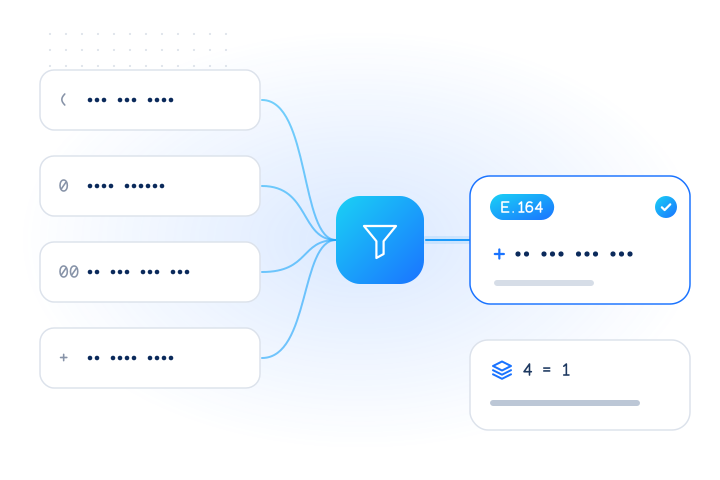
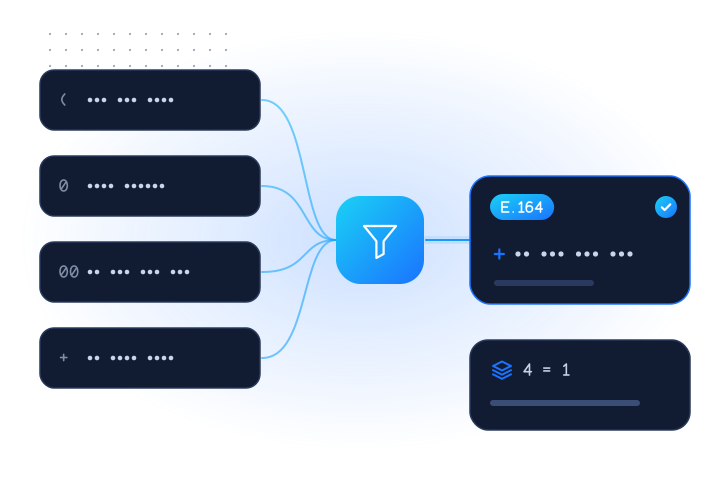
Algeria runs two lengths side by side. ARPCE (then called ARPT) adopted a 10-digit national numbering plan on 22 February 2008 to make room for mobile growth: it added one digit in front of the old 9-digit numbers for mobiles, value-added services, satellite (VSAT) and non-geographic VoIP numbers. Landlines kept their 9 digits, "pour des contraintes techniques de migration du réseau fixe", because migrating the fixed network was technically hard (ARPCE numbering plan). Both lengths count the trunk 0. The trunk prefix is 0 and the international prefix is 00 (ITU, 2008).
| Starts with (national) | Use in ARPCE's plan | Digits with the 0 | Shape at home |
|---|---|---|---|
02, 03, 04 | Landlines of Algérie Télécom | 9 | 0XX XX XX XX |
05, 06, 07 | Mobile networks | 10 | 0XXX XX XX XX |
0800 | Freephone | 10 | 0800 1X XX XX |
0801–0809 | Value-added and premium services | 10 | 080X XX XX XX |
0961 | Satellite (VSAT) | 10 | 0961 XX XX XX |
0982 | Non-geographic VoIP | 10 | 098 2XX XX XX |
A 2008 ITU filing said landlines "shall migrate to ten digits in 2009". That never happened: ARPCE's current plan still lists 9-digit geographic numbers. If you read that a full 10-digit migration is planned, it is an old plan.
| Item | Value |
|---|---|
| Country calling code | +213 |
| International call prefix (dialling out) | 00 |
| Trunk prefix (dialling at home) | 0 |
| Mobile: digits after +213 | 9 |
| Fixed line: digits after +213 | 8, 9 |
| Toll-free: digits after +213 | 9 |
| Premium rate: digits after +213 | 9 |
| Shared cost: digits after +213 | 9 |
| VoIP: digits after +213 | 9 |
| Mobile, national format (masked) | 055X XX XX XX |
| Mobile, international (masked) | +213 55X XX XX XX |
| Mobile, E.164 (masked) | +21355XXXXXXX |
| Fixed line, national format (masked) | 010 XX XX XX |
| Fixed line, international (masked) | +213 10 XX XX XX |
| Fixed line, E.164 (masked) | +21310XXXXXX |
Store only the E.164 form: +213, then the national number without the 0. 0551 23 45 67, +213 551 23 45 67, 00213 551 234 567 and 213551234567 are the same number (libphonenumber's test number). A frequent mistake in Algerian lists is +213 0551…, with the trunk 0 kept after the country code. libphonenumber removes that 0 for Algeria, as the code below shows, but a hand-written regex usually doesn't. The other common mix-up is length: a landline has one digit less than a mobile, so a "10 digits" rule throws away every landline and a "9 digits" rule every mobile.
Which prefixes are mobile numbers?
The generator counted every 9-digit number that libphonenumber's mobile pattern for DZ accepts:
| National prefix | International | Share of the block that is mobile (9-digit numbers) | 3-digit sub-blocks that aren't fully mobile |
|---|---|---|---|
054 | +213 54 | 40.0% | not mobile: 0543–0548 |
055 | +213 55 | 100% | — |
056 | +213 56 | 50.0% | not mobile: 0565–0569 |
060 | +213 60 | 100% | — |
061 | +213 61 | 100% | — |
062 | +213 62 | 100% | — |
063 | +213 63 | 100% | — |
064 | +213 64 | 100% | — |
065 | +213 65 | 100% | — |
066 | +213 66 | 100% | — |
067 | +213 67 | 100% | — |
068 | +213 68 | 100% | — |
069 | +213 69 | 100% | — |
077 | +213 77 | 100% | — |
078 | +213 78 | 100% | — |
079 | +213 79 | 100% | — |
05, 06 and 07 by operator
Algeria has three mobile network operators. ARPCE assigns mobile numbers in blocks of four digits (with the 0), and its numbering page lists these holders (ARPCE numbering plan):
| Level | Blocks in ARPCE's table | Holder | Brand |
|---|---|---|---|
05 | 0540–0542, 0549, 055, 0560–0562 | Wataniya Télécom Algérie (WTA) | Ooredoo |
06 | 0655–0659, 066, 0670–0676, 0696–0699 | Algérie Télécom Mobile (ATM) | Mobilis |
07 | 077, 0780–0784, 079 | Optimum Télécom Algérie (OTA) | Djezzy |
In 2008 only 055 (then Nedjma, today Ooredoo), 066 and 0697–0699 (Mobilis), and 077 and 0790–0796 (Djezzy) existed (ITU, 2008). Every other block was added later, as the networks grew. libphonenumber's carrier data maps the whole level to one name: 5 Ooredoo, 6 Mobilis, 7 Djezzy (libphonenumber carrier data).
Why does libphonenumber accept more blocks than ARPCE lists?
Compare the two tables and the library is wider than the regulator's list:
- All of
06. libphonenumber accepts060to069, every block. ARPCE's table lists only0655–0659,066,0670–0676and0696–0699. 0785–0789. The library accepts all of078; ARPCE lists0780–0784.0563–0564. The library accepts them; ARPCE lists0560–0562.
The ARPCE page was last revised in February 2020, so some of these blocks may have been assigned since without the page being updated; libphonenumber changed Algeria's metadata twice in May and June 2026 (see "What changed recently?"). We can't tell from the public sources which of the extra blocks carry live subscribers. For forms, accept what the library accepts, so you don't block real customers; for anything that costs money or carries an OTP, confirm the number with a live lookup.
Who is the carrier of an Algerian number?
For now, the block holder. Until portability starts, a number stays on the network that holds its block, so 0661… means Mobilis today. Once porting opens (see below), a number will keep its digits when it moves, and prefix tables will slowly go wrong. Build the lookup in now rather than hard-coding the operator table.
What do 021, 0800, 0982 and the other ranges mean?
Landlines have nine digits with the 0. The two digits after it are the area code, set per province (wilaya) in a list Algeria sent to the ITU in 2006: for example 021 for Algiers, 031 for Constantine and 041 for Oran (ITU, 2008). ARPCE's plan gives 02, 03 and 04 to Algérie Télécom and marks 01 as unassigned. libphonenumber still accepts 01 landline numbers, which is why its example in the table above starts with 01; treat such numbers with suspicion.
| Range (national) | Use (ARPCE plan) | libphonenumber type |
|---|---|---|
08001 | Freephone ("libre appel") | TOLL_FREE |
0801–0806 | Value-added services, with price caps from 5 DA to 120 DA | SHARED_COST (0801–0802), PREMIUM_RATE (0803–0806) |
0807 | Not assigned | — |
0808, 0809 | Games and competitions | PREMIUM_RATE for 08081 and 08091; ARPCE's 08080 block isn't in the library |
0961 | VSAT satellite numbers | FIXED_LINE (09619) |
0982 | Non-geographic VoIP | VOIP (0982–0983) |
Short numbers follow ARPCE Decision 21/SP/PC/ARPCE/2019 of 15 April 2019. They never start with 0. Numbers starting with 1 are for emergency and social services and must be reachable on every network. Voice short codes have four digits starting with 3; SMS and MMS short codes have five digits starting with 6. The second digit sets the price: 30XX voice and 60XXX SMS codes are free to the user, and the other levels are paid, up to more than 100 DA per SMS for 68XXX (ARPCE Decision 21/2019). None of the ranges in this section can receive an OTP by SMS.
Why does a simple regex fail for Algerian numbers?
The usual tutorial pattern, "0, then 5, 6 or 7, then eight digits", accepts every block in the three mobile levels and misses in several ways:
- It accepts blocks no operator holds in either source, such as
050,051,0543–0548and0565–0569. - It rejects all landlines, because they are one digit shorter, and accepts nothing from
08or09. - It usually fails on
+213 0551…, the trunk0kept after the country code. - It says nothing about the network or whether the number is in service.
Our post on why an E.164 regex is not enough shows the same pattern in other countries.
How do I validate an Algerian number in code?
Remove spaces and punctuation, parse with full metadata and the default region DZ, and keep only numbers typed as mobile. Algeria needs no special rewrites: 00213 is a normal international prefix, and the library drops a stray trunk 0 after +213. To try a batch of inputs without writing code, paste them into our free phone number validator.
Python (pip install phonenumbers):
import re

import phonenumbers
from phonenumbers import PhoneNumberType


def normalize_dz(raw: str) -> str | None:
    """E.164 for an Algerian mobile number (05, 06 or 07 + 8 digits), or None."""
    s = re.sub(r"[\s().-]", "", raw)
    try:
        n = phonenumbers.parse(s, "DZ")
    except phonenumbers.NumberParseException:
        return None
    if (not phonenumbers.is_valid_number(n) or phonenumbers.region_code_for_number(n) != "DZ"
            or phonenumbers.number_type(n) != PhoneNumberType.MOBILE):
        return None
    return phonenumbers.format_number(n, phonenumbers.PhoneNumberFormat.E164)


for raw in ["0551 23 45 67", "+213 551 23 45 67", "00213 551 234 567", "+213 0551 23 45 67",
            "213551234567", "012 34 56 78", "098 312 34 56", "0800 12 34 56", "0501 23 45 67", "0551 23 45 6"]:
    print(f"{raw!r:22} -> {normalize_dz(raw)}")
JavaScript (npm install libphonenumber-js):
import { parsePhoneNumberFromString } from "libphonenumber-js/max";

/** "05…", "+213 5…", "00213…" or "213…" → E.164 for an Algerian mobile number, or null. */
export function normalizeDz(raw) {
  const input = String(raw).replace(/[\s().-]/g, "");
  const phone = parsePhoneNumberFromString(input, "DZ");
  if (!phone?.isValid() || phone.country !== "DZ" || phone.getType() !== "MOBILE") return null;
  return phone.number;
}

for (const raw of ["0551 23 45 67", "+213 551 23 45 67", "00213 551 234 567", "+213 0551 23 45 67",
                   "213551234567", "012 34 56 78", "098 312 34 56", "0800 12 34 56", "0501 23 45 67", "0551 23 45 6"]) {
  console.log(JSON.stringify(raw).padEnd(22), "->", normalizeDz(raw));
}
The inputs are libphonenumber's example numbers for Algeria: mobile 0551 23 45 67, landline 012 34 56 78, VoIP 098 312 34 56 and freephone 0800 12 34 56, plus a mobile-shaped number in the unassigned 050 block and a mobile one digit short. They aren't real subscribers. We ran both on 2026-11-08 (Python 3.12 with phonenumbers 9.0.41, Node.js 24 with libphonenumber-js 1.13.15). Both printed the same answers; Python prints None and single quotes, JavaScript null and double quotes:
'0551 23 45 67'        -> +213551234567
'+213 551 23 45 67'    -> +213551234567
'00213 551 234 567'    -> +213551234567
'+213 0551 23 45 67'   -> +213551234567
'213551234567'         -> +213551234567
'012 34 56 78'         -> None
'098 312 34 56'        -> None
'0800 12 34 56'        -> None
'0501 23 45 67'        -> None
'0551 23 45 6'         -> None
The first five are one number written five ways, including the +213 0551… mistake and 213… without a plus. The landline, VoIP and freephone numbers are valid but not mobile, so they are dropped. 0501… has the right shape but no operator holds 050, and the last input is too short.
The generated test table runs the same idea over masked inputs with the raw library call. The shape regex column tests a loose tutorial pattern after spaces, dashes and brackets are removed:
| # | Case | Input (masked) | Shape regex ^(?:\+213|00213|0)?[5-7]\d{8}$ | libphonenumber (DZ) |
|---|---|---|---|---|
| 1 | National, with trunk prefix | 055X XX XX XX | passes | valid, MOBILE |
| 2 | International, with spaces | +213 55X XX XX XX | passes | valid, MOBILE |
| 3 | International dialling prefix 00 | 00213 55X XX XX XX | passes | valid, MOBILE |
| 4 | E.164 | +21355XXXXXXX | passes | valid, MOBILE |
| 5 | Dashes and brackets | (055X) XX-XX-XX | passes | valid, MOBILE |
| 6 | One digit short | 055XXXXXX | fails | invalid |
| 7 | One digit too many | 055XXXXXXXX | fails | invalid |
| 8 | Mobile shape, unused block 050 | 050XXXXXXX | passes | invalid |
| 9 | Fixed line | 010 XX XX XX | fails | valid, FIXED_LINE |
| 10 | Toll-free range | 0800 XX XX XX | fails | valid, TOLL_FREE |
Rows 8 and 9 are the ones to remember:
- Row 8:
050…has the right length and passes the regex, but no such block exists, so libphonenumber says invalid. - Row 9: a landline fails the regex because it is one digit shorter, but it is a valid number. If you need landlines too (for voice, not SMS), don't filter by length.
Our Python and JavaScript guides cover more cases. For a whole file, the free phone list cleaner normalises numbers to E.164 and removes duplicates in your browser before you upload anything.
Does number portability change the carrier?
Not yet. As of November 2026 Algerians can't keep their mobile number when they switch operator, even though the legal framework has been complete for years:
- The law. Article 108 of Law 18-04 of 10 May 2018 on post and electronic communications says operators "sont tenus de garantir la portabilité des numéros pour l'ensemble des abonnés", must guarantee number portability for all subscribers, under conditions set by regulation (Law 18-04).
- The decree. Executive Decree 21-199 of 11 May 2021 set the rules for mobile numbers, prepaid and postpaid. A number must be identified and in use for at least three months (prepaid) or the minimum contract term (postpaid) before it can move. The new operator handles the request, and the operators run a shared central database with direct routing (JORADP No. 38, 2021).
- The time limits. ARPCE Decision 18/SP/PC/ARPCE/2021 of 27 June 2021 sets a port at no more than seven days, with the losing operator answering within three working days, service interrupted for at most two hours, and no new port for three months. It gave operators twelve months to launch (ARPCE Decision 18/2021).
- The delay. Decision 37/SP/PC/ARPCE/2022 of 13 July 2022 cited "retards pris dans le lancement" (delays in the launch) and extended the deadline to 24 months (ARPCE Decision 37/2022). Decision 55/SP/PC/ARPCE/2022 then fixed the format of the operator identity code (RIO) a subscriber gives to request a port (ARPCE Decision 55/2022).
- The status. ARPCE's portability page still describes a project, with no launch date (ARPCE). In December 2024 the president of ARPCE said portability would come "peut-être dans quelques mois", perhaps in a few months (Radio Algérienne, 2024). We found no launch announcement in 2025 or 2026.
Some 2021 news reports called portability "a reality" in Algeria; they were reporting the decree, not a working service.
Our MNP atlas has no verified row for Algeria yet.
The facts above are what we would add to the atlas: no mobile portability in service, a seven-day limit in the 2021 rules, launch overdue. What it means for your data: in 2026, prefix-based routing still matches the network. Plan for ported numbers anyway, because the rules are ready and the launch can come at short notice. A live network status (HLR) check or an MNP lookup returns the current network per number, so the same code keeps working after launch. Our MNP atlas compares portability across countries, and how to check if a phone number is ported shows the lookup.
How are SIM cards registered in Algeria?
Every mobile line must be tied to an identified subscriber:
- Identity before activation. Article 161 of Law 18-04 requires the subscriber's identity to be established before the line is switched on. Article 162 gave operators six months to identify all anonymous lines, and article 130 fines a licensed operator 1,000,000 DA per failure plus 5,000 DA a day per unidentified subscriber (Law 18-04).
- What operators collect. Operators' licence terms, here the 4G licence annexed to Executive Decree 22-195 of 24 May 2022, list the subscriber's name, date and place of birth, address and a copy of an official identity document, plus the national identification number in the operator's database (article 21.1) (Decree 22-195).
- Unidentified lines are cut. Algeria has enforced this before: in a 2008 campaign, 91% of 29.2 million lines were identified and the rest were deactivated, with the numbers lost (ARPT communiqué, 2008).
- Check your own lines. On 1 December 2025 ARPCE launched a service, "Arkami DZ": a subscriber dials
*254#, enters a date of birth and receives an SMS with the number of SIM cards registered in their name at that operator (Algérie Eco, 2025).
We found no published cap on the number of SIMs per person and no ARPCE text on foreigners' documents, so we don't state either. For your data, this means an Algerian mobile is linked to an identified person, and lines that are cut get reissued later. Old lists therefore hold numbers that now belong to someone else; our post on number recycling and list decay explains how to deal with that.
What are the rules for SMS marketing and personal data?
These summarise three laws as we read them on 2026-11-10. Not legal advice; ask counsel how they apply to you.
Law 18-07 on personal data and the ANPDP
Law 18-07 of 10 June 2018 protects individuals in the processing of their personal data, and a phone number linked to a person is personal data (Law 18-07). It only became enforceable once its authority existed: the national personal data protection authority (ANPDP) was installed on 11 August 2022 (Radio Algérienne, 2022), and article 75 gave organisations one year from that date to comply, so the law has applied in full since August 2023 (Gide, 2023). The articles that matter for number checks and messaging:
| Article | Rule |
|---|---|
| Art. 7 | Personal data may only be processed with the person's express consent, except in the cases the law lists |
| Art. 12 | Processing must be declared to the ANPDP beforehand, or authorised by it |
| Art. 36 | The person may object, free of charge, to the use of their data for marketing |
| Art. 37 | Direct marketing by automated call, fax, e-mail "ou d'un moyen employant une technologie de même nature" (or similar technology, which covers SMS) is banned without the person's prior consent; e-mail to existing customers about similar products, with a free opt-out, is the only exception |
| Art. 44 | Personal data may go to another country only with the ANPDP's authorisation, and only if that country protects it adequately |
| Art. 47 | Fine of 500,000 DA for refusing a person's rights or failing to make the required notifications |
| Art. 55 | Processing without consent, or for marketing despite an objection: one to three years in prison and 100,000 to 300,000 DA |
Law 25-11 of 24 July 2025 amended Law 18-07 (JORADP No. 48, 2025). It makes a data protection officer mandatory for controllers (new article 41 bis), requires a record of processing activities, and adds definitions such as profiling, pseudonymisation and personal data breach. It also introduces breach notification within five days and impact assessments, in a new title on processing by police and judicial authorities; commentators read some of these duties as general, so ask counsel whether they apply to you.
For a business holding Algerian numbers, article 44 is the one to plan around: sending customer numbers to a check or messaging service abroad is a transfer that needs the ANPDP's authorisation unless an exception, such as the person's express consent, applies. Our posts on whether a phone number is personal data and on consent for WhatsApp checks give the baseline we work to: your own customers, a stated purpose, minimal data and honoured objections.
Law 18-05 on e-commerce
Law 18-05 of 10 May 2018 on electronic commerce adds rules for anyone selling online (Law 18-05):
| Article | Rule |
|---|---|
| Art. 30 | A commercial message must be clearly identifiable as such and identify the advertiser |
| Art. 31 | Direct marketing by electronic communications to a person who has not given prior consent is banned |
| Art. 32 | The seller must offer a free electronic way to stop messages, acknowledge the request, and honour it within 24 hours |
| Art. 33 | In a dispute, the seller must prove the consent |
| Art. 40 | Breaches are fined 50,000 to 500,000 DA |
Article 33 is the practical one: keep a dated record of how and when each person agreed to receive your messages.
Bulk SMS and short codes
A ministerial order of 27 July 2022 on services under general authorisation allows SMS services to take the form of bulk and application-to-person (A2P) SMS "exclusivement, en national", sent within Algeria. Advertising messages must identify each advertiser, and advertising tobacco, alcohol and medicines is banned (Order of 27 July 2022). Paid and free SMS short codes follow the 2019 decision described above. We found no official text on sender-name registration, quiet hours or the language of messages, so we don't claim any; if your SMS gateway requires a registered sender name for Algeria, that is the operator's or gateway's rule.
Which messaging apps and channels reach people in Algeria?
ARPCE counted 56,758,292 mobile subscribers at the end of the second quarter of 2026: 23,157,898 at Mobilis, 18,027,639 at Djezzy and 15,572,755 at Ooredoo, about 41%, 32% and 27% of the market. About 91% were on 4G or 5G and about 96% were prepaid (ARPCE observatory, Q2 2026). We found no official figures for messaging-app use, so we don't quote any.
For WhatsApp, Meta doesn't price Algeria as a separate market: it is one of the "Rest of Africa" markets on its rate card, while Egypt and Morocco have rates of their own (Meta pricing, read on 2026-11-10). Our WhatsApp cost calculator shows what a campaign would cost. Messages in Arabic, and French with letters such as ê or œ, use the Unicode SMS encoding, so a message splits into more parts sooner; our SMS character counter shows how many parts a message will take.
The method is the same as in our channel-by-country guide: check which apps your opted-in customers are registered on, route each one to the channel they use, and keep SMS as the fallback. To open a chat with a customer who wrote to you first, our WhatsApp link generator builds a wa.me link from the E.164 number. Our bulk WhatsApp check guide for Egypt covers a neighbouring market.
How do I check WhatsApp registration for an Algerian customer list?
Normalise every row with normalize_dz() first. A check tells you whether a number is registered at the time of the check. It can't tell you whether the person wants your messages:
| Answer | What it means | What to do |
|---|---|---|
registered: true | The number has a WhatsApp account at checked_at | Offer WhatsApp to customers who opted in to it |
registered: false | No account at checked_at | Use SMS or another channel |
unknown | No conclusive answer (not billed) | Keep the current channel; retry later |
invalid_number | Failed format validation (not billed) | Fix the data at the source |
See WhatsApp number check for the fields. It runs in real time and in bulk jobs.
What changed recently?
The rows for DZ and +213 in our numbering-plan changes dataset, built from libphonenumber's release notes:
| Change named in the release notes (2019-01-08 to 2026-09-23) | Releases |
|---|---|
| Numbering-plan metadata (validation, lengths, types) | 7 |
| Geocoding (area names) | 2 |
| Original-carrier prefix data | 1 |
| Short numbers | 1 |
| All | 11 |
Latest numbering-plan updates for DZ: 2026-06-03 (v9.0.32), 2026-05-20 (v9.0.31), 2024-08-07 (v8.13.43), 2022-01-27 (v8.12.42), 2021-06-23 (v8.12.26).
Algeria's metadata changed twice in May and June 2026, after almost two years without an update. The release notes don't say which blocks changed, so we can't tell whether they explain the gap between the library and ARPCE's 2020 table. Update your library regularly: an old copy rejects numbers in blocks assigned since.
The bigger changes were in rules:
- 2008: the 10-digit plan for mobiles (22 February); the first SIM identification campaign.
- 2018: Law 18-04 on electronic communications (May), Law 18-05 on e-commerce (May) and Law 18-07 on personal data (June).
- 2021: Executive Decree 21-199 on mobile number portability (May); ARPCE's portability decision with the seven-day limit (27 June).
- 2022: the ANPDP is installed (11 August); the portability deadline is extended to 24 months (13 July).
- 2023: full compliance with Law 18-07 due (August).
- 2025: Law 25-11 amends the data protection law (24 July); the
*254#SIM count service starts (1 December).
What can MobileValidate check for Algerian numbers?
Generated from our public catalog:
Catalog data as of 2026-11-08.
| Check | Accepts Algeria numbers | Notes |
|---|---|---|
| Format and country (every lookup) | Yes | Each number is parsed first; an invalid number returns invalid_number and is never billed. |
| Carrier lookup (beta) | Yes | Line type and current network where data exists; no data means unknown, not billed. Real time and bulk. |
| US/CA carrier lookup (premium) | No (US, CA only) | Answers unsupported_country for other countries, not billed. |
| Live network status (HLR) | Yes | Live reachability, porting, roaming (true or false) and current network; unknown is free. Real time and bulk. |
| Number portability (MNP) | Yes | Ported or not ported, and the current network code; unknown is free. Real time and bulk. |
| Spam reputation | Limited access | All countries except sanctioned ones; report coverage is strongest in North America and Europe. |
| Messaging apps | Yes: WhatsApp, Telegram, Viber*, Signal*, iMessage*, RCS*, LINE*, Zalo*, Botim*, Facebook Messenger* | Registered, not registered or unknown; unknown is free. |
| Social networks | Yes: Facebook, Instagram, Threads, X (Twitter), TikTok*, Snapchat* | Not for Algeria numbers: LinkedIn (US, IN only). |
| Online accounts (Apple, Amazon, Microsoft, Netflix) | Yes: Apple, Amazon, Microsoft, Netflix | Registered, not registered or unknown; unknown is free. |
* bulk jobs only. The live list is at GET /v1/services.
A lookup returns network and registration facts. It never returns a subscriber's name, ID number or address, and we don't offer "number details" searches.
For Algerian numbers, a live network status (HLR) check tells you whether a line is reachable now and which network serves it, which catches lines that were cut and numbers in blocks the regulator's table doesn't list. A carrier lookup gives the line type and network in one call. Our free MCC-MNC lookup turns the network code in an answer into an operator name. For channels, WhatsApp and Telegram run in real time and in bulk; the starred checks run in bulk jobs only.
How do I start for free?
- 100 free real checks. Every live account can run 100 phone numbers and 20 e-mail addresses through the real checks for free on the dashboard's Try it page. Use them on your own number first.
- A free carrier lookup. The carrier lookup page has a public form for 3 lookups a day, no sign-up needed.
- Free tools. The phone number validator, phone list cleaner and country calling code lookup work in your browser; all of them are on the tools page.
- A free test key. Get a test key for the sandbox. It gives fixed test answers so you can build every branch of your code; see test mode.
- A free estimate.
POST /v1/jobs/estimatetakes the same body as a job, checks nothing and shows the maximum cost before you start. - Then add credit. Create your account; approval is automatic. Top-ups of larger amounts get 5% to 10% bonus credit; see pricing. Unknown, invalid and duplicate results are never charged.
A bulk flow for an Algerian customer list
- Export the numbers you hold with consent or another lawful basis, one per row.
- Normalise them with
normalize_dz(), or upload them as they are withdefault_country=DZ, so0551 XX XX XXis read as Algerian. - Run
POST /v1/jobs/estimatewith your checks, for examplehlrandwhatsapp, and read the cost breakdown. - Start the job, then download the results as CSV or NDJSON. Result rows carry
row_no, so you can join them back to your file by row number.
curl https://api.mobilevalidate.com/v1/jobs \
  -H "Authorization: Bearer $MOBILEVALIDATE_API_KEY" \
  -F file=@customers.csv -F checks=hlr,whatsapp -F default_country=DZ
For single numbers, here is a small check against the real-time endpoint. It asks for live reachability, the current network code and WhatsApp registration in one call. It uses the public sandbox key mv_test_publicSandboxn9ZgneuhR1B9CRfKG3fulym and our test values. The sandbox accepts only those UK drama numbers, so the example uses them; with a live key, pass the output of normalize_dz().
import os

import requests  # pip install requests

API = "https://api.mobilevalidate.com/v1/lookup"
KEY = os.environ["MOBILEVALIDATE_API_KEY"]


def reachable_and_whatsapp(numbers: list[str]) -> dict[str, tuple]:
    """Per E.164 number: (reachable or unreachable, network code, WhatsApp registered?). None means unknown."""
    r = requests.post(API, headers={"Authorization": f"Bearer {KEY}"}, timeout=15,
                      json={"numbers": numbers, "checks": ["hlr", "whatsapp"], "wait": 5})
    r.raise_for_status()
    out = {}
    for row in r.json()["results"]:
        hlr, wa = row["checks"]["number.hlr"], row["checks"]["whatsapp.registered"]
        attrs = (hlr.get("attributes") or {}) if hlr["status"] == "completed" else {}
        registered = wa.get("registered") if wa["status"] == "completed" else None
        out[row["e164"]] = (attrs.get("status"), attrs.get("mcc_mnc"), registered)
    return out


for number, answer in reachable_and_whatsapp(["+447700900001", "+447700900002", "+447700900003"]).items():
    print(number, answer)
We ran it against the sandbox on 2026-11-08. It printed:
+447700900001 ('reachable', '23415', True)
+447700900002 ('unreachable', '23415', False)
+447700900003 (None, None, None)
The first test value is reachable and on WhatsApp; the second is unreachable and not on WhatsApp, both on network code 23415. The third stands for a timeout, so every answer is None and nothing is billed. Keep None apart from False: None means we don't know. Requests with 20 or more consecutive numbers are refused (403 suspected_enumeration), and our acceptable use policy forbids finding recipients for unsolicited messages. People can object through our opt-out form.
What are the key takeaways?
- Algerian mobiles are
+213plus nine digits starting with5,6or7, written0XXX XX XX XXat home. Store the E.164 form, without the trunk0. 05is Ooredoo,06Mobilis and07Djezzy, but only some blocks in each level are assigned, and libphonenumber accepts more than ARPCE's 2020 table lists.- Landlines have one digit less: eight after
+213, with area codes such as21(Algiers). Don't validate by length. - Number portability is required by law and fully specified since 2021, with a seven-day limit, but it hasn't launched as of November 2026.
- SIMs are registered to an identified person; since December 2025 subscribers can check their lines with
*254#. - Marketing SMS needs prior consent (Law 18-07, art. 37; Law 18-05, art. 31), opt-outs must be honoured within 24 hours, and sending numbers abroad needs the ANPDP's authorisation unless an exception applies.
Platform, regulator and company names are used descriptively. MobileValidate is not affiliated with any of them.
Sources
- Numérotation: Plan National de Numérotation (French) — Autorité de Régulation de la Poste et des Communications Électroniques (ARPCE), 2020
- Algeria (country code +213): communications of 1.IV.2006 and 17.XII.2007 on the national numbering plan — International Telecommunication Union, 2008
- Décision n° 21/SP/PC/ARPCE/2019 du 15 avril 2019 relative aux numéros courts (French) — ARPCE, 2019
- Loi n° 18-04 du 10 mai 2018 fixant les règles générales relatives à la poste et aux communications électroniques (French) — ARPCE (Journal Officiel No. 27 of 13 May 2018), 2018
- Décret exécutif n° 21-199 du 11 mai 2021 relatif à la portabilité des numéros mobiles, Journal Officiel No. 38 (French) — Journal Officiel de la République Algérienne (JORADP), 2021
- Décision n° 18/SP/PC/ARPCE/2021 du 27 juin 2021 relative à la portabilité des numéros mobiles (French) — ARPCE, 2021
- Décision n° 37/SP/PC/ARPCE/2022 du 13 juillet 2022 modifiant la décision n° 18 (French) — ARPCE, 2022
- Décision n° 55/SP/PC/ARPCE/2022 du 29 août 2022 relative au relevé d'identité opérateur (RIO) (French) — ARPCE, 2022
- Portabilité des numéros mobiles (project page, French) — ARPCE, 2026
- Interview with the president of ARPCE on number portability (3 December 2024, French) — Radio Algérienne, 2024
- Décret exécutif n° 22-195 du 24 mai 2022 et cahier des charges de licence 4G (French) — ARPCE (Journal Officiel No. 35 of 2022), 2022
- Communiqué sur l'identification des abonnés à la téléphonie mobile (2008, French) — ARPT (now ARPCE), 2008
- L'ARPCE lance un nouveau service pour consulter le nombre de cartes SIM enregistrées au nom de l'abonné (1 December 2025, French) — Algérie Eco, 2025
- Loi n° 18-07 du 10 juin 2018 relative à la protection des personnes physiques dans le traitement des données à caractère personnel, Journal Officiel No. 34 (French) — JORADP, 2018
- Installation of the national personal data protection authority (11 August 2022, Arabic) — Radio Algérienne, 2022
- Protection des données personnelles en Algérie: l'ANPDP et le délai de mise en conformité (client alert, July 2023, French) — Gide Loyrette Nouel, 2023
- Loi n° 25-11 du 24 juillet 2025 modifiant et complétant la loi n° 18-07, Journal Officiel No. 48 (French) — JORADP, 2025
- Loi n° 18-05 du 10 mai 2018 relative au commerce électronique, Journal Officiel No. 28 (French) — JORADP, 2018
- Arrêté du 27 juillet 2022 fixant les conditions des services soumis au régime d'autorisation générale, Journal Officiel No. 66 (French) — ARPCE, 2022
- Observatoire du marché de la téléphonie mobile, 2ème trimestre 2026 (French) — ARPCE, 2026
- Pricing: rate card regions and markets — Meta (WhatsApp Business Platform documentation), 2026
- libphonenumber carrier prefix data for +213 (213.txt) and PhoneNumberMetadata.xml (region DZ) — libphonenumber project (Apache License 2.0), 2026
Frequently asked questions
How many digits is an Algerian mobile number?
Nine after the country code +213, ten with the leading 0. An Algerian mobile is written 05XX XX XX XX, 06XX XX XX XX or 07XX XX XX XX at home and +213 5XX XX XX XX (and so on) from abroad, stored in E.164 as +2135XXXXXXXX. Landlines are one digit shorter: eight digits after +213, for example 021 XX XX XX in Algiers.
What is the +213 country code and how do I write an Algerian number for WhatsApp?
+213 is Algeria's country calling code. Drop the leading 0 of the national number and put +213 in front: 0551 23 45 67 becomes +213 551 23 45 67, stored as +213551234567 (libphonenumber's test number). The same E.164 form works for WhatsApp, wa.me links and SMS APIs. From abroad you can also dial 00213.
Which prefix is Ooredoo, Mobilis or Djezzy in Algeria?
By block holder: 05 is Ooredoo (Wataniya Télécom Algérie), 06 is Mobilis (Algérie Télécom Mobile) and 07 is Djezzy (Optimum Télécom Algérie). The regulator ARPCE assigns blocks of four digits, so not every 05, 06 or 07 block is in use: its table lists 0540–0542, 0549, 055 and 0560–0562 for Ooredoo; 0655–0659, 066, 0670–0676 and 0696–0699 for Mobilis; and 077, 0780–0784 and 079 for Djezzy.
Does Algeria have mobile number portability?
Not yet, as of November 2026. The 2018 telecom law requires it, Executive Decree 21-199 of May 2021 set the rules and ARPCE fixed a seven-day porting limit in June 2021, but the launch deadline was extended in 2022 and ARPCE still lists portability as a project. Until it starts, an Algerian mobile stays on the network that holds its block.
Are SIM cards registered in Algeria?
Yes. Law 18-04 of 2018 requires operators to establish a subscriber's identity before a line is switched on, and operators' licences require the name, date and place of birth, address and a copy of an official ID. Since December 2025, subscribers can dial *254# to see how many SIM cards are registered in their name at their operator.
Is marketing SMS allowed in Algeria without consent?
No. Law 18-07 on personal data bans direct marketing by automated calls, fax, e-mail or similar technology to people who haven't given prior consent, and Law 18-05 on e-commerce bans electronic direct marketing without prior consent and requires a free opt-out honoured within 24 hours. Processing personal data without consent can bring one to three years in prison.
Can I check whether Algerian customers are on WhatsApp?
Yes, for numbers you hold with consent or another lawful basis, such as your own customers. A MobileValidate WhatsApp check answers registered, not registered or unknown with a checked_at date, and unknown answers are never billed. It returns no name or profile, and requests that look like scans of number ranges are refused.
Related services and guides
More from the blog
All articlesGuides
Phone numbers by country: formats, portability, channels and rules
How phone numbers differ by country: formats and E.164, numbering changes, portability, line types, messaging channels, and a dated tracker of calling and texting rules.
11 min read
Developers
International phone number formats by country: a 2026 reference table
Calling code, international and trunk prefix, mobile and fixed-line number lengths and a masked E.164 mobile format for 238 regions, generated from libphonenumber.
19 min read
Developers
E.164 phone number format: a practical guide for developers
How to normalize phone numbers to E.164 in JavaScript and Python, the pitfalls that break deduplication, and how the MobileValidate API normalizes input.
9 min read