On this page
DR Congo phone numbers use the country code +243 and have 9 digits after it. At home a mobile is written with a trunk 0: 08X XXX XXXX or 09X XXX XXXX, often grouped as 099X XXX XXX. From abroad you drop the 0: +243 99X XXX XXX, stored in E.164 as +24399XXXXXXX. Four networks hold the mobile blocks (Vodacom, Airtel, Orange and Africell), and as of November 2026 numbers can't be ported between them, so the prefix still shows the network.
This guide is part of our phone numbers by country series. The tables are generated from libphonenumber's metadata, our MNP atlas and our public catalog. Example numbers are masked with X. The code samples use libphonenumber's own example number, which is for testing only; don't call or text it. On 2026-11-22 we read the numbering plan filed with the International Telecommunication Union (ITU), the market report and notices of the regulator, the Autorité de Régulation de la Poste et des Télécommunications du Congo (ARPTC), the 2020 telecoms law and the 2023 Digital Code. The ARPTC doesn't publish its current numbering plan online, so the operator blocks below rest on its 2010 notice to the ITU and libphonenumber's carrier data; we say where. The government's 2026 SIM decisions are known from press reports of the Council of Ministers. This is a summary, not legal advice.
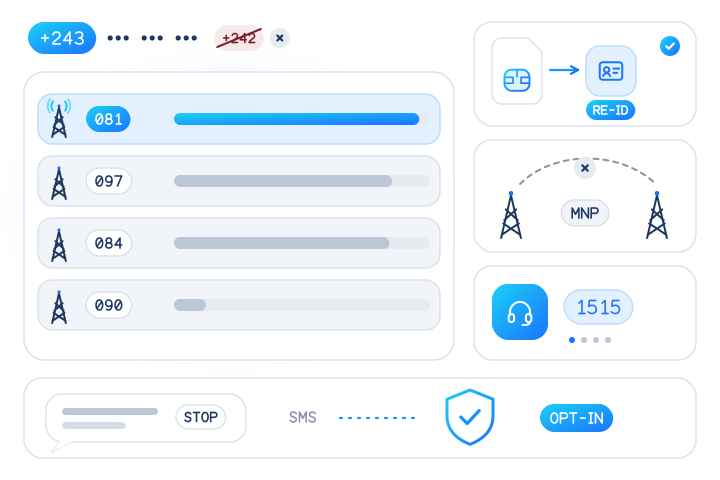
Don't mix up the two Congos. The Democratic Republic of the Congo (DR Congo, capital Kinshasa) is +243. The Republic of the Congo (capital Brazzaville) is +242, with a different numbering plan. A Kinshasa number typed with +242 fails validation, as the code below shows.
What does a DR Congo phone number look like?
A mobile number has nine digits after +243: a two-digit network code (80 to 99) and seven subscriber digits. At home people add the trunk 0, so a mobile has ten digits on a business card. libphonenumber groups the national form 4 + 3 + 3 (0991 234 567); Congolese adverts often write 099 123 4567 or +243 99 123 4567. All of them are the same number.
Code after the trunk 0 | Use | Shape at home |
|---|---|---|
80–91, 96–99 | Mobile, nine digits | 08X XXX XXXX, 09X XXX XXXX |
88 | An old mobile block with seven digits (see below) | 088 XX XXX |
12 | Kinshasa landlines of the state operator SCPT, nine digits (plan of 2012) | 012 XXX XXXX |
1–6 | Older fixed numbers with seven digits | 0A XXXXX |
Fixed lines are rare. The ARPTC's market report for the second quarter of 2026 counts 77.0 million active mobile subscriptions and doesn't report fixed lines among its headline figures (ARPTC, T2 2026). In practice, a Congolese customer number is a mobile number.
| Item | Value |
|---|---|
| Country calling code | +243 |
| International call prefix (dialling out) | 00 |
| Trunk prefix (dialling at home) | 0 |
| Mobile: digits after +243 | 7, 9 |
| Fixed line: digits after +243 | 7–10 |
| Mobile, national format (masked) | 099X XXX XXX |
| Mobile, international (masked) | +243 99X XXX XXX |
| Mobile, E.164 (masked) | +24399XXXXXXX |
| Fixed line, national format (masked) | 012 XXX XXXX |
| Fixed line, international (masked) | +243 12 XXX XXXX |
| Fixed line, E.164 (masked) | +24312XXXXXXX |
Store only the E.164 form: +243, then the nine digits without the 0. 0991 234 567, +243 991 234 567, 00243 991 234 567, 243991234567 and the bare 991234567 are one number. Two input habits are common in Congolese lists: the nine digits without any prefix, typed into a form that already shows +243, and +243 0… with the trunk 0 kept. libphonenumber handles both.
Which prefixes are mobile numbers?
The generator counted every number that libphonenumber's mobile pattern for CD accepts:
| National prefix | International | Share of the block that is mobile (7, 9-digit numbers) | 3-digit sub-blocks that aren't fully mobile |
|---|---|---|---|
080 | +243 80 | 100% | — |
081 | +243 81 | 100% | — |
082 | +243 82 | 100% | — |
083 | +243 83 | 100% | — |
084 | +243 84 | 100% | — |
085 | +243 85 | 100% | — |
086 | +243 86 | 100% | — |
087 | +243 87 | 100% | — |
088 | +243 88 | 100% | — |
089 | +243 89 | 100% | — |
090 | +243 90 | 100% | — |
091 | +243 91 | 100% | — |
096 | +243 96 | 100% | — |
097 | +243 97 | 100% | — |
098 | +243 98 | 100% | — |
099 | +243 99 | 100% | — |
The 7-digit length in the table comes from one block only. libphonenumber's mobile pattern is 88 followed by five digits, or 80–87, 89, 90, 91 and 96–99 followed by seven. So 088 is accepted only as a seven-digit number, and a nine-digit number starting 88 fails. A comment in libphonenumber's metadata says the 88 range "looks as if it is defunct" since 2013. 092 to 095 are not in use.
Which operator holds which prefix?
The ARPTC's notice to the ITU of 15 September 2010 is the last published list of mobile blocks (ITU). It named seven holders: Supercell (80), Vodacom Congo (81, 82), Congo-Chine Telecom (84), Yozma Timeturns (88), Sait-Télécom (89) and Celtel Congo (97, 98, 99). The market has consolidated since. Orange agreed to buy Congo-Chine Telecom in October 2011 (France Telecom-Orange, 2011) and bought Tigo, the brand that used Sait-Télécom's block, in April 2016 (Orange, 2016). Celtel's three blocks now carry the Airtel name, and Africell, the newest of the four networks, holds 090 and 091. libphonenumber's carrier file shows the current holders (243.txt):
| Prefix (national) | Holder in libphonenumber | Active lines, Q2 2026 (ARPTC) | Share |
|---|---|---|---|
081, 082, 083, 086 | Vodacom Congo | 26.55 million | 34.5% |
097, 098, 099 | Airtel Congo | 23.66 million | 30.7% |
080, 084, 085, 089 | Orange RDC | 23.33 million | 30.3% |
090, 091 | Africell RDC | 3.50 million | 4.5% |
087 | Tatem Telecom | not in the report | — |
088 (7 digits) | Yozma Timeturns | not in the report | — |
096 | no holder listed | — | — |
The subscriber counts are the ARPTC's active lines (used in the last 90 days) at the end of June 2026 (ARPTC, T2 2026). Three networks of almost equal size are unusual in Africa: no single prefix family covers most of a Congolese list. Three rows are uncertain. The ITU list gave 80 to Supercell, while libphonenumber now names Orange. We found no ARPTC document for 86, 87 and 96. The market report counts only the four networks above.
Who is the carrier of a DR Congo number?
For now, the range holder: 081 means Vodacom and 099 means Airtel, because numbers can't move between networks yet. The prefix can't tell you whether the line is still active, and DR Congo is a multi-SIM market. The ARPTC puts mobile penetration in Kinshasa at 140.8%, and higher still in the mining provinces of Haut-Katanga (172.1%) and Lualaba (165.9%). Many people carry two or three networks, and lists collect numbers that have gone quiet.
How do I validate a DR Congo number in code?
Remove spaces and punctuation, parse with full metadata and the default region CD, and keep only numbers typed as mobile. Check the result's region too: an input that starts with +242 parses as the Republic of the Congo and must not pass. To try a batch of inputs without writing code, paste them into our free phone number validator.
Python (pip install phonenumbers):
import re

import phonenumbers
from phonenumbers import PhoneNumberType


def normalize_cd(raw: str) -> str | None:
    """E.164 for a DR Congo mobile number (08X or 09X + 7 digits), or None."""
    s = re.sub(r"[\s().-]", "", raw)
    try:
        n = phonenumbers.parse(s, "CD")
    except phonenumbers.NumberParseException:
        return None
    if (not phonenumbers.is_valid_number(n) or phonenumbers.region_code_for_number(n) != "CD"
            or phonenumbers.number_type(n) != PhoneNumberType.MOBILE):
        return None
    return phonenumbers.format_number(n, phonenumbers.PhoneNumberFormat.E164)


for raw in ["0991 234 567", "+243 991 234 567", "00243 991 234 567", "243991234567",
            "+243 0991 234 567", "991234567", "+242 991 234 567", "012 345 6789", "093 123 4567", "0991 234 56"]:
    print(f"{raw!r:22} -> {normalize_cd(raw)}")
JavaScript (npm install libphonenumber-js):
import { parsePhoneNumberFromString } from "libphonenumber-js/max";

/** "099…", "9…", "+243 9…", "00243…" or "243…" → E.164 for a DR Congo mobile number, or null. */
export function normalizeCd(raw) {
  const input = String(raw).replace(/[\s().-]/g, "");
  const phone = parsePhoneNumberFromString(input, "CD");
  if (!phone?.isValid() || phone.country !== "CD" || phone.getType() !== "MOBILE") return null;
  return phone.number;
}

for (const raw of ["0991 234 567", "+243 991 234 567", "00243 991 234 567", "243991234567",
                   "+243 0991 234 567", "991234567", "+242 991 234 567", "012 345 6789", "093 123 4567", "0991 234 56"]) {
  console.log(JSON.stringify(raw).padEnd(22), "->", normalizeCd(raw));
}
The inputs are libphonenumber's example mobile number for DR Congo (0991 234 567) written six ways, the same digits under the Republic of the Congo's code +242, a Kinshasa landline shape, a number in the unused 093 block and a mobile one digit short. They aren't real subscribers. We ran both on 2026-11-22 (Python 3.12 with phonenumbers 9.0.40, Node.js 24 with libphonenumber-js 1.13.15). Both printed the same answers; Python prints None and single quotes, JavaScript null and double quotes:
'0991 234 567'         -> +243991234567
'+243 991 234 567'     -> +243991234567
'00243 991 234 567'    -> +243991234567
'243991234567'         -> +243991234567
'+243 0991 234 567'    -> +243991234567
'991234567'            -> +243991234567
'+242 991 234 567'     -> None
'012 345 6789'         -> None
'093 123 4567'         -> None
'0991 234 56'          -> None
The first six are one number, including the bare nine digits and +243 0…. The +242 input is rejected because those digits are not a valid Congo-Brazzaville number; if your form has a country picker, make sure customers in Kinshasa don't pick the wrong Congo. The landline is valid but not mobile, 093 isn't in use, and the last input is too short.
The generated test table runs the same idea over masked inputs with the raw library call. The shape regex column tests a pattern that tutorials often give, after spaces, dashes and brackets are removed:
| # | Case | Input (masked) | Shape regex ^(?:\+243|00243|0)?[89]\d{6,8}$ | libphonenumber (CD) |
|---|---|---|---|---|
| 1 | National, with trunk prefix | 099X XXX XXX | passes | valid, MOBILE |
| 2 | International, with spaces | +243 99X XXX XXX | passes | valid, MOBILE |
| 3 | International dialling prefix 00 | 00243 99X XXX XXX | passes | valid, MOBILE |
| 4 | E.164 | +24399XXXXXXX | passes | valid, MOBILE |
| 5 | Dashes and brackets | (099X) XXX-XXX | passes | valid, MOBILE |
| 6 | One digit short | 099XXXXXX | passes | invalid |
| 7 | One digit too many | 099XXXXXXXX | fails | invalid |
| 8 | Mobile shape, unused block 092 | 092XXXXXXX | passes | invalid |
| 9 | Fixed line | 012 XXX XXXX | fails | valid, FIXED_LINE |
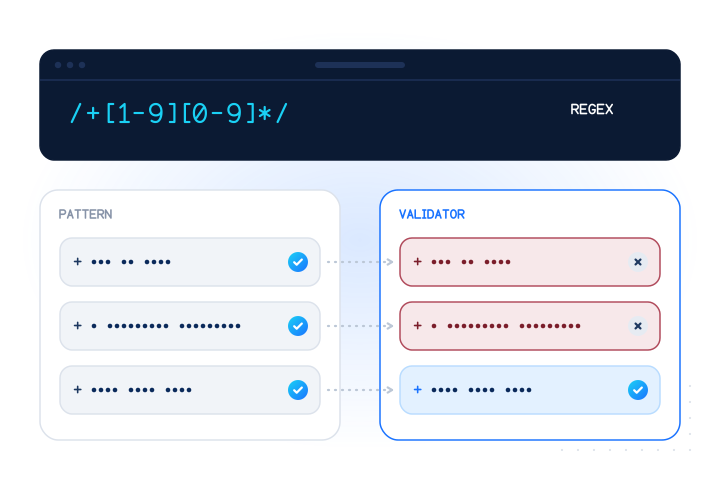
Rows 6 and 8 are the ones to remember. Because the library allows a seven-digit 088 number, a loose regex that copies the lengths accepts a 099 number with digits missing (row 6), and any 09 shape passes the regex even in the unused 092–095 blocks (row 8). Our post on why an E.164 regex is not enough shows the same problem in other countries, and our Python and JavaScript guides cover more cases. For a whole spreadsheet, our free phone list cleaner normalises and deduplicates a column in the browser.
Does number portability change the carrier?
Not yet. The law promises portability, but as of November 2026 Congolese subscribers can't keep their number when they change network:
- The law. Law No. 20/017 of 25 November 2020 on telecommunications and ICT defines portability as the right of every subscriber to change operator while keeping their number, and article 76 says: "La portabilité des numéros fixes ou mobiles est garantie" (Law 20/017). Article 77 leaves the numbering plan's rules to a ministerial order on the regulator's proposal.
- No service. We found no ARPTC decision or notice that launches porting, and no date. Messaging providers' country guides say number portability "is not available" in DR Congo (Sent.dm).
Our MNP atlas has no verified row for DR Congo yet.
For the atlas we would add DR Congo as "guaranteed by law, not implemented", with Law 20/017 as the legal basis. Our MNP atlas compares portability across countries. When porting starts, the prefix will stop being a safe guide to the network; until then, the useful lookup in DR Congo is not "which network?" but "is this number still in service?".
How are SIM cards registered in DR Congo?
The 2020 telecoms law made subscriber identification a statutory duty; its explanatory memorandum lists the missing rule on compulsory identification among the gaps of the 2002 law it replaced (Law 20/017):
- ID at sign-up. Every operator must identify its subscribers when they subscribe and keep a completed subscriber record (article 92).
- No connection without it. "Aucune connexion au réseau ne peut être accordée sans identification préalable" (article 93). Minors are registered in a parent's or guardian's name.
- Cut-off. The state may interrupt the connection of any subscriber who is not, or wrongly, identified (article 94).
- Fines. An operator that connects a minor or an unidentified subscriber pays 100,000 Congolese francs per subscriber (article 173).
Practice lags behind the law. The government's 2026 ban on pre-registered SIM cards (below) shows they were on sale, and SIM swap fraud against mobile-money users is a known problem: an Institute for Security Studies study of December 2025 describes fraudsters buying replacement SIMs from informal street sellers, and reports that the ARPTC now requires biometric identification for new and replacement SIMs, while many service centres in the east lack the equipment (ENACT, 2025).
What changed in 2026?
After a wave of crime in Kinshasa, the government took up SIM control at two Councils of Ministers:
- 20 March 2026. The Interior Minister announced that the sale of pre-registered SIM cards would be banned and that all subscribers would be re-identified, with the details to be set with the telecoms ministry, the ARPTC and the operators (Trends.cd).
- 10 April 2026. The 86th Council of Ministers took note of "urgent" measures with stricter, mandatory identification for every SIM purchase (Infos-Express). Press reports add a cap on the number of SIM cards one person may hold, closer checks on foreign subscribers and a new national identification campaign, including rural areas (Échos & Ressources).
As of November 2026 we found no published deadline for the re-identification, no cap figure and no report of mass cut-offs. Article 94 already lets the state cut off unidentified lines, so a deadline would turn some numbers on your list dead at once. A live network status (HLR) check shows which numbers on your list still reach a phone; our post on number recycling and list decay explains why a number collected two years ago may now belong to someone else.
What are the rules for SMS marketing and personal data?
These summarise the laws as we read them on 2026-11-22. Not legal advice; ask counsel how they apply to you.
The Digital Code: consent before marketing
The Digital Code, Ordonnance-loi No. 23/010 of 13 March 2023, sets the rules for electronic marketing and personal data (Digital Code). The articles that matter for messaging lists:
| Article | Rule |
|---|---|
| Art. 68 | Direct marketing by SMS, e-mail, fax or automated calls needs the recipient's prior consent. "L'absence de réponse ne peut pas être considérée comme un consentement", and the sender must prove consent |
| Art. 69 | Exception: a customer whose contact details were collected at a sale may get offers for similar products from the same supplier, if they could refuse at collection and in every message |
| Art. 70 | Anyone can ask a supplier to stop marketing, free of charge; the supplier must acknowledge it without delay and keep an opt-out list |
| Art. 72 | Every marketing message must give a valid, free way to opt out, and must not hide who sends it |
| Art. 186 | Processing personal data needs a prior declaration to the data protection authority |
| Art. 201 | Personal data are stored in DR Congo; a transfer abroad needs the authority's approval and an adequate level of protection |
| Art. 257 | Fines from 8 million to 200 million Congolese francs after a formal notice, and more for the gravest cases |
There is a gap between the text and the institutions. According to DLA Piper's country summary, the data protection authority the Code creates has not been set up, a ministerial order of 17 August 2024 gave its tasks to the telecoms regulator for the time being, and the declaration and transfer regimes are not followed in practice (DLA Piper). The consent rule in article 68 doesn't depend on the authority: it binds every sender now. Our posts on whether a phone number is personal data and on consent for WhatsApp checks give the baseline we work to: your own customers, a stated purpose, minimal data and honoured opt-outs.
Sender names and delivery
We found no ARPTC rule on sender names among its published resources, and provider guides disagree. One provider's operator table shows that Airtel accepts alphanumeric sender names but not numeric senders, while Vodacom, Orange and Africell accept both, and says that registration is neither required nor possible (LINK Mobility). Another says that Vodacom needs sender names registered in advance, that two-way SMS isn't supported, and that campaigns must support STOP and HELP (Sent.dm). Ask your provider before a campaign: rules differ between networks and change often.
French is the official language. A French SMS fits the 160-character GSM alphabet only without letters such as ê, â, î, ô, û and ç; one of those switches the message to UCS-2 with 70 characters per part. Lingala, Swahili, Kikongo and Tshiluba in plain Latin letters fit GSM. Our SMS character counter shows how many parts a message will take. For customer service, the ARPTC opened a single short code, 1515, on 30 October 2026: it reaches the customer service of whichever mobile network the caller is on, alongside each operator's own numbers (ARPTC, 2026).
Which messaging apps and channels reach people in DR Congo?
SMS still carries a lot. The ARPTC counted 13.43 billion SMS in the second quarter of 2026, up 12.6% on the quarter, and notes that SMS remains in use for notifications, transactions and, in the east of the country, for everyday messages. Mobile internet reached 39.8 million subscriptions, 51.7% of all mobile lines, and 34.8 million people use mobile money, so a phone number is often also a wallet (ARPTC, T2 2026). The regulator publishes no figures for individual messaging apps, so we don't quote shares.
WhatsApp costs more in DR Congo than in most of Africa. Meta's "Rest of Africa" region lists 40 countries, including the Republic of the Congo, but not DR Congo, and any country not listed "maps to Other" (Meta pricing, read on 2026-11-22). In our WhatsApp rate-card dataset, the card effective on 2026-10-01 prices Other at:
| Message category (per message, USD) | DR Congo ("Other") | Rest of Africa, for comparison |
|---|---|---|
| Marketing | 0.0604 | 0.0225 |
| Utility | 0.0077 | 0.0040 |
| Authentication | 0.0077 | 0.0040 |
A marketing message to a Kinshasa number costs about 2.7 times one to Kampala or Dar es Salaam. That makes it worth knowing who is on WhatsApp before you send: a template sent to a number without an account is wasted. Our WhatsApp cost calculator shows what a campaign would cost, and our guide to WhatsApp Business API pricing explains the categories.
The method is the same as in our channel-by-country guide: check which apps your opted-in customers are registered on, route each one to the channel they use, and keep SMS as the fallback. To open a chat with a customer who wrote to you first, our WhatsApp link generator builds a wa.me link from the E.164 number.
How do I check WhatsApp registration for a Congolese customer list?
Normalise every row with normalize_cd() first. A check tells you whether a number is registered at the time of the check. It can't tell you whether the person wants your messages:
| Answer | What it means | What to do |
|---|---|---|
registered: true | The number has an account at checked_at | Offer that app to customers who opted in to it |
registered: false | No account at checked_at | Use SMS or another channel |
unknown | No conclusive answer (not billed) | Keep the current channel; retry later |
invalid_number | Failed format validation (not billed) | Fix the data at the source |
For lists, use a bulk job. Upload a CSV with numbers written the Congolese way (099X XXX XXX, bare nine digits or 243… also work) and default_country=CD:
curl https://api.mobilevalidate.com/v1/jobs \
  -H "Authorization: Bearer $MOBILEVALIDATE_API_KEY" \
  -F file=@customers.csv -F checks=whatsapp,telegram,hlr -F default_country=CD
Send the same body to POST /v1/jobs/estimate first: it is free, checks nothing and shows the maximum cost before anything runs. The result file keeps your row order in row_no, so you join it back to your own records by row number, and each check adds its own columns, such as whatsapp.registered.status and whatsapp.registered.registered.
What it costs, at the bulk prices in our public catalog on 2026-11-22 (per conclusive answer; unknown, invalid and duplicate rows are free):
| Check for 10,000 Congolese numbers | Bulk price per answer | Maximum cost |
|---|---|---|
| WhatsApp registration | $0.00025 | $2.50 |
| Telegram registration | $0.0003 | $3.00 |
| Live network status (HLR) | $0.005 | $50.00 |
The WhatsApp bulk price applies to groups of at least 132 numbers from the same country in one job. Real-time checks are priced on the pricing page; for lists, bulk jobs are the cheaper route. For comparison, $2.50 is the price of about 41 WhatsApp marketing messages to DR Congo at the "Other" rate above.
What changed recently?
The rows for CD and +243 in our numbering-plan changes dataset, built from libphonenumber's release notes:
| Change named in the release notes (2019-01-08 to 2026-09-23) | Releases |
|---|---|
| Original-carrier prefix data | 7 |
| Numbering-plan metadata (validation, lengths, types) | 5 |
| Geocoding (area names) | 1 |
| All | 13 |
Latest numbering-plan updates for CD: 2026-09-23 (v9.0.40), 2026-01-29 (v9.0.23), 2024-08-22 (v8.13.44), 2024-04-18 (v8.13.35), 2021-04-29 (v8.12.22).
Most of DR Congo's changes were to carrier data, which shows how the block holders moved as the market consolidated. The latest numbering-plan update came in September 2026, so update the library at least monthly and log the numbers it rejects instead of dropping them silently.
The bigger changes were in the market and the rules:
- 2002: the telecoms framework law and the law creating the ARPTC (16 October).
- 2010: the ARPTC's list of mobile blocks filed with the ITU (15 September).
- 2011 and 2016: Orange agrees to buy Congo-Chine Telecom (October 2011), then completes the purchase of Tigo (April 2016).
- 2020: Law No. 20/017 on telecommunications and ICT (25 November), which guarantees portability and makes ID at sign-up a statutory duty.
- 2023: the Digital Code (13 March), with prior consent for marketing messages.
- 2026: the ban on pre-registered SIMs and the re-identification announced (March and April); the
1515customer-care short code (30 October).
What can MobileValidate check for DR Congo numbers?
Generated from our public catalog:
Catalog data as of 2026-11-22.
| Check | Accepts DR Congo numbers | Notes |
|---|---|---|
| Format and country (every lookup) | Yes | Each number is parsed first; an invalid number returns invalid_number and is never billed. |
| Carrier lookup (beta) | Yes | Line type and current network where data exists; no data means unknown, not billed. Real time and bulk. |
| US/CA carrier lookup (premium) | No (US, CA only) | Answers unsupported_country for other countries, not billed. |
| Live network status (HLR) | Yes | Live reachability, porting, roaming (true or false) and current network; unknown is free. Real time and bulk. |
| Number portability (MNP) | Yes | Ported or not ported, and the current network code; unknown is free. Real time and bulk. |
| Spam reputation | Limited access | All countries except sanctioned ones; report coverage is strongest in North America and Europe. |
| Messaging apps | Yes: WhatsApp, Telegram, Viber*, Signal*, iMessage*, RCS*, LINE*, Zalo*, Botim*, Facebook Messenger* | Registered, not registered or unknown; unknown is free. |
| Social networks | Yes: Facebook, Instagram, Threads, X (Twitter), TikTok*, Snapchat* | Not for DR Congo numbers: LinkedIn (US, IN only). |
| Online accounts (Apple, Amazon, Microsoft, Netflix) | Yes: Apple, Amazon, Microsoft, Netflix | Registered, not registered or unknown; unknown is free. |
* bulk jobs only. The live list is at GET /v1/services.
A lookup returns network and registration facts. It never returns a subscriber's name, ID number or address, and we don't offer "number details" searches.
In DR Congo the prefix already shows the network, so the lookup that adds most is the live network status (HLR) check: it shows whether a number is reachable right now, which catches lines that went quiet in a multi-SIM market or after a re-identification cut-off. The carrier lookup gives line type and network in one call, and our free MCC-MNC lookup turns a network code into an operator name. For channels, the WhatsApp number check and the Telegram check run in real time and in bulk; the starred checks in the table run in bulk jobs only.
How do I start for free?
- 100 free real checks. Every live account can run 100 phone numbers and 20 e-mail addresses through the real checks for free on the dashboard's Try it page. Use them on your own number first.
- A free carrier lookup. The carrier lookup page has a public form for 3 lookups a day, no sign-up needed.
- Free tools. The phone number validator, phone list cleaner and number-to-country lookup work in your browser; all of them are on the tools page.
- A free test key. Get a test key for the sandbox. It gives fixed test answers so you can build every branch of your code; see test mode.
- A free estimate.
POST /v1/jobs/estimatetakes the same body as a job, checks nothing and shows the maximum cost before you start. - Then add credit. Create your account; approval is automatic. Top-ups of $100 or more get bonus credit (5% from $100, 8% from $500, 10% from $2,000); see pricing. Unknown, invalid and duplicate results are never charged.
Here is a small reachability check against the real-time endpoint. It asks for the live network status and WhatsApp and Telegram registration in one call. It uses the public sandbox key mv_test_publicSandboxn9ZgneuhR1B9CRfKG3fulym and our test values. The sandbox accepts only those UK drama numbers, so the example uses them; with a live key, pass the output of normalize_cd().
import os

import requests  # pip install requests

API = "https://api.mobilevalidate.com/v1/lookup"
KEY = os.environ["MOBILEVALIDATE_API_KEY"]


def reach(numbers: list[str]) -> dict[str, dict]:
    """Live status, network code and WhatsApp/Telegram registration per number. None means unknown."""
    r = requests.post(API, headers={"Authorization": f"Bearer {KEY}"}, timeout=15,
                      json={"numbers": numbers, "checks": ["hlr", "whatsapp", "telegram"], "wait": 5})
    r.raise_for_status()
    out = {}
    for row in r.json()["results"]:
        c = row["checks"]
        hlr = (c["number.hlr"]["attributes"] or {}) if c["number.hlr"]["status"] == "completed" else {}
        app = lambda key: c[key]["registered"] if c[key]["status"] == "completed" else None
        out[row["e164"]] = {"status": hlr.get("status"), "network": hlr.get("mcc_mnc"),
                            "whatsapp": app("whatsapp.registered"), "telegram": app("telegram.registered")}
    return out


for number, info in reach(["+447700900001", "+447700900002", "+447700900005"]).items():
    print(number, info)
We ran it against the sandbox on 2026-11-22. It printed:
+447700900001 {'status': 'reachable', 'network': '23415', 'whatsapp': True, 'telegram': True}
+447700900002 {'status': 'unreachable', 'network': '23415', 'whatsapp': False, 'telegram': False}
+447700900005 {'status': None, 'network': None, 'whatsapp': None, 'telegram': None}
The second test value is the case that matters most in DR Congo: the number exists but is unreachable, so an OTP or a WhatsApp template at the "Other" rate would be wasted. The third stands for an unsupported country, so every field is None and nothing is billed. Keep None apart from False: None means we don't know. Requests with 20 or more consecutive numbers are refused (403 suspected_enumeration), and our acceptable use policy forbids finding recipients for unsolicited messages. People can object through our opt-out form.
What are the key takeaways?
- DR Congo numbers have nine digits after
+243, written with a trunk0at home:08X XXX XXXXor09X XXX XXXXfor mobiles. Store the E.164 form, and don't confuse+243with+242(Congo-Brazzaville). - Vodacom holds
081–083and086, Airtel097–099, Orange080,084,085and089, Africell090and091; the first three networks each have about a third of the market. 092–095aren't in use, and088is accepted only as an old seven-digit block, so a shape regex lets bad numbers through.- Law 20/017 guarantees portability, but no porting service runs as of November 2026, so the prefix shows the network, but not whether the SIM is still active.
- SIMs must be registered with an ID; in 2026 the government banned pre-registered SIMs and announced the re-identification of all subscribers.
- The 2023 Digital Code requires prior consent for marketing SMS, a free opt-out in every message and local storage of personal data. WhatsApp prices DR Congo as "Other", well above the Rest of Africa rate.
Platform, regulator and company names are used descriptively. MobileValidate is not affiliated with any of them.
Sources
- Dem. Rep. of the Congo (country code +243): national numbering plan communications of 2003 to 2012, including the ARPTC mobile ranges of 15 September 2010 — International Telecommunication Union, national numbering plans, 2012
- Présentation: création et missions de l'ARPTC (loi n° 014/2002) — Autorité de Régulation de la Poste et des Télécommunications du Congo (ARPTC), 2026
- Observatoire du marché de la téléphonie mobile, T2 2026 — ARPTC, 2026
- L'ARPTC met en service le numéro court unique et harmonisé 1515 (30 octobre 2026) — ARPTC, 2026
- Loi n° 20/017 du 25 novembre 2020 relative aux télécommunications et aux technologies de l'information et de la communication — Droit-Numérique.cd (text of the law), 2020
- Ordonnance-loi n° 23/010 du 13 mars 2023 portant Code du numérique — Droit-Numérique.cd (text of the ordinance-law), 2023
- Data protection laws of the world: Democratic Republic of the Congo — DLA Piper, 2026
- RDC : le gouvernement interdit la vente des cartes SIM préenregistrées et renforce le contrôle des abonnés (21 mars 2026) — Trends.cd, 2026
- RDC : le Gouvernement adopte l'identification des abonnés pour toute acquisition d'une carte Sim parmi les mesures urgentes (11 avril 2026) — Infos-Express, 2026
- RDC : vers un encadrement strict de la vente des cartes SIM pour lutter contre la criminalité (12 avril 2026) — Échos & Ressources, 2026
- La répression insuffisante aggrave la fraude par échange de cartes SIM en RDC (10 décembre 2025) — ENACT Observer, Institute for Security Studies, 2025
- France Telecom-Orange to acquire 100% of Congo Chine Télécom (CCT) (20 October 2011) — France Telecom-Orange press release, via the AMF archive, 2011
- Orange completes the acquisition of the mobile operator Tigo in the Democratic Republic of the Congo (21 April 2016) — Orange, via TelecomTV, 2016
- Regulatory guidelines, sender ID: Democratic Republic of Congo — LINK Mobility, 2026
- SMS compliance guide: Democratic Republic of the Congo — Sent.dm, 2026
- Pricing: rate card regions and markets — Meta (WhatsApp Business Platform documentation), 2026
- libphonenumber carrier prefix data for +243 (243.txt) and PhoneNumberMetadata.xml (region CD) — libphonenumber project (Apache License 2.0), 2026
Frequently asked questions
How many digits is a DR Congo mobile number?
Nine after the country code +243, or ten when written at home with the leading 0. A Congolese mobile looks like 099X XXX XXX or 081X XXX XXX nationally and +243 99X XXX XXX in E.164 form, stored as +24399XXXXXXX. The only exception in libphonenumber is the old 088 block, which it accepts as seven digits.
What is the DR Congo country code for WhatsApp?
+243. Drop the leading 0 of the national number: 0991 234 567 becomes +243 991 234 567, stored as +243991234567. Don't confuse it with +242, the code of the Republic of the Congo (Congo-Brazzaville). The same E.164 form works for WhatsApp, wa.me links and SMS APIs.
Which network is 081, 097, 084 or 090 in DR Congo?
In libphonenumber's carrier data, read on 2026-11-22: 081, 082, 083 and 086 are Vodacom; 097, 098 and 099 are Airtel; 080, 084, 085 and 089 are Orange; 090 and 091 are Africell. That is the range holder. The law guarantees number portability, but no porting service runs yet, so the prefix still shows the network in November 2026.
Does DR Congo have mobile number portability?
Not in practice. Article 76 of Law No. 20/017 of 25 November 2020 on telecommunications says that the portability of fixed and mobile numbers is guaranteed, but as of November 2026 we found no porting service, no regulator decision launching one and no date. Messaging providers list portability for DR Congo as not available.
Do I need an ID to buy a SIM card in DR Congo?
Yes. Law No. 20/017 forbids connecting any subscriber without prior identification and fines operators 100,000 Congolese francs per unidentified subscriber. In March and April 2026 the government announced a ban on pre-registered SIM cards, stricter ID checks at purchase and the re-identification of all subscribers; we found no published deadline.
What are the rules for marketing SMS in DR Congo?
The Digital Code of 13 March 2023 (Ordonnance-loi No. 23/010) bans marketing by SMS, e-mail or automated calls to people who haven't consented in advance (article 68). Silence is not consent, the sender must prove consent, and every message must show a free way to opt out (article 72). Existing customers may get offers for similar products if they could refuse each time.
Can I check whether Congolese customers are on WhatsApp?
Yes, for numbers you hold with consent or another lawful basis, such as your own customers. A MobileValidate check answers registered, not registered or unknown with a checked_at date; unknown is never billed. It returns no name or profile, and requests that look like scans of number ranges are refused.
Related services and guides
More from the blog
All articlesGuides
Phone numbers by country: formats, portability, channels and rules
How phone numbers differ by country: formats and E.164, numbering changes, portability, line types, messaging channels, and a dated tracker of calling and texting rules.
11 min read
Developers
International phone number formats by country: a 2026 reference table
Calling code, international and trunk prefix, mobile and fixed-line number lengths and a masked E.164 mobile format for 238 regions, generated from libphonenumber.
19 min read
Developers
E.164 regex: why a pattern is not enough to validate phone numbers
The common E.164 regex accepts impossible numbers. Real counterexamples, the shortest valid international numbers, and what to use a regex for instead.
7 min read